Production tubing selection is a multi-variable engineering decision — reservoir conditions, corrosion environment, production rate, completion design, and economic well life all feed into the same specification line on a purchase order. Get the grade wrong and the failure modes are material: sulfide stress cracking in N80Q run into an H2S environment, or CO2 wall loss in uninhibited carbon steel tubing. Get the size wrong and the well underproduces for its entire life. Neither mistake is recoverable cheaply.
ZC Steel Pipe supplies API Specification 5CT, 11th Edition seamless production tubing in N80Q, L80-1, T95, and L80-13Cr grades from 1.050" through 4½" OD for operators and EPC contractors across Africa, the Middle East, South America, and Southeast Asia. The sections below reflect what we see on purchase orders, what customers ask us, and where the common specification errors occur.
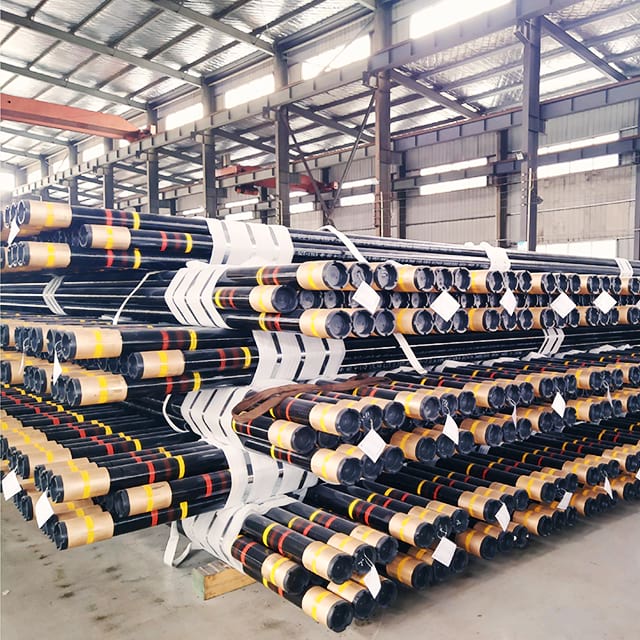 ZC production tubing staged for dispatch — color-coded band markings identify the grade, thread protectors guard the connections.
Grade Selection by Well Environment
Grade selection is driven first by corrosion environment, then by yield requirement. Structural load governs size after grade is fixed.
| Environment | Grade | Key Requirement |
|---|---|---|
| Sweet oil/gas, medium depth | N80Q | Q+T heat treatment; no hardness ceiling |
| Mild sour, H2S present | L80-1 | NACE MR0175 qualified; 23 HRC max, 100% per-joint hardness |
| Deep sour, higher pressure | T95 | 95 ksi minimum yield; 25.4 HRC max API (22 HRC for NACE) |
| Sweet CO2 environment | L80-13Cr | 12–14% Cr passive film; CO2 grade only — not for H2S |
From the API 5CT specification tables, the verified mechanical property floors for each grade are: N80Q minimum yield 552 MPa (80 ksi), minimum tensile 689 MPa (100 ksi), no hardness ceiling. L80-1 minimum yield 552 MPa (80 ksi), minimum tensile 655 MPa (95 ksi), 23 HRC maximum. T95 minimum yield 655 MPa (95 ksi), minimum tensile 724 MPa (105 ksi), 25.4 HRC maximum (API limit) versus 22 HRC for NACE MR0175 sour service. L80-13Cr minimum yield 552 MPa (80 ksi), minimum tensile 655 MPa (95 ksi), 23 HRC maximum — CO2 grade only. All grades require quench-and-temper heat treatment per API 5CT.
What we see on orders: The most dangerous production tubing selection mistake is treating "probably sweet" as "sweet" and ordering N80Q. We see this especially on wells where reservoir data shows no H2S in offset wells but DST data has not been obtained for the specific well. If H2S is encountered during production, N80Q with uncontrolled hardness — API 5CT sets no hardness ceiling for N80Q — can fail by sulfide stress cracking within months. The time to qualify the corrosion environment is before the purchase order, not after the first production anomaly.
For guidance matching grade to H2S partial pressure thresholds and chloride levels, see sour service grade selection.
Size Selection — Flow Rate and Artificial Lift
Tubing size governs deliverability over well life. A nodal analysis (inflow performance versus tubing intake pressure) should be the primary input, but four sizes cover the large majority of completions. For the complete weight and wall range in every OD, see the API 5CT tubing sizes and weights guide. The dimensions below are the workhorse weight for each, per API Specification 5CT, 11th Edition; the flow-rate guidance follows.
| Size (OD) | Wall (mm / in) | ID (mm / in) | Weight NU / EU (lb/ft) | Typical service |
|---|---|---|---|---|
| 2⅜″ (60.32 mm) | 4.83 / 0.190 | 50.66 / 1.994 | 4.6 / 4.7 | Most common; oil ≤ ~500–800 bbl/d, moderate gas |
| 2⅞″ (73.02 mm) | 5.51 / 0.217 | 62.00 / 2.441 | 6.4 / 6.5 | Higher-rate oil, ESP, gas |
| 3½″ (88.90 mm) | 6.45 / 0.254 | 76.00 / 2.992 | 9.2 / 9.3 | High-rate gas and condensate |
| 4½″ (114.30 mm) | 6.88 / 0.271 | 100.54 / 3.958 | 12.6 / 12.75 | Large-bore, high-rate ESP |
Two things to read from this table. First, the ID column, not the OD, is what sets the flow area and the drift for wireline and coiled-tubing access — a 2⅞″ tubing carries a 21% larger OD than 2⅜″ but roughly a 50% larger flow area (flow area scales with ID²), which is why the step up matters so much for rate. Second, the NU and EU weights differ by only a fraction of a lb/ft at the same wall, because the upset adds metal only at the ends — the choice between NU and EU is a connection-strength decision, covered below, not a pipe-body-weight one. Heavier walls are available in every size (up to 7.35 lb/ft in 2⅜″ and 17.0 lb/ft in 3½″) where burst or collapse governs.
- 2-3/8" OD (60.32 mm), wall 0.190" (4.83 mm) at 4.70 lb/ft EU — most common global tubing size; suited to oil wells up to approximately 500–800 bbl/day and moderate-rate gas wells. Fits inside 5½" casing with adequate annular clearance.
- 2-3/8" OD (60.32 mm), wall 0.254" (6.45 mm) at 5.95 lb/ft EU — heavier wall for higher burst-load wells at the same OD, or where collapse governs in depleted reservoirs.
- 2-7/8" OD (73.02 mm), wall 0.217" (5.51 mm) at 6.50 lb/ft EU — second most common size; higher-rate oil wells, ESP installations, gas wells where 2-3/8" produces critical velocity erosion risk.
- 3-1/2" OD (88.90 mm), wall 0.254" (6.45 mm) at 9.20 lb/ft EU — high-rate gas and condensate wells; requires at least 7" casing.
- 4-1/2" OD (114.30 mm), wall 0.271" (6.88 mm) at 12.60 lb/ft EU — large-bore completions and high-rate ESP installations; requires 9-5/8" or larger production casing.
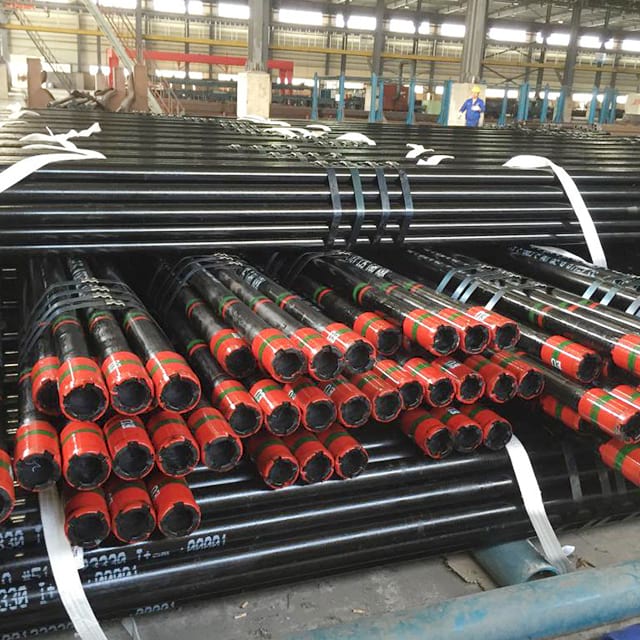 Tubing pin ends with red-and-green band markings — the color code identifies grade and weight before the string goes downhole.
2-3/8" tubing running in a high-rate gas well carries a critical velocity risk: if gas velocity exceeds the erosional threshold, wall loss progresses faster than inhibitor programs can compensate. At reservoir deliverabilities above approximately 5 MMscfd through 2-3/8", move to 2-7/8" or perform an erosional velocity check before fixing the tubing size.
NU vs EU vs IJ Connections
API 5CT defines three standard connection configurations. The choice is primarily between EU and NU for most wells; IJ is a special-application connection. The EU vs NU tubing connections guide covers the thread geometry and makeup differences in detail.
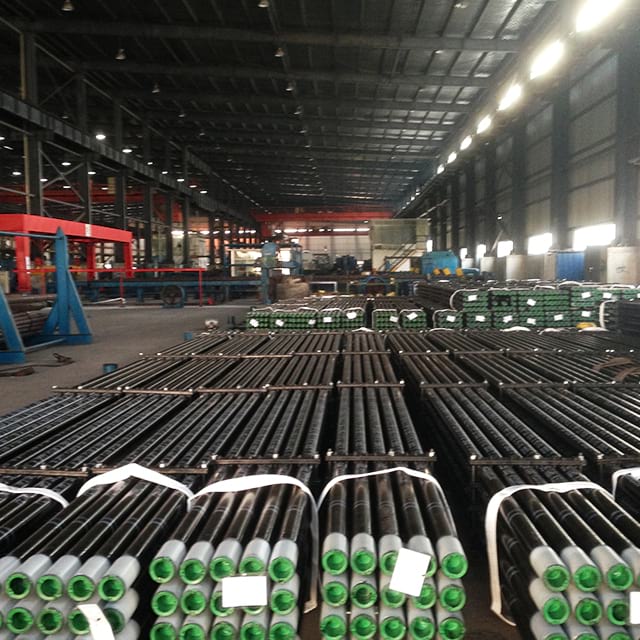 Premium-connection tubing racked in the ZC warehouse, each joint fitted with a green thread protector.
NU (non-upset) — same OD at the pipe body and threaded ends; separate coupling. Wall at the thread is taken from the pipe body, producing a thinner section than EU at the same pipe weight. Adequate for shallow, low-pressure sweet wells and recompletions where tensile loads are modest.
EU (external upset) — increased OD at threaded ends achieved by hot upsetting during manufacture. The thicker section at the thread zone gives higher tensile efficiency and better gas-tightness than NU. For most production tubing applications — any well with sour service, gas production, or depths beyond approximately 2,000 m — EU is the correct connection type.
L80-13Cr looks like a sour service grade because it shares L80's 23 HRC hardness ceiling — the number is identical. But the metallurgical basis is completely different. L80-13Cr's 23 HRC limit is an API 5CT mechanical property requirement for a CO2 corrosion grade, not a NACE MR0175 sour service qualification. The grade is listed explicitly in API 5CT as a CO2 corrosion grade and is excluded from sour service qualification under ISO 15156-2. A procurement team specifying "L80 max 23 HRC" for an H2S well and receiving L80-13Cr has received an API-conforming product that is not qualified for the service environment. See L80 13Cr specifications for the full CO2 qualification envelope and temperature limits.
IJ (integral joint) — pin machined directly on one end, box on the other; no separate coupling. Eliminates the coupling OD, allowing smaller outside clearance than NU or EU at the same pipe body ID. Used where the tubing must pass through a downhole safety valve with a restricted minimum ID or in slim-hole completions where coupling clearance is the binding constraint.
Burst Pressure Worked Example
The API 5C3 burst formula (Barlow approximation with 0.875 safety factor):
P = 0.875 × (2 × Yp × t / D)
For 2-7/8" 6.50 lb/ft EU tubing — OD = 2.875 inch, wall t = 0.217 inch — the comparison between N80Q and T95 at minimum yield:
N80Q (Yp = 80,000 psi): P = 0.875 × (2 × 80,000 × 0.217 / 2.875) = 0.875 × 12,077 = 10,570 psi
T95 (Yp = 95,000 psi): P = 0.875 × (2 × 95,000 × 0.217 / 2.875) = 0.875 × 14,341 = 12,550 psi
T95 delivers 18.8% higher burst resistance than N80Q at the same OD and wall. For a sour gas well where N80Q is disqualified on H2S grounds and L80-1's 80 ksi yield produces insufficient burst rating, T95 is the correct grade — it gains that 18.8% pressure envelope while retaining sour service qualification at the NACE 22 HRC hardness maximum. The L80 vs T95 sour gas well selection guide walks through where that crossover falls. Use the Barlow pressure calculator to run this calculation across the full size and weight range for your string design.
When NOT to Use Each Grade
N80Q — never in H2S service. The grade carries no hardness ceiling under API 5CT; there is no mechanism to control SSC risk. Any confirmed H2S partial pressure above the NACE MR0175 threshold eliminates N80Q from the candidate list. This applies even when offset well data suggests sweet service — if DST data for the specific well is not in hand, default to L80-1.
L80-13Cr — never in H2S service. Despite the matching 23 HRC hardness ceiling, the grade is a CO2 corrosion grade with passive film protection that breaks down in the presence of H2S. At temperatures above approximately 150°C, the passive chromium oxide film also becomes unstable even in CO2 service. Where both CO2 and H2S are present, Super 13Cr or a duplex alloy must be evaluated against the specific partial pressures.
T95 — do not run in a sour well without verifying the NACE 22 HRC hardness limit. API 5CT permits T95 Type 1 at up to 25.4 HRC. A Type 1 pipe at 24 HRC is API-conforming and NACE non-conforming. Always specify Type 2 or Type 1 + SR15 hardness survey for any sour service application. SSC in high-hardness carbon steel at H2S exposure produces brittle fracture, not a slow leak.
2-3/8" in high-rate gas wells — critical velocity and erosion risk increase sharply above approximately 5 MMscfd at this OD. Tubing erosion from entrained solids accelerates at high velocity and reduces wall below the rated burst and collapse thicknesses. Perform an erosional velocity check before specifying 2-3/8" for any well expected to produce above moderate gas rates over its life.
Procurement Trap — L80 Type Specification
API 5CT defines L80 in four types: Type 1 (carbon-manganese steel), Type 3Cr, Type 9Cr, and Type 13Cr. Type 1 is the sour service grade. Types 3Cr, 9Cr, and 13Cr are CO2 corrosion grades with progressively higher chromium content — none of them are NACE MR0175 qualified for H2S service.
Wrong PO language: "API 5CT L80, PSL-2, 2-7/8" × 6.50 lb/ft, EU"
Under API 5CT, a purchase order that reads "L80" without a type designation gives the mill latitude to ship any of the four types. If the well has H2S and the PO just says "L80," the mill can ship L80-13Cr and be fully API-compliant. We flag this before production begins, but not every supplier will.
Correct PO language: "API 5CT L80 Type 1, PSL-2, max hardness 23 HRC per API 5CT (22 HRC per NACE MR0175 for sour service), 2-7/8" × 6.50 lb/ft, EU, EN 10204 3.2 MTC with per-joint hardness records"
The type designation and the explicit hardness ceiling at the NACE limit are both required. A PO that says "Type 1" but omits the 22 HRC NACE limit may still receive API-conforming pipe above the NACE ceiling.
PSL-2 for Sour Service Tubing
PSL-2 adds four requirements that matter for H2S service: full-length ultrasonic or electromagnetic body inspection, pipe end NDE, tighter dimensional tolerances, and — in conjunction with SR2 — Charpy V-notch impact testing at a specified temperature. For L80-1 and T95 in any H2S environment, PSL-2 is the practical minimum; most IOC and NOC project specifications require it regardless of well severity. PSL-1 lacks mandatory NDE — undetected laminations and seam flaws in H2S service are not manageable risks.
Supply and Documentation
ZC supplies seamless production tubing in N80Q, L80-1, T95, and L80-13Cr from 1.050" through 4½" OD. PSL-2, EN 10204 3.2 MTC (third-party witnessed), and full mill inspection programs are available. For sour service orders, we confirm per-joint hardness records are included on the MTC before shipment — not as a statement of compliance, but as individual values by joint. For T95 sour service orders, we confirm Type 1 versus Type 2 on the purchase order before placing with the mill; this conversation takes one day, whereas resolving a Type 1 shipment that fails NACE hardness survey takes months.
Contact ZC with well profile, grade, OD, weight, connection type, and quantity. We provide MTC review and technical review as part of the standard supply process.
Frequently Asked Questions
What grade of tubing is most commonly used in oil and gas wells?
N80 (typically N80Q) is the most widely run API 5CT production tubing grade globally for sweet oil and gas wells at medium depth. For sour service wells with H2S, L80-1 is the standard entry-level grade. T95 is used in deeper or higher-pressure sour wells where L80's 80–95 ksi yield range is insufficient. L80-13Cr tubing is used where CO2 corrosion is the primary threat.
What is the most common production tubing size?
2 3/8 inch (60.32 mm OD) is the most common production tubing size globally, used in the majority of oil and gas wells across a wide range of production rates. 2 7/8 inch (73.02 mm OD) is the second most common, preferred for higher-rate wells. 3 1/2 inch (88.90 mm OD) is used for high-rate gas wells and when artificial lift equipment requires larger bore.
What is the difference between NU and EU tubing?
NU (non-upset) tubing has the same OD at the pipe body and the coupling area — the wall thickness at the threaded end is taken from the pipe body. EU (external upset) tubing has an increased OD at the threaded ends, achieved by upsetting the pipe during manufacturing. EU provides a stronger thread connection and is generally preferred for deeper, higher-pressure wells. NU is adequate for shallower, lighter service and costs less.
How do I choose between N80Q and L80 for production tubing?
Choose N80Q when the well is sweet (no meaningful H2S partial pressure) — N80Q provides adequate strength at lower cost. Choose L80 when H2S is present at any significant partial pressure, as L80 is the NACE MR0175/ISO 15156 qualified grade for mild sour service. L80 mandates Q+T heat treatment and maximum 23 HRC hardness with 100% per-joint testing. N80Q lacks both hardness control and NACE qualification.
Can I run L80-13Cr tubing in an H2S environment?
No. L80-13Cr is a CO2 corrosion grade, not a sour service grade. Despite carrying the L80 designation and the same hardness limit, it is explicitly classified as a CO2 corrosion grade in API 5CT and should not be specified for H2S service. Running 13Cr in H2S environments without careful analysis risks sulfide stress cracking. When both CO2 and H2S are present, Super 13Cr or a higher CRA grade must be evaluated against the specific partial pressures.
What size tubing should I use for high-rate gas wells?
High-rate gas wells typically require 3 1/2 inch (88.90 mm OD) or 4 1/2 inch (114.30 mm OD) tubing to minimize friction losses and maintain economic flow rates. The specific size depends on reservoir deliverability, tubing intake pressure, surface facility design, and whether artificial lift is anticipated. A nodal analysis (inflow-outflow) should be performed to optimize tubing ID for the well's expected production profile over field life.
What is an integral joint (IJ) tubing connection?
An integral joint (IJ) tubing connection is machined directly into the pipe body — pin on one end, box on the other — with no separate coupling. This eliminates the coupling OD, allowing a smaller OD outside diameter than NU or EU connections with the same pipe body ID. IJ connections are used where coupling clearance is tight, particularly in slim-hole wells or where the tubing must pass through a downhole safety valve with a restricted ID.
When should I specify PSL-2 for production tubing?
Specify PSL-2 when the well is classified as sour service per NACE MR0175, when gas-tight connections are required, when Charpy V-notch impact testing is needed for cold service, or when the operator's well design standard mandates PSL-2 for the well type. PSL-2 adds NDE (full-length ultrasonic inspection), drift testing, stricter dimensional tolerances, and in some cases Charpy requirements. For L80 and T95 sour service tubing, PSL-2 is the practical minimum.