Tubing connections are specified differently from casing connections. While casing uses BTC as its primary API connection, production tubing predominantly uses the EU (External Upset) 8-round thread connection — commonly called EUE — as the standard API specification. Understanding the difference between EU and NU tubing, their tensile ratings, coupling dimensions, and when premium connections are required is essential for correct tubing string design.
ZC Steel Pipe supplies API 5CT tubing in EU and NU connections across all grades from J55 through C110, including L80 13Cr and T95 for sour and corrosive service, with premium connections available for all grades. Most of our West Africa and Middle East orders for production tubing specify EUE as the default — NUE appears primarily on short, shallow strings or recompletion strings where the running clearance has already been engineered to be tight. This guide covers EU and NU tubing connection specifications, dimensional data, tensile ratings, worked calculations, named failure modes, and when to step up to premium connections.
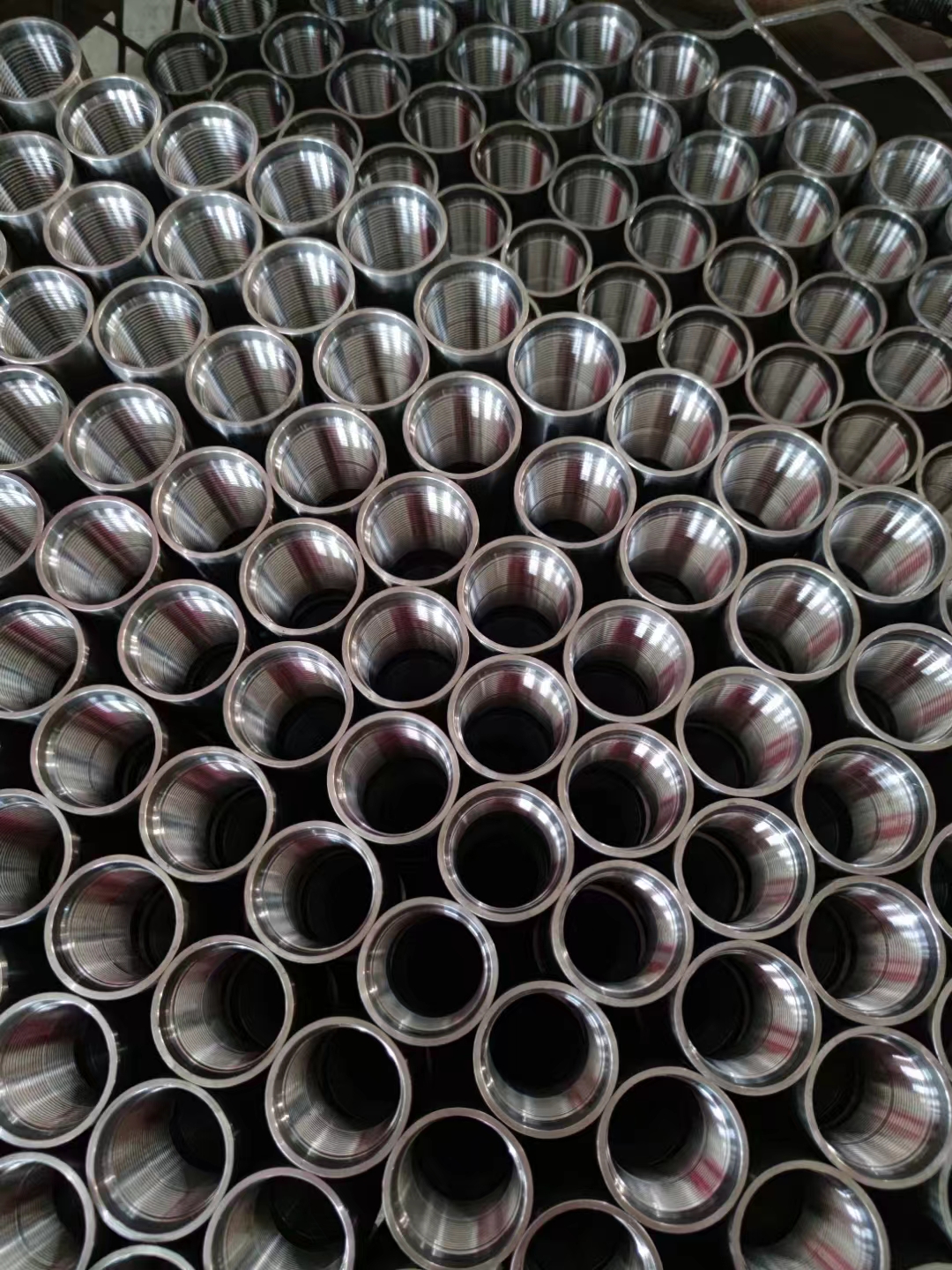 Machined API 5CT couplings viewed end-on — ZC supplies EU and NU tubing couplings across all grades from J55 through C110.
Quick Answer
For the majority of production tubing, EUE (external upset, 8-round) is the default: the longer upset coupling delivers 80–100% of pipe-body tensile efficiency, against 60–75% for NUE. Choose NUE only where the tubing-casing annulus is engineered tight enough that the larger EUE coupling OD will not drift through, or on shallow low-load strings. For gas-tight service, deviated or horizontal wells, or 13Cr and CRA grades, step past both API round-thread connections to a premium metal-to-metal seal — see BTC vs premium connection selection for that decision.
What we see on completion engineering reviews: In completion engineering reviews for West Africa and Middle East operators, coupling OD clearance failures are the most common EUE design error. The engineering team specifies 3-1/2 inch EUE tubing inside 5-1/2 inch 23 lb/ft casing — coupling OD 107.95mm, casing drift 116.28mm — radial clearance 4.2mm. That passes the minimum clearance check on paper. But when the 3-1/2 inch coupling hits an uncentralized packer seal assembly with an eccentric bore, the coupling gets lodged. The workover to free the string costs more than the premium connection upgrade that would have avoided the issue entirely.
1. EU and NU Tubing — The Key Difference
The fundamental difference between EU and NU tubing is whether the pipe ends are upset:
External Upset (EU): The pipe ends are hot-upset during manufacturing to increase the OD at both ends. This enlarged end diameter allows a longer threaded coupling with more thread engagement, providing higher tensile capacity. The coupling OD is larger than the pipe body OD.
Non-Upset (NU): No upsetting is applied. The pipe end OD equals the pipe body OD. Thread engagement is shorter, tensile capacity is lower, but there is no OD enlargement at the coupling location.
| Property | EU (EUE) | NU (NUE) |
|---|---|---|
| End OD | Larger than pipe body | Same as pipe body |
| Coupling OD | Larger than pipe body | Approximately equal to pipe body |
| Thread engagement | Long | Short |
| Tensile efficiency | 80–100% of pipe body | 60–75% of pipe body |
| Drift clearance | Coupling must be checked | More clearance |
| Common application | Standard production tubing | Tight clearance applications |
| Thread form | 8-round, 8 TPI | 8-round, 8 TPI |
The tensile efficiency difference is the primary reason EUE dominates production tubing. NUE's 60–75% pipe body rating becomes a hard constraint in wells deeper than approximately 2,000m, where the cumulative string weight begins to approach that rating. For wells deeper than 3,000m, EUE is the minimum API connection — even EUE requires a tensile check against string weight before the design is signed off.
2. EUE Tubing — Specifications and Dimensions
EUE (External Upset End) with 8-round thread is the standard production tubing connection globally. It is specified in API Specification 5CT, 11th Edition, and the thread form is defined in API 5B.
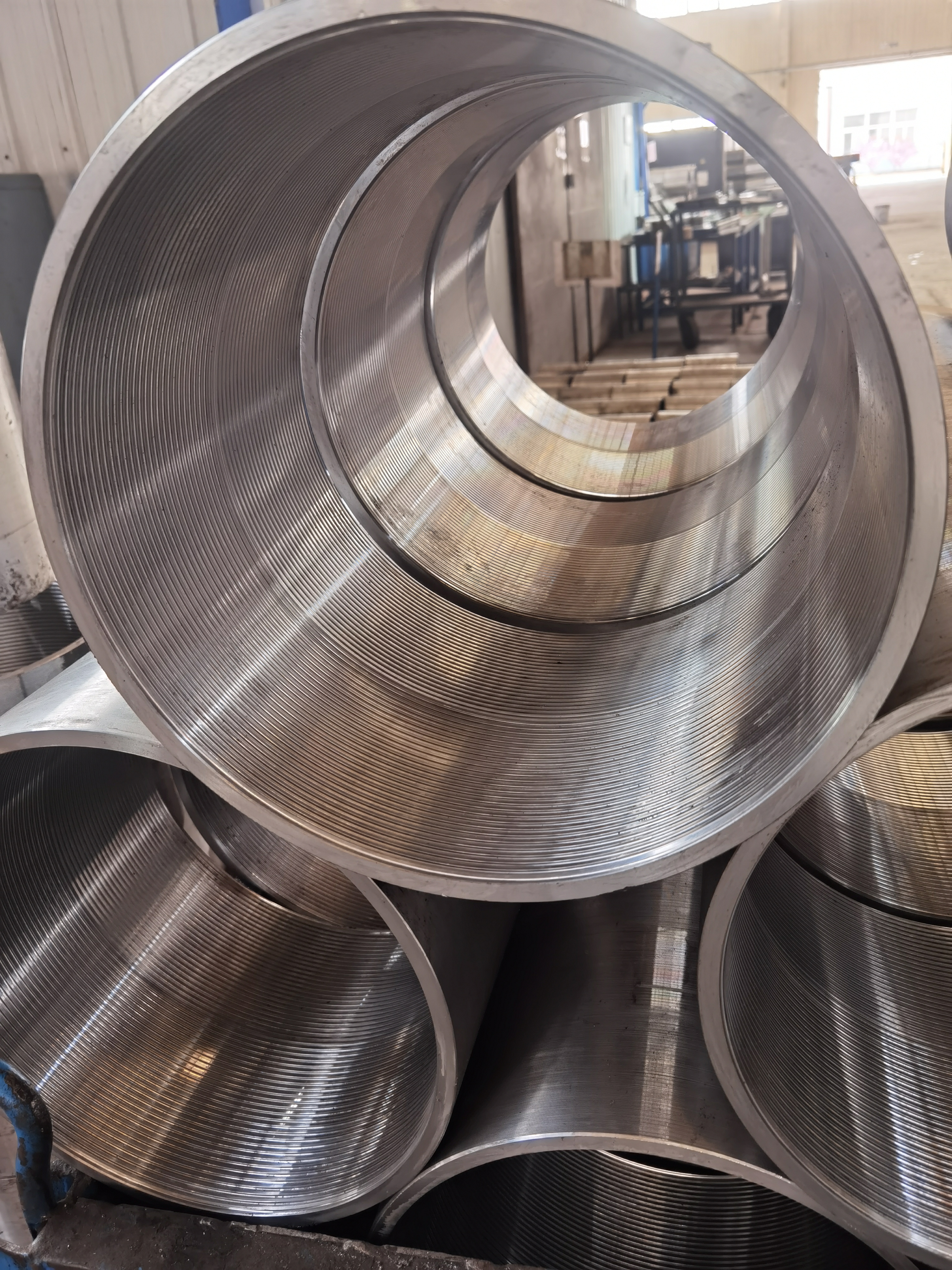 Internal thread detail on stacked couplings — the 8-round thread form defined in API 5B is used for both EUE and NUE tubing.
Common EUE tubing sizes:
| OD (in) | OD (mm) | Weight (lb/ft) | Wall (mm) | ID (mm) | Coupling OD (mm) | Drift (mm) |
|---|---|---|---|---|---|---|
| 1.900 | 48.26 | 2.75 | 3.18 | 41.91 | 60.33 | 39.75 |
| 1.900 | 48.26 | 3.65 | 4.44 | 39.37 | 60.33 | 37.21 |
| 2-3/8 | 60.32 | 4.00 | 3.18 | 53.97 | 73.02 | 51.81 |
| 2-3/8 | 60.32 | 4.60 | 3.56 | 53.21 | 73.02 | 51.05 |
| 2-3/8 | 60.32 | 5.80 | 5.54 | 49.25 | 73.02 | 47.09 |
| 2-7/8 | 73.02 | 6.40 | 5.51 | 62.00 | 88.90 | 59.84 |
| 2-7/8 | 73.02 | 7.90 | 5.51 | 62.00 | 88.90 | 59.84 |
| 2-7/8 | 73.02 | 8.70 | 6.45 | 60.12 | 88.90 | 57.96 |
| 3-1/2 | 88.90 | 7.70 | 5.49 | 77.92 | 107.95 | 75.76 |
| 3-1/2 | 88.90 | 9.20 | 6.45 | 76.00 | 107.95 | 73.84 |
| 3-1/2 | 88.90 | 10.20 | 7.34 | 74.22 | 107.95 | 72.06 |
| 4 | 101.60 | 9.50 | 5.74 | 90.12 | 120.65 | 87.96 |
| 4-1/2 | 114.30 | 9.50 | 5.21 | 103.89 | 132.08 | 101.60 |
| 4-1/2 | 114.30 | 11.60 | 6.35 | 101.60 | 132.08 | 99.31 |
The coupling OD column is the dimension that engineering teams most often undercheck. Note that the 4-inch EUE coupling OD (120.65mm) exceeds the drift diameter of 5-1/2 inch 17 lb/ft casing (120.50mm) — that combination will not pass. The 3-1/2 inch size has a 107.95mm coupling OD that passes comfortably in 5-1/2 inch 17 lb/ft casing but becomes marginal in heavier-wall 23 lb/ft casing. Run the explicit clearance calculation before finalizing any size combination.
For the complete grade and connection-class specification tables, see the API 5CT specification tables →
To match a connection type to your well conditions, use the Pipe Grade Selector →
What EU volume actually looks like: EU is the default on our tubing order book. One South American order alone was 15,000 J55 and N80Q couplings in EU and LTC across 3½″, 4½″, and 5½″ — the EU (external upset) couplings for the tubing strings and LTC for the larger-diameter casing. The coupling OD that the upset creates is exactly the dimension buyers most often skip checking against packer and casing drift; we ask for the completion clearance before confirming EU on a tight annulus.
3. NUE Tubing — Specifications and Dimensions
NUE tubing is less common but specified for tight clearance applications. The coupling OD is only slightly larger than the pipe body OD.
Common NUE tubing sizes:
| OD (in) | OD (mm) | Weight (lb/ft) | Wall (mm) | ID (mm) | Coupling OD (mm) | Drift (mm) |
|---|---|---|---|---|---|---|
| 1.050 | 26.67 | 1.14 | 2.41 | 21.84 | 33.40 | 19.69 |
| 1.315 | 33.40 | 1.70 | 2.90 | 27.61 | 42.16 | 25.45 |
| 1.660 | 42.16 | 2.30 | 2.90 | 36.37 | 48.26 | 34.21 |
| 1.900 | 48.26 | 2.75 | 3.18 | 41.91 | 54.00 | 39.75 |
| 2-3/8 | 60.32 | 4.00 | 3.18 | 53.97 | 66.68 | 51.81 |
| 2-7/8 | 73.02 | 6.40 | 5.51 | 62.00 | 79.38 | 59.84 |
| 3-1/2 | 88.90 | 7.70 | 5.49 | 77.92 | 95.25 | 75.76 |
Comparing the 2-7/8 inch row: NUE coupling OD is 79.38mm versus 88.90mm for EUE. That 9.5mm reduction in coupling diameter provides meaningful additional clearance in completions where the tubing-casing annulus is engineered to a minimum. For the 1.050 and 1.315 inch sizes, NUE is the only available API connection — these small-bore sizes do not have a standard EUE design.
4. Tensile Rating Comparison
Connection tensile rating is a critical design parameter for tubing string design, particularly in deep wells and gas lift completions where the string weight is significant. The joint-strength formulas that produce these ratings are set out in API 5C3.
Approximate tensile ratings (N80 grade — illustrative):
| OD (in) | Weight (lb/ft) | Pipe Body (kN) | EUE Rating (kN) | NUE Rating (kN) |
|---|---|---|---|---|
| 2-3/8 | 4.60 | 312 | 285 | 195 |
| 2-7/8 | 6.40 | 436 | 401 | 278 |
| 3-1/2 | 9.20 | 623 | 587 | 401 |
| 4-1/2 | 11.60 | 845 | 801 | 534 |
EUE tensile ratings are typically 85–95% of pipe body. NUE tensile ratings are typically 60–75% of pipe body. The gap between EUE and NUE becomes the deciding factor when string weight is the primary load — for deep wells where string weight approaches the connection rating, EUE or premium connections are required. The NUE rating for 2-7/8 inch N80 (278 kN) looks adequate for many strings, but that number includes no safety factor; most operators apply 1.25×, which puts the working limit at 222 kN. To compute the joint strength for a specific EUE or NUE size and grade before you finalise the string, use the joint-strength calculator →
5. Clearance Calculations — EUE Coupling vs Casing Drift
Worked Clearance Calculation — EUE Coupling OD Check
The EUE coupling OD must clear the casing drift diameter. This is not a step to delegate to the completion report — it should be done on the initial well design and again before the string is ordered.
Minimum clearance required: Most operators specify a minimum radial clearance of 3mm (6mm diametrical) between coupling OD and casing drift diameter. Below 3mm radial, the risk of the coupling contacting an eccentric or misaligned bore is unacceptably high.
EUE coupling OD clearance check — 3-1/2 inch EUE in 5-1/2 inch casing:
| Casing | Drift (mm) | Coupling OD (mm) | Radial Clearance | Decision |
|---|---|---|---|---|
| 5-1/2 inch 17 lb/ft | 120.50 | 107.95 | (120.50 − 107.95) / 2 = 6.28mm | Pass ✓ |
| 5-1/2 inch 23 lb/ft | 116.28 | 107.95 | (116.28 − 107.95) / 2 = 4.17mm | Marginal — engineering review required |
| 5-1/2 inch 26 lb/ft | 113.80 | 107.95 | (113.80 − 107.95) / 2 = 2.93mm | Reject ✗ — fails minimum clearance |
For 5-1/2 inch 26 lb/ft casing, 3-1/2 inch EUE fails the 3mm radial clearance minimum. The correct specification in this configuration is 2-7/8 inch EUE (coupling OD 88.90mm, radial clearance = (113.80 − 88.90) / 2 = 12.45mm) or a premium near-flush connection with a reduced coupling OD that clears the 26 lb/ft drift.
Tensile Check — 2-7/8 inch N80 EUE at 3,000m
For a 2-7/8 inch N80 EUE tubing string in a 3,000m well, confirm the EUE tensile rating (401 kN from the table above) exceeds the string weight:
String weight = 3,000m × 6.40 lb/ft × 0.45359 kg/lb × 9.81 m/s² / 1,000 = approximately 84.9 kN
The 84.9 kN string weight is well within the 401 kN EUE rating, giving a safety factor of 4.7× against axial tension. Even applying the industry-standard 1.25× safety factor, the working tensile limit (321 kN) comfortably exceeds the string weight. For burst and collapse checks on the same string, use the Barlow pressure calculator → — enter the pipe OD, wall thickness, and grade yield strength to verify the pressure ratings against your wellhead and reservoir conditions.
The EUE tensile efficiency rating (85–95% of pipe body) is a room-temperature, axial-load value from API 5CT. It does not account for the combined tension-bending loads in deviated wells, nor for the reduction in thread compound friction that occurs when the compound partially washes out during long production periods. In deviated completions, the bending stress at the connection adds to the axial tension — the combined load can exceed the EUE tensile rating at wellbore inclinations that appear moderate (40–50°). For tubing strings where bending is significant, the EUE connection rating must be checked against the triaxial stress state, not just the axial tension.
6. Named EUE and NUE Failure Modes
Failure Mode 1: EUE Gas Leak — Compound Washout Under Cyclic Pressure
Mechanism: EUE 8-round thread depends on thread compound to seal the helical thread gap. In gas wells, the high-pressure gas phase applies differential pressure across the thread flanks. Over repeated pressure cycles — start-up, shut-in, drawdown — thread compound slowly migrates out of the thread form, particularly at the last-engaged-thread (LET) where stress concentration is highest. Once the compound film is locally depleted, gas migrates through the thread helix as a leak path. The leak rate starts small and grows with each pressure cycle.
Diagnostic: Sustained casing pressure (SCP) increasing over time, detected at A-annulus. Gas detected between tubing and casing at wellhead. EUE connection shows compound residue in the annular space around the coupling. Pressure test of the pulled connection fails gas integrity test.
Fix: EUE is not rated for gas-tight service. The correct specification is a premium metal-to-metal seal connection — ISO 13679 CAL III minimum for gas wells. Do not attempt to re-seal EUE gas leaks with additional compound. If EUE is deployed in a gas well and sustained casing pressure develops, plan a workover to replace the connection rather than waiting for the leak rate to stabilize.
Failure Mode 2: NUE Tensile Pull-Out in Deep Wells
Mechanism: NUE connections have 60–75% of pipe body tensile capacity. In wells deeper than approximately 3,000m, the cumulative string weight approaches or exceeds the NUE tensile rating, particularly for the top joint which carries the full string weight. At the NUE rating limit, the thread form deforms plastically (jump-out), releasing the string suddenly — this is a wellbore incident, not a gradual failure.
Diagnostic: Loss of string weight at surface (sudden reduction in hook load). String is stuck or lost in the well. Top joint shows thread deformation consistent with tensile overload.
Fix: For wells deeper than 2,000m, specify EUE not NUE. Run a tensile check: string weight (length × weight per meter × gravity) must be less than 80% of the connection tensile rating to maintain a 1.25 safety factor. For deviated wells, add the bending component to the tensile load before checking against the rating.
Failure Mode 3: EUE Coupling OD String Stuck on Completion Equipment
Mechanism: EUE coupling OD is 15–25mm larger than the pipe body OD. If the coupling OD is not checked against all downhole equipment — packers, safety valves, gas lift mandrels, nipple profiles — the coupling can contact and lodge against an eccentric or undersized bore. This occurs particularly when the well has been re-completed with equipment from different vendors, where the actual bore may differ from the nominal published dimension.
Diagnostic: Overpull required to set or retrieve tubing. Weight indicator shows sustained increased drag consistent with a stuck coupling. Camera survey or impression block confirms the coupling location as the obstruction.
Fix: Before specifying EUE, create a coupling clearance register: for each piece of downhole equipment in the completion, record the minimum bore and confirm it exceeds the EUE coupling OD by the operator's minimum radial clearance. Use premium connections with flush or near-flush OD where equipment clearance is tight.
7. When NOT to Use EUE Tubing Connections
EUE is the right connection for the majority of production tubing strings — sweet oil wells, moderate-depth gas lift strings, and sour service wells where the fluid and depth profile fall within the EUE load envelope. The following conditions take the application outside that envelope.
| Condition | Why EUE Is Unsuitable | Correct Connection |
|---|---|---|
| Gas producer | Not gas-tight; thread compound is the only seal | Premium metal-to-metal seal, ISO 13679 CAL III or IV |
| Well deeper than 3,000m | NUE tensile rating may be exceeded — check EUE | EUE after tensile verification |
| Deviated well > 30° inclination | Bending adds to tension; EUE triaxial rating needed | EUE with combined load check or premium |
| HPHT well | Combined loads exceed EUE capability | Premium connection ISO 13679 CAL IV |
| L80-13Cr or CRA grade | Connection must match pipe body corrosion resistance | Premium connection with same alloy coupling |
| Tight OD clearance | Coupling OD may contact completion equipment | Premium near-flush connection |
The gas producer case is the most frequently misapplied. EUE appears on L80 13Cr purchase orders for gas condensate wells at an industry-wide frequency that is higher than it should be. The 13Cr pipe body provides CO2 corrosion resistance — but the EUE 8-round thread, sealed only with compound, will leak gas on a sufficient number of pressure cycles. Matching a premium metal-to-metal seal connection to an L80 13Cr pipe body is not over-engineering; it is the only specification that achieves both corrosion resistance and gas-tight integrity.
8. Grade Selection for EU Tubing
| Grade | EU Availability | Application |
|---|---|---|
| J55 | EUE and NUE | Shallow, low pressure, sweet service |
| N80-1 | EUE and NUE | Medium depth, sweet service |
| L80-1 | EUE | Sour service, mild to moderate H₂S |
| L80 13Cr | EUE | CO₂ corrosive gas condensate wells |
| T95 | EUE | Moderate sour service, deeper wells |
| P110 | EUE | Deep sweet HPHT wells |
| C110 | EUE | Severe sour service |
| Q125 | Premium preferred | Ultra-deep — premium connection standard |
For mild-to-moderate H₂S service, L80-1 EUE is the standard sour-service tubing specification — see the L80 sour-service grade specifications for the hardness and PSL-2 requirements. For L80 13Cr and higher CRA grades, EUE is available but premium connections are typically required for gas wells due to the gas-tight seal requirement. Q125 in EUE is rarely available from mills in standard stock — if a project specifies Q125 EUE, expect extended lead times and verify mill capability before committing the delivery schedule to the operator.
9. Purchase Order Specification — Getting It Right
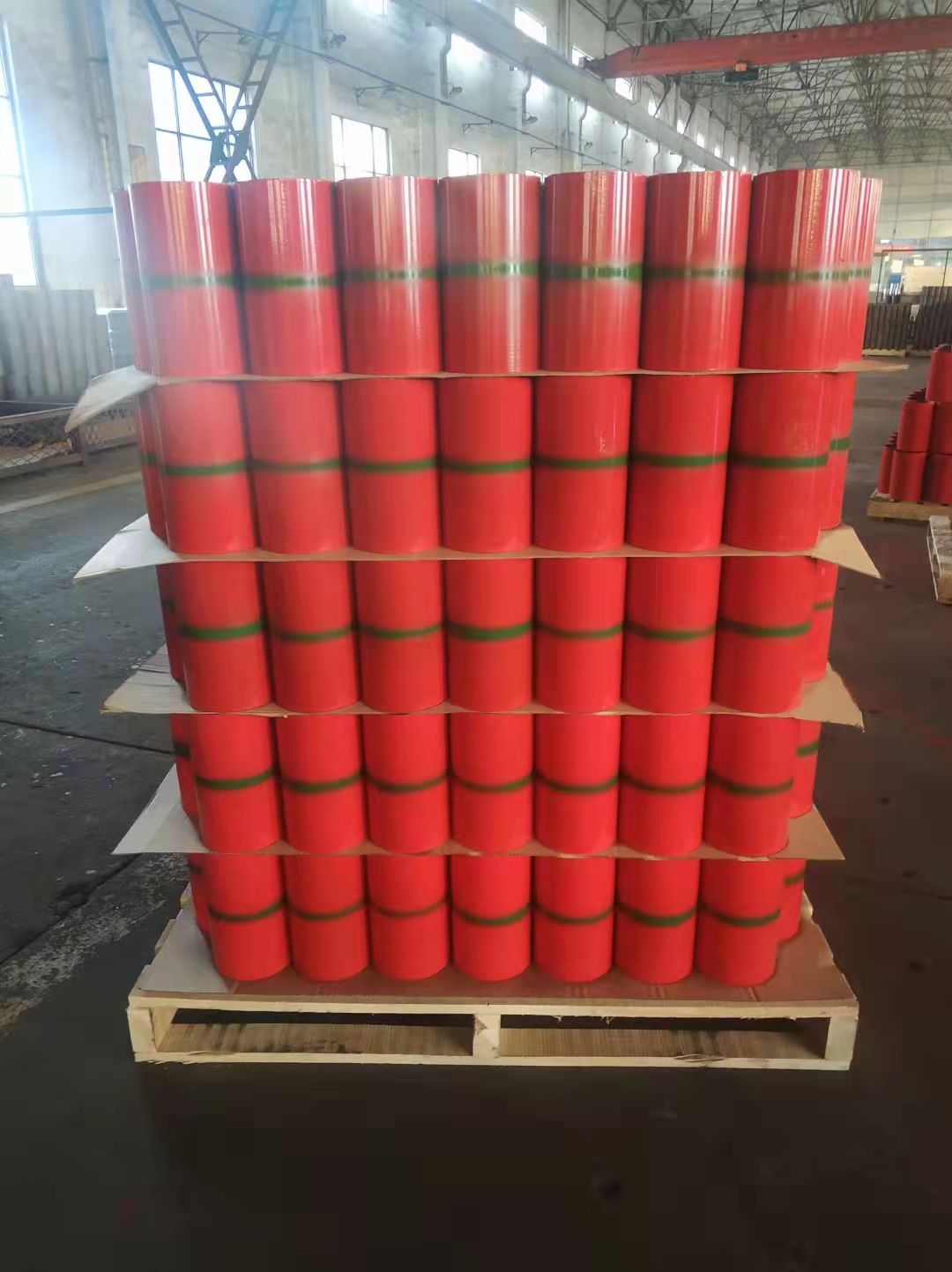 Phosphate-coated couplings palletised and shrink-wrapped for export — the coupling material, thread compound, and PSL level all belong on the purchase order.
When ordering EU or NU tubing, specify:
- Standard: API 5CT / ISO 11960
- Grade and type (e.g. L80 Type 1, L80 Type 13Cr)
- OD and nominal weight (lb/ft)
- End finish: EUE (external upset, 8-round thread) or NUE (non-upset, 8-round thread)
- Length range: Range 2 (8.0–9.6m) standard for tubing
- PSL level (PSL-1 or PSL-2)
- MTC: EN 10204 3.1 or 3.2
- Supplementary requirements if applicable (SR2 Charpy, SR15A SSC for sour)
- Thread compound specification
- Drift diameter confirmation
Procurement Trap — L80 13Cr EUE on a Gas Condensate Well
Wrong PO: "2-7/8 inch 6.40 lb/ft L80 13Cr tubing, EUE, API 5CT PSL-2, Range 2, 400 joints — gas condensate producer"
What the mill ships: EUE connections with carbon steel couplings. L80-13Cr pipe body with standard API EUE coupling — not necessarily 13Cr coupling material. The connection is not gas-tight. The galvanic couple between a 13Cr body and a carbon steel coupling in a CO2-bearing condensate fluid accelerates coupling corrosion, creating an integrity failure that has nothing to do with the pipe body grade selected.
Correct PO: "2-7/8 inch 6.40 lb/ft L80 Type 13Cr per API Specification 5CT, 11th Edition, premium metal-to-metal seal connection [specify connection designation], ISO 13679 CAL III minimum, 13Cr compatible coupling material, PSL-2, Q+T heat treatment, per-pipe hardness ≤ 23.0 HRC, Range 2, EN 10204 3.2 MTC, 400 joints."
The hardness limit (23.0 HRC maximum) reflects the NACE MR0175 / ISO 15156 requirement for 13Cr in sour service. If the well has any H2S component, this limit is not negotiable — omitting it from the PO means the mill can ship pipe within API 5CT limits that exceeds NACE limits, and the consignment will be rejected at the receiving inspection if a NACE-qualified inspector is present.
For premium connections, replace EUE/NUE with the specific connection series designation and include the connection qualification standard (ISO 13679 CAL III or CAL IV as appropriate). On ZC orders for West African operators, we include the connection qualification test report number on the MTC as a line item — this prevents disputes at the port of entry where inspectors ask for the connection certification separately from the pipe body MTC.
Frequently Asked Questions
What is the difference between EU and NU tubing connections?
EU (External Upset) tubing has an enlarged OD at both pipe ends, achieved by hot upsetting during manufacture. This larger end diameter accommodates longer thread engagement and provides higher tensile capacity. NU (Non-Upset) tubing has the same OD at the ends as the pipe body — no upsetting is applied. EU tubing connections have approximately 20-40% higher tensile capacity than NU connections of the same OD and weight, making EU the standard choice for most production tubing applications. NU is used where maximum clearance inside the casing is required.
What does EUE mean for tubing connections?
EUE stands for External Upset End — it refers to tubing with external upset ends that accommodate the API 8-round thread (8 TPI) connection. EUE 8-round is the most common API tubing connection globally and is the default specification for most production tubing strings in L80, N80, and J55 grades. The external upset increases the OD at the coupling location, which must be considered when calculating running clearances inside the production casing.
What is NUE tubing and when is it used?
NUE stands for Non-Upset End, referring to tubing with no OD enlargement at the ends. NUE tubing uses a shorter thread engagement than EUE and has lower tensile capacity — typically 60-70% of pipe body. NUE is specified when maximum bore clearance inside the casing is critical, when the tubing OD clearance with the casing is very tight, or for shallow low-load applications where EUE tensile capacity is not required. NUE is less common than EUE in modern completion designs.
What thread form is used for API tubing connections?
Standard API tubing connections use the 8-round thread form — 8 threads per inch with a rounded thread profile — defined in API 5B. Both EUE and NUE use this thread form. The external upset on EUE allows longer thread engagement (longer coupling) than NUE, which provides the higher tensile capacity. Premium tubing connections use proprietary thread forms (trapezoidal, wedge, or modified buttress) that provide gas-tight metal-to-metal sealing not achievable with API round thread.
Can EUE tubing be run through a packer?
EUE tubing can be run through most standard bore packers and completion equipment designed for the nominal tubing OD. However the coupling OD of EUE tubing is larger than the pipe body OD and must be checked against the packer bore and any other completion equipment the tubing string must pass through. Always verify coupling OD clearance against the minimum bore of all downhole equipment before specifying EUE tubing for a completion with restrictive bore requirements.
What grades are available for EUE tubing?
EUE tubing is available in all API 5CT grades from J55 through P110 and C110 in standard sizes. L80 13Cr EUE is the standard specification for CO2-corrosive gas condensate wells. For sour service, L80-1 EUE PSL2 is the standard specification. T95 and C110 EUE are specified for deeper sour service wells. Q125 tubing is less commonly available in EUE — premium connections are generally specified for Q125 grade.
What is the coupling OD for EUE tubing?
EUE tubing coupling OD is larger than the pipe body OD by approximately 12-25mm depending on size. For example, 2-7/8 inch EUE tubing (73.0mm pipe body OD) has a coupling OD of approximately 88.9mm. 3-1/2 inch EUE tubing (88.9mm pipe body OD) has a coupling OD of approximately 107.9mm. Always check the coupling OD against casing drift diameter and packer bore when designing the completion.
When should premium tubing connections be specified instead of EUE?
Premium tubing connections should be specified instead of EUE when: the well produces gas and gas-tight integrity is required; the tubing string is in a deviated or horizontal well with bending loads; the grade is T95, C110, or a CRA (13Cr, Super 13Cr, duplex) where connection performance must match the pipe body; the well is HPHT with high combined loads; or the operator specification explicitly requires premium connections for the application.