L80 13Cr is the first step up from carbon steel OCTG when a well encounters CO₂ corrosion that plain L80-1 cannot handle. The 13% chromium content forms a passive oxide layer on the pipe inner surface that provides substantially better resistance to CO₂-driven sweet corrosion, making it the standard tubing grade for gas condensate wells, CO₂-rich oil producers, and re-injection strings where H₂S is absent or trace. It occupies a clear position in the CRA selection ladder: above plain carbon steel grades, below Super 13Cr and duplex stainless, and with a hard ceiling on its corrosion envelope that engineers must understand before selection.
We supply API 5CT L80 13Cr casing and tubing to PSL-2 with EN 10204 3.2 MTC, corrosion qualification data, and third-party inspection for operators and EPC contractors across West and East Africa, Southeast Asia, and South America. What we see in practice differs from what the spec sheet shows — and those differences are what this article addresses.
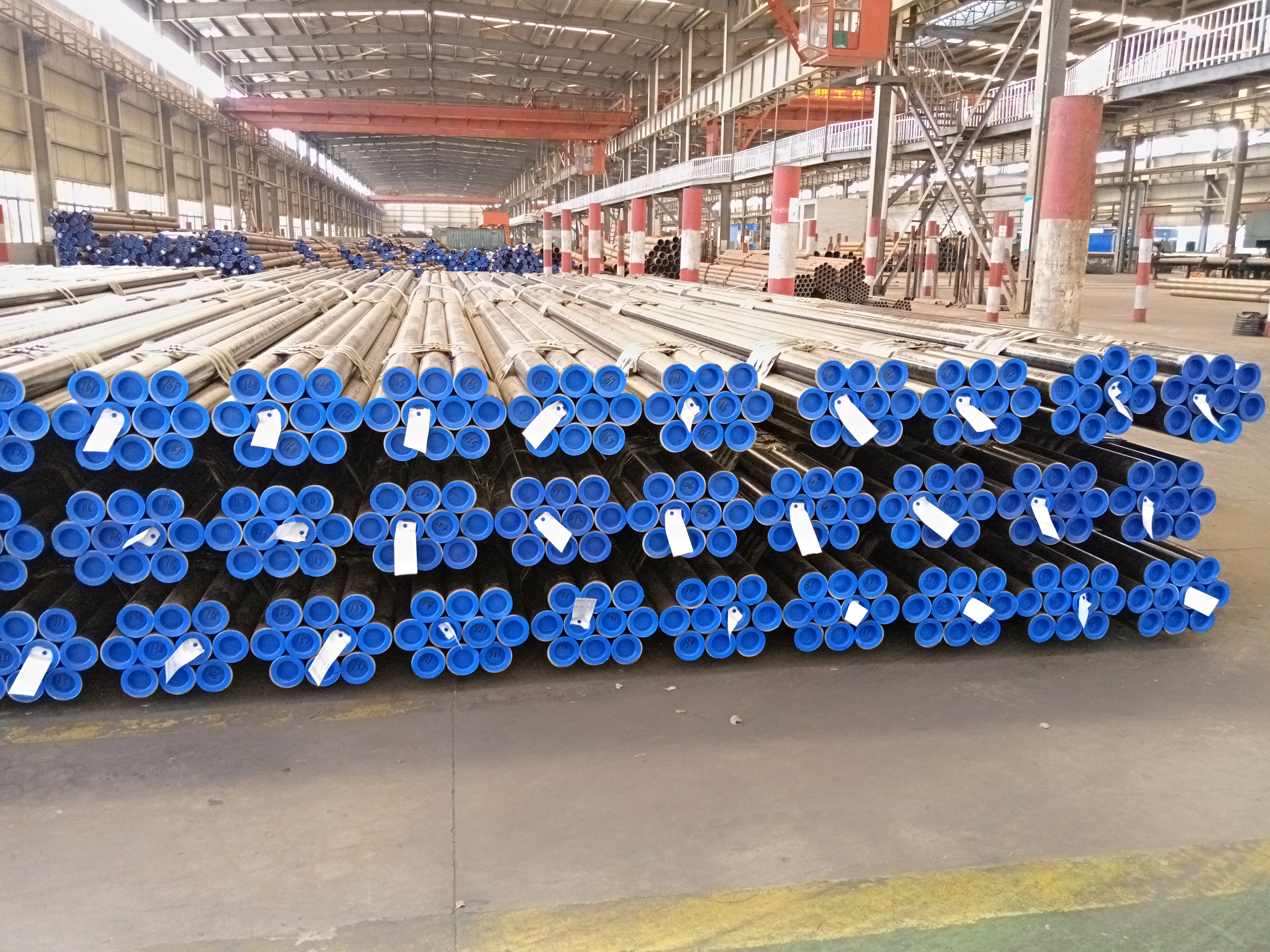 Bundled seamless L80-13Cr flowline pipe with protective blue end caps in our warehouse — from a real ZC CO₂-resistant flowline shipment to a West African field.
At a Glance
L80 13Cr is a martensitic 12–14% chromium OCTG grade for CO₂-corrosive sweet wells. It carries the same L80 mechanical properties as carbon-steel L80-1 but adds a passive chromium oxide film that resists CO₂ corrosion. It is not a sour-service grade — H₂S disqualifies it.
| Property | L80 13Cr |
|---|---|
| API 5CT classification | L80 Type 13Cr, Group 2 |
| Chromium | 12.0–14.0% |
| Minimum yield strength | 552 MPa (80 ksi) |
| Maximum yield strength | 655 MPa (95 ksi) |
| Minimum tensile strength | 655 MPa (95 ksi) |
| Maximum hardness | 23 HRC / 241 HBW |
| Heat treatment | Quench and temper (Q+T), mandatory |
| CO₂ envelope | Up to ~2.5 MPa (25 bar), ≤ 150°C |
| H₂S / sour service | Not qualified — sweet wells only |
| Weight correction factor | 0.989 |
Full chemistry, the CO₂ corrosion envelope, and a burst worked example follow below.
What we see on orders: A significant share of the L80 13Cr purchase orders we receive do not include a type designation — they read "API 5CT L80" with no further qualification. Under API Specification 5CT, 11th Edition, a mill receiving that PO is fully compliant shipping L80 Type 1, which is plain carbon-manganese steel with no chromium. We flag the missing type designation before production begins. Not every mill will. The PO must read "L80 Type 13Cr" — three words that make the difference between a CO₂-resistant tubing string and a standard carbon steel one.
What API 5CT Defines for L80 13Cr
API Specification 5CT, 11th Edition defines L80 as a grade group covering three types: Type 1 (carbon-manganese steel), Type 9Cr (9% chromium), and Type 13Cr (13% chromium). All three types carry the same mechanical property requirements — the distinction between them is entirely in chemistry and heat treatment. L80 13Cr is classified as a martensitic chromium steel, produced exclusively by quench and temper (Q+T) heat treatment. It is not permitted to be produced in the normalized condition.
The grade sits within API 5CT's CRA sub-family alongside the 3Cr and 9Cr types, but 13Cr has by far the largest application footprint of the three. It is the grade most CO₂ corrosion engineers encounter first when carbon steel grades are ruled out by corrosion modelling.
Mechanical Properties and Hardness
L80 13Cr shares its mechanical property requirements with L80 Type 1 per API 5CT Table C.3/E.3:
| Property | Value |
|---|---|
| Minimum yield strength | 552 MPa (80 ksi) |
| Maximum yield strength | 655 MPa (95 ksi) |
| Minimum tensile strength | 655 MPa (95 ksi) |
| Maximum hardness | 23 HRC / 241 HBW |
| Minimum elongation | 19.5% |
| Heat treatment | Quench and temper (Q+T) — mandatory |
The yield band of 552–655 MPa is narrow by OCTG standards — only 103 MPa of spread. Mills that run this grade tight to the minimum will produce pipe near 80 ksi yield; mills running closer to mid-band will land around 87–89 ksi. For string design purposes, engineers should request yield histograms from the mill if actual yield distribution matters — particularly for compression-loaded strings.
For the complete L80 grade ladder with chemistry and hardness comparison across all types, see the API 5CT specification tables.
Chemistry and the Role of Chromium
API 5CT specifies the following chemical composition for L80 13Cr:
| Element | Minimum | Maximum |
|---|---|---|
| Carbon (C) | 0.15% | 0.22% |
| Manganese (Mn) | 0.25% | 1.00% |
| Silicon (Si) | — | 1.00% |
| Phosphorus (P) | — | 0.020% |
| Sulphur (S) | — | 0.010% |
| Chromium (Cr) | 12.00% | 14.00% |
| Nickel (Ni) | — | 0.50% |
| Copper (Cu) | — | 0.25% |
| Molybdenum (Mo) | not specified | not specified |
Chromium drives everything that distinguishes this grade from L80-1. In the presence of CO₂ and water, chromium reacts to form a passive Cr₂O₃ layer on the pipe surface. That layer is self-repairing under most production conditions — small scratches or minor mechanical damage will re-passivate if oxygen is available and pH is above approximately 3.5. The 12.00% minimum is the threshold below which the passive layer becomes unreliable; the 14.00% maximum reflects the upper bound at which the martensitic microstructure remains stable after Q+T. Mills typically aim for 12.5–13.5% to stay well within the approved band.
The absence of a molybdenum specification is the key chemistry difference from Super 13Cr. Molybdenum in Super 13Cr (typically 1.5–2.5%) stabilises the passive layer at higher temperatures and chloride concentrations — which is exactly why Super 13Cr's corrosion envelope extends beyond L80 13Cr's.
CO₂ Corrosion Resistance — What "13Cr" Actually Means
The 13Cr designation is not a guarantee of corrosion immunity — it is a statement that, within a defined envelope of temperature, CO₂ partial pressure, chloride concentration, and pH, the passive chromium oxide layer will significantly slow CO₂ corrosion relative to plain carbon steel. Outside that envelope, corrosion rates can increase sharply.
The generally accepted operational limits for L80 13Cr in CO₂ service are:
| Parameter | L80 13Cr Guideline | Consequence if Exceeded |
|---|---|---|
| CO₂ partial pressure | Up to ~2.5 MPa (25 bar) | Passive layer overwhelmed; corrosion rate climbs |
| Temperature | Up to 150°C continuous | Passive layer thermally destabilised — see failure mode below |
| Chloride concentration | Up to ~50,000 ppm | Pitting corrosion initiates under high chloride |
| pH | Above 3.5 | Very low pH dissolves passive layer |
| Flow velocity | Below ~10 m/s | Above this, erosion-corrosion removes the passive layer mechanically |
These are industry guidelines, not hard API 5CT limits — the actual threshold for any specific well must be verified against corrosion modelling that accounts for the combined effects of temperature, CO₂ partial pressure, chloride, pH, and flow regime simultaneously.
What we ship for CO₂ wells: The 4½″ (114.3 mm) × 7.37 mm L80-13Cr we supplied as CO₂-resistant flowline tubing to a West African field went out plain-end in black coating, so the operator could thread it in-country to their own coupling dimensions. On a casing string for the same kind of corrosive gas service we ran the identical 4½″ × 7.37 mm body with our ZC-2 premium connection, because a BTC thread-compound seal is not dependable in CO₂-rich gas. Same metallurgy, two end configurations — the choice driven entirely by whether the string sees gas pressure at the connection.
The 23 HRC Hardness Trap
L80 13Cr and L80-1 both carry a 23 HRC / 241 HBW maximum hardness limit per API 5CT Table C.3/E.3. They look identical on paper. They are not equivalent.
L80-1's 23 HRC ceiling simultaneously satisfies NACE MR0175 / ISO 15156-2's hardness restriction for carbon and low-alloy steels in H₂S sour service. A mill that produces L80-1 within that hardness limit is also producing a NACE MR0175-qualified material — which is why L80-1 appears in sour service string designs.
L80 13Cr's 23 HRC ceiling is an API 5CT mechanical requirement only. It has nothing to do with NACE MR0175 or ISO 15156. L80 13Cr is a martensitic stainless steel; the NACE MR0175 / ISO 15156-3 framework that applies to CRA alloys in H₂S service is a separate qualification system with its own environmental limits. An MTC showing L80 13Cr at 20 HRC does not mean the material is sour service qualified. The grade is not sour service regardless of the hardness value.
Procurement teams accustomed to L80-1 sometimes see the same hardness limit on the L80 13Cr MTC and assume the grades are interchangeable for sour service. They are not. The hardness number is coincidentally the same; the qualification basis is entirely different.
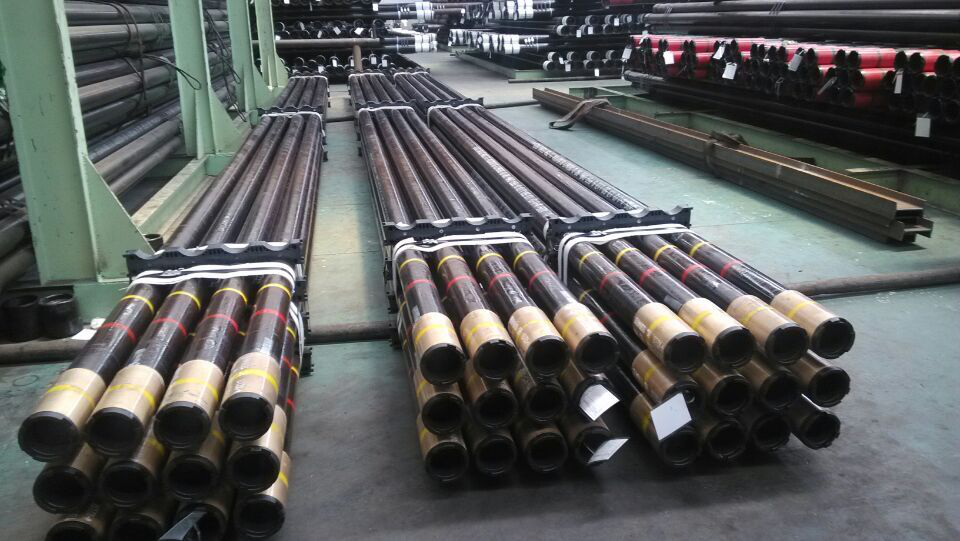 L80-13Cr casing racked with couplings made up and thread protectors fitted — from a real ZC premium casing order.
When NOT to Use L80 13Cr
The cases where L80 13Cr is the wrong selection are as important to understand as the cases where it is right:
H₂S present at any meaningful partial pressure. L80 13Cr is not qualified under NACE MR0175 / ISO 15156 and has no defined H₂S envelope. Even trace H₂S — above the NACE MR0175 threshold of 0.05 psia (0.34 kPa) H₂S partial pressure — disqualifies L80 13Cr without further engineering analysis. The corrosion mechanism in H₂S is sulphide stress cracking (SSC), which is not inhibited by the chromium passive layer. For wells with combined CO₂ and H₂S, the selection escalates to Super 13Cr (very low H₂S, per the mill's ISO 15156-3 qualified envelope) or 22Cr duplex where H₂S is significant.
Bottom-hole temperature above 150°C. The named failure mode for L80 13Cr in high-temperature service is passive film thermal destabilisation. Above approximately 150°C, the Cr₂O₃ passive layer loses structural stability — it thins, becomes discontinuous, and loses its self-repairing capability. Once the passive layer breaks down, corrosion rates approach those of plain carbon steel in the same CO₂ environment. This failure mode develops gradually, not catastrophically, which means it can progress undetected until inspection reveals severe pitting. For wells above 150°C, Super 13Cr (rated to approximately 180°C) is the minimum CRA step-up.
CO₂ partial pressure above 2.5 MPa (25 bar). At higher CO₂ partial pressures the passive layer formation rate is insufficient to protect the surface reliably, particularly in turbulent flow regimes.
High chloride concentration above ~50,000 ppm. Chloride ions compete with the passive layer at the pipe surface, initiating pitting at local defects. High-chloride wells — particularly high-temperature, high-chloride gas condensate wells — require Super 13Cr or duplex stainless evaluation.
Passive layer damaged by incorrect handling or incompatible inhibitors. The passive layer can be chemically damaged by certain scale inhibitors and biocides that are not formulated for 13Cr service. Using inhibitor packages designed for carbon steel service in a 13Cr completion is a common field error.
Welding required. L80 13Cr cannot be field-welded without specific qualified welding procedures. The martensitic microstructure is highly sensitive to heat-affected zone cracking, and welding disrupts the passive layer in a way that does not self-repair reliably.
Weight Correction Factor
API 5CT assigns L80 13Cr a weight correction factor of 0.989, reflecting the slightly lower density of the martensitic chromium steel alloy relative to plain carbon steel. This factor applies to all nominal weight values in the API 5CT dimensional tables.
For 2-7/8" 6.50 lb/ft tubing — one of the most common L80 13Cr tubing sizes in gas condensate wells — the actual pipe body weight is:
6.50 lb/ft × 0.989 = 6.43 lb/ft
The MTR will state 6.43 lb/ft, not 6.50 lb/ft. Engineers and yard QA teams who expect the nominal weight and see 6.43 lb/ft on the certificate sometimes flag this as a discrepancy. It is not — it is the correct reported weight for L80 13Cr at this size. We see this confusion regularly on projects where the QAQC team is accustomed to reviewing carbon steel MTRs and encounters a 13Cr heat for the first time. Including a note on the purchase order that the L80 13Cr weight correction factor is 0.989 per API 5CT eliminates the hold.
Burst Pressure Worked Example
For 2-7/8" 6.50 lb/ft L80 13Cr tubing (OD = 2.875 inch, wall thickness t = 0.217 inch), the internal yield pressure (burst) per API 5C3 Barlow formula with a 0.875 mill tolerance factor is:
P_burst = 0.875 × (2 × Y_p × t / D)
Where Y_p = 80,000 psi (minimum yield, L80 13Cr):
P_burst = 0.875 × (2 × 80,000 × 0.217 / 2.875)
= 0.875 × (34,720 / 2.875)
= 0.875 × 12,077
= 10,567 psi → rounded to 10,570 psi
This is the minimum burst pressure at the API-specified minimum yield. Run other sizes through the Barlow pressure calculator rather than scaling this figure by hand. Pipe produced at mid-band yield (say 87 ksi) will test higher, but string design must use the minimum — 80 ksi — not the actual mill test result. Engineers who use the MTC yield value rather than the API minimum for burst calculations are building in a non-conservative assumption.
Procurement Trap and Correct PO Language
The most consequential procurement error we see on L80 13Cr orders is the missing type designation. Here is the exact sequence:
Wrong PO language: "API 5CT L80, PSL-2, 3-1/2" 9.20 lb/ft, EUE 8rd, R2"
What happens: The mill is contractually permitted to supply L80 Type 1 — plain carbon-manganese steel. The MTC will show L80, PSL-2, EUE 8rd, and all mechanical property requirements will be met. The MTC will not be wrong. The pipe will be API-compliant. It will also have no chromium content and no CO₂ corrosion resistance. The corrosion failure in the well will not be traceable to a supply defect — the mill shipped exactly what was ordered.
Correct PO language: "API 5CT L80 Type 13Cr, PSL-2, 3-1/2" 9.20 lb/ft, [ZC premium connection], R2, EN 10204 3.2 MTC, Cr content 12.0–14.0% confirmed on MTC, weight correction factor 0.989 applied"
The addition of "Type 13Cr" is the only mandatory change. The additional MTC requirements close a second common gap: mills occasionally supply L80 13Cr with MTCs that do not explicitly state the chromium percentage. Specifying "Cr content 12.0–14.0% confirmed on MTC" makes this a hold point at third-party inspection.
Supply and Documentation
We supply L80 13Cr casing and tubing to PSL-2 as the standard — PSL-1 is not acceptable for CRA tubulars in CO₂ service because it does not mandate full-length NDE of the pipe body or Charpy impact testing. For corrosive service, the absence of mandatory PSL-2 testing creates unacceptable risk given the cost of a string replacement.
Standard documentation package for L80 13Cr supply:
- EN 10204 3.2 MTC (third-party witnessed) with chromium content confirmed per heat
- Full-length electromagnetic or ultrasonic NDE records
- Charpy V-notch impact test records per API 5CT Table C.36/E.36
- Hardness survey records confirming ≤23 HRC / 241 HBW
- Mill corrosion qualification data for the specific well conditions, where requested
- Third-party dimensional inspection report (SGS, Bureau Veritas, or equivalent)
L80 13Cr is almost exclusively run with premium connections — not standard API BTC. The reasons are specific: gas condensate wells requiring 13Cr tubulars are almost always gas wells where a gas-tight metal-to-metal seal is required; BTC thread compound seals are not reliable under sustained gas pressure in CO₂-rich environments; and the material cost of CRA tubulars justifies the connection premium. We supply L80 13Cr with the ZC premium connection series, qualified to API 5C5 CAL IV, covering tubing OD 1.900" through 4-1/2" and casing OD 4-1/2" through 9-5/8".
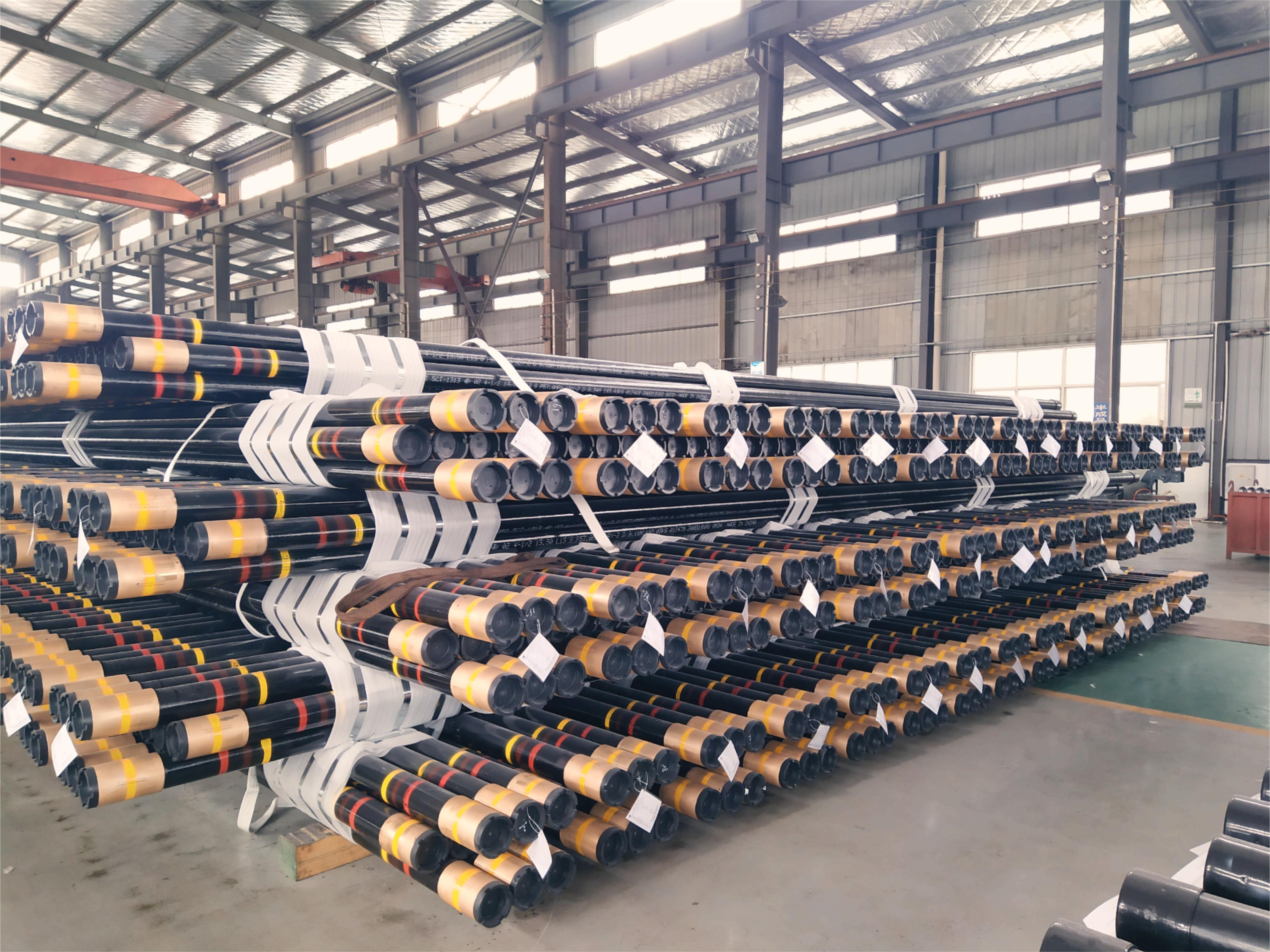 Premium L80-13Cr casing with copper protective bands and black thread caps, stencilled "5CT … MADE IN CHINA" — from a real ZC premium casing shipment to South America.
Full L80 13Cr dimensional data is available in the API 5CT specification tables.
For engineers selecting between L80 13Cr and Super 13Cr based on CO₂ partial pressure, temperature, or H₂S content, the L80 13Cr vs Super 13Cr selection guide covers the decision framework in detail. For wells where H₂S is present and the correct sour service grade for the carbon steel intervals needs to be established alongside the CRA production string, the sour service grade selection guide and the API 5CT L80 sour service specifications article address L80-1's NACE MR0175 qualification — a distinct grade that shares a name and a hardness limit with L80 13Cr but serves a fundamentally different well environment.
Frequently Asked Questions
What is L80 13Cr and how does it differ from L80-1?
L80 13Cr is a corrosion-resistant alloy (CRA) variant of the API 5CT L80 grade, containing approximately 13% chromium. Unlike L80-1 (plain carbon steel), L80 13Cr forms a passive chromium oxide layer that provides significant resistance to CO₂ corrosion in oil and gas production environments. Both grades share the same minimum yield strength of 552 MPa (80 ksi) and maximum yield of 655 MPa (95 ksi), and both have a 23 HRC hardness ceiling — but for different reasons: L80-1's 23 HRC limit satisfies NACE MR0175 for sour service qualification; L80-13Cr's 23 HRC limit comes from API 5CT and is not a NACE MR0175 qualification. L80-13Cr is a CO₂ corrosion resistance grade for sweet wells, not a sour service grade.
What CO₂ partial pressure can L80 13Cr handle?
L80 13Cr is generally suitable for CO₂ partial pressures up to approximately 2.5 MPa (25 bar) at temperatures up to 150°C. Above these thresholds — or where chloride concentrations are high — Super 13Cr or higher CRA grades should be evaluated. The actual CO₂ resistance envelope depends on temperature, chloride content, flow velocity, and pH, and should be verified against corrosion modelling for the specific well conditions.
Can L80 13Cr be used in H₂S sour service?
No — L80 13Cr is not a sour service grade and is not qualified under NACE MR0175/ISO 15156-3. The 13% chromium content provides CO₂ corrosion resistance through a passive oxide film, but does not provide resistance to sulphide stress cracking (SSC) in H₂S environments. L80 13Cr should only be selected for sweet wells — CO₂-corrosive service without significant H₂S. For combined CO₂ and H₂S service, the correct escalation is Super 13Cr (for very low H₂S environments per the mill's qualified envelope) or duplex stainless steel where H₂S is meaningful.
What connection types are used with L80 13Cr tubing?
L80 13Cr tubing is almost always run with premium connections rather than standard API BTC. The reasons are: gas-tight metal-to-metal seals are required for most CO₂-corrosive gas wells; BTC connections use elastomer seals that can degrade in CO₂ environments; and the higher cost of CRA tubulars justifies the additional investment in premium connections. ZC supplies L80 13Cr with its patented ZC premium connection series qualified to API 5C5 CAL IV.
What is the maximum temperature for L80 13Cr?
L80 13Cr is generally limited to approximately 150°C continuous service temperature for CO₂ corrosion resistance. Above 150°C, the passive chromium oxide layer becomes less stable and corrosion rates increase significantly. For higher temperature applications, Super 13Cr (rated to approximately 180°C) or higher CRA grades such as 22Cr duplex should be evaluated.
How should L80 13Cr be specified on a purchase order?
L80 13Cr should be specified as: API 5CT L80 Type 13Cr, PSL-2, with the required OD, nominal weight, connection type, and length range. Additionally specify: corrosion qualification data requirement, EN 10204 3.2 MTC, third-party inspection scope, and any project-specific supplementary requirements (SR). The chromium content (12.0–14.0% per API 5CT) and other alloying elements should be confirmed against the mill's chemical composition certificate.
What is the difference between L80 13Cr and Super 13Cr?
L80 13Cr is defined by API 5CT with a chromium content of 12.0–14.0% and minimum yield of 552 MPa. Super 13Cr is a proprietary mill grade (not an API grade) with modified chemistry — typically higher chromium (12.0–14.0%), added nickel (4.0–6.0%) and molybdenum (1.5–2.5%) — giving significantly better CO₂ corrosion resistance, higher yield strength (typically 110 ksi / 758 MPa), wider temperature envelope (up to 180°C), and improved H₂S tolerance compared to standard L80 13Cr.
Can L80 13Cr casing and tubing be welded in the field?
L80 13Cr is not designed for field welding and should not be welded without specific engineering approval and qualified welding procedures. The martensitic microstructure is sensitive to heat-affected zone cracking, and the passive corrosion-resistant layer is disrupted by welding heat. All connections should be made using threaded connections as specified on the purchase order.