Buttweld fittings manufactured to ASME B16.9 are the standard choice for permanent pressure piping connections in oil and gas, petrochemical, power generation, and industrial process systems. They are welded directly onto the connected pipe, producing a joint of equivalent strength to the pipe itself. Selecting the correct fitting type, material grade, and wall thickness from the outset avoids costly field modifications and inspection failures — the decisions that seem minor at the purchasing stage are the ones that generate the largest rework costs in the field.
ZC Steel Pipe supplies ASME B16.9 carbon and alloy steel buttweld fittings in sizes NPS ½ through 48, covering elbows, tees, reducers, caps, and crosses in all standard pipe schedules. Most of our B16.9 volume goes to EPC projects in Southeast Asia, the Middle East, and West Africa — refinery piping packages, compressor station piping, and offshore module fabrication. This guide covers dimensional requirements, material grades, pressure ratings, and the procurement information needed to specify fittings correctly.
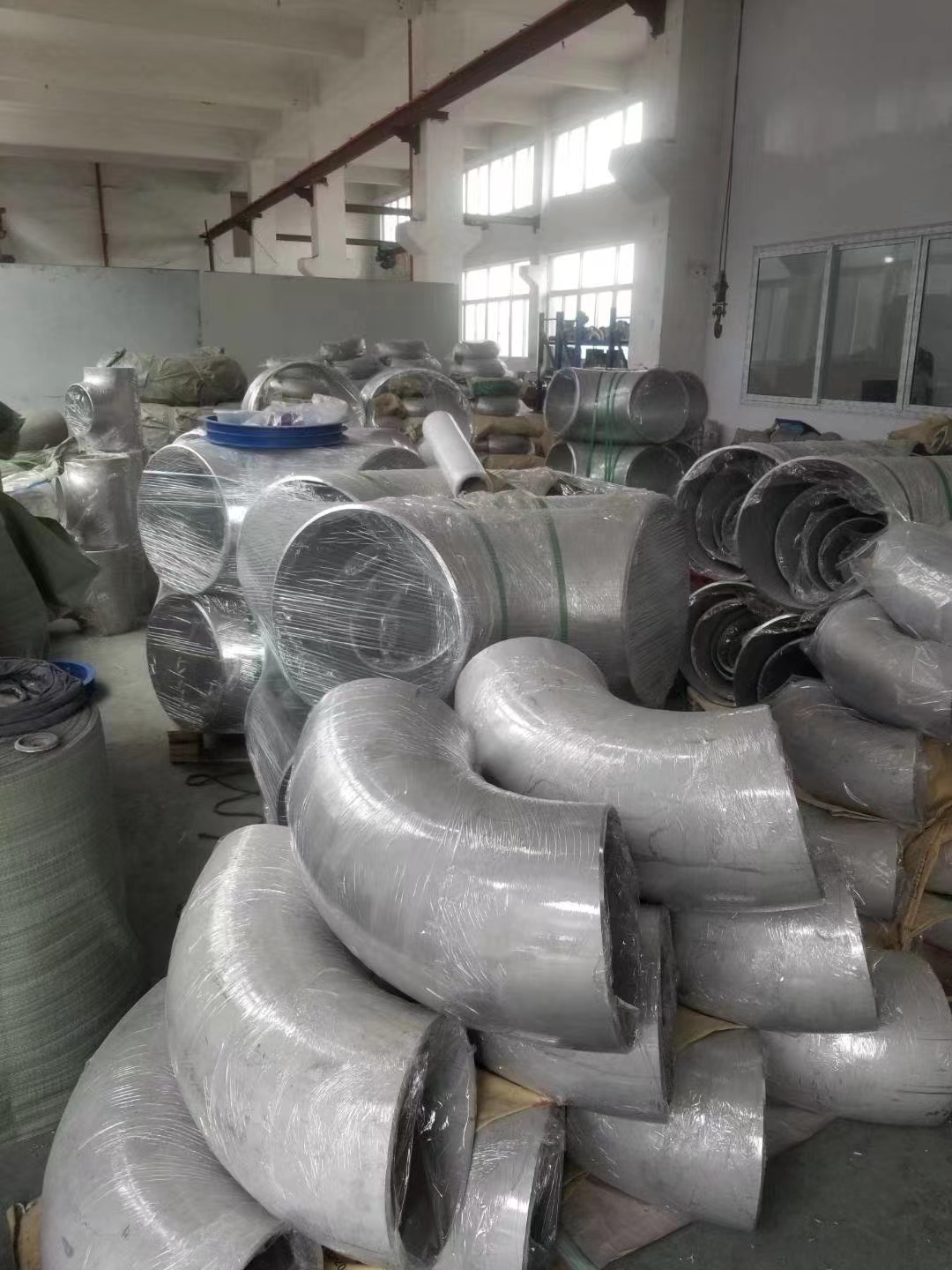 Shrink-wrapped butt-weld elbows and tees stacked in bulk on the factory floor.
Quick Answer
ASME B16.9 covers factory-made wrought buttweld fittings — long-radius elbows (90° and 45°), tees, crosses, concentric and eccentric reducers, caps, and stubends — in sizes NPS ½ through 48. Fittings are ordered to match the connecting pipe's schedule or minimum wall, and must carry at least the same pressure capacity as that pipe. The standard carbon-steel grade is ASTM A234 WPB; high-temperature circuits step up to chrome-moly grades WP11 through WP91. Long-radius elbows (centreline radius 1.5 × NPS) are the default; short-radius elbows sit under ASME B16.28 and are for confined space only. Fittings made from welded pipe carry a mandatory "W" body stamp — reject these wherever the specification calls for seamless.
What we see on receiving inspection: On a Southeast Asia oil refinery project, a batch of NPS 12 Sch 40 long-radius elbows was received for a high-temperature chrome-moly circuit. The project specification required seamless fittings — the circuit operated at 540°C and was covered under ASME B31.1. Several elbows in the batch were stamped with the letter "W" on their body marking, indicating they were manufactured from welded pipe. The receiving inspector checked size, schedule, material grade, and ASME B16.9 marking — all correct — but did not read the "W" stamp or check it against the specification requirement. The elbows were installed, the circuit was commissioned, and the weld seam in the elbow body was found during a post-hydrotest radiographic examination (RT) — a standard requirement from the operator's inspection protocol. All "W"-stamped elbows were rejected and replaced — a 3-week delay and full re-procurement at premium lead time. The "W" is mandatory marking per ASME B16.9 Section 11 when a fitting is made from welded pipe or tube. It is visible on the fitting body; it must be checked at receiving inspection.
1. Scope of ASME B16.9
ASME B16.9 — Factory-Made Wrought Buttwelding Fittings — specifies the dimensional and testing requirements for the following fitting types:
| Fitting Type | Common Configurations |
|---|---|
| Elbows | 90° long radius, 45° long radius, 90° reducing |
| Return bends | 180° long radius (U-bend) |
| Tees | Equal tee, reducing tee (branch smaller than run) |
| Crosses | Equal cross, reducing cross |
| Reducers | Concentric reducer, eccentric reducer |
| Caps | End cap |
| Stubends | Lap joint stubend |
Short radius elbows (1D centerline radius) are covered separately by ASME B16.28. The B16.9 scope explicitly excludes fittings manufactured by casting or forging — those are covered by ASME B16.11 (socket-weld and threaded fittings) and ASME B16.47 (large diameter flanges). The flanged connections in the same spool are specified to ASME B16.5. Every fitting covered by B16.9 is a wrought product, meaning it is formed from pipe or plate material rather than cast from molten steel.
2. Size Range and Dimensional Tolerances
ASME B16.9 covers NPS ½ through 48 (DN 15 through DN 1200). End tolerances on outside diameter are:
| NPS Range | OD Tolerance |
|---|---|
| ½ to 3½ | ±1/32 inch (±0.8 mm) |
| 4 to 18 | ±1/16 inch (±1.6 mm) |
| 20 to 48 | ±3/32 inch (±2.4 mm) |
Centre-to-face and face-to-face dimensions are tabulated in the standard for each fitting type and size. These dimensions must be met for interchangeability with fittings from different manufacturers. What the tolerance table does not say explicitly is that dimensional interchangeability matters most in modular fabrication — when elbows from one supplier and tees from another are being fitted together in a prefabricated spool, a face-to-face deviation outside tolerance forces field modification. For major spool fabrication contracts, specify that all fittings come from a single supply batch to eliminate tolerance stack-up issues.
To convert between pressure ratings, units, and pipe dimensions, use the Unit Converter →
3. Wall Thickness and Schedule Matching
Fittings are supplied in wall thickness designations that match the connected pipe. The fitting must have at least the same pressure-carrying capacity as the pipe — typically expressed as a minimum wall thickness equal to or greater than the pipe wall specified:
| Schedule Designation | Typical Application |
|---|---|
| Schedule 40 / Standard (STD) | General service to moderate pressures |
| Schedule 80 / Extra Strong (XS) | Higher pressure or corrosion allowance |
| Schedule 160 | High-pressure service |
| XXS | Very high-pressure, reduced bore ID |
For wall thicknesses not covered by schedule designations, fittings can be ordered by specifying minimum wall thickness in mm or inches. One ordering pattern we see regularly from Middle East refinery projects is dual-designation on the PO: "Sch 80 minimum / 9.53 mm minimum wall" — the schedule sets the standard, and the explicit mm value prevents any ambiguity when the fitting manufacturer interprets the order. For how schedules map to wall thickness across the NPS range, see our ASME B36.10M pipe schedule selection guide.
ASME B16.9 does not set a pressure rating for buttweld fittings — it sets a pressure equivalence requirement: the fitting must have at least the same pressure-carrying capacity as the connecting pipe of the same nominal size and schedule. In practice, the forming process for a 90° LR elbow thins the metal at the outer radius (crown) and thickens it at the inner radius (intrados). The nominal wall designation of the fitting (e.g., Sch 40) applies to the ends of the fitting where it connects to the pipe — not necessarily to the crown where the wall may be thinner than the nominal. ASME B16.9 validates pressure equivalence through a burst pressure test, not through a minimum wall thickness check at every point. This means a fitting marked Sch 40 may have a crown wall thinner than the Sch 40 pipe it connects to — yet it meets B16.9 because the burst test confirms overall pressure equivalence. For extremely high-pressure applications, this distinction may be important in the stress analysis.
4. Material Grades
ASME B16.9 fittings are manufactured from wrought steel to ASTM material specifications. The most common grades are listed below.
Carbon Steel — ASTM A234
| Grade | Alloy | Min Tensile (MPa) | Min Yield (MPa) | Max Service Temp (°C) |
|---|---|---|---|---|
| WPB | Carbon-Mn | 415 | 240 | 482 |
| WPC | Carbon-Mn, higher strength | 485 | 275 | 482 |
| WP1 | 0.5Mo | 415 | 205 | 593 |
WPB is the standard grade for general carbon steel piping and is compatible with ASTM A106 Gr B and API 5L X52–X60 pipe — our ASTM A234 WPB fitting grades and specs guide covers its chemistry and mechanical limits in full. WPC is used where higher strength is required. What the table does not show is that WPB has no maximum yield limit — a WPB fitting could be considerably stronger than its 240 MPa minimum, and for brittle fracture analysis in cold climates this matters more than the nominal grade.
Chrome-Moly Alloy Steel — ASTM A234
| Grade | Alloy (Cr-Mo) | Min Tensile (MPa) | Max Service Temp (°C) |
|---|---|---|---|
| WP11 | 1.25Cr-0.5Mo | 415 | 580 |
| WP22 | 2.25Cr-1Mo | 415 | 600 |
| WP5 | 5Cr-0.5Mo | 415 | 620 |
| WP9 | 9Cr-1Mo | 415 | 635 |
| WP91 | 9Cr-1Mo-V | 585 | 650 |
WP91 requires normalized and tempered heat treatment and strict PWHT to maintain creep strength — specify PWHT requirements in the purchase order. WP91 is the grade where we see the most MTC disputes: the normalized-and-tempered condition must be confirmed on the MTC as a separate heat treatment record, not inferred from the tensile results. If the MTC does not carry the heat treatment record explicitly, it is not complete for WP91.
Low-Temperature Carbon Steel — ASTM A420
| Grade | Min Tensile (MPa) | Min Yield (MPa) | Min Test Temp (°C) |
|---|---|---|---|
| WPL6 | 415 | 240 | −46 |
| WPL3 | 450 | 240 | −100 |
ASTM A420 fittings are required where Charpy impact testing at low temperature is needed, such as LNG or low-temperature process piping.
Stainless and Alloy Steel
For stainless steel buttweld fittings, ASTM A403 covers austenitic grades (304, 316, 316L), and ASTM A815 covers duplex and super duplex grades (2205, 2507).
For the complete pressure-temperature rating tables by fitting grade, use the Barlow Pressure Calculator → and the ASME B36.10M pipe dimension tables →
5. Elbow Geometry
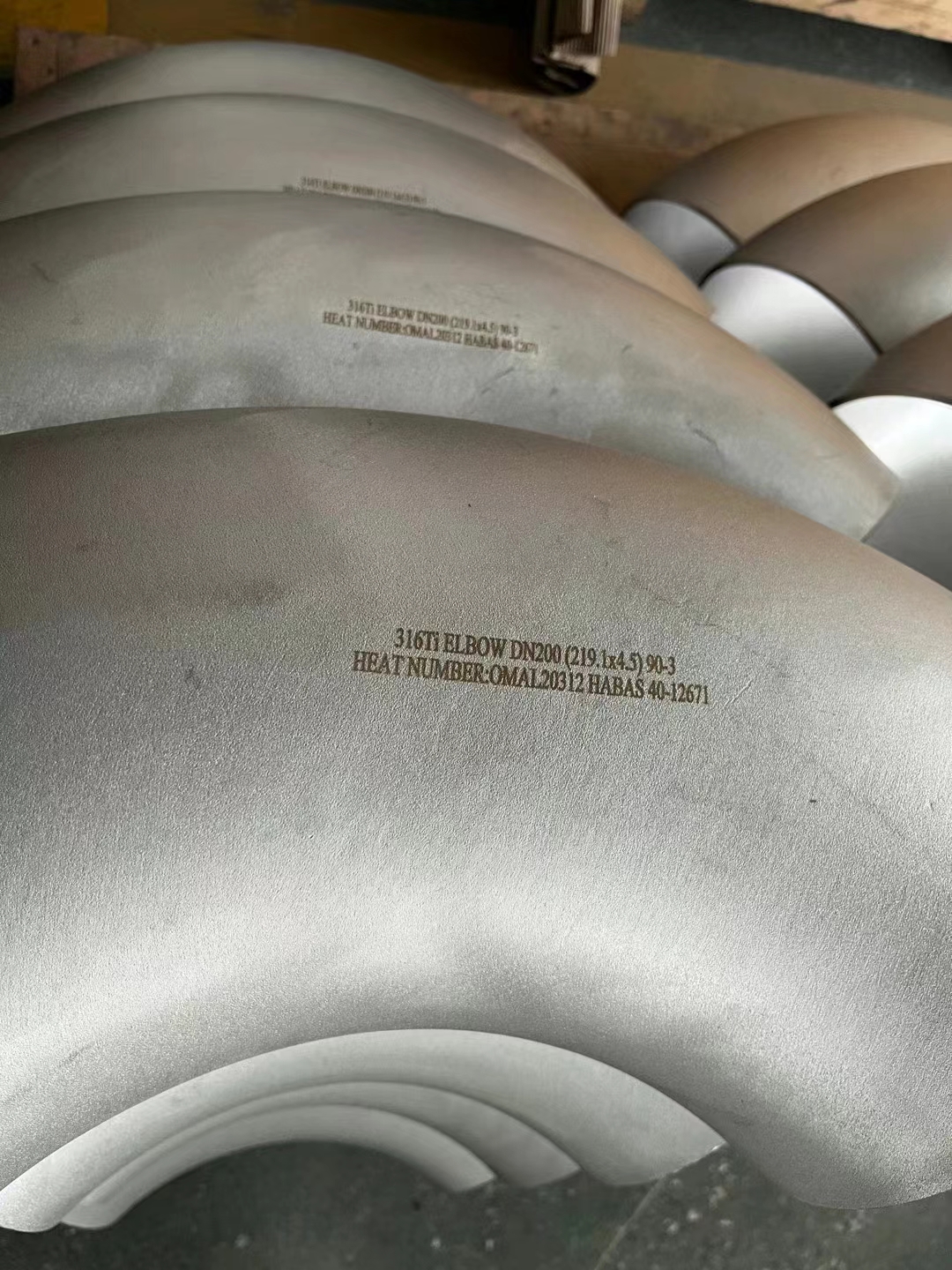 Butt-weld elbows laser-marked 316Ti, DN200, and heat number.
The most commonly ordered fitting type is the 90° long radius elbow. Key geometry terms:
Long radius (LR) 90° elbow:
- Centreline radius = 1.5 × NPS (e.g. 6-inch LR elbow: 9-inch CLR)
- Lower pressure drop than short radius
- Standard choice for most applications
Short radius (SR) 90° elbow (ASME B16.28):
- Centreline radius = 1.0 × NPS (e.g. 6-inch SR elbow: 6-inch CLR)
- Used only where space is limited
- Higher pressure drop, not suitable for pigging
45° LR elbow:
- Used for gradual direction changes
- Same CLR as 90° LR elbow of same size
Reducing elbow:
- Run and outlet are different NPS
- Dimension tables in B16.9 for standard reducing configurations
Pressure Drop Comparison: Long Radius vs Short Radius Elbows
The flow resistance difference between LR and SR elbows is quantifiable and directly affects compressor and pump sizing. Using the equivalent length method from Crane TP-410:
For NPS 6 (OD 168.3 mm, Sch 40 ID = 154.1 mm = 0.1541 m) in gas service, fully turbulent flow:
Friction factor at fully turbulent flow for NPS 6: f_T ≈ 0.013 (Crane TP-410 Table A-26)
Resistance factor K:
- 90° LR elbow (B16.9, CLR = 1.5 × NPS): K = 16 × f_T = 16 × 0.013 = 0.208
- 90° SR elbow (B16.28, CLR = 1.0 × NPS): K = 30 × f_T = 30 × 0.013 = 0.390
Equivalent length (L_eq = K/f_T × ID):
- LR elbow: L/D = 0.208/0.013 = 16D → L_eq = 16 × 0.1541 = 2.47 m per elbow
- SR elbow: L/D = 0.390/0.013 = 30D → L_eq = 30 × 0.1541 = 4.62 m per elbow
For a train of 8 elbows in a compressor suction line:
| Elbow type | Equivalent length per elbow | Total equivalent length (8 elbows) |
|---|---|---|
| 90° LR (B16.9) | 2.47 m | 19.8 m |
| 90° SR (B16.28) | 4.62 m | 37.0 m |
| Difference (SR penalty) | +2.15 m | +17.2 m |
The SR train adds 17.2 m of equivalent NPS 6 Sch 40 pipe resistance compared with the LR train — resistance that does not exist in straight pipe, yet must be overcome by the compressor on every cycle. On a compressor suction where every kPa of pressure drop directly increases suction pressure and reduces compression ratio, this is measurable power consumption. SR elbows should be specified only where physical space prevents LR elbows — not as a blanket cost-saving substitution.
6. Tee and Reducer Configurations
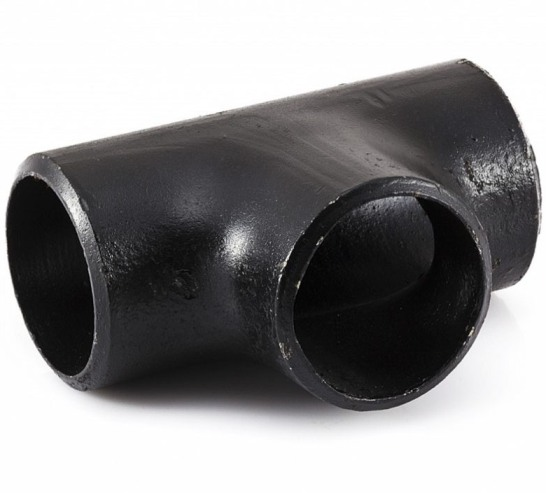 Black carbon-steel equal butt-weld tee, studio product shot.
Equal tee: Run and branch are the same NPS. Identified as NPS × NPS × NPS (e.g. 6 × 6 × 6). For equal tees in erosive or high-velocity service, the inner crotch — the 90° impingement zone at the branch outlet — is the highest-wear point. We cover this in the failure modes section below.
Reducing tee: Branch is smaller than run. Identified as run NPS × run NPS × branch NPS (e.g. 6 × 6 × 4). The branch reinforcement in a reducing tee is inherently greater than in an equal tee because more material exists in the run body at the branch takeoff — this matters for pressure rating at high branch-to-run ratios.
Concentric reducer: Both ends on same centreline. Suitable for vertical piping. The large end OD and small end OD are both specified (e.g. 8 × 6 concentric reducer).
Eccentric reducer: One flat side, so one side of the pipe bottom remains level. Required for horizontal liquid lines to prevent air pockets and facilitate drainage. The eccentric reducer orientation — bottom flat (BF) or top flat (TF) — must be specified on the PO; the default if not specified varies by manufacturer.
7. End Preparation
ASME B16.9 requires ends to be bevelled per ASME B16.25 for welding:
- Standard bevel (wall ≤22 mm): 37.5° bevel angle, 1.6 mm (1/16 inch) land
- Compound bevel (wall >22 mm): Multi-angle bevel to facilitate root pass access
- Plain end: Supplied when specified by the purchaser
End bevel condition must be verified on receipt before fit-up and welding. Damaged or deformed bevels that arrive from transit are a common reason for fit-up delay on skid fabrication jobs — we ship B16.9 fittings with individual plastic end protectors on each bevel face for this reason.
8. Marking Requirements
Each ASME B16.9 fitting must be marked with:
- Manufacturer's name or trademark
- Material specification and grade (e.g. A234 WPB)
- Size
- Schedule or wall thickness designation
- Heat number (for traceability)
- The letter W if the fitting was made from welded pipe or tube
The W mark is the single most important marking check at receiving inspection for seamless-required circuits. It is not a defect mark — W-marked fittings are fully code-compliant for most services — but they are non-conforming where the project specification mandates seamless manufacture. A receiving inspector who checks grade, size, and schedule but not the W mark will miss a material non-conformance that cannot be corrected after installation.
Procurement Trap — Welded Fitting in Seamless-Required Circuit
Wrong PO: "90° LR elbow, NPS 8, Sch 80, A234 WPB, ASME B16.9."
What ships: An elbow manufactured from welded pipe, correctly marked with "W" per ASME B16.9 Section 11. The W is stamped on the fitting body alongside the size and grade marking. The material and dimensions fully comply with B16.9. However, if the project specification for this high-temperature steam circuit requires seamless fittings, this elbow is a non-conformance — one that passes all dimensional and grade checks and can only be caught by reading the body stamp.
Correct PO: "90° LR elbow, NPS 8, Sch 80, ASTM A234 WPB, ASME B16.9. SEAMLESS ONLY — fitting manufactured from seamless pipe or tube. Fittings made from welded pipe or tube (identified by 'W' body marking per ASME B16.9 Section 11) will be rejected. Confirm seamless manufacture on MTC."
For WP91 fittings, also add: "Confirm normalized and tempered heat treatment on MTC as a separate line item — tensile results alone do not confirm heat treatment condition."
When NOT to Use Short Radius Elbows
SR elbows solve a specific problem — confined space where an LR elbow will not fit. Outside that context, they introduce flow resistance, pigging incompatibility, and stress concentration that are not justified by any cost saving. The table below covers the applications where SR elbows fail or are code-restricted:
| Application | Required elbow type | Why SR fails |
|---|---|---|
| Gas or vapour lines (any diameter) | LR 90° (B16.9) wherever space permits | SR adds 87% more resistance (K = 30f_T vs 16f_T for LR); increased erosion at the higher-velocity inner radius |
| Piggable pipelines or any pigging-qualified line | LR only | Pigs require minimum CLR = 1.5 × NPS; SR (CLR = 1.0 × NPS) blocks pig passage |
| High-velocity slurry, erosive, or abrasive service | LR — or 3D/5D radius induction bend | SR elbows concentrate erosion at the outer radius intrados; LR distributes wear over a larger arc |
| High-pressure cyclic service (surge, water hammer) | LR only | SR elbows have higher stress concentration factors at the intrados under dynamic loading |
| ASME B31.1 high-temperature power piping | LR or induction bend per code | ASME B31.1 restricts SR elbows in power piping above certain pressure-temperature thresholds |
| Any service where space is not the constraint | LR | SR elbows are a space-constraint solution — they should not be used simply to reduce fitting cost |
B16.9 Fitting Failure Modes to Specify Against
Failure Mode 1 — "W"-Marked Welded Fitting in Seamless-Required Circuit
Mechanism: Buttweld elbows manufactured from ERW (Electric Resistance Welded) pipe carry the "W" body marking per ASME B16.9. They are code-compliant for many piping services, but project specifications for high-temperature alloy circuits (WP91, WP22), subsea systems, and sour service piping typically require seamless manufacture. A welded fitting that passes all dimensional and mechanical checks may contain a weld seam that is not detected by visual inspection and that is oriented at an unfavourable angle relative to the piping stress state.
Diagnostic: The "W" stamp is visible on the fitting body without magnification. It appears adjacent to the size, schedule, and grade marking. A receiving inspector who checks only the grade and size will miss it; a receiving procedure that explicitly requires checking for "W" marking will catch it in 10 seconds per fitting.
Fix: Add "Check for 'W' body marking per ASME B16.9 Section 11 — reject if present and purchase order requires seamless" to the receiving inspection checklist. For seamless-only applications, add "seamless manufacture required — W-marked fittings not acceptable" to the PO.
Failure Mode 2 — SR Elbow in Piggable Line Blocking Pig Passage
Mechanism: During a pipeline re-certification campaign, a geometry pig is run through a section of NPS 8 pipeline that includes 90° SR elbows (CLR = 1.0 × NPS = 8 inches). The geometry pig, sized for the minimum ID of an NPS 8 LR elbow (CLR = 12 inches), contacts the tighter SR geometry and lodges at the elbow. The stuck pig requires retrieval from an excavated access point — a major unplanned cost. Investigation confirms the SR elbows were specified from a catalogue that listed "90° elbows" without distinguishing LR and SR.
Diagnostic: Pig detection signal shows the pig stopped at the first SR elbow in the run. Excavation and fitting inspection confirms CLR = 1.0 × NPS, not the required 1.5 × NPS for a standard LR fitting.
Fix: Specify "LR (long radius) 90° elbow, per ASME B16.9" explicitly on all POs for piggable lines — do not use the generic term "90° elbow." Add the LR/SR designation to the piping class specification as a mandatory field.
Failure Mode 3 — Tee Branch Crotch Erosion in Erosive Fluid Service
Mechanism: A fabricated equal tee (run and branch the same NPS) is used in a produced-water line carrying sand. At an NPS 8 equal tee, the branch outlet creates a flow turning loss and a local high-turbulence zone at the crotch. Under sustained erosive fluid service, the inner crotch of the tee — the 90° impingement point at the branch outlet — shows accelerated wall thinning at 3–5× the straight-pipe erosion rate. After 3 years, UT on the tee body confirms the crotch wall has thinned below the minimum acceptable value.
Diagnostic: UT thickness measurements on the tee body, focused on the crotch area (inner radius of the branch takeoff). Thinning pattern is concentrated at the flow impingement zone — the inner crotch, 90° from the run centreline at the branch outlet. Straight pipe adjacent to the tee is within tolerance.
Fix: For erosive or abrasive service, specify a swept tee or induction branch fitting with a larger CLR at the branch outlet. Alternatively, specify weld-o-let or laterals instead of standard tees to reduce the impingement angle. Add the tee body to the UT inspection scope in the corrosion monitoring programme.
9. Procurement Checklist
Receiving inspection and purchase order items that prevent the failure modes described above:
- Standard: ASME B16.9 (latest edition)
- Fitting type: elbow / tee / reducer / cap — specify LR or SR for elbows (default is LR); concentric or eccentric for reducers (include BF/TF orientation)
- NPS and schedule or minimum wall thickness (dual-designation if critical)
- Material grade: A234 WPB, WP11, WP22, WP91 (or low-temp A420, stainless A403)
- Seamless or welded: state explicitly if seamless is required — the PO must carry this; do not assume B16.9 implies seamless
- End preparation: bevelled per B16.25 (standard) or plain end
- Surface treatment: none, shot blast, or primer
- Mill test certificates: EN 10204 3.1 required for most pressure piping applications; 3.2 (third-party witnessed) for critical circuits
- NDE: UT, MT, or PT if required by design code
- NACE: specify NACE MR0175 compliance if sour service
- Receiving inspection: check W stamp on every fitting — reject W-marked fittings if seamless was specified
- For WP91: confirm normalised and tempered heat treatment on MTC as a separate record
Frequently Asked Questions
What does ASME B16.9 cover?
ASME B16.9 covers factory-made wrought buttweld fittings in sizes NPS ½ through 48. It specifies dimensional requirements for long radius elbows (90° and 45°), short radius elbows (per B16.28), reducing elbows, equal tees, reducing tees, crosses, concentric reducers, eccentric reducers, end caps, and stubends. The standard also specifies materials, marking, testing, and end preparation requirements.
What is the difference between long radius and short radius elbows?
Long radius elbows (covered by B16.9) have a centerline radius equal to 1.5 times the nominal pipe size — for example, a 6-inch long radius elbow has a centerline radius of 9 inches. Short radius elbows (covered by B16.28) have a centerline radius equal to 1.0 times the nominal pipe size. Long radius elbows produce lower pressure drop and are preferred wherever space permits. Short radius elbows are used only where space constraints prevent the use of long radius elbows.
What material grade is ASTM A234 WPB?
ASTM A234 WPB is the most common material for carbon steel buttweld fittings. It is equivalent in chemistry to ASTM A106 Grade B seamless pipe — a carbon-manganese steel with C ≤0.30%, Mn 0.29–1.06%, P ≤0.050%, S ≤0.058%, and Si ≥0.10%. Minimum tensile strength is 60,000 psi (415 MPa) and minimum yield is 35,000 psi (240 MPa). WPB is suitable for general service from −29°C to 482°C.
How is wall thickness specified for buttweld fittings?
ASME B16.9 fittings are manufactured to match the wall thickness of the connecting pipe. The fitting wall thickness is designated by the same schedule system used for pipe — Schedule 40, Schedule 80, Standard (STD), Extra Strong (XS), Double Extra Strong (XXS) — or by minimum wall thickness in inches or millimetres. The fitting must have at least the same pressure-carrying capacity as the pipe of the same nominal size and schedule.
What is the difference between a concentric and eccentric reducer?
A concentric reducer has both ends aligned on the same centreline — it reduces the pipe diameter symmetrically and is used in vertical piping runs. An eccentric reducer has one flat side (the bottom flat, BF) so that the bottom of the pipe remains at the same level — it is used in horizontal piping runs to maintain a consistent invert elevation for drainage, to facilitate pigging, or to avoid air pockets in liquid service.
What are the end preparation requirements for B16.9 fittings?
ASME B16.9 requires that ends be bevelled for welding in accordance with ASME B16.25, unless otherwise specified. The standard bevel is a 37.5° bevel on the pipe end. For heavy wall fittings (wall thickness above a certain threshold), compound bevels are used. Plain ends (no bevel) can be supplied when specified. End OD tolerances are ±1/32 inch for NPS ½–3½, ±1/16 inch for NPS 4–18, and ±3/32 inch for NPS 20 and larger.
Which fitting grades are used for high-temperature chrome-moly service?
For high-temperature service in power plant and refinery piping, ASTM A234 alloy grades are used: WP11 (1.25Cr-0.5Mo) for service up to approximately 580°C, WP22 (2.25Cr-1Mo) for up to 600°C, WP5 (5Cr-0.5Mo) and WP9 (9Cr-1Mo) for higher temperatures, and WP91 (9Cr-1Mo-V) for the most demanding high-temperature service up to 650°C. These grades match the corresponding ASTM A335 pipe grades for complete system compatibility.
What does the 'W' stamp on a buttweld fitting mean?
The letter W stamped on an ASME B16.9 fitting body indicates that the fitting was manufactured from welded pipe or tube rather than seamless pipe. The W marking is mandatory per ASME B16.9 Section 11 when welded pipe is used as the starting material. For high-temperature alloy circuits, sour service piping, and other applications where the project specification requires seamless manufacture, W-marked fittings must be rejected at receiving inspection. The W stamp appears adjacent to the size, schedule, and grade marking and is visible without magnification.
Can short radius elbows be used in piggable pipelines?
No. Short radius elbows (CLR = 1.0 × NPS, covered by ASME B16.28) cannot be used in piggable pipelines. Pipeline pigs require a minimum centreline radius of 1.5 × NPS to pass through a bend — the geometry of a standard inspection or cleaning pig does not fit the tighter radius of an SR elbow. For any piggable line, specify long radius elbows per ASME B16.9 explicitly on the purchase order. Use of the generic term '90° elbow' without the LR designation has resulted in SR elbows being supplied and pigs becoming stuck in service.