ASTM A234 is the material specification for wrought carbon and alloy steel buttweld fittings used across oil and gas, petrochemical, power generation, and industrial process piping. It covers everything from standard carbon steel Grade WPB — the workhorse of general piping — through high-temperature chrome-moly Grade WP91 used in ultra-high-temperature steam systems. Selecting the correct A234 grade for the operating temperature is one of the most consequential fitting procurement decisions, and one of the most frequently mishandled.
ZC Steel Pipe supplies ASTM A234 carbon and alloy steel buttweld fittings in sizes NPS ½ through 48, covering elbows, tees, reducers, caps, and crosses to ASME B16.9. Our fittings serve EPC projects across Africa, the Middle East, South America, and Southeast Asia, with EN 10204 3.1 and 3.2 mill test certificates and third-party inspection available on request.
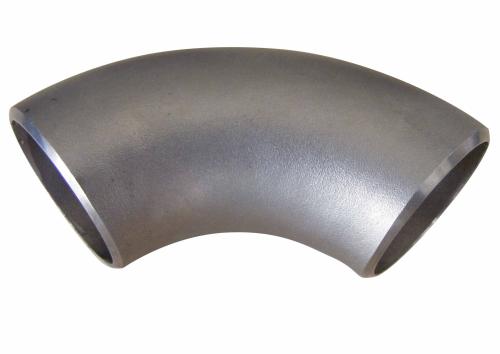 90-degree carbon-steel butt-weld elbow, studio shot on white.
What we see on orders: On a West Africa refinery steam-header project, WP91 elbow fittings were ordered correctly, but the reducer line items on the same bill of materials referenced WPB from site stock — same OD, same schedule, different grade. The procurement engineer assumed fittings were interchangeable on a "same size" basis. The reducing sections of the circuit operated at 575°C. Within 2,400 service hours, two WPB reducers showed Type IV creep cracks at both HAZ zones. The cracks were visible in a routine NDT scan; two reducers were cut out and replaced with WP91 at 3× the original fitting cost plus an unplanned 6-day shutdown. The MTC showed "A234 WPB" in plain sight on the certificate — the material was correctly identified, just incorrectly specified on the line item. Matching the A234 fitting grade to the pipe grade on every chrome-moly circuit line item is the single most important A234 procurement discipline.
What Is ASTM A234?
ASTM A234 — Standard Specification for Piping Fittings of Wrought Carbon Steel and Alloy Steel for Moderate and High Temperature Service — covers factory-made wrought buttwelding fittings in all standard NPS sizes and wall thickness schedules. The equivalent ASME code designation is ASME SA234, used when the fitting must comply with the ASME Boiler and Pressure Vessel Code (Section I or Section VIII).
The standard covers two main material families:
Carbon steel grades (WPB, WPC, WP1): General piping service from −29°C to approximately 482°C.
Chrome-moly alloy grades (WP11, WP22, WP5, WP9, WP91): High-temperature service in power plant steam piping, refinery heaters, and hydrogen reformer headers, to temperatures up to 650°C.
Fittings manufactured to A234 are dimensioned per ASME B16.9 (NPS ½ to 48) for buttweld applications — elbows, tees, reducers, and caps — or ASME B16.28 for short radius elbows. The material standard and the dimensional standard must both be specified on every purchase order.
Carbon Steel Grades
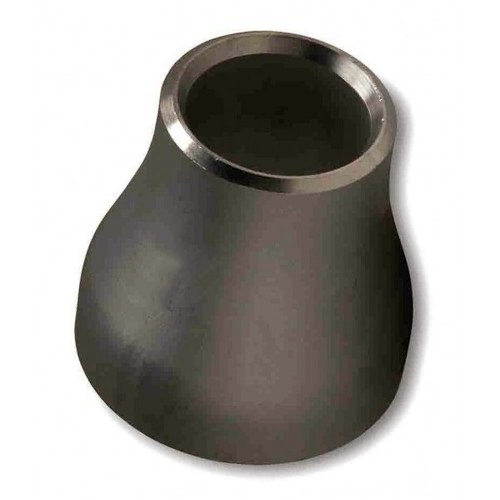 Black carbon-steel concentric butt-weld reducer, studio shot.
WPB — The Standard Grade
Grade WPB is the default material for carbon steel buttweld fittings in oil, gas, and process piping. It is a carbon-manganese steel with chemistry equivalent to ASTM A106 Grade B seamless pipe.
WPB chemical requirements:
| Element | Limit |
|---|---|
| Carbon (C) | ≤ 0.30% |
| Manganese (Mn) | 0.29–1.06% |
| Phosphorus (P) | ≤ 0.050% |
| Sulfur (S) | ≤ 0.058% |
| Silicon (Si) | ≥ 0.10% |
Source: ASTM A234 / ASME SA234. Verify limits against the current edition for the applicable section thickness.
WPB mechanical properties:
| Property | Minimum |
|---|---|
| Tensile strength | 415 MPa (60,000 psi) |
| Yield strength | 240 MPa (35,000 psi) |
| Elongation (2 inch gauge) | 22% |
WPB is suitable for service from −29°C to 482°C. For temperatures below −29°C, low-temperature ASTM A420 grades are required.
WPC — Higher Strength Carbon Steel
WPC is used where the system pressure requires higher strength, or where wall thickness reduction is beneficial. Chemistry is similar to WPB but permits higher carbon for heavier sections.
| Property | WPB | WPC |
|---|---|---|
| Tensile min | 415 MPa (60 ksi) | 485 MPa (70 ksi) |
| Yield min | 240 MPa (35 ksi) | 275 MPa (40 ksi) |
WPC is less common than WPB and is typically specified for high-pressure systems where the additional strength increment is required by the pressure-temperature rating.
WP1 — 0.5 Molybdenum Grade
WP1 adds 0.44–0.65% molybdenum to improve creep resistance above 400°C. It bridges the gap between carbon steel WPB and the full chrome-moly grades for moderate high-temperature service.
| Property | Value |
|---|---|
| Tensile min | 415 MPa (60,000 psi) |
| Yield min | 205 MPa (30,000 psi) |
| Approximate upper service temp | 593°C (1100°F) |
For dimensional selection and pressure rating calculations across fitting sizes and schedules, use the ASME B36.10M pipe schedule tables →
To pull the exact wall thickness for any NPS and schedule at a fitting end, use the Pipe Size & Schedule Lookup →
To check pressure ratings and pipe wall requirements, use the Barlow Pressure Calculator →
Chrome-Moly Alloy Grades
Chrome-moly grades add chromium for oxidation resistance and molybdenum for creep resistance, enabling service at temperatures far above the capability of carbon steel. Each A234 alloy grade is the fitting counterpart to the corresponding ASTM A335 alloy pipe grade — they must be used together as a matched pair in the same high-temperature circuit.
| A234 Fitting | A335 Pipe | Alloy System | Max Service Temp |
|---|---|---|---|
| WP11 | P11 | 1.25Cr-0.5Mo | ~580°C (1075°F) |
| WP22 | P22 | 2.25Cr-1Mo | ~600°C (1110°F) |
| WP5 | P5 | 5Cr-0.5Mo | ~620°C (1150°F) |
| WP9 | P9 | 9Cr-1Mo | ~635°C (1175°F) |
| WP91 | P91 | 9Cr-1Mo-V | ~650°C (1200°F) |
Temperature limits are approximate. Verify against ASME B31.1 or B31.3 allowable stress appendices for the specific wall thickness and applicable code edition.
Chromium content range by grade:
| Grade | Cr (%) | Mo (%) |
|---|---|---|
| WP11 | 1.00–1.50 | 0.44–0.65 |
| WP22 | 1.90–2.60 | 0.87–1.13 |
| WP5 | 4.00–6.00 | 0.45–0.65 |
| WP9 | 8.00–10.00 | 0.90–1.10 |
| WP91 | 8.00–9.50 | 0.85–1.05 |
Source: ASTM A234 / ASME SA234. Verify against current standard edition.
WP91 — Highest Strength and Temperature Grade
WP91 (9Cr-1Mo-V) incorporates vanadium (0.18–0.25%) and niobium (0.06–0.10%) additions that create a fine martensitic microstructure, providing superior creep strength at 550–650°C compared to all other A234 grades.
WP91 mechanical properties:
| Property | Minimum |
|---|---|
| Tensile strength | 585 MPa (85,000 psi) |
| Yield strength | 415 MPa (60,000 psi) |
WP91 must be supplied in the normalized and tempered condition. It cannot be substituted with WP9 or WP22 for service above 580°C without engineering review of the applicable allowable stress tables.
Required Wall Thickness: WP22 vs WP91 at High Temperature
For a steam header operating at 566°C, 12 MPa, NPS 6 (OD 168.3 mm), using the ASME B31.1 formula t_min = P×D / (2×(S×E + 0.8×P)), with E = 1.0 for seamless:
WP22 (2.25Cr-1Mo) at 566°C — approximate ASME B31.1 allowable stress S ≈ 64 MPa:
t_min = 12 × 168.3 / (2 × (64 × 1.0 + 0.8 × 12)) = 2019.6 / (2 × 73.6) = 2019.6 / 147.2 = 13.7 mm
→ NPS 6 Schedule 160 (wall = 18.26 mm) required
WP91 (9Cr-1Mo-V) at 566°C — approximate ASME B31.1 allowable stress S ≈ 103 MPa:
t_min = 12 × 168.3 / (2 × (103 × 1.0 + 0.8 × 12)) = 2019.6 / (2 × 112.6) = 2019.6 / 225.2 = 8.97 mm
→ NPS 6 Schedule 80 (wall = 11.09 mm) is adequate
WPB at 566°C: NOT PERMITTED — WPB is limited to 482°C service temperature; no allowable stress exists above this limit in ASME B31.1.
| Grade | S at 566°C (MPa) | Required wall (mm) | Minimum schedule |
|---|---|---|---|
| WPB | Not permitted | — | — |
| WP22 | 64 | 13.7 | Sch 160 |
| WP91 | 103 | 8.97 | Sch 80 |
The WP91 fitting is 38% thinner wall than WP22 at this condition — a meaningful reduction in weight and cost that partially offsets the WP91 material premium. Verify allowable stress values against ASME B31.1 Appendix A Table A-2 for the applicable code edition.
WP91 and WP9 are both 9Cr-Mo alloy systems and are frequently confused in procurement. The critical difference is vanadium (0.18–0.25%) and niobium (0.06–0.10%) additions in WP91 that create a fine-grained precipitation-hardened martensitic microstructure. WP9 lacks these additions and loses creep strength significantly above 580°C. The ASME B31.1 allowable stress for WP91 at 600°C is approximately 62 MPa — versus approximately 33 MPa for WP9 — nearly double. Using WP9 as a "close enough" substitute for WP91 above 580°C is not a conservative choice; it is an under-specification by nearly 2×. Always specify the full designation (WP91 or WP9) and verify the allowable stress at the operating temperature from ASME B31.1 Appendix A for the specific grade.
Grade Selection by Operating Temperature
| Operating Temperature | Grade |
|---|---|
| Up to 400°C (750°F) | WPB |
| 400°C to 482°C (750°F to 900°F) | WPB at reduced allowable stress, or WP1 |
| 482°C to 560°C (900°F to 1040°F) | WP11 or WP22 |
| 560°C to 620°C (1040°F to 1150°F) | WP5 or WP22 |
| 620°C to 650°C (1150°F to 1200°F) | WP91 |
Selection based on temperature alone is necessary but not sufficient. Confirm the allowable stress at the operating temperature from the ASME B31.1 or B31.3 code appendix and verify the fitting wall thickness provides the required pressure rating.
When NOT to Use WPB
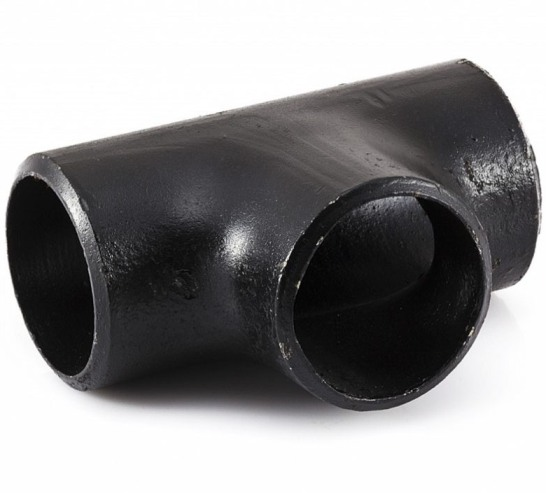 Black carbon-steel equal butt-weld tee, studio shot.
| Service condition | Required grade | Why WPB fails |
|---|---|---|
| Operating temperature above 482°C | WP11, WP22, or WP91 depending on temperature | WPB has no allowable stress above ~540°C in ASME B31.1; creep failure above 482°C sustained |
| Chrome-moly piping circuit (pipe grade WP11, WP22, WP91) | Matching A234 alloy grade | Grade mismatch creates a creep-soft zone at the fitting that is the weakest point in the circuit |
| Cryogenic service below −29°C | ASTM A420 WPL6 (impact tested to −46°C) | WPB has no impact test requirement; brittle failure risk at cryogenic temperatures |
| Sour H2S service requiring NACE MR0175 hardness control | WPB with verified hardness ≤ HRC 22 + project review | WPB hardness is not routinely controlled to NACE limits; specify supplementary hardness testing |
| High-temperature refinery or power plant service above 560°C | WP91 | WP22 and WP9 both insufficient above approximately 560°C; WP91 is the minimum grade |
The table above covers the most common misapplications. The pattern across all five rows is the same: WPB is the lowest-cost A234 grade and it will be defaulted to by any procurement team that does not verify the service condition against the grade capability before the PO is issued. If your project specification names a design temperature above 482°C anywhere in the system, every fitting BOM line item must be reviewed against that temperature — not just the pipe grades.
ASTM A234 Fitting Failure Modes to Specify Against
Failure Mode 1 — WPB Reducer in a WP91 Chrome-Moly Circuit
Mechanism: A WPB reducer is installed as part of a WP91 steam header operating at 575°C. At this temperature, WPB has essentially no remaining creep strength — the steel is operating 93°C above its maximum service temperature. The WPB reducer deforms plastically at the heat-affected zone adjacent to both welds within 2,000–5,000 service hours. The creep deformation is concentrated in the HAZ where the microstructure is coarser and more susceptible, producing visible surface cracking (Type IV cracking pattern) at the HAZ boundary.
Diagnostic: Circumferential cracking at both weld HAZ zones of the reducer, visible by surface magnetic particle testing (MT) or penetrant testing (PT). Dimensional measurement shows bulging at the weld joint. Metallographic section confirms creep voids and intergranular cracking in the HAZ — distinguishable from stress corrosion cracking by the crack morphology and temperature-dependent pattern.
Fix: Remove and replace all WPB fittings with the correct A234 alloy grade matching the circuit pipe. After replacement, verify every line item on the valve and fitting BOM for the circuit to confirm grade consistency. Add a "grade audit" step to the design review checklist for any chrome-moly piping circuit.
Failure Mode 2 — WP91 Installed Without Post-Weld Heat Treatment
Mechanism: WP91 reducers are installed and field-welded to the WP91 pipe. The PWHT requirement (730–780°C, minimum 1 hour) is overlooked in the weld procedure specification, or the PWHT temperature falls below 730°C due to calibration error in the heating equipment. In the un-tempered condition, the weld HAZ is fully martensitic with high hardness and low toughness. At the high service temperature, the untempered martensite undergoes accelerated creep and transforms to an embrittled microstructure within approximately 10,000 hours. Type IV cracking initiates at the outer HAZ boundary where the peak temperature during welding was insufficient to re-austenitize the microstructure.
Diagnostic: PWHT records reviewed — thermocouple chart shows temperature below 730°C minimum, or no PWHT performed. Hardness measurements at the weld HAZ confirm values above the normalized-and-tempered baseline (WP91 weld HAZ hardness without PWHT typically >350 HV; after correct PWHT, 200–250 HV). Metallographic section shows untempered martensite in HAZ.
Fix: PWHT specification must be in the weld procedure specification (WPS), the inspection test plan (ITP), and the purchase order. PWHT must be performed by a qualified contractor with calibrated heating equipment and thermocouple records provided to the project QA/QC engineer. Do not rely on the field welder or piping contractor to determine PWHT requirements from memory — state them explicitly in every document.
Failure Mode 3 — Grade Substitution Passing Dimensional Receiving Inspection
Mechanism: A procurement emergency causes WPB fittings to be substituted for WP91 on a purchase order amendment. The amendment is processed by a procurement administrator who does not understand the engineering significance of the grade change. The WPB fittings arrive with correct dimensions, correct MTC (showing A234 WPB), and correct markings. The receiving inspector checks size, schedule, and ASME B16.9 conformance — all pass. The grade mismatch is not detected until the first NDT scan after installation.
Diagnostic: The MTC clearly shows "A234 WPB" — the substitution is visible on the document. The fitting body marking also shows "WPB." The failure mode is administrative — the substitution was documented and visible but not caught in the receiving inspection procedure because the receiving inspector was not required to verify fitting grade against the design specification.
Fix: Add a "material grade verification" step to the receiving inspection procedure: compare the grade on the MTC against the grade required by the piping class specification for that service line. For chrome-moly lines, make this a hold point, not a review point. Any substitution from the specified A234 alloy grade must be reviewed and approved by the piping engineer before the fitting is accepted.
Purchase Order Guidance
Minimum PO line items for A234 fittings:
- Standard: ASTM A234 (or ASME SA234 for boiler code applications)
- Grade: state exactly — WPB, WPC, WP11, WP22, WP91 (do not leave grade unspecified)
- Fitting type, NPS, and schedule or minimum wall thickness (per ASME B16.9)
- Heat treatment condition: normalized for WPB; normalized and tempered for WP91
- Testing: hydrostatic test per A234; Charpy impact testing if required by design code
- MTC: EN 10204 3.1 minimum for pressure piping; 3.2 for witnessed inspection
- NDE: MT or PT of the fitting body if required by the project specification
For guidance on MTC documentation and certificate types, see the Pipe Mill Test Certificate (MTC) Guide →
The same piping class that fixes the A234 fitting grade also fixes the flange rating on the spool — for pressure-class selection, see the ASME B16.5 flange pressure-class guide →
Procurement Trap 1 — WPB Fittings in a WP91 System
The most common A234 procurement error is specifying WP91 pipe and WPB fittings in the same high-temperature piping system. Fittings appear as separate line items in a bill of materials, and a procurement team unfamiliar with chrome-moly metallurgy may default to standard WPB fittings because they are cheaper and more available. The consequence is a system where the fittings creep at 560°C+ while the WP91 pipe remains intact.
Wrong PO: "Reducer, 8 × 6, Sch 80, ASTM A234 WPB, ASME B16.9." (Ordered from a site that has WPB in stock; WP91 elbows in the same circuit were ordered separately as WP91.)
What ships: Carbon steel WPB reducer, correctly certified as A234 WPB on the MTC. Dimensionally identical to a WP91 reducer. Will begin creeping at temperatures above 482°C and show Type IV cracking within 2,000–5,000 service hours at 550°C+.
Correct PO: "Reducer, 8 × 6, Sch 80, ASTM A234 WP91, ASME B16.9. Heat treatment: normalized and tempered. PWHT after field welding at 730–780°C, minimum 1 hour per 25 mm wall (1 hour minimum). MTC EN 10204 3.1 to include chemistry (confirm V 0.18–0.25%, Nb 0.06–0.10%), tensile test, and hardness results."
Rule: Every welded fitting in a circuit specified with WP11, WP22, or WP91 pipe must be the matching A234 alloy grade. Do not mix grades in the same high-temperature circuit without engineering sign-off.
Procurement Trap 2 — Missing PWHT on WP91
WP91 must be post-weld heat treated (PWHT) after all field welding at 730–780°C for a minimum of one hour per 25 mm of wall thickness (minimum one hour). PWHT must be performed by the fabricator after welding is complete.
Skipping PWHT — or performing it outside the specified temperature band — leaves the weld heat-affected zone with untempered martensite. At service temperature this zone creeps at a rate orders of magnitude higher than the surrounding WP91, producing Type IV cracking at the HAZ boundary. State PWHT requirements in the purchase order and confirm they are included in the weld procedure specification submitted to project QA.
Frequently Asked Questions
What does ASTM A234 cover?
ASTM A234 — Standard Specification for Piping Fittings of Wrought Carbon Steel and Alloy Steel for Moderate and High Temperature Service — covers factory-made buttwelding fittings in all standard NPS sizes and schedules. It specifies chemical composition, mechanical properties, heat treatment, and testing requirements for carbon steel grades (WPB, WPC, WP1) and chrome-moly alloy grades (WP11, WP22, WP5, WP9, WP91) used in oil, gas, refinery, and power plant piping systems.
What material is ASTM A234 WPB?
ASTM A234 WPB is a carbon-manganese steel with chemistry equivalent to ASTM A106 Grade B seamless pipe: carbon maximum 0.30%, manganese 0.29–1.06%, phosphorus maximum 0.050%, sulfur maximum 0.058%, and silicon minimum 0.10%. Minimum tensile strength is 415 MPa (60,000 psi) and minimum yield strength is 240 MPa (35,000 psi). WPB is the standard material for carbon steel buttweld elbows, tees, reducers, and caps in general service piping.
What is the difference between A234 WPB and WPC?
WPC has higher minimum tensile and yield strength than WPB. WPC requires a minimum tensile of 485 MPa (70,000 psi) and minimum yield of 275 MPa (40,000 psi), compared to WPB at 415 MPa tensile and 240 MPa yield. WPC is used where higher system pressure or a thinner fitting wall is required. WPC also permits higher carbon content for heavier sections where WPB chemistry limits would otherwise restrict strength.
When should I specify WP91 instead of WPB?
WP91 (9Cr-1Mo-V) should be specified when operating temperatures exceed approximately 550°C, where carbon steel WPB loses strength and creep resistance. WP91 is standard in high-temperature power plant steam piping, refinery heaters, and hydrogen reformer headers. It has a minimum tensile strength of 585 MPa (85,000 psi) and maintains acceptable creep strength to approximately 650°C. WP91 fittings must be used with WP91 pipe — inserting WPB fittings into a WP91 circuit creates a metallurgical mismatch that will fail in creep service.
What is the maximum service temperature for ASTM A234 WPB?
ASTM A234 WPB is generally rated for service up to 482°C (900°F) under the ASME B31.3 process piping code, with allowable stress values reducing significantly above 400°C. For service above 482°C, chrome-moly grades are required: WP11 to approximately 580°C, WP22 to 600°C, WP5 to 620°C, and WP91 to 650°C. The specific limit depends on the applicable design code and the allowable stress table used.
Does WP91 require post-weld heat treatment?
Yes. WP91 fittings must be post-weld heat treated (PWHT) after field welding, typically at 730–780°C for a minimum of one hour per 25 mm of wall thickness, with a one-hour minimum. Skipping PWHT or performing it outside the specified temperature range significantly reduces creep strength in the weld heat-affected zone and leads to Type IV cracking within tens of thousands of operating hours. PWHT requirements must be stated in the purchase order and confirmed in the weld procedure specification.
What is the difference between ASTM A234 and ASTM A420?
ASTM A234 covers fittings for moderate and high temperature service. ASTM A420 covers fittings for low-temperature service requiring Charpy impact testing: Grade WPL6 is impact-tested at −46°C and Grade WPL3 at −100°C. For standard carbon steel piping above −29°C, A234 WPB is used. For LNG, cryogenic, or Arctic pipeline applications below −29°C, A420 is specified instead.
How do I verify ASTM A234 fittings on a mill test certificate?
The MTC must show the ASTM A234 standard and grade (e.g. A234 WPB), the heat number, chemical analysis with all elements within specified limits, mechanical test results meeting the tensile and yield minimums, the heat treatment condition (normalized for WPB; normalized and tempered for WP91), and the inspector's signature. For EN 10204 3.1, results are certified by the mill's quality department. For 3.2, a third-party inspection authority co-signs the certificate.