Selecting the wrong OCTG manufacturing route is one of the most consequential procurement decisions a drilling engineer can make, because the standard itself — API Specification 5CT, 11th Edition — explicitly ties manufacturing method to grade eligibility, heat treatment capability, and sour-service compliance. A casing string sourced from an electric welded mill when the well classification calls for seamless is not just a specification deviation; it is a liability that no amount of third-party documentation can fully remedy. Understanding how casing and tubing are made, and why the process sequence matters for mechanical performance, is therefore essential knowledge for engineers, inspectors, and procurement professionals who sign off on OCTG purchase orders.
The two permitted manufacturing routes under API 5CT — seamless (designated S) and electric welded (designated EW) — differ in how the tube body is formed, which in turn determines which heat treatment responses are achievable and which grades may be produced. The route also influences wall uniformity, residual stress distribution, and collapse performance under downhole loading. For high-pressure high-temperature (HPHT) and sour-service wells, these differences are not academic; they translate directly into collapse and burst safety factors on the well design sheet.
ZC Steel Pipe manufactures seamless casing and tubing to API Specification 5CT, 11th Edition in PSL-1 and PSL-2, supplying engineers and procurement teams in Africa, the Middle East, South America, and Southeast Asia with MTRs compliant with EN 10204 3.1 and 3.2.
Quick Answer — Seamless vs Electric Welded by Grade
The manufacturing route under API 5CT is not a free choice — the standard ties it to grade, and getting it wrong on a sour-service or HPHT string is a non-conformance that no documentation can remedy after the pipe is rolled.
| Route | Permitted grades (API 5CT) | Use when |
|---|---|---|
| Seamless (S) | All 15 grades, including L80-1, T95, C110, P110, Q125 | Any sour-service, HPHT, or collapse-critical string |
| Electric welded (EW) | H40, J55, K55, N80-1, N80Q, R95 only | General-service, sweet, non-critical strings |
If the well is sour or high-pressure, the purchase order must state "Seamless (S)" explicitly — silence lets the mill ship EW wherever API 5CT allows it. For the complete grade ladder see the API 5CT specification tables →, and for what each grade means in selection terms see the OCTG grades explained (N80, L80, P110, Q125).
What we see on MTC reviews: In OCTG shipment reviews for Middle East and West Africa customers, the most common MTC non-conformance we see is hardness reported as a batch average rather than per-pipe. An MTC that reads "Hardness: 22.1 HRC (batch average, 5 pipes tested)" is non-conforming for L80-1 or T95 — API 5CT requires hardness testing of every pipe, not a sample. The batch average can pass the 23.0 HRC limit while individual pipes in the batch reach 25 HRC. A single non-conforming pipe in a sour-service string is all it takes.
How OCTG Is Classified: Seamless vs Electric Welded
API Specification 5CT, 11th Edition defines two manufacturing routes and assigns grades to each with clear restrictions. The seamless route (S) is open to all 15 API 5CT grades without restriction. The electric welded route (EW) is permitted only for the lower-strength general-service grades: H40, J55, K55, N80-1, N80Q, and R95.
The following grades are seamless-only: L80-1, L80-3Cr, L80-9Cr, L80-13Cr, C90, T95, C110, P110, and Q125. This distinction is not arbitrary. The sour-service grades (L80-1, C90, T95, C110) require controlled Q+T heat treatment through the full pipe body cross-section to achieve the mandatory hardness ceilings that prevent sulfide stress cracking. The HPHT grades (P110, Q125) require the microstructural uniformity that only seamless rolling can deliver across large-OD, heavy-wall sections. An EW seam introduces a localized heat-affected zone that cannot be fully homogenized even with post-weld heat treatment, making it unsuitable for grades where property uniformity is non-negotiable.
The practical consequence for procurement is straightforward: any purchase order for L80, T95, C110, P110, or Q125 must specify seamless manufacture. Accepting EW supply for these grades is a violation of API 5CT, regardless of what the supplier's documentation states. If you are new to the product category, the complete guide to what OCTG pipe is covers casing, tubing, and drill pipe roles before the manufacturing detail below.
Steelmaking and Billet Production
OCTG steel originates in either a basic oxygen furnace (BOF) or an electric arc furnace (EAF). Both routes produce liquid steel that is then refined through ladle metallurgy, which typically includes vacuum degassing to reduce dissolved gases (hydrogen and nitrogen), desulfurization to meet the tight sulfur limits required for sour-service grades (S ≤ 0.01% for T95 and C110; S ≤ 0.005% for C110), and calcium treatment to modify sulfide inclusion morphology to globular shapes that are less harmful to through-wall toughness.
For seamless OCTG, the refined steel is continuously cast into round billets, typically 150–300 mm in diameter depending on the target pipe size. Billet quality is critical: internal segregation, pipe (central void), and heavy inclusions carried into the rolling mill will become surface defects or wall-thickness variations in the finished pipe. High-grade OCTG billets are inspected by UT before rolling. For electric welded OCTG, the steel is cast into slabs or hot-rolled into coil, then slit to skelp width matched to the target pipe OD.
Chemistry is locked in at the steelmaking stage and determines which heat treatment will succeed in meeting the mechanical targets. P110 has no chemistry prescription beyond P ≤ 0.030% and S ≤ 0.030%, leaving the alloy design entirely to the mill. T95 requires C ≤ 0.35%, Mn ≤ 1.20%, Cr 0.40–1.50%, and Mo 0.25–0.85% — a Cr-Mo alloy system designed to deliver adequate hardenability in heavy walls while staying within the hardness ceiling of 25.4 HRC after tempering.
For the complete grade ladder with tensile, hardness, and chemistry limits, see the API 5CT specification tables →
To match a grade to your well conditions, use the Pipe Grade Selector →
Seamless Pipe Manufacturing
Hot Piercing and Elongation
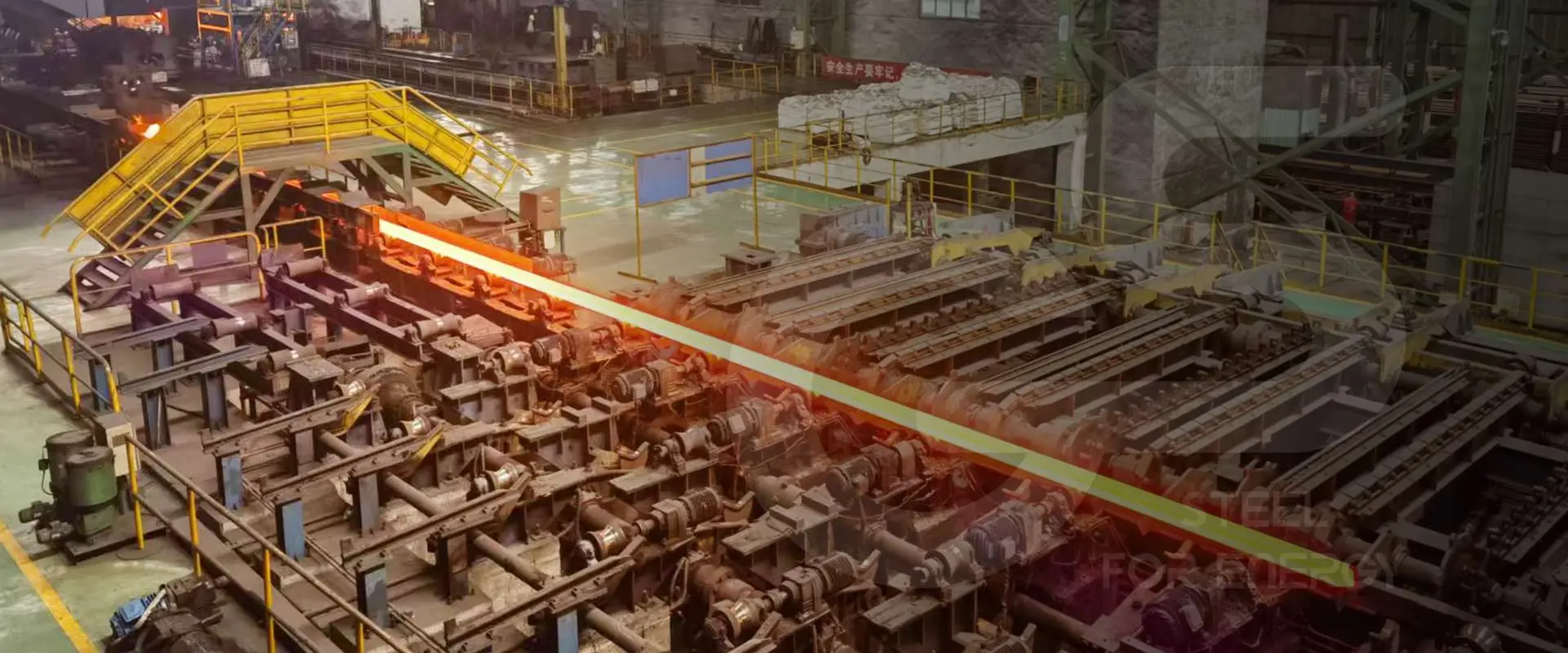
Seamless OCTG production begins by heating the billet in a rotary hearth or walking-beam furnace to the hot-working temperature, typically 1200–1280 °C. The heated billet is then fed into the rotary piercing mill, where two barrel-shaped rolls set at skew angles grip the billet and drive it onto a pointed piercing plug. The combination of compressive and shear forces cause the billet center to fail in tension along the rolling axis, opening a bore while the outer surface remains solid. The result is a thick-walled hollow shell known as a bloom or mother tube.
From the piercing mill, the shell is elongated over a mandrel in a plug mill, mandrel mill, or Assel mill to reduce the wall thickness and increase the length toward the target dimensions. The Assel mill, commonly used for heavier-wall OCTG, uses three rolls positioned around the shell to work it over a tapered mandrel, achieving tight wall-thickness tolerances on sections up to approximately 177.8 mm (7 in.) OD. Plug mills and multi-stand mandrel mills are used across a wider OD range. The elongation step is where the majority of the plastic work is done, and the rolling schedule determines the final wall uniformity, ovality, and internal surface quality.
Sizing and Straightening
After elongation, the pipe passes through a stretch-reducing or sizing mill that brings the OD to final dimension and controls the roundness within API 5CT tolerances (OD tolerance is ±0.79% for casing sizes ≥ 4½ in.; the casing sizes, weights, and drift tables list the nominal dimensions these tolerances apply to). The pipe exits the sizing mill at reduced temperature, typically in the range of 800–950 °C, and is either air-cooled (for grades that will be normalized) or transferred immediately to the quench system for grades requiring Q+T in the as-rolled condition.
Straightening is performed on a multi-roll rotary straightener after final cooling or heat treatment. API 5CT requires casing and tubing to meet straightness tolerances measured over the full pipe length. Straightness is particularly important for threading: excessive bow causes the lathe centers to run out, degrading thread geometry and making it impossible to achieve proper gauge contact on the finished thread.
Electric Welded Casing Manufacturing
Electric welded OCTG is produced from hot-rolled skelp that has been slit to the precise width needed to form the target pipe OD. The skelp passes through a series of forming rolls that progressively shape it into an open tube with a V-shaped gap at the weld seam. The edges are then brought together and welded by one of two methods permitted under API 5CT: high-frequency electric resistance welding (HF-ERW) or laser welding.
In HF-ERW, high-frequency electrical current (typically 100–400 kHz) flows through the skelp edges and generates intense, localized heating due to the skin effect. The heated edges are mechanically pressed together by squeeze rolls, expelling molten and oxidized material as a bead (flash) and forming a solid-state forge weld. The weld zone and the adjacent heat-affected zone (HAZ) immediately enter the seam normalization station, where an in-line induction coil heats the seam to a minimum of 540 °C (1004 °F) as required by API Specification 5CT, 11th Edition. This normalization step transforms any martensitic or bainitic seam microstructure back to ferritic-pearlitic structure compatible with the base metal, eliminating the hardness peak at the weld and removing the stress concentration that would otherwise exist at that location.
After seam normalization, the pipe is sized to final OD, cut to length, and heat-treated per the grade requirement. EW pipe is equally capable of full-body Q+T for grades like N80Q and R95. However, the weld seam remains a detectable feature on electromagnetic inspection, and API 5CT PSL-2 requires UT of the weld seam area in addition to full-body inspection.
The 540°C minimum seam normalization temperature in API 5CT for EW pipe is auditable on the MTC — the mill must record the seam normalization condition, not just state that normalization was performed. What the standard cannot audit from a document is whether the in-line induction coil actually covered the full seam length and heat-affected zone at the required temperature on every pipe. A heat balance calculation from the mill's process records is the only verification. For N80Q EW casing where the seam microstructure matters for your collapse design, requesting the process control records — not just the MTC — is the correct QC step.
Heat Treatment: Why Q+T Matters for High-Grade OCTG
Heat treatment is the step that converts a tube's microstructure from the as-rolled state — a mix of ferrite, pearlite, and possibly bainite depending on the cooling rate from the mill — into the fine-grained tempered martensite that delivers the yield strength, toughness, and hardness control required by high grades.
The quench-and-temper sequence begins with austenitization: the pipe is heated uniformly above the Ac3 transformation temperature (typically 870–950 °C depending on the chemistry) to dissolve carbides and produce a homogeneous austenitic structure. The pipe then enters the quench system — water quench, polymer quench, or oil quench depending on the grade and mill design — where rapid cooling transforms the austenite to martensite. Fresh martensite is hard but brittle and carries high residual stress; it cannot be accepted as a final product.
Tempering follows immediately. The quenched pipe is reheated to a controlled temperature below Ac1 (typically 600–700 °C) and held for a specified time to allow carbon to precipitate from martensite as fine carbide particles, reducing hardness to the target range and dramatically improving toughness and ductility. The tempering temperature determines the final yield-hardness combination. For L80-1, the mill must temper high enough to bring hardness below 23.0 HRC (241 HBW) while retaining minimum yield of 552 MPa (80 ksi). For T95, the window is narrower: yield must reach 655 MPa (95 ksi) minimum while hardness stays below 25.4 HRC (255 HBW).
The following table summarizes heat treatment requirements and key mechanical properties per grade per API Specification 5CT, 11th Edition. The hardness ceiling column is where the manufacturing discipline shows up in the supply chain: a mill that cannot hold its tempering furnace to a consistent setpoint will produce a spread of hardness values, some of which will breach the limit even though the batch mean is acceptable.
| Grade | Heat Treatment | Min Yield MPa (ksi) | Max Yield MPa (ksi) | Min Tensile MPa (ksi) | Max HRC |
|---|---|---|---|---|---|
| H40 | None required | 276 (40) | 552 (80) | 414 (60) | — |
| J55 | None required | 379 (55) | 552 (80) | 517 (75) | — |
| K55 | None required | 379 (55) | 552 (80) | 655 (95) | — |
| N80-1 | N, N+T, or Q+T | 552 (80) | 758 (110) | 689 (100) | — |
| N80Q | Q+T only | 552 (80) | 758 (110) | 689 (100) | — |
| R95 | Q+T | 655 (95) | 758 (110) | 724 (105) | — |
| L80-1 | Q+T only | 552 (80) | 655 (95) | 655 (95) | 23.0 |
| T95 | Q+T only | 655 (95) | 758 (110) | 724 (105) | 25.4 |
| C110 | Q+T only | 758 (110) | 828 (120) | 793 (115) | 29.0 |
| P110 | Q+T only | 758 (110) | 965 (140) | 862 (125) | — |
| Q125 | Q+T only | 862 (125) | 1034 (150) | 931 (135) | — |
Source: API Specification 5CT, 11th Edition (December 2023)
Hydrostatic Test: The Barlow Calculation in Practice
Full-length hydrostatic testing is mandatory for all PSL-1 and PSL-2 casing and tubing under API Specification 5CT, 11th Edition. The test pressure is calculated using the Barlow formula applied to the pipe's minimum wall thickness (using a 0.875 factor to account for the API 5CT wall thickness tolerance), specified minimum yield strength, and OD.
The Barlow formula for API 5CT hydrotest pressure is:
P_test = 0.875 × (2 × SMYS × t / D)
where SMYS is specified minimum yield strength (ksi), t is nominal wall thickness (in.), and D is OD (in.). The 0.875 factor applies because API 5CT permits a wall thickness tolerance of −12.5%, and the hydrotest must be valid at the minimum wall, not nominal.
Worked example — 9-5/8" 47 lb/ft P110 casing:
OD = 244.5 mm (9.625 in.), nominal wall = 11.99 mm (0.472 in.), P110 SMYS = 758 MPa (110 ksi).
P_test = 0.875 × (2 × 110 × 0.472 / 9.625) = 0.875 × (104.0 / 9.625) = 0.875 × 10.80 = 9.45 ksi = 9,453 psi (65.2 MPa)
The pipe is filled with water, pressurized to 9,453 psi, held for the minimum period with no leakage or deformation permitted, and released. Every pipe in the consignment receives this test individually — it is not a sampling exercise. To reproduce this hydrotest pressure for any OD, wall, and grade in your string, use the Barlow pressure calculator →.
For EW pipe, this is why the hydrotest matters beyond simple pressure integrity confirmation: the weld seam is the unknown variable. Pipe body properties are verified by mechanical testing on a heat basis. The weld seam has a unique microstructure that body test specimens do not capture. The hydrotest at 9,453 psi is the only 100% pressure-integrity check applied to every joint, and for EW pipe it is the only in-production test that loads the seam in service-relevant tension. P110 has no hardness limit and no sour-service restriction; the hydrotest is the final and only per-pipe confirmation that the weld zone can sustain internal pressure. For seamless P110, it serves the same function for the pipe body.
Inspection and Testing per API 5CT
Dimensional and Visual Inspection
Every pipe must be measured for OD, wall thickness, and length, and must pass a drift test confirming that the bore is clear to the specified drift diameter. Visual inspection of the pipe body, ends, and coupling-seat surfaces is performed on every pipe. Mechanical damage, laps, seams, and folds are cause for rejection or repair by grinding within the wall tolerance.
Non-Destructive Testing
PSL-1 does not mandate EM or UT for the pipe body, though many mills run it as process control. PSL-2 mandates full-length EM or UT for body defects and full-length UT for wall thickness verification. EW pipe under PSL-2 additionally requires UT or flux-leakage testing of the weld seam. Calibration is performed against reference notches or flat-bottomed holes per API 5CT Annex E. Pipes flagged by UT or EM are either rejected or downgraded pending follow-up manual UT and disposition.
Special Tests for Sour Service Grades
Sour-service grades (L80-1, C90, T95, C110) carry additional mandatory test requirements under API Specification 5CT SR16 (supplementary requirement for sour service) referencing NACE TM0177 or ISO 11960 test protocols for sulfide stress cracking (SSC). Hardness must be measured on every pipe, not as a batch sample, because a single pipe exceeding the hardness limit is unacceptable and constitutes nonconformance regardless of the batch average.
PSL-2 adds Charpy V-notch (CVN) impact testing at a temperature specified in the purchase order, with minimum absorbed energy per the grade and wall thickness group. CVN results must appear on the MTC alongside the per-pipe hardness records. For C110 in particular, the chemistry sulfur limit drops to S ≤ 0.005%, reflecting the need for extremely clean steel to resist both SSC and hydrogen-induced cracking.
Named Failure Modes: What Goes Wrong and How to Find It
These are not theoretical failure modes. They are patterns visible in metallurgical investigations and in MTC disputes.
Failure Mode 1: EW Seam Microstructure — HAZ SSC in N80Q
Mechanism: Even after seam normalization at 540°C, the weld HAZ in HF-ERW pipe can retain a bainitic microstructure if the normalization pass was insufficient — too fast a traverse speed, coil current drop at pipe ends, or induction zone narrower than the actual HAZ width. If this N80Q EW pipe is used in a gas well with trace H₂S, the harder HAZ becomes the preferential cracking path even though N80Q is not a sour-service grade and the operator did not classify the well as sour. Bainitic HAZ microstructure in the presence of even low H₂S partial pressure can initiate sulfide stress cracking at stress levels well below the nominal yield of the pipe body.
Diagnostic: Longitudinal crack along or adjacent to the weld seam, early in service. EM or UT inspection shows a linear indication at the seam position. Metallurgical cross-section of the cracked region shows bainitic microstructure in the cracking zone and ferrite-pearlite in the pipe body away from the seam.
Fix: Specify seamless for any application where seam microstructure is a concern, including wells where H₂S is uncertain rather than confirmed absent. For EW N80Q casing, require seam UT on every pipe to API 5CT PSL-2 standard as a minimum, and request the mill's process normalization control records showing temperature uniformity along the full seam length — not just the MTC statement that normalization was performed.
Failure Mode 2: Under-Tempered Martensite — Brittleness in Q+T Grades
Mechanism: If the tempering furnace has a temperature variation exceeding ±15°C across the pipe length, some sections of a P110 or Q125 pipe will be under-tempered. The martensitic microstructure in those sections remains hard and brittle, meeting the minimum yield requirement but failing to achieve the Charpy impact values required for the temperature and service class. In a cold-climate offshore application at 0°C or below, under-tempered zones can fracture at normal tensile loads without visible warning — the fracture surface is flat and crystalline, with no plastic deformation.
Diagnostic: Brittle fracture perpendicular to the pipe axis with no necking or ductile tearing. CVN specimens from the affected sections fall below the specified minimum. Tempering furnace records, if obtained, show a temperature excursion at the time the affected heat was processed. Hardness measurements across the fracture zone will show elevated values relative to the pipe body average.
Fix: Require PSL-2 with CVN impact testing for P110 and Q125 on all cold-climate and offshore applications. Add supplementary requirement SR2 (per-pipe CVN testing) for critical wells where a single joint failure has disproportionate consequences. During MTC review, check that the furnace temperature uniformity record accompanies the heat treatment condition — some mills provide this voluntarily; for critical grades, require it on the PO.
Failure Mode 3: Dimensional Non-Conformance After Thread Cutting — Drift Failure
Mechanism: Excessive pipe bow — above the API 5CT straightness tolerance — causes the thread-cutting lathe centers to run eccentric. The resulting thread geometry, including taper, lead, and thread height, can fall outside API 5B tolerance even though the pipe body passes all mechanical and dimensional tests on the mill floor. The thread-gauging process at the mill may not catch this: the gauge contact point may fall within tolerance while the thread flanks are out. The pipe ships with what appears to be an acceptable thread on the MTC but fails to make up correctly in the field, leading to a leak path, galling on a subsequent makeup attempt, or a connection that never reaches the specified torque.
Diagnostic: Persistent makeup problems in the field — connections that will not reach the specified torque, visible gauge standoff after makeup, or galling on the first connection attempt. Thread profile measurement with a lead-and-taper gauge reveals out-of-tolerance dimensions. Cross-referencing to the pipe's straightness measurement on the MTC, if recorded, shows bow near the API 5CT limit.
Fix: Specify the API 5CT straightness tolerance explicitly on the purchase order — state the maximum bow per 12 m joint. For premium-threaded OCTG such as VAM TOP or Tenaris Blue on T95 or C110, add a thread-by-thread profile inspection requirement on a sampling basis. Reject pipes that fail the straightness check before threading begins; reworking bow after threading is not reliably effective because the thread geometry is already compromised.
When NOT to Accept Electric Welded OCTG
The following table defines the conditions under which EW pipe is not an acceptable supply option, regardless of price differential or supplier claims.
| Situation | Why EW is Unacceptable | Correct Specification |
|---|---|---|
| L80-1, C90, T95, C110, P110, Q125 | API 5CT restricts these grades to seamless only | State "Seamless (S)" explicitly on PO |
| Sour service of any grade | EW seam HAZ cannot be fully homogenized; SSC risk at seam persists | Seamless + per-pipe hardness testing on MTC |
| Collapse design at full API rating | Seam HAZ may have different yield response under non-uniform loading | Seamless for collapse-critical strings |
| Cold climate with CVN requirement | Seam zone toughness variability is not captured by body CVN specimens | Seamless + PSL-2 CVN |
If the purchase order does not explicitly state "Seamless (S)", a supplier may read ambiguity as permission to ship EW where API 5CT technically allows it. For the grades listed above — L80-1, C90, T95, C110, P110, Q125 — EW is not an API 5CT option. Supplying EW for these grades is a non-conformance, not an interpretation. For general-service grades where EW is permitted (H40, J55, K55, N80-1, N80Q, R95), the decision to accept EW over seamless must be an explicit engineering decision documented in the well program — not a default that occurs because the PO was silent on the manufacturing route.
Threading and Coupling
Threading is the final value-adding step before the pipe ships. API 5CT casing uses either 8-round thread per API Specification 5B (Short Thread Coupling, STC, or Long Thread Coupling, LTC) or Buttress Thread Coupling (BTC). Tubing uses API 8-round non-upset (NU) or external-upset (EU) connections. All API thread forms are cut on automatic thread-cutting lathes with in-process gauging to API 5B tolerances, and finished threads are inspected with ring and plug gauges after cutting.
Premium connections — metal-to-metal seal designs such as VAM TOP, Tenaris Blue, and others — are licensed separately from the API threads and are manufactured to ISO 13679 CAL I–IV qualification levels. Mills that produce premium-threaded OCTG operate dedicated CNC thread-cutting cells with tighter machining tolerances than API 5B requires. Premium threading is common on T95, C110, P110, and Q125 where gas-tight sealing under high combined loading is required.
After threading, couplings are applied — power-tight to a specified torque — and thread protectors installed. Color coding per API 5CT is applied to the pipe body before shipment: P110 receives one white band, T95 one silver band, L80-1 one red and one brown band, allowing field identification even after long storage.
Purchase Order Guidance
The most costly procurement trap in OCTG is failing to specify the manufacturing route for sour-service and HPHT grades.
Wrong PO: "L80-1 casing, 9-5/8 in., 53.5 lb/ft, API 5CT PSL-2, BTC, 200 joints"
What the mill ships: EW N80Q upgraded to L80-1 documentation. API 5CT does not permit EW for L80-1, so supplying it would be a non-conformance — but purchase orders that do not state "seamless" have been associated with exactly this dispute at the receiving inspection stage, when the MTC process designation reads "EW" and the receiving inspector is left to decide whether to hold the shipment.
Correct PO: "L80-1 per API Specification 5CT, 11th Edition, seamless (S), 9-5/8 in., 53.5 lb/ft, Q+T heat treatment, per-pipe hardness ≤ 23.0 HRC recorded on MTC, PSL-2, BTC, Range R3, EN 10204 3.2 MTC, 200 joints."
The difference between these two purchase orders is approximately 120 words. The difference in supply-chain risk is the difference between a string that meets NACE MR0175 / ISO 15156 and one that does not.
A second common trap is assuming that seam normalization makes EW pipe equivalent to seamless for all applications. API 5CT seam normalization at ≥ 540 °C addresses the microstructure at the weld seam under the conditions defined in the standard. It does not eliminate the slightly different yield strength response that the seam HAZ may exhibit under collapse loading. For wells where the collapse design uses the full API rating without de-rating, seamless pipe is the correct specification.
Minimum PO line items for high-grade OCTG:
- Grade and type (e.g., L80-1, T95, P110)
- Manufacturing route: Seamless (S) — state explicitly
- PSL level: PSL-1 or PSL-2
- Heat treatment: Q+T — confirm on MTC
- Connection type: STC, LTC, BTC, or premium connection designation
- Length range: R1, R2, or R3 per API 5CT
- Inspection standard: EN 10204 3.1 or 3.2
- Third-party inspection if required
MTC verification checklist: Confirm the process designation (S or EW) is explicitly stated; verify heat treatment (Q+T) is recorded; check that per-pipe hardness values are listed for sour-service grades — a batch average is non-conforming; confirm that PSL-2 test results (CVN, UT) are included if PSL-2 was ordered; verify the heat and lot numbers on the MTC match the stenciling on the pipe body.
ZC Steel Pipe provides EN 10204 3.1 MTRs as standard on all OCTG shipments, with 3.2 (independent verification) and third-party inspection by SGS, Bureau Veritas, or TÜV available on request for PSL-2 and sour-service orders.
Frequently Asked Questions
What is the difference between seamless and electric welded OCTG?
Seamless OCTG is produced by hot-piercing a solid billet to form a tube without a longitudinal seam, giving a uniform microstructure around the full pipe circumference. Electric welded (EW) OCTG is roll-formed from flat strip and joined along one seam using high-frequency resistance or laser welding. Seamless pipe has no weld zone and therefore no localized heat-affected zone, which is the primary reason high-grade sour service and HPHT grades require seamless manufacture under API Specification 5CT, 11th Edition.
Which API 5CT grades require quench-and-temper heat treatment?
API Specification 5CT, 11th Edition mandates quench-and-temper (Q+T) for N80Q, R95, L80-1, C90, T95, C110, P110, and Q125. N80-1 has the most flexibility and may be delivered normalized, normalized-and-tempered, or Q+T. H40, J55, and K55 have no mandatory heat treatment requirement. For all sour-service grades — L80-1, C90, T95, and C110 — Q+T is the only permitted condition because it produces the fine, tempered martensite microstructure needed to meet the hardness ceiling that prevents sulfide stress cracking.
Can electric welded pipe be used for L80 sour service casing?
No. API Specification 5CT, 11th Edition restricts electric welded manufacture to grades H40, J55, K55, N80-1, N80Q, and R95. L80-1 is a sour-service grade and must be manufactured by the seamless route only. Using EW pipe for L80 sour service is non-compliant with API 5CT and would also fail to satisfy NACE MR0175 / ISO 15156 requirements because the weld seam can become a hardness exceedance point even after seam normalization.
What NDT is required for API 5CT PSL-2 casing?
PSL-2 adds mandatory Charpy V-notch impact testing, full-length electromagnetic (EM) or ultrasonic testing (UT) for body defects, and full-length UT for wall thickness in addition to all PSL-1 requirements. PSL-1 mandates a full-length hydrostatic test, dimensional inspection, visual inspection, drift test, and thread gauging. PSL-2 represents a significantly more rigorous inspection regime and is required by many operators for HPHT and sour service applications.
How does the manufacturing route affect casing collapse resistance?
The seamless process produces a pipe body with no weld seam, meaning the yield strength and microstructure are uniform around the full circumference. EW pipe has a seam heat-affected zone that can exhibit slightly lower yield strength or different residual stress patterns, which can reduce collapse resistance under non-uniform external loading. For grades subject to high collapse pressure — particularly thick-wall P110 and Q125 used in deep HPHT wells — seamless manufacture is specified precisely to eliminate this variability. API 5CT does not publish separate collapse ratings for seamless versus EW; the restriction on high-grade EW pipe implicitly addresses this concern.
What is seam normalization in EW casing production?
Seam normalization is the in-line heat treatment applied to the weld seam of electric welded OCTG after the HF-ERW or laser welding step. API Specification 5CT, 11th Edition requires the seam and adjacent heat-affected zone to be heated to a minimum of 540 °C (1004 °F) to eliminate the hardened microstructure created during rapid weld cooling. Without this step, the seam can retain a martensitic or bainitic structure that is harder and more brittle than the pipe body, creating a stress concentration point and a potential site for corrosion or mechanical failure.
What does ZC Steel Pipe supply in terms of OCTG manufacturing?
ZC Steel Pipe manufactures seamless casing and tubing to API Specification 5CT, 11th Edition in PSL-1 and PSL-2, covering the commercially significant high-value grades including N80Q, L80-1, T95, C110, P110, and Q125. Material test reports comply with EN 10204 3.1 and 3.2, and third-party inspection by SGS, Bureau Veritas, or TÜV is available. ZC supplies customers in Africa, the Middle East, South America, and Southeast Asia.
How do I verify the manufacturing route on the MTC?
API Specification 5CT, 11th Edition requires the mill test certificate (MTC) to state the manufacturing process designation: S for seamless or EW for electric welded. The MTC must also include the grade, heat treatment condition, heat or lot number, mechanical test results, and chemical analysis per heat. For sour-service grades, confirm that the MTC records the hardness value for every pipe tested and that all values are within the grade limit — 23.0 HRC for L80-1, 25.4 HRC for C90 and T95, or 29.0 HRC for C110. Any MTC that omits the process designation or records hardness as a batch average rather than per-pipe should be rejected.