EPC engineers ordering OCTG for a new well program face an immediate problem: API Specification 5CT, 11th Edition defines 15 grades across four groups, and several of them share identical yield strength ranges while differing sharply on heat treatment, hardness limits, and corrosive-environment suitability. Selecting N80 instead of L80-1 for a well with even mild H2S exposure can cause a sulfide stress cracking (SSC) failure within months. Choosing P110 where C110 is required exposes the operator to the same risk at higher well cost.
This guide maps every API 5CT grade onto a single ladder — strength level, heat treatment class, maximum hardness, service classification, and color code — so that engineers and procurement teams can move from well classification to purchase order specification without ambiguity. If you need the fundamentals first, start with what is OCTG pipe →.
ZC Steel Pipe supplies seamless casing and tubing in all commercially significant high-value grades, from N80Q and L80-1 through T95, C110, P110, and Q125, with full material test reports (MTRs) and third-party inspection available on request.
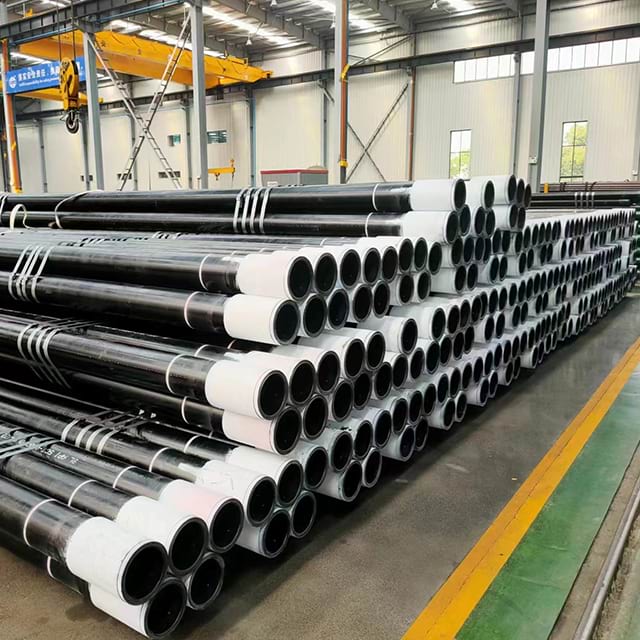 Casing stacks with couplings made up, staged in the factory.
Quick Answer
API 5CT, 11th Edition defines 15 grades across four groups. Selection is driven first by service (sweet vs sour), then by strength:
- General / sweet service (no hardness limit): H40, J55, K55, N80-1, N80Q, R95, P110, Q125
- Sour service (mandatory hardness ceiling for H2S): L80-1 (23.0 HRC), C90 and T95 (25.4 HRC), C110 (29.0 HRC)
- CO2 corrosion (chromium-alloyed, sweet only): L80-3Cr, L80-9Cr, L80-13Cr
The number in each grade is its minimum yield in ksi — P110 is 110 ksi, Q125 is 125 ksi. The trap to know up front: P110 and Q125 are high-strength but carry no hardness limit and are not sour-qualified — never substitute them into an H2S well.
In reviewing 20+ OCTG enquiries from Sub-Saharan Africa and the Middle East, roughly 60% spec the grade as "N80" with no sub-grade designation. When the mill delivers N80-1 normalized product to a sour-service well, no alarm sounds at goods receipt — the color code (one red band) matches both N80-1 and the expected L80-1 (one red + one brown band) if someone counts the bands wrong in low light. The material test report reads "N80-1" — compliant with the PO. The well classification never got reconciled against the tubing string spec.
How API 5CT Organizes OCTG Grades
API 5CT groups its 15 grades into four categories defined by yield class and heat treatment class.
Group 1 covers general-service grades from H40 through R95. These grades have no mandatory hardness ceiling and are not intended for H2S service. Heat treatment requirements range from none (H40) to mandatory quench-and-temper (R95).
Group 2 covers controlled-yield grades with mandatory hardness limits. L80-1, C90, and T95 are sour-service grades meeting NACE MR0175 / ISO 15156 hardness thresholds. L80-3Cr, L80-9Cr, and L80-13Cr share L80 mechanical properties but add chromium content for CO2 corrosion resistance in sweet, high-CO2 environments — they are not sour-rated.
Group 3 contains C110 and P110. Both sit at 110 ksi minimum yield. C110 carries a 29.0 HRC maximum for sour service; P110 has no hardness limit and is restricted to general (sweet) service.
Group 4 contains Q125 alone, the highest-strength grade in the standard at 125 ksi minimum yield, used exclusively for ultra-deep HPHT wells.
Service Classification
API 5CT grades fall into three service categories:
- General service — sweet wells with no H2S restrictions (H40, J55, K55, N80-1, N80Q, R95, P110, Q125)
- Sour service — wells where H2S partial pressure triggers SSC risk per NACE MR0175 / ISO 15156 (L80-1, C90, T95, C110)
- CO2 corrosion — sweet wells with significant CO2 partial pressure requiring chromium alloying (L80-3Cr, L80-9Cr, L80-13Cr)
Color Code Identification System
API 5CT mandates color-band marking on pipe ends to enable visual grade identification at the wellsite. The color coding matters operationally: a single band of red (N80-1) and a red-plus-brown band (L80-1) are easy to confuse under field lighting, but substituting N80 for L80 in a sour well is a safety-critical error.
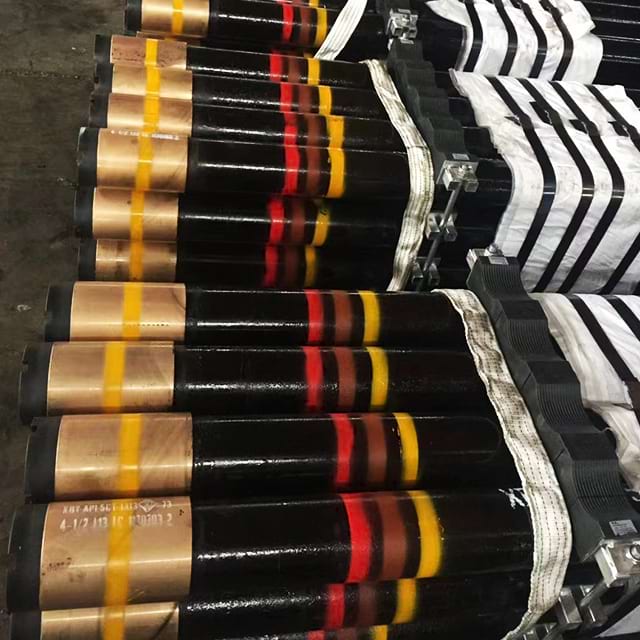 Casing joints with red and yellow color-band markings and copper thread protectors.
| Grade | Color Code |
|---|---|
| H40 | None or black band |
| J55 | One bright green band |
| K55 | Two bright green bands |
| N80-1 | One red band |
| N80Q | One red + one bright green band |
| R95 | One brown band |
| L80-1 | One red + one brown band |
| C90 | One purple band |
| T95 | One silver band |
| C110 | One white + two brown bands |
| P110 | One white band |
| Q125 | One orange band |
The API 5CT Grade Ladder
The table below covers the 12 primary grades (CO2-variant L80 grades omitted for clarity; see Group 2 section below). All values from API Specification 5CT, 11th Edition.
| Grade | Group | Min Yield MPa (ksi) | Max Yield MPa (ksi) | Min Tensile MPa (ksi) | Max HRC | Heat Treatment | Service |
|---|---|---|---|---|---|---|---|
| H40 | 1 | 276 (40) | 552 (80) | 414 (60) | — | — | General |
| J55 | 1 | 379 (55) | 552 (80) | 517 (75) | — | — | General |
| K55 | 1 | 379 (55) | 552 (80) | 655 (95) | — | — | General |
| N80-1 | 1 | 552 (80) | 758 (110) | 689 (100) | — | N or Q+T | General |
| N80Q | 1 | 552 (80) | 758 (110) | 689 (100) | — | Q+T only | General |
| R95 | 1 | 655 (95) | 758 (110) | 724 (105) | — | Q+T | General |
| L80-1 | 2 | 552 (80) | 655 (95) | 655 (95) | 23.0 | Q+T | Sour |
| C90 | 2 | 621 (90) | 724 (105) | 689 (100) | 25.4 | Q+T | Sour |
| T95 | 2 | 655 (95) | 758 (110) | 724 (105) | 25.4 | Q+T | Sour |
| C110 | 3 | 758 (110) | 828 (120) | 793 (115) | 29.0 | Q+T | Sour |
| P110 | 3 | 758 (110) | 965 (140) | 862 (125) | — | Q+T | General |
| Q125 | 4 | 862 (125) | 1034 (150) | 931 (135) | — | Q+T | General |
For the complete grade ladder with tensile, hardness, and chemistry limits, see the API 5CT specification tables →
To match a grade to your well conditions, use the Pipe Grade Selector →
N80-1 and L80-1 share an identical 552 MPa (80 ksi) minimum yield — they look equivalent on the strength ladder. The engineering difference is the yield ceiling: N80-1 goes to 758 MPa (110 ksi) maximum with no hardness limit, while L80-1 is capped at 655 MPa (95 ksi) and 23.0 HRC. That 95 ksi ceiling exists precisely because a narrower yield window forces the mill to temper higher, keeping hardness below 23.0 HRC. Specifying N80 where L80 is required does not just violate NACE — it gives the mill permission to deliver product at 108 ksi yield and 28 HRC, values that will SSC within weeks in H₂S service.
Yield Window Burst Implications: Why the Hardness Cap Matters
The yield ceiling is not an academic distinction. For 7-inch 26 lb/ft casing (OD = 177.8 mm / 7.0 in, wall thickness t = 9.19 mm / 0.362 in), applying the API Barlow burst formula with the 0.875 de-rating factor shows the pressure range that the yield window spans:
Barlow burst formula: P = 0.875 × (2 × SMYS × t) / OD
| Yield Point | SMYS | Calculated Burst Pressure |
|---|---|---|
| N80 / L80 minimum yield | 552 MPa (80 ksi) | 0.875 × (2 × 80 × 0.362 / 7.0) = 7,240 psi (49.9 MPa) |
| L80-1 maximum yield (cap) | 655 MPa (95 ksi) | 0.875 × (2 × 95 × 0.362 / 7.0) = 8,597 psi (59.3 MPa) |
| N80-1 maximum yield (no cap) | 758 MPa (110 ksi) | 0.875 × (2 × 110 × 0.362 / 7.0) = 9,952 psi (68.6 MPa) |
The swing from N80 minimum to N80 maximum yield is 2,712 psi — a 37% increase in burst capacity from the same grade designation. That is the design uncertainty an engineer accepts when ordering "N80" without locking a hardness ceiling. L80-1's 95 ksi yield cap compresses that window to 1,357 psi. This narrower window is not a limitation — it is the mechanism by which API 5CT enforces the hardness ceiling that NACE MR0175 / ISO 15156 requires for sour service.
In practice: a procurement team ordering "N80" for a sour-service production string on a 7-inch 26 lb/ft string may receive pipe that bursts at 9,952 psi but cracks at the first thread root before the well reaches operating pressure in H₂S.
Group 1 — General Service Grades (H40 to R95)
H40
H40 is the lowest-strength API 5CT grade with a minimum yield of 276 MPa (40 ksi) and no heat treatment requirement. It is used for surface casing in shallow, low-pressure wells and for conductor pipe where structural load rather than burst or collapse governs the design. H40 availability is limited compared to J55; some operators specify J55 as a minimum for all strings.
J55 and K55
J55 and K55 share an identical yield range — 379 to 552 MPa (55 to 80 ksi) — making them appear equivalent on first glance. The difference is tensile strength: J55 requires a minimum of 517 MPa (75 ksi), while K55 requires 655 MPa (95 ksi). In practice, K55 is predominantly used for casing because the higher tensile minimum provides greater resistance to running loads and joint makeup forces. J55 is the dominant tubing grade for shallow sweet wells in Africa and Southeast Asia due to its wide availability and low cost.
Neither grade requires heat treatment, which contributes to their lower cost and shorter lead times. Both are general-service only with no hardness limit.
N80-1 and N80Q
N80 represents the first significant step up in the grade ladder at 552 MPa (80 ksi) minimum yield. The two sub-grades differ only in heat treatment:
N80-1 permits normalization, normalization-and-tempering, or quench-and-temper. The flexibility in heat treatment makes N80-1 easier to source from a wider range of mills, but it produces more variability in microstructure and mechanical properties across heats.
N80Q mandates quench-and-temper exclusively. The Q+T microstructure gives finer grain size, more uniform hardness distribution, and better resistance to fatigue and impact loading. Wells with moderate deviated trajectories or where consistent API drift testing is critical should prefer N80Q.
Both sub-grades are general-service with no hardness limit. For wells in any H2S environment, even trace concentrations, neither N80 grade is appropriate — L80-1 at equivalent yield strength is the correct choice.
R95
R95 sits between N80Q and L80/T95 at 655 MPa (95 ksi) minimum yield. It is a quench-and-tempered general-service grade used for medium-depth wells where N80 is insufficient and neither sour service nor CO2 service is present. R95 can be a cost-effective intermediate when the well depth and pressure require more than N80 but the formation is fully sweet, allowing the operator to avoid the procurement complexity and lead time associated with sour-service grades.
Group 2 — Controlled-Yield Sour Service Grades (L80, C90, T95)
The Group 2 sour-service grades (L80-1, C90, T95) are defined as much by what they cap as by their minimum strength. For the full sour envelope including C110 and how H2S partial pressure drives the choice, see the sour service grade selection guide →. Sulfide stress cracking occurs when high-strength steel under tensile stress is exposed to H2S — harder steel is more susceptible because the higher dislocation density provides sites for hydrogen diffusion. NACE MR0175 / ISO 15156 controls SSC risk by setting a maximum steel hardness. API 5CT translates this into mandatory HRC limits for each sour-service grade.
L80-1
L80-1 has a minimum yield of 552 MPa (80 ksi), a maximum yield of 655 MPa (95 ksi), and a maximum hardness of 23.0 HRC. The tight yield window (95 ksi max vs. 110 ksi max for N80) is intentional: a wider yield range would allow some production to be harder than the NACE threshold. L80-1 is the entry-level sour-service grade and the correct substitute wherever N80 would otherwise be used in wells with H2S exposure. It is also the most readily available Group 2 grade from most OCTG mills.
C90
C90 fills the yield gap between L80 and T95 at 621 to 724 MPa (90 to 105 ksi) with a maximum hardness of 25.4 HRC. It is less commonly stocked than L80-1 or T95 and may require mill-order lead times. C90 is appropriate for intermediate sour wells where L80-1 yield strength is insufficient but the well parameters do not yet call for T95.
T95
T95 has a minimum yield of 655 MPa (95 ksi) and the same 25.4 HRC hardness cap as C90. It delivers higher strength than L80 for more demanding sour environments — deeper wells or higher H2S partial pressures where collapse and burst loads exceed what L80 can sustain. T95 requires more stringent QC at the mill and carries longer lead times than L80-1 in most markets.
CO2 Corrosion Variants: L80-3Cr, L80-9Cr, L80-13Cr
These three grades share the mechanical property limits of L80-1 but add chromium alloying (3%, 9%, and 13% respectively) for passive-film resistance to CO2-driven corrosion in sweet gas condensate wells. They are not sour-service grades — their hardness limits are the same as L80-1, but NACE MR0175 / ISO 15156 qualification is not the design driver. L80-13Cr is the most widely specified for CO2-corrosive tubing strings in gas fields with high CO2 partial pressure and low H2S. Because CO2 and H2S often co-exist in produced fluids, the engineer must confirm whether the dominant corrosion mechanism is CO2 or H2S before specifying a chromium grade.
Group 3 and 4 — High-Strength HPHT Grades (C110, P110, Q125)
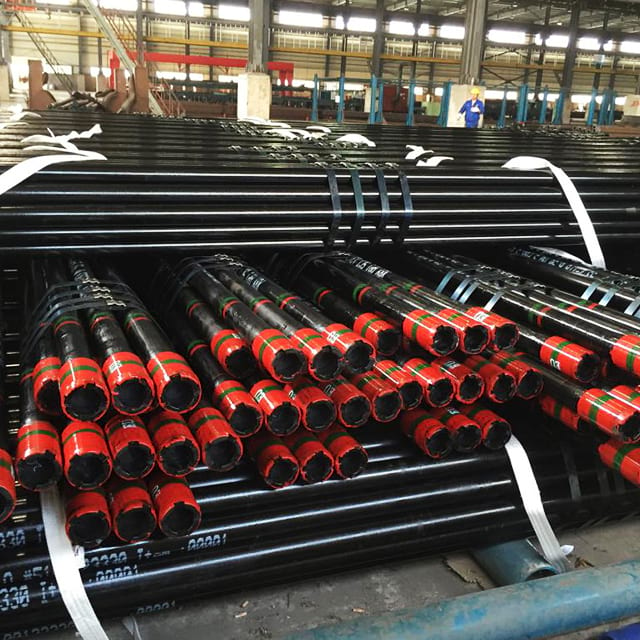 Casing bundles fitted with red and orange thread protectors in the warehouse.
P110
P110 is the workhorse grade for deep HPHT wells, carrying a minimum yield of 758 MPa (110 ksi) and a wide maximum yield ceiling of 965 MPa (140 ksi). The broad yield window gives mills flexibility in production, which contributes to P110's wide availability and competitive pricing relative to other high-strength grades. Heat treatment is mandatory quench-and-temper.
P110 has no hardness limit and is not an API 5CT sour-service grade. Despite its prevalence in deep wells — including many wells in the Middle East, West Africa, and the Gulf of Mexico — it cannot be used where H2S is present. Operators who attempt to qualify P110 for H2S service by citing low H2S partial pressures must still comply with NACE MR0175 / ISO 15156, which does not provide a P110 exemption.
C110
C110 is the high-strength sour-service grade: a minimum yield of 758 MPa (110 ksi) with a maximum hardness of 29.0 HRC. It occupies a narrow niche — wells that are both deep enough to require P110-class strength and corrosive enough to require sour-service qualification. This combination is demanding to produce. C110 requires tighter chemistry control, post-Q+T hardness verification on each pipe joint, and supplemental SSC testing. Lead times are typically longer than P110 and stocking availability is limited to a small number of mills globally.
Procurement teams should confirm C110 availability early in the well program schedule. Substituting P110 while awaiting C110 delivery is not an option where H2S is present.
Q125
Q125 is Group 4 and the strongest API 5CT grade at 862 MPa (125 ksi) minimum yield and a maximum of 1034 MPa (150 ksi). It is specified for ultra-deep wells where the triaxial load envelope exceeds P110 capacity — typically wells beyond 6,000 m total depth with combined high burst, collapse, and axial tension requirements.
Q125 is general service (no hardness limit, not sour-rated) but its high strength comes with increased susceptibility to hydrogen embrittlement. Premium connections, careful handling to avoid notch defects, and strict thread compound and torque protocols are required. Storage and transportation should minimize impact loading. Q125 purchases should always include full supplemental testing: impact testing per SR16, hardness lot testing, and dimensional inspection by a third-party inspector.
Named Failure Modes
The three failures below are not hypothetical. Each maps to a recognized SSC or hydrogen-related failure pattern encountered in operating wells. Understanding the mechanism at the material level is the only reliable defence.
Failure Mode 1: N80-1 Normalized in H₂S Well — SSC
Mechanism: N80-1 delivered normalized has hardness of 22–28 HRC depending on carbon content. NACE MR0175 / ISO 15156-2 permits maximum 22 HRC for carbon steel in H₂S service. When normalized N80-1 at 25–28 HRC is exposed to dissolved H₂S in the production string, atomic hydrogen diffuses into the steel and causes delayed cracking at stress concentrators — thread roots, coupling shoulders, or upset transitions — within days to weeks of H₂S breakthrough.
Diagnostic: String failure early in producing life (less than 12 months), cracking at or near connection, H₂S detected in production stream. Metallurgical cross-section shows intergranular or quasi-cleavage fracture. MTC hardness not reported (batch average only).
Fix: Specify L80-1 per API 5CT for all sour-service strings. Require per-pipe hardness records on MTC (not batch averages). Add color-code inspection checklist at goods receipt: L80-1 = one red + one brown band; reject any delivery showing only one red band.
Failure Mode 2: T95 Hardness Trap
Mechanism: API 5CT permits T95 at up to 25.4 HRC. NACE MR0175 / ISO 15156-2 caps carbon steel for sour service at 22 HRC. T95 delivered at 24.8 HRC is technically API-compliant but NACE-non-compliant. No warning flag appears on the MTC — the hardness value passes API 5CT inspection. When this pipe goes into a sour well, the 2.8 HRC excess over the NACE limit creates measurable SSC susceptibility under static tensile stress.
Diagnostic: Late-life cracking (post H₂S breakthrough), T95 string, MTC shows hardness 23–25.4 HRC range. Fracture surface shows SSC morphology. MTC shows hardness reported "≤ 25.4 HRC" with no individual per-pipe values.
Fix: For T95 in H₂S service, add supplementary requirement to PO: "Maximum hardness 22 HRC per NACE MR0175 / ISO 15156-2" (not just "per API 5CT"). Require per-pipe hardness on MTC. This is 3.4 HRC tighter than the API limit — confirm mill capability before ordering.
Failure Mode 3: P110 in H₂S Well (No Hardness Limit)
Mechanism: P110 has no API 5CT hardness ceiling. Production heats can reach 35+ HRC while remaining fully API-compliant. In an H₂S environment — even low partial pressures — P110 at high hardness undergoes rapid SSC because the high dislocation density of untempered or under-tempered martensite provides abundant hydrogen trap sites.
Diagnostic: Catastrophic failure within 24–72 hours of H₂S exposure, brittle fracture, no plastic deformation at fracture surface. Well classified as "sweet" at design but showed H₂S breakthrough post-completion.
Fix: No in-field remedy once the string is deployed. The fix is design-stage: if any H₂S risk exists (even trace), specify C110 (max 29.0 HRC) not P110. For wells where formation data is uncertain, run a conservative assumption and design to sour-service.
When NOT to Use an OCTG Grade Without Running the Numbers
Grade selection errors cluster around the same misunderstandings: the yield number looks right, the price looks right, and the delivery lead time looks right — but the service classification is wrong. The table below maps the most common incorrect uses to what actually goes wrong and what the correct specification is.
| Grade | Incorrect Use Case | What Goes Wrong | Correct Grade |
|---|---|---|---|
| N80-1 | Sour well, any H₂S | No hardness limit; SSC within weeks | L80-1 |
| L80-13Cr | H₂S present | Passive film concentrates hydrogen; worse SSC than carbon steel | L80-1 + sour assessment |
| T95 | Sour well, API 5CT hardness accepted | 25.4 HRC API limit > 22 HRC NACE limit = NACE non-compliance | T95 with max 22 HRC SR |
| P110 | Any H₂S trace | No hardness ceiling; heats may reach 35+ HRC | C110 |
| Q125 | Sour service | No hardness limit; not listed in NACE MR0175 | C110 or SSC-tested alternative |
The L80-13Cr case deserves emphasis: procurement teams sometimes assume that more chromium means more corrosion resistance in all environments. In H₂S service, L80-13Cr's passive chromium-oxide film can concentrate hydrogen at the metal surface and accelerate SSC rather than prevent it. Chromium grades are for CO2 environments — when the dominant corrosive agent is H₂S, the correct answer is a carbon-steel sour-service grade with a verified hardness ceiling.
For wells where both CO2 and H₂S are present in produced fluids, the question of which corrosion mechanism governs is a reservoir engineering determination, not a materials shortcut. That assessment must happen before the grade is specified, not after the pipe arrives on the wellsite.
Grade Selection Quick Reference
| Well Classification | Recommended Grade |
|---|---|
| Shallow sweet (< 2,000 m) | J55 / K55 |
| Medium-depth sweet | N80-1 or N80Q |
| Medium-depth sweet, consistent QC needed | N80Q |
| Deep HPHT, sweet | P110 |
| Ultra-deep HPHT, sweet | Q125 |
| Mild sour (low H2S partial pressure) | L80-1 |
| Moderate sour, higher strength needed | C90 or T95 |
| High-strength sour (HPHT + H2S) | C110 |
| Sweet, high CO2 partial pressure | L80-13Cr (tubing) |
Purchase Order Guidance
A complete OCTG grade specification on a purchase order must include: API 5CT grade and sub-grade designation (e.g., "N80Q" not "N80"), outside diameter and nominal wall thickness, end finish and connection type, pipe body specification level (PSL-1 or PSL-2), and any supplemental requirements (SR numbers) applicable to the well classification.
MTR review for sour-service grades. When reviewing material test reports for L80-1, C90, T95, or C110, confirm the following: hardness test results are reported (Rockwell C scale, not HRB or HB), all hardness readings fall at or below the grade maximum (23.0 HRC for L80-1, 25.4 HRC for C90/T95, 29.0 HRC for C110), heat treatment is recorded as "Q+T" (quench-and-temper — no other treatment is permissible for these grades), and the chemical analysis shows no anomalies in carbon equivalent that would indicate elevated hardenability risk. Any MTR that reports hardness in a non-HRC scale, or that omits hardness data entirely for a sour-service grade, should be rejected and re-issued before pipe is accepted at the wellsite.
The procurement trap — wrong PO, what ships, correct PO.
Wrong PO: "7-inch 26 lb/ft N80 casing, API 5CT PSL-2, BTC, 200 joints — sour service production string, Well XX"
What the mill ships: N80-1 normalized, 24 HRC, color-coded with one red band. MTC reads "N80-1, normalized, API 5CT PSL-2." Fully compliant with the PO as written.
Correct PO: "7-inch 26 lb/ft L80-1 per API Specification 5CT, 11th Edition, sour service per NACE MR0175 / ISO 15156, maximum hardness 23.0 HRC per-pipe (not batch average), Q+T heat treatment, EN 10204 3.2 MTC, PSL-2, BTC or premium connection per well design, color code verified at goods receipt: one red + one brown band."
The difference between the wrong PO and the correct PO is 47 additional words. Those 47 words determine whether the string cracks within the first year of production.
Frequently Asked Questions
How many grades of OCTG pipe does API 5CT define?
API Specification 5CT, 11th Edition defines 15 grades: H40, J55, K55, N80-1, N80Q, R95, L80-1, L80-3Cr, L80-9Cr, L80-13Cr, C90, T95, C110, P110, and Q125, organized into four groups by yield strength and heat treatment class.
What is the most commonly used OCTG grade?
J55 and N80 are the most widely used grades for shallow to medium-depth sweet wells due to their combination of moderate yield strength, wide availability, and competitive cost. P110 is the dominant grade for deeper HPHT wells.
What is the difference between N80-1 and N80Q?
N80-1 can be normalized, normalized-and-tempered, or quench-and-tempered. N80Q is restricted to quench-and-tempered (Q+T) heat treatment only, giving it more consistent mechanical properties and tighter microstructure control. Both have identical yield and tensile minimums of 552 MPa (80 ksi) and 689 MPa (100 ksi) respectively.
Which OCTG grades are rated for sour service?
L80-1, C90, T95, and C110 are the four API 5CT sour-service grades. They carry mandatory hardness limits (L80=23.0 HRC, C90/T95=25.4 HRC, C110=29.0 HRC) to resist sulfide stress cracking per NACE MR0175 / ISO 15156. P110 is NOT sour-rated despite its wide HPHT use.
What does the number in an OCTG grade mean?
The number represents the minimum yield strength in ksi. J55 has a minimum yield of 55 ksi (379 MPa), P110 has a minimum yield of 110 ksi (758 MPa), and Q125 has a minimum yield of 125 ksi (862 MPa). This convention makes comparing grades straightforward.
Can P110 be used in H2S environments?
No. P110 has no hardness limit and is not listed in API 5CT as a sour-service grade. Using P110 in H2S service violates NACE MR0175 / ISO 15156. For high-strength sour service at equivalent strength, C110 is the appropriate alternative, carrying a maximum hardness of 29.0 HRC.
What is Group 4 OCTG and when is it used?
Group 4 consists of Q125 only. It is used for ultra-deep HPHT wells where the combined collapse, burst, and tension requirements exceed what P110 can deliver. Q125 has the highest minimum yield (862 MPa / 125 ksi) and requires premium connections and strict handling protocols due to its susceptibility to hydrogen embrittlement.
Are L80-13Cr and L80-1 interchangeable?
No. L80-13Cr is a CO2 corrosion grade for sweet wells with high CO2 partial pressure. L80-1 is a sour-service grade for H2S environments. Their mechanical properties are identical, but they are designed for entirely different corrosive environments and cannot be substituted without an engineering review.