Q125 is the ceiling of the standard API 5CT grade ladder — 125,000 psi minimum yield, mandatory quench and temper, and a four-subtype system that most procurement teams encounter once and find confusing until they understand what the type designations actually control. It is specified for the deepest, highest-pressure sweet wells where P110 cannot provide sufficient collapse resistance and the engineer has ruled out H2S at NACE MR0175 threshold levels. That last point is the most important selection constraint for Q125: it is not, and cannot be, used in sour service under any type designation.
Q125 purchase orders arrive at our desk from drilling teams running ultra-deep production strings in formations where collapse is the governing design criterion — wells typically below 5,000 m TVD with shutin wellhead pressures that put sustained axial loads on the casing. The most common procurement gap we see is the type designation: the PO says "Q125" and leaves the type blank, which defaults to Type 1. On a Q125 order for a critical deep well, that matters, because Types 1 and 2 carry no hardness ceiling and no mandatory Charpy testing.
ZC Steel Pipe supplies API 5CT Q125 casing in seamless form to PSL-1 and PSL-2, covering the standard size range from 4-1/2 inch through 13-3/8 inch OD, to operators and EPC contractors working in deep sweet well programmes across Africa, South America, and Southeast Asia.
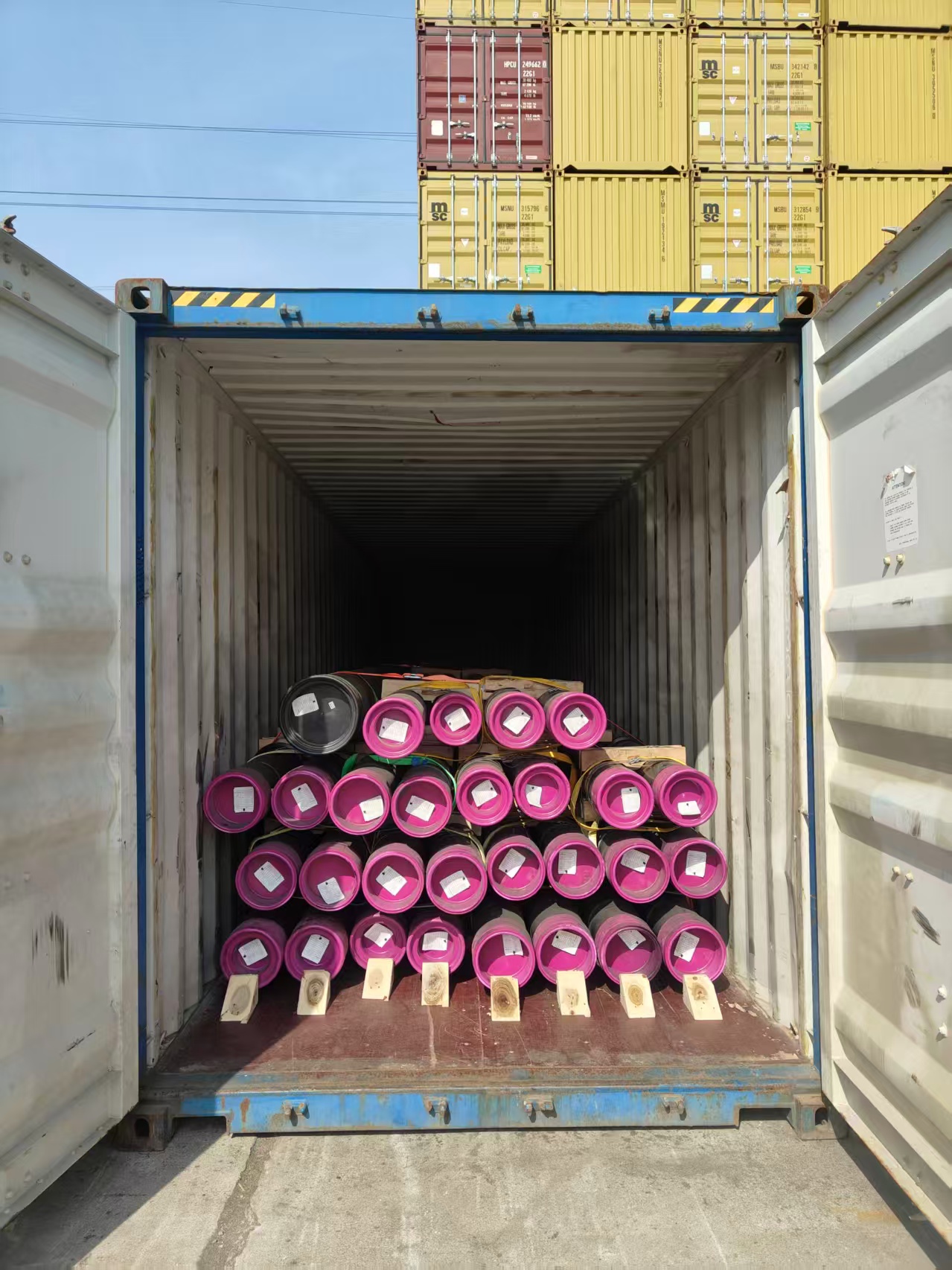 Container loading of ZC Steel Pipe casing with thread protectors fitted, staged in the yard for an Africa-bound shipment.
Quick Answer
Q125 is the highest-strength standard API 5CT casing grade — 862–1034 MPa (125–150 ksi) yield, quench-and-temper only — specified for deep, high-pressure sweet wells where P110 cannot deliver enough collapse resistance. It is not qualified for sour (H2S) service under any subtype; where H2S is present at NACE MR0175 threshold levels, C110 is the correct high-strength grade instead. For any critical deep well, order Type 3 or Type 4 — an unstated type defaults to Type 1, which carries no hardness ceiling.
| Q125 at a glance | Value |
|---|---|
| Min / max yield | 862 / 1034 MPa (125 / 150 ksi) |
| Min tensile | 931 MPa (135 ksi) |
| Heat treatment | Quench & temper (mandatory) |
| Hardness ceiling | None (Types 1–2); 34 HRC (Types 3–4) |
| Sour service (NACE MR0175) | Not permitted |
| Specify for critical wells as | Type 3 or Type 4, PSL-2 |
What we see on Q125 orders: Q125 purchase orders from HPHT project teams almost always specify Type 3 or Type 4 — we have not shipped a Type 1 or Type 2 in the last two years. The engineering reason is the hardness ceiling: Types 3 and 4 carry a 34 HRC maximum, which gives the drilling engineer a hard upper bound on heat treatment quality. Types 1 and 2 have no ceiling. When a PO arrives with the type blank, we contact the buyer before going to mill. Sending Q125 Type 1 to a team expecting Type 3 hardness control creates MTR acceptance problems that are expensive to resolve after the shipment has arrived at port.
What Is API 5CT Q125?
API Specification 5CT, 11th Edition defines Q125 as a casing and tubing grade at the top of the carbon-steel OCTG yield range. The "125" refers to the 125,000 psi (862 MPa) minimum yield strength — a floor 13.6% above P110's 110,000 psi minimum. Three engineering characteristics separate Q125 from everything below it on the API grade ladder:
Maximum yield ceiling of 150,000 psi (1034 MPa). This is the narrowest yield band of any API OCTG grade at this strength level — a 25,000 psi window between the 125 ksi floor and the 150 ksi ceiling. That tight band is intentional: at yield levels above 150 ksi, fracture toughness in Q+T carbon steel degrades sharply and brittle failure risk at connection stress concentrations increases. Q125 material testing above 150 ksi is non-conforming and must be rejected.
Mandatory quench and temper heat treatment. No alternative heat treatment produces the microstructure required to achieve 125–150 ksi yield with adequate toughness at these strength levels. This is not a preferred manufacturing practice under API 5CT — it is required.
Four-subtype system controlling hardness and impact testing. Types 1 through 4 carry progressively tighter quality controls. The subtype determines whether the pipe has a hardness ceiling and whether Charpy V-notch testing is mandatory. This is the most operationally important characteristic of Q125 and the one most often underspecified on purchase orders.
Q125 sits in API 5CT Group 4 alongside its design envelope: deep, high-pressure, confirmed sweet wells. The API color code is one orange band — the same as P110, which sometimes causes marking confusion at the yard. The grade letter "Q" and the size/weight stencil are the distinguishing identifiers.
Mechanical Properties
| Property | Q125 Requirement |
|---|---|
| Minimum yield strength | 862 MPa (125,000 psi) |
| Maximum yield strength | 1034 MPa (150,000 psi) |
| Minimum tensile strength | 931 MPa (135,000 psi) |
| Hardness limit | None for Types 1 and 2; 34 HRC (327 HBW) maximum for Types 3 and 4 |
| Hardness variation control | Maximum 3.0–5.0 HRC delta within a single pipe, per API 5CT wall-thickness schedule |
| Heat treatment | Quench and temper — mandatory for all types |
| API 5CT group | Group 4 |
| Color code | One orange band |
| Sour service (NACE MR0175) | Not permitted |
The yield range deserves equal attention at both ends. The 862 MPa (125 ksi) minimum is the strength floor — pipe below this is non-conforming and must be rejected. The 1034 MPa (150 ksi) maximum is a hard ceiling, not a target. Pipe above 150 ksi yield is non-conforming regardless of other properties, and unlike the P110 over-yield scenario — where the material could theoretically be assessed for alternate applications — Q125 over-yield has nowhere to go in the OCTG grade structure above it.
Even where a hardness limit does not apply (Types 1 and 2), API 5CT does impose hardness variation control: the difference between the maximum and minimum hardness readings within a single pipe body must not exceed 3.0 HRC for wall thickness under 12.70 mm, and not exceed 5.0 HRC for heavier wall. This variation control is the quality proxy that substitutes for a ceiling when no absolute limit is specified — it confirms the Q+T heat treatment was applied uniformly and that the microstructure is consistent along the pipe length.
For the complete grade ladder with tensile, hardness, and chemistry limits, see the API 5CT specification tables →
To match a grade to your well conditions, use the Pipe Grade Selector →
Q125 hardness variation control is not the same as a hardness ceiling. A Type 1 or Type 2 Q125 pipe could theoretically test at 36 HRC throughout its length — consistent, but far above any NACE-compatible level — and still be API-conforming because variation control was met and no absolute ceiling applies. This is one of the structural reasons Q125 cannot be used in H2S environments: without an absolute hardness ceiling for Types 1 and 2, NACE MR0175 compliance cannot be demonstrated or controlled. The only Q125 types with a hardness ceiling are Types 3 and 4 at 34 HRC — and even that is above NACE's carbon-steel limit of 22 HRC.
Q125 Subtype System — Types 1 Through 4
The subtype is the most consequential specification choice on a Q125 purchase order, and the one most often left undefined. All four types share identical yield, tensile, and heat treatment requirements. What changes between them is the hardness ceiling and the mandatory testing requirements.
Type 1 is the baseline designation. API 5CT does not set a hardness ceiling for Type 1. Charpy V-notch testing is not mandatory. The chemistry limits are the broadest of the four types. Type 1 pipe can be produced with the full permissible yield range and no upper bound on actual hardness — only the variation control requirement applies.
Type 2 adds tighter phosphorus (P ≤ 0.020%) and sulfur (S ≤ 0.010%) limits compared to Type 1. There is still no hardness ceiling and still no mandatory Charpy testing. The tighter P and S limits reduce the density of sulphide inclusions and phosphorus segregation — not for sour service use (Q125 is not sour-service rated regardless of type), but for fracture toughness consistency in deep well service.
Type 3 introduces two significant changes: a maximum hardness of 34 HRC (327 HBW), and mandatory Charpy V-notch impact testing per API 5CT requirements. The 34 HRC ceiling provides an upper bound on heat treatment output and gives the drilling engineer a verifiable quality control limit when reviewing the MTR. Types 3 and 4 are the types we actually ship — the hardness ceiling is the feature that makes Type 3 and 4 meaningful for deep critical well applications.
Type 4 carries the same 34 HRC hardness ceiling and mandatory Charpy testing as Type 3, with the addition of a lower maximum carbon content (0.45% vs 0.50% for Types 1–3 per API 5CT) and the most restrictive overall chemistry profile of the four types. Type 4 is specified for the most demanding conditions where both impact toughness and hardness control are critical to string integrity.
| Feature | Type 1 | Type 2 | Type 3 | Type 4 |
|---|---|---|---|---|
| Hardness ceiling | None | None | 34 HRC (327 HBW) | 34 HRC (327 HBW) |
| Mandatory Charpy testing | No | No | Yes | Yes |
| P and S limits | Broader | Tighter | Tighter | Tighter |
| Typical use case | Rarely specified for deep critical wells | Rarely specified for deep critical wells | Standard for HPHT deep wells | Most demanding HPHT applications |
The practical selection guidance: for any well application that requires Q125 — which by definition is a deep, high-pressure critical completion — Types 3 and 4 are the correct specification. The hardness ceiling and mandatory impact testing are not luxury requirements; they are the quality controls that distinguish a known, verifiable heat treatment output from an unconstrained one.
Chemical Composition
API 5CT sets the following chemistry limits for Q125 across all types. Note that several elements are not restricted at the API level — null in the API 5CT table means no maximum applies, not that the element is absent from the steel.
| Element | API 5CT Limit | Notes |
|---|---|---|
| Carbon (C) | Max 0.35% | API 5CT limits carbon for Q125 — controls hardenability and weldability at high strength |
| Manganese (Mn) | Max 1.35% | Upper limit only; no minimum specified |
| Molybdenum (Mo) | Max 0.85% | Upper limit only; the alloying strategy is mill-selected within this bound |
| Chromium (Cr) | Max 1.50% | Upper limit only; no minimum — unlike T95, Cr is not mandatory for Q125 |
| Phosphorus (P) | Max 0.020% | Applies to all Q125 types — tighter than P110 (0.030%) |
| Sulphur (S) | Max 0.010% | Applies to all Q125 types — tighter than P110 (0.030%) |
| Niobium (Nb) | Not restricted by API 5CT | |
| Nickel (Ni) | Not restricted by API 5CT | |
| Copper (Cu) | Not restricted by API 5CT | |
| Silicon (Si) | Not restricted by API 5CT |
The 0.020% phosphorus and 0.010% sulphur limits for Q125 match the tight chemistry controls seen in T95, and both are significantly tighter than P110's 0.030% limits for both elements. This is not arbitrary — at 125–150 ksi yield strength, sulphide inclusions and phosphorus boundary segregation become more consequential to fracture toughness and resistance to brittle failure at connection stress concentrations. Even though Q125 is not sour-service rated, these tight P and S limits reflect the engineering reality that at the top of the carbon-steel yield range, the quality of the base chemistry directly affects fatigue and fracture behaviour in deep well service.
The unrestricted elements — Nb, Ni, Cu, Si — are not absent from Q125 steel. They appear in varying amounts depending on the mill's alloying strategy. API 5CT does not restrict them because Q125's mechanical targets can be achieved through multiple alloying routes. Project specifications from IOC and NOC operating companies frequently add supplementary chemistry requirements on top of API for these elements — check the technical addendum before placing the mill order.
Burst Pressure Calculation
The worked burst calculation below uses the API 5C3 Barlow formula with the 0.875 correction factor applied as required. The example pipe is a 7-inch 29 lb/ft Q125 string, a commonly ordered size for deep production casing applications.
API 5C3 burst formula:
P_burst = 0.875 × (2 × SMYS × t / D)
Inputs:
- SMYS (minimum yield): 125,000 psi (862 MPa)
- Wall thickness (t): 0.408 inch (7" 29 lb/ft per API 5CT Table C.18)
- Outside diameter (D): 7.000 inch
Calculation:
P_burst = 0.875 × (2 × 125,000 × 0.408 / 7.000) P_burst = 0.875 × (102,000 / 7.000) P_burst = 0.875 × 14,571 P_burst = 12,750 psi (87.9 MPa)
For comparison, the same 7-inch 29 lb/ft pipe in P110 (SMYS = 110,000 psi) gives:
P_burst = 0.875 × (2 × 110,000 × 0.408 / 7.000) = 0.875 × 12,823 = 11,220 psi (77.4 MPa)
Q125 delivers 1,530 psi more burst resistance than P110 at identical geometry — a 13.6% gain that corresponds exactly to the ratio of the minimum yield strengths (125/110). The burst advantage of Q125 over P110 is proportional and predictable; what changes in the design is the collapse calculation, where Q125's higher yield shifts the D/t collapse regime boundaries and can deliver significantly larger collapse resistance improvements at thinner wall.
Use the Barlow pressure calculator → to run burst calculations across your full Q125 size and weight range.
When NOT to Use Q125
Q125 is a narrow-application grade. Its correct use cases are deep, high-pressure, confirmed sweet wells — and when any of those three conditions is absent, Q125 is the wrong choice.
Any well with H2S at or above NACE MR0175 threshold partial pressures. Q125 is not listed in NACE MR0175 / ISO 15156-2. There is no type, no chemistry modification, and no supplementary testing that qualifies Q125 for H2S service. Types 3 and 4 have a 34 HRC hardness ceiling — which is still well above NACE's 22 HRC carbon-steel limit. If the wellbore contains H2S above the NACE threshold, C110 is the correct grade for high-pressure sour service.
Wells where P110 collapse and burst ratings are sufficient. Q125 carries a cost premium over P110 — higher alloy content, tighter chemistry controls, tighter quality requirements, and lower production volumes at most mills. If the casing design passes with P110 at adequate design factors for both collapse and burst, Q125 provides no engineering return for that premium. Run the collapse analysis first. Specify Q125 only when the numbers require it.
Surface casing strings. Surface casing sits in a low-collapse, low-burst load environment. The yield strength that defines Q125 is irrelevant in surface strings where H40 or J55 is the engineering-correct selection. Q125 in surface casing wastes material, cost, and available market supply of a grade that is not widely stocked.
When premium connections cannot be sourced for the size. Q125's pipe body performance is largely wasted if the connection cannot develop equivalent strength. At 125–150 ksi yield, BTC provides approximately 95% tensile efficiency — a gap that becomes structurally significant under combined axial and bending loads in deviated deep wells. If premium connections qualified to Q125 body strength are not available for the specified size within the project timeline, rethink the grade or the connection before finalising the design.
Short procurement windows. Q125 Q+T is not a standard mill stocking item. Most mills produce Q125 to order with lead times of 12–16 weeks from PO placement, depending on the size and weight requested. If the well programme timeline has a steel delivery window shorter than this and Q125 is not available from distribution inventory, the grade selection must change — or the programme schedule must be revised. We have delivered Q125 in 10 weeks from order in specific cases, but that depends on whether a suitable heat was partially through the mill schedule. It is not a reliable planning assumption.
When the H2S risk assessment has not been completed. Q125 selection should always be the last step in the grade selection process — after reservoir fluid analysis has confirmed no H2S above NACE threshold levels. If the fluid analysis is pending, do not place a Q125 purchase order. If the analysis comes back positive for H2S after Q125 has been ordered, the entire string specification must be re-evaluated. This is not a theoretical risk; it is a programme scenario we have been involved in.
Q125 vs P110 vs C110 — Grade Selection
The three grades that procurement engineers most commonly compare at the top of the OCTG yield range are Q125, P110, and C110. The selection logic is straightforward once the H2S question is resolved.
| Property | P110 | C110 | Q125 |
|---|---|---|---|
| Min yield strength | 758 MPa (110 ksi) | 758 MPa (110 ksi) | 862 MPa (125 ksi) |
| Max yield strength | 965 MPa (140 ksi) | 828 MPa (120 ksi) | 1034 MPa (150 ksi) |
| Min tensile strength | 862 MPa (125 ksi) | 793 MPa (115 ksi) | 931 MPa (135 ksi) |
| Hardness limit (API) | Not specified | 29.0 HRC maximum | None (Types 1–2); 34 HRC max (Types 3–4) |
| NACE MR0175 sour service | Not permitted | Yes — qualified | Not permitted |
| Mandatory Charpy testing | No (standard PSL-1) | Yes | Types 3 and 4 only |
| Heat treatment | Q+T mandatory | Q+T mandatory | Q+T mandatory |
| Subtype system | None | None | Types 1–4 |
| Primary application | Deep sweet wells | High-pressure sour wells | Ultra-deep sweet wells |
| Relative market availability | Widely stocked | Limited — order-specific | Limited — order-specific |
Choose P110 when the well is sweet, depth and pressure are within P110's collapse and burst design envelope, and cost efficiency at the casing design margins is a factor. P110 is the default high-strength sweet well grade for a reason: it is widely available, well-understood, and the engineering calculations are established.
Choose C110 when the well contains H2S above NACE threshold levels and T95 cannot provide sufficient yield for the casing design. C110's 29 HRC hardness ceiling and NACE MR0175 qualification make it the only high-strength option in sour service. C110's maximum yield ceiling (120 ksi) is lower than Q125's (150 ksi) — a narrower yield band that reflects the tighter heat treatment control required to keep hardness under 29 HRC.
Choose Q125 when the well is confirmed sweet, P110 collapse or burst ratings are insufficient at practical wall thicknesses, and the project timeline accommodates a 12–16 week lead time for Q125 production to order.
The comparison with C110 comes up when a well presents moderate H2S alongside extreme pressure requirements. In that scenario, Q125 is not an option regardless of its strength advantage — C110 with a 29 HRC ceiling and NACE qualification is the answer. We have had buyers propose Q125 for this scenario on the basis that "the H2S is only trace." The correct response is that NACE MR0175 thresholds are defined by partial pressure, not perceived severity — if the threshold is crossed, C110 is required.
Standard Sizes
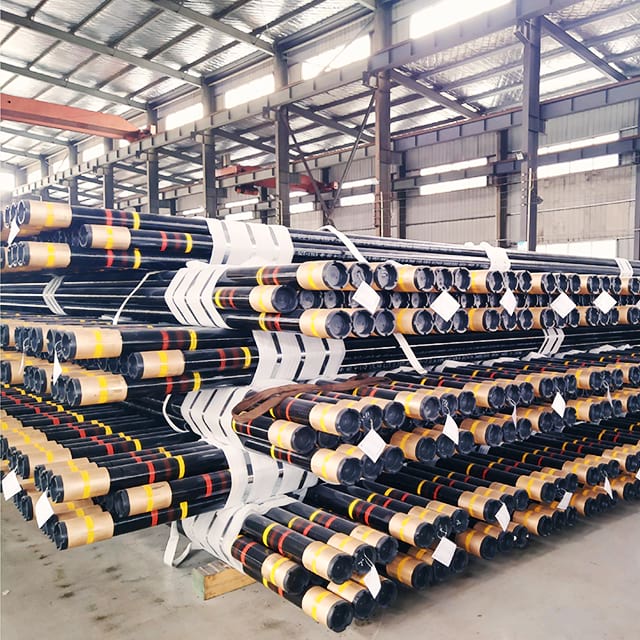 Stacked casing bundles at ZC Steel Pipe, color-band marked by grade and fitted with thread protectors.
Q125 is produced in casing sizes covering the full API range, though market availability concentrates in the sizes most commonly used for deep intermediate and production casing strings.
| OD (inches) | OD (mm) | Common Weights (lb/ft) | Typical Application |
|---|---|---|---|
| 4-1/2 | 114.3 | 9.50–15.10 | Small production casing, deep sweet wells |
| 5 | 127.0 | 11.50–18.00 | Production casing, deep wells |
| 5-1/2 | 139.7 | 14.00–23.00 | Production casing — common Q125 size |
| 7 | 177.8 | 17.00–38.00 | Intermediate and production casing |
| 7-5/8 | 193.7 | 24.00–45.30 | Intermediate casing, ultra-deep wells |
| 9-5/8 | 244.5 | 36.00–58.40 | Intermediate casing |
| 10-3/4 | 273.1 | 40.50–65.70 | Intermediate casing |
| 13-3/8 | 339.7 | 54.50–72.00 | Limited availability — confirm with mill |
Q125 is not a distribution-stock item at most pipe yards. Availability at larger ODs — particularly 10-3/4 inch and 13-3/8 inch — depends heavily on mill scheduling and heat availability. Confirm size and weight availability with the mill before finalising the casing programme design. We have had Q125 orders arrive at advanced project stages where the required size was not achievable within the programme's steel procurement window, requiring a design revision. The size and lead time conversation needs to happen before the casing design is finalized, not after the purchase order is issued.
Product form: Q125 is a casing grade — deep production and intermediate strings. It is not a standard production-tubing product; wells needing tubing at or above the 125 ksi level are specified in CRA or high-strength sour-tubing grades instead. For casing dimensions across the full weight range, see the API 5CT casing sizes and weights guide →.
Connection Selection for Q125
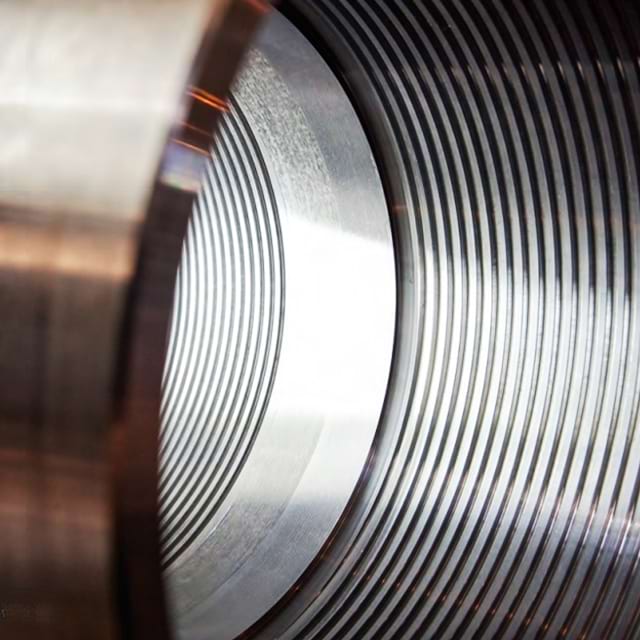 Close-up of a machined premium connection thread — thread form and hardness control are decisive at Q125 yield levels.
Connection selection at Q125 yield strength is different in character from the same exercise at P110 or T95. At 125–150 ksi yield, the connection is almost always the weakest point in the string.
Standard API connections rated against Q125 pipe body:
| Connection | Approximate Tensile Efficiency | Suitability for Q125 |
|---|---|---|
| STC | ~60–70% pipe body | Not recommended — significant strength gap |
| LTC | ~75–80% pipe body | Not recommended for deep or critical wells |
| BTC | ~90–95% pipe body | Marginal — the residual gap becomes significant at depth |
| Premium (metal-to-metal seal) | 100% pipe body | Required for deep, HPHT, and gas-critical applications |
A BTC at 90–95% tensile efficiency against a Q125 pipe body of 125 ksi minimum yield still leaves 6,250–12,500 psi of yield strength in the pipe body that the connection cannot develop. In a deep well where axial string weight alone places significant tensile load on the connection, that gap reduces the operational safety margin below what the pipe body calculations suggest. For Q125, premium connections rated to full pipe body yield are the appropriate specification for any application where the grade is actually needed — which is, by definition, a demanding deep well condition. To size the connection gap against your string weight, use the joint strength calculator →.
Premium connections for Q125 must also be verified to match Q125's chemistry and heat treatment. At 125–150 ksi yield, the coupling material must be machined from Q125 or an equivalent high-strength alloy that maintains dimensional integrity under combined loads. Ask for the coupling material specification on the MTR alongside the pipe body data.
For gas-tight applications in deep sweet wells — where Q125 most commonly appears — metal-to-metal seal connections with an independent thread and seal design provide sustained gas containment independent of thread compound condition. Thread compound seal in BTC connections is not reliable for sustained high-pressure gas service regardless of the pipe grade.
Purchase Order Guidance
A complete Q125 casing purchase order requires explicit specification of items that are optional or implicit for lower API grades:
- Standard — API Specification 5CT, 11th Edition (or ISO 11960)
- Grade and type — Q125 Type 3 or Type 4 for critical deep wells (or Types 1/2 with explicit acknowledgement that no hardness ceiling applies)
- OD and nominal weight — e.g. 7 inch × 29.00 lb/ft
- Connection type — BTC or premium connection designation with qualification standard and tensile efficiency rating
- Range — R1, R2, or R3 (most production strings are R3)
- PSL level — PSL-1 or PSL-2 (PSL-2 for all HPHT or critical applications)
- Charpy impact testing — mandatory for Types 3 and 4; specify if required for Types 1 and 2
- Hardness survey — specify individual pipe hardness values on MTR for Types 3 and 4 (confirm ceiling was met on the actual production heat)
- Sweet service confirmation — confirm H2S is absent at NACE MR0175 threshold levels; Q125 is not suitable for H2S service
- Quantity — in joints or metric tonnes, with minimum order quantity confirmed with the mill
- Delivery port and lead time — confirm 12–16 week minimum for Q125 production to order
- MTC level — EN 10204 3.1 or 3.2 (3.2 third-party witnessed is standard for HPHT and deep well applications)
- Third-party inspection scope — witness hardness and Charpy testing at the mill before shipment
The Procurement Trap — Type Designation
This is the most consequential specification gap on Q125 orders, and the one that creates the most downstream cost.
Wrong PO language:
"API 5CT Q125, PSL-2, 7 inch × 29.00 lb/ft, Premium Connection"
What the mill ships:
Q125 Type 1 — no hardness ceiling, no mandatory Charpy testing, broader chemistry controls. The MTC will show conformance with API 5CT. If the production heat runs at 36–38 HRC — which is API-conforming for Type 1 — the shipment arrives with a valid document and fails any independent quality audit that expects hardness control or impact toughness verification. You cannot upgrade a Type 1 MTC to Type 3 after the fact; the type is set at the time of production.
What to write instead:
"API 5CT Q125 Type 3 (or Type 4), PSL-2, 7 inch × 29.00 lb/ft, [Premium Connection designation], EN 10204 3.2, individual hardness values by pipe on MTR, Charpy V-notch impact test results at [specified temperature] on MTR"
One additional line item in the purchase order. The cost of that line is the 60 seconds it takes to type it. The cost of omitting it is a full-string re-evaluation, potential rejection, and programme delay while Type 3 or Type 4 stock is sourced.
What to Verify on a Q125 MTR
| MTR Item | What to Verify | Why It Matters |
|---|---|---|
| Grade and type designation | Q125 Type [1/2/3/4] — type must be stated | Type defaults to Type 1 if unspecified |
| Yield strength | 862–1034 MPa (125–150 ksi) — verify both limits | Over-yield above 1034 MPa is non-conforming — reject |
| Tensile strength | Min 931 MPa (135 ksi) | Confirms Q+T microstructure was achieved |
| Hardness (Types 3/4) | Individual values by pipe or heat — must not exceed 34 HRC (327 HBW) | Compliance statement alone is insufficient |
| Hardness variation | Maximum delta per pipe per API 5CT schedule | Confirms uniform Q+T — not just the average |
| Heat treatment | Q+T confirmed | No alternative heat treatment is API-conforming for Q125 |
| Phosphorus | ≤ 0.020% | Tighter than P110; failure indicates chemistry substitution |
| Sulphur | ≤ 0.010% | Tighter than P110; high S increases fracture risk at depth |
| Charpy results (Types 3/4) | Values, temperature, specimen size | Mandatory — absence means Type 3/4 was not produced to spec |
| NDE records (PSL-2) | Full-length UT or EMI body scan confirmed | Absence = PSL-1 regardless of labelling |
| Connection MTC (if T&C) | Coupling material specification and heat number | Coupling must match Q125 mechanical requirements |
References
- API Specification 5CT, 11th Edition — Specification for Casing and Tubing (American Petroleum Institute)
- ISO 11960 — Petroleum and Natural Gas Industries: Steel Pipes for Use as Casing or Tubing
- NACE MR0175 / ISO 15156 — Materials for Use in H2S-Containing Environments in Oil and Gas Production
- API Technical Report 5C3 — Equations and Calculations for Casing, Tubing, and Line Pipe Used as Casing or Tubing
Frequently Asked Questions
What is API 5CT Q125 casing pipe?
Q125 is the highest-strength standard casing grade defined in API 5CT, with a minimum yield strength of 125,000 psi (862 MPa) and a maximum yield strength of 150,000 psi (1034 MPa). It is produced exclusively by quench and temper heat treatment and is available in four subtypes (Type 1, 2, 3, and 4) with differing chemistry and hardness limits. Q125 is designed for deep, high-pressure sweet wells where maximum collapse resistance and tensile strength are required.
What are the four types of Q125 casing?
API 5CT defines four Q125 subtypes. Type 1 has no specified chemistry limits beyond carbon equivalent and no hardness limit — it is the baseline type. Type 2 adds a maximum phosphorus limit of 0.020% and a maximum sulfur limit of 0.010%. Type 3 adds more restrictive chemistry controls including a CVN impact test requirement. Type 4 has the most restrictive chemistry and mandatory Charpy impact testing. Higher type numbers indicate tighter quality controls appropriate for more demanding well conditions.
Can Q125 be used in sour service?
No. Q125 is not listed in NACE MR0175/ISO 15156-2 for use in H2S-containing environments. Its high yield strength and the absence of a hardness ceiling in lower type designations make it susceptible to sulfide stress cracking (SSC) in the presence of H2S. For high-strength sour service applications, C110 is the correct grade — it provides 110 ksi minimum yield with explicit NACE MR0175 qualification. Never specify Q125 for wells with H2S present at NACE MR0175 threshold partial pressures.
What is the difference between Q125 and P110?
Q125 has a higher minimum yield strength (125 ksi vs 110 ksi for P110) and a higher maximum yield strength (150 ksi vs 140 ksi for P110). Q125 requires quench and temper heat treatment; P110 can be produced by quench and temper or normalising and tempering depending on the manufacturer. Both grades are not qualified for sour service. Q125 is specified for the deepest, highest-pressure sweet wells where P110 collapse resistance is insufficient.
What is the difference between Q125 and C110?
Q125 has higher yield strength (125 ksi min vs 110 ksi min) but is not rated for sour service. C110 is explicitly qualified under NACE MR0175/ISO 15156-2 for H2S-containing environments with a 29.0 HRC hardness limit. If the well is sweet, Q125 provides higher strength and is the correct choice. If H2S is present at NACE MR0175 threshold levels, C110 is required regardless of the strength advantage of Q125.
What sizes is Q125 casing available in?
Q125 casing is available in standard API casing sizes from 4-1/2 inch to 20 inch OD. Due to its high strength, Q125 is most commonly ordered in intermediate and production casing sizes where collapse resistance is the governing design criterion. ZC Steel Pipe supplies Q125 in seamless form — contact us with your OD, weight per foot, and connection type for availability and lead time.
What connections are recommended for Q125 casing?
Premium connections are strongly recommended for Q125 casing. At 125–150 ksi yield strength, the connection is typically the weakest point in the string — standard BTC or STC connections do not develop full pipe body strength at Q125 yield levels. For deep wells with high axial loads, high collapse requirements, and critical gas containment requirements, a premium connection with 100% tensile efficiency and metal-to-metal seal is the standard specification.