OCTG — Oil Country Tubular Goods — is the collective designation for the steel tubular products that make up the structural and operational core of every oil and gas well: casing, tubing, and drill pipe. The term matters because it signals which standard governs the product. OCTG casing and tubing are manufactured to API Specification 5CT, 11th Edition (ISO 11960); drill pipe to API Specification 5DP. Neither standard is interchangeable with API 5L (line pipe), and specifying the wrong product against the wrong standard is one of the more expensive mistakes a procurement team can make on a well.
Getting OCTG right means more than ordering the right OD and weight. Grade selection determines whether the pipe survives downhole loading — collapse, burst, and tension acting simultaneously — and whether it survives the chemical environment. A grade that is appropriate for a sweet well becomes a liability in a well with H₂S traces. A grade that handles sour service may not have enough yield strength to survive the burst loads in a deep HPHT well. The selection decisions compound, and they start before the purchase order is written.
ZC Steel Pipe supplies API 5CT casing and tubing across the full grade range from J55 through Q125, including the sour service grades L80 Type 1, C90, T95, and C110. We supply BTC and premium connections, and we supply into oil and gas projects across West Africa, the Middle East, and South America. This article covers the complete OCTG product family — product types, the grade ladder, connection types, when each grade is appropriate, and what to write on the purchase order.
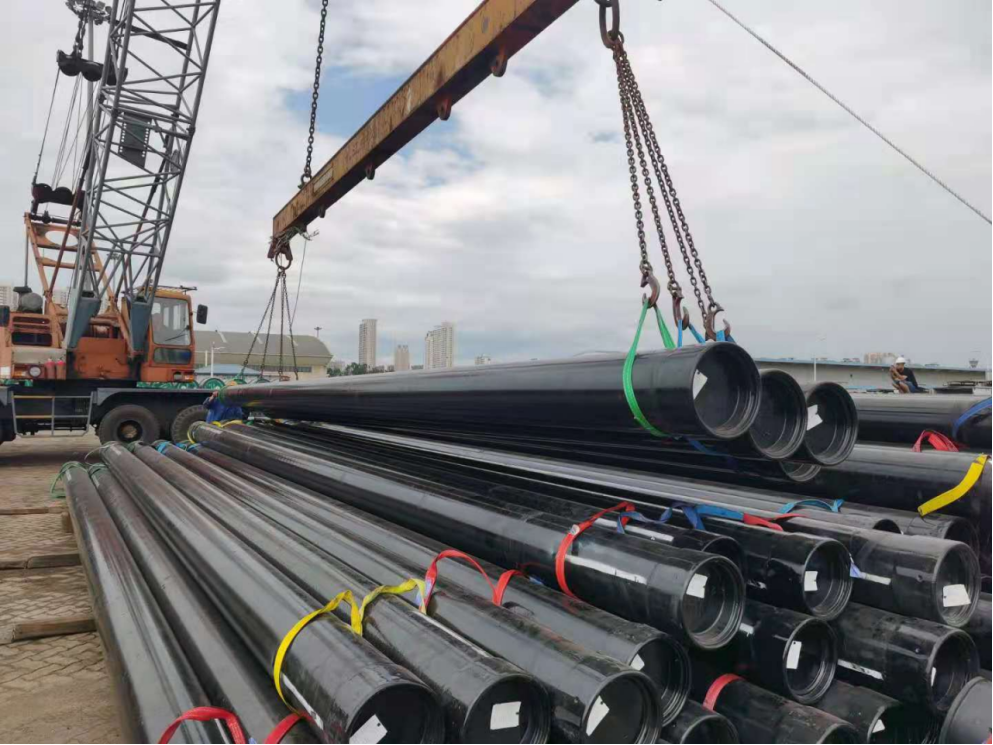 A crane lifting a sling of coated line pipe at the dock — from a real ZC mixed OCTG and line pipe shipment to Africa.
At a Glance
OCTG (Oil Country Tubular Goods) is the umbrella term for three well tubulars, each with its own governing standard:
| Product | Function | Standard |
|---|---|---|
| Casing | Lines and structurally supports the wellbore; cemented in place, permanent | API 5CT |
| Tubing | Production string run inside casing; retrievable during workover | API 5CT |
| Drill pipe | Rotating string that turns the bit and circulates mud; reused across wells | API 5DP |
Grade selection turns on two questions: strength (minimum yield, from J55 at 55 ksi up to Q125 at 125 ksi) and environment — whether the well contains H₂S, which forces a NACE MR0175 sour-service grade such as L80, T95, or C110. The rest of this guide walks the full grade ladder, connection types, and purchase-order language, and you can match a grade to your well directly with the Pipe Grade Selector →.
What OCTG Covers — Three Product Categories
OCTG covers three distinct steel tubular product types, each serving a different function in the well.
Casing is the large-diameter pipe that lines the wellbore. It is run in sections (strings) from surface to progressively deeper formations, and cemented in the annular space between the pipe and the wellbore wall. Casing provides structural integrity to the wellbore, isolates producing formations from other zones (including freshwater aquifers), and contains wellbore pressure during drilling, completion, and production. Once cemented, casing is permanent — it cannot be retrieved without milling. Casing ranges from 4-1/2 inch OD for liners and production strings to 20 inch OD for conductor and surface strings.
Production tubing is run inside the production casing to carry reservoir fluids — oil, gas, formation water — from the perforated interval to surface, and to convey injection fluids downward in injection wells. Tubing is sealed against the production casing by a packer. Unlike casing, tubing can be pulled and replaced during workover operations, which means a tubing corrosion problem is recoverable in a way that a casing corrosion problem is not. Tubing sizes range from 1.9 inch OD for slim-hole applications to 4-1/2 inch OD for high-rate completions.
Drill pipe is the rotating tubular string used during the drilling operation. It transmits torque from the surface rotary table or top drive to the drill bit, and circulates drilling mud down the bore and back up the annulus. Drill pipe is governed by API Specification 5DP — see the drill pipe grades, sizes, and tool joints guide — and differs fundamentally from casing and tubing: it is reused across multiple wells and is not permanently installed. We note this because buyers occasionally ask whether drill pipe can be substituted for casing in certain sizes — it cannot, because the metallurgy, dimensional tolerances, and connection geometry are entirely different.
Why the OCTG/line-pipe split matters on one PO: We regularly consolidate OCTG and line pipe into a single package — one ~2,000-tonne shipment to an African development combined API 5CT K55 13⅜" 68 ppf BTC casing with API 5L X56 LSAW 20"/24" pipe and GR.B seamless flowlines in one delivery. They ship together, but they are certified to different standards — API 5CT for the casing, API 5L for the line pipe — and the MTCs, thread gauging, and inspection scopes do not cross over. Keeping the two standards straight on the order is the buyer's job, not the mill's.
API 5CT Grade Ladder
API Specification 5CT defines casing and tubing grades by minimum yield strength and required heat treatment. The table below covers the full grade range with the key mechanical property values from the specification:
| Grade | Min Yield (ksi) | Max Yield (ksi) | Min Tensile (ksi) | Max HRC | Sour Service |
|---|---|---|---|---|---|
| H40 | 40 | 80 | 60 | — | No |
| J55 | 55 | 80 | 75 | — | No |
| K55 | 55 | 80 | 95 | — | No |
| N80-1 | 80 | 110 | 100 | — | No |
| N80Q | 80 | 110 | 100 | — | No |
| L80 Type 1 | 80 | 95 | 95 | 23.0 | Yes |
| C90 | 90 | 105 | 100 | 25.4 | Yes |
| T95 | 95 | 110 | 105 | 25.4 | Yes |
| P110 | 110 | 140 | 125 | — | No |
| C110 | 110 | 125 | 115 | 29.0 | Yes |
| Q125 | 125 | 150 | 135 | — | No |
The sour service grades — L80 Type 1, C90, T95, and C110 — are qualified under NACE MR0175 / ISO 15156-2 for use in H₂S-containing environments, subject to their hardness limits. Grades without a hardness limit (N80, P110, Q125) must not be used where H₂S is present at partial pressures that trigger NACE MR0175.
For the complete grade ladder with tensile, hardness, and chemistry limits, see the API 5CT specification tables →
To match a grade to your well conditions, use the Pipe Grade Selector →
The API 5CT grade ladder is not a continuous strength progression, and two pairs of grades illustrate this clearly. J55 and K55 share an identical minimum yield strength of 55 ksi — yet they are not interchangeable. J55 has a minimum tensile of 75 ksi; K55's minimum tensile is 95 ksi. The two grades exist for structurally different purposes: K55 is used where higher tensile capacity is required for collapse-dominant loading, while J55 suffices for lighter surface casing where tensile is not the design driver. Similarly, N80 and L80 share an identical minimum yield of 80 ksi — but L80 has a maximum yield ceiling of 95 ksi and a hardness limit of 23.0 HRC, both of which are absent from N80. Those constraints are what make L80 sour-service-rated and N80 not. Two grades at the same yield floor can have entirely different performance envelopes.
PSL-1 vs PSL-2 — Documentation and Testing Floor
API 5CT defines two Performance Specification Levels that operate as a documentation and testing floor on top of the grade requirements:
| Requirement | PSL-1 | PSL-2 |
|---|---|---|
| Charpy V-notch impact test | Not required | Mandatory |
| Hardness testing | Grade-dependent | Mandatory for all grades |
| Chemical analysis | Heat analysis | Product (pipe) analysis |
| Maximum yield strength | Not controlled | Controlled |
| Non-destructive examination | Not required for most grades | Required |
| MTC format | EN 10204 3.1 | EN 10204 3.2 (most markets) |
| Typical application | Standard sweet service casing | Gas wells, sour service, HPHT |
PSL-1 is the minimum required by API 5CT. PSL-2 adds a layer of testing and documentation that gives engineering teams higher confidence in material performance lot-to-lot. For gas wells, PSL-2 is effectively mandatory — most operating company specifications require it. For sour service grades (L80, C90, T95, C110), specifying PSL-2 ensures that the Charpy testing and hardness records that NACE MR0175 compliance reviews require are part of the delivered documentation package.
We treat PSL-2 as the default for sour service orders from West African and Middle Eastern operators, where operating company specifications consistently require it regardless of well depth or pressure. Buyers who default to PSL-1 to reduce cost sometimes find that the receiving yard's QAQC team rejects the documentation package on arrival — at which point the pipe is on hold and the rig is waiting.
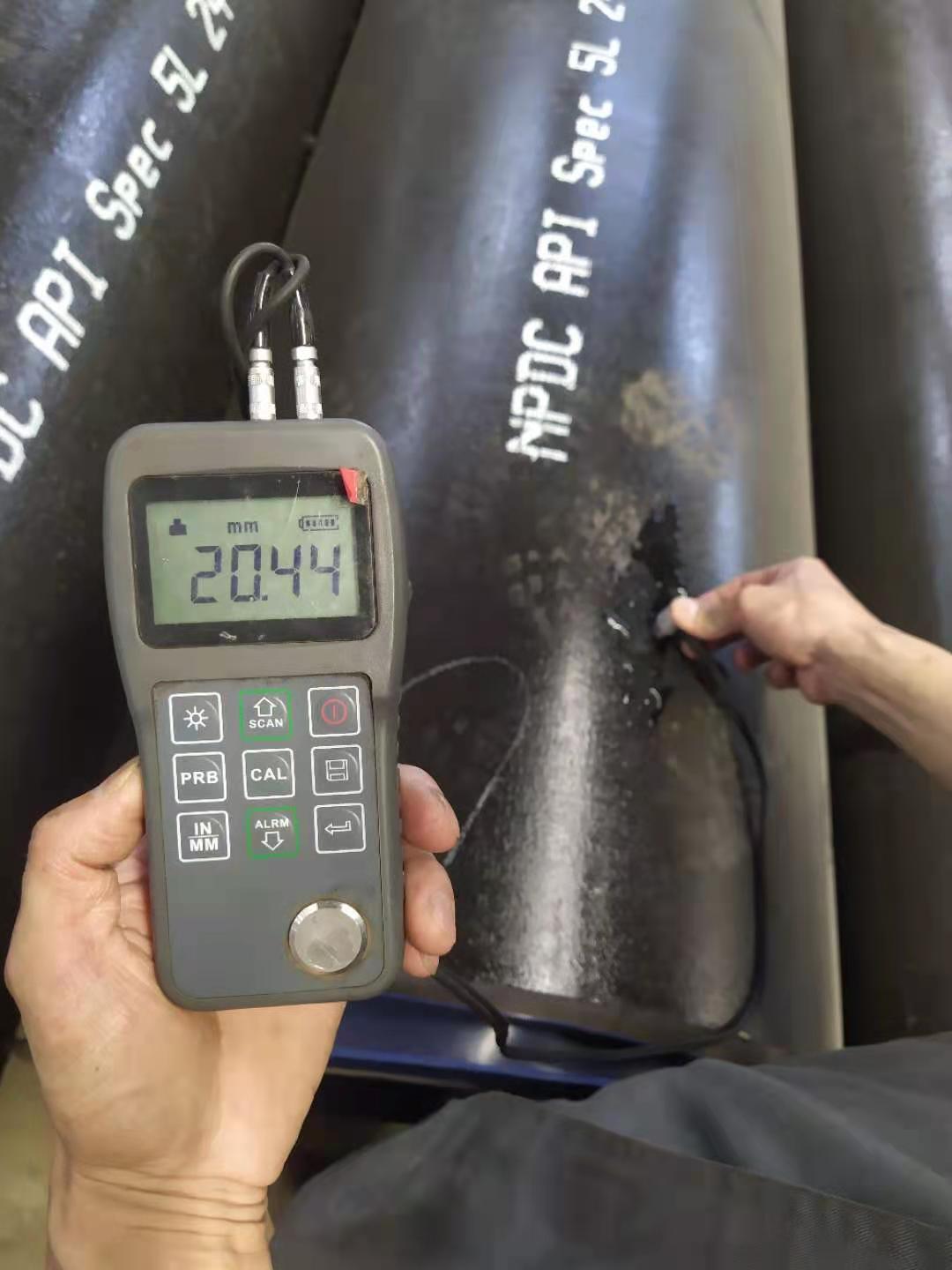 Ultrasonic wall-thickness measurement on a joint stencilled "API Spec 5L" during dimensional QC — from a real ZC line pipe order shipped alongside OCTG.
What we see on orders: The single most common OCTG procurement error we encounter is purchase orders that specify "N80 casing" without stating whether N80-1 (normalised or normalised and tempered) or N80Q (quench and tempered) is required. API 5CT treats these as two distinct grades — the designation appears on the MTC, the heat treatment route is different, and the hardness variation between the two types is not negligible. N80-1 permits a broader hardness range than N80Q because the normalising process does not produce the same microstructural uniformity as quench and temper. When the PO says only "N80," the mill supplies whichever type is in stock. For most sweet casing applications the distinction is acceptable. For buyers running string design calculations that assume consistent mechanical properties through the string — or for buyers switching from N80 to L80 and not understanding why L80 has a hardness ceiling — the difference matters. Write "N80Q" or "N80-1" on the PO, not "N80."
OCTG Connections
Connections join individual casing or tubing joints into a continuous string. The choice of connection affects sealing integrity, tensile capacity, and leak resistance — and it interacts with the grade selection in ways that are not always obvious.
API Connections (API 5B) cover three casing thread types: STC (Short Thread Casing), LTC (Long Thread Casing), and BTC (Buttress Thread Casing). STC has the shortest thread engagement and lowest tensile efficiency — approximately 60–80% of pipe body — and is used for shallow surface casing where loading is light. LTC improves on STC's engagement and runs at roughly 80–95% tensile efficiency. BTC uses a trapezoidal thread profile that provides the highest API connection tensile efficiency and is the industry default for production casing in most conventional wells. BTC is not gas-tight on its own — it relies on thread compound for sealing, which is adequate for liquid-dominant wells but insufficient for sustained gas pressure.
Premium connections are proprietary designs with metal-to-metal seals that provide gas-tight performance independent of thread compound. They are required for gas producers, HPHT wells, highly deviated wells, and any application where BTC combined-load capacity is the design constraint. Premium connections are qualified to ISO 13679 — typically CAL IV for gas-tight service. The connection and the casing grade must both be specified for the service environment: a premium connection on P110 casing in a sour well does not resolve the P110 suitability problem.
For a detailed comparison of API and premium connection performance, load ratings, and failure modes, see the casing connection types guide →
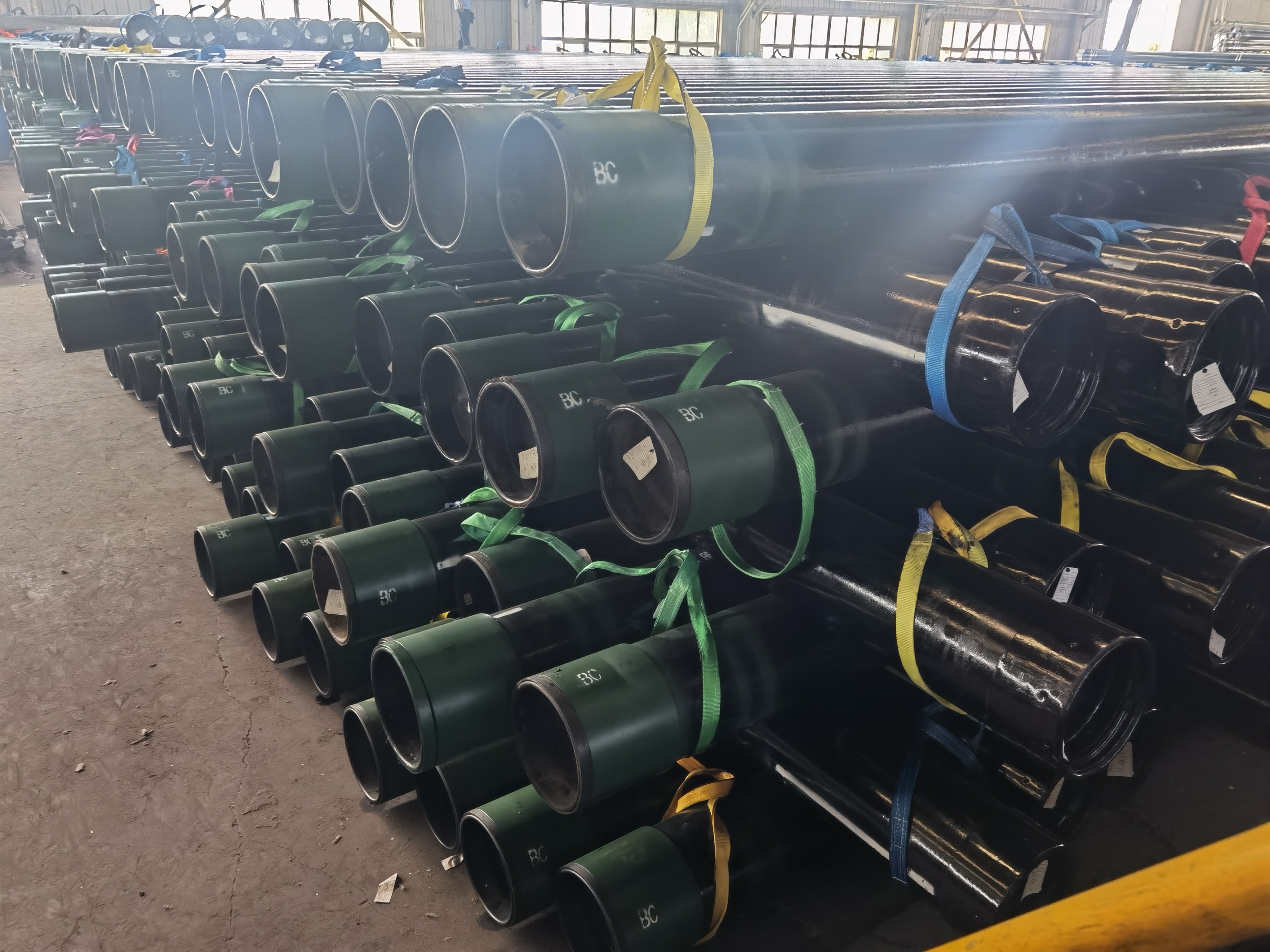 OCTG casing with buttress "BC" couplings made up and green thread protectors fitted — from a real ZC casing order.
When NOT to Use Each Grade Category
Grade selection is as much about knowing what to exclude as what to specify. These are the misspecification scenarios we see most often.
Do not use P110 or Q125 where H₂S is present. Neither grade is listed in NACE MR0175 / ISO 15156-2 as sour-service-rated. P110 has no hardness ceiling — it can be manufactured at hardness levels that make it susceptible to sulphide stress cracking (SSC) in the presence of H₂S partial pressures above the NACE threshold. SSC is a brittle fracture mechanism that can cause catastrophic failure without visible corrosion or significant plastic deformation. A well design that uses P110 for the production string and subsequently encounters H₂S — even at low concentrations in what was assessed as a "probably sweet" reservoir — is a well with a P110 string that cannot be left in service without remediation. This is one of the named failure modes in OCTG that causes the most expensive outcomes in the industry, because SSC in casing typically requires a well kill and a full string pull.
Do not use N80 in wells where H₂S is uncertain. N80 does not have a hardness ceiling and is not sour-service-qualified. If the reservoir assessment is uncertain about H₂S partial pressure — if there is geological evidence of H₂S in adjacent formations, or if the field has produced H₂S previously — using N80 to save cost over L80 creates risk that is not proportional to the price differential. L80 Type 1 adds a hardness ceiling and NACE qualification. In most markets the cost premium for L80 over N80 at equivalent OD and weight is not large enough to justify the exposure.
Do not over-specify CRA tubing in confirmed sweet wells. L80-13Cr tubing costs three to five times the equivalent L80 carbon steel, and the premium is only justified where CO₂ corrosion rates would otherwise require inhibitor injection at a cost that exceeds the material premium over well life. In sweet wells with no CO₂ or H₂S, standard N80 or L80 Type 1 carbon steel tubing is the correct specification. We have received CRA tubing inquiries from operators who specified it as a precaution on wells where the produced fluid analysis showed no corrosive species — the correct answer in those cases is not to supply the CRA, but to ask whether the well assessment genuinely warrants it.
Burst Pressure Worked Example — Grade Impact
To make the grade selection decision concrete, consider a 7-inch, 23 lb/ft production casing string. This is one of the most common casing sizes and weights in the industry, and the choice between N80/L80 and P110 at this size is a real procurement decision.
The Barlow burst pressure formula per API 5C3 is:
P = 0.875 × (2 × YS × t) / OD
where YS is minimum yield strength (psi), t is nominal wall thickness (inches), and OD is outside diameter (inches). The 0.875 factor is the API design factor for burst.
For 7-inch 23 lb/ft casing: OD = 7.000 inches, nominal wall t = 0.317 inches.
N80 or L80 (both have minimum yield 80,000 psi):
P = 0.875 × (2 × 80,000 × 0.317) / 7.000 = 0.875 × 7,246 = 6,340 psi
P110 (minimum yield 110,000 psi):
P = 0.875 × (2 × 110,000 × 0.317) / 7.000 = 0.875 × 9,963 = 8,720 psi
The same pipe size — 7-inch 23 lb/ft — delivers 37.5% higher burst resistance by upgrading from N80 to P110. That is the engineering case for P110 in deep, high-pressure sweet wells. The cost of that upgrade is losing sour service qualification entirely. If H₂S is present, P110's 8,720 psi burst rating is irrelevant — the grade is disqualified, and the well must be designed around T95 (95 ksi yield) or C110 (110 ksi yield, sour service rated) at higher material cost.
Use the Barlow pressure calculator → to run these calculations for your specific OD and wall combination.
Procurement Trap and Correct PO Language
The most consequential procurement trap in OCTG sourcing involves L80 type designation. API 5CT defines multiple L80 sub-types: L80 Type 1 (carbon-manganese steel, sour service qualified), L80 Type 9Cr (9% chromium, CO₂ corrosion grade), and L80 Type 13Cr (13% chromium, CO₂ corrosion grade). These are not interchangeable — they have different chemistry, different heat treatment, and different service qualifications.
A purchase order that reads "API 5CT L80" without a type designation is legally and commercially valid for the mill to fulfil with any of these types, whichever is available. If you need sour service casing (H₂S environment), you need L80 Type 1 — the carbon-manganese grade. If you need CO₂ corrosion resistance, you need L80 Type 13Cr. If your PO says only "L80," you may receive L80 Type 13Cr, which is not sour-service-qualified under NACE MR0175 / ISO 15156-2. The mill is fully API-compliant. The pipe is wrong for the well.
The correct PO language is explicit: "API 5CT L80 Type 1" for sour service, "API 5CT L80 Type 13Cr" for CO₂ service. The word "Type" and the number must appear on the purchase order.
For a full discussion of sour service grade selection across the NACE MR0175 H₂S partial pressure envelope, see the sour service grade selection guide →
Supply and Documentation
When ordering OCTG casing or tubing, the minimum required specification on the purchase order is:
- Standard and edition: API Specification 5CT, 11th Edition / ISO 11960
- Grade and type: for example, "L80 Type 1" or "N80Q" or "P110" — never a bare grade designation for any grade with sub-types
- OD (inches) and nominal weight (lb/ft)
- End finish: BTC, EUE (for tubing), or premium connection designation with proprietary name
- Length range: Range 1 (16–25 ft), Range 2 (25–34 ft), or Range 3 (34–48 ft)
- PSL level: PSL-1 or PSL-2
- Sour service requirements if applicable — SR15A or SR15C per API 5CT Annex H
- MTC format: EN 10204 3.1 or 3.2 (specify 3.2 for gas wells and sour service)
- Quantity in joints and tonnes
For sour service grades, also specify the applicable NACE MR0175 / ISO 15156-2 requirements — particularly whether individual pipe hardness survey records are required on the MTC. Mills can supply aggregate heat hardness without individual pipe records unless the PO requires otherwise. For operating companies whose QAQC process requires individual pipe verification, this must be in the PO — not in a post-delivery dispute.
ZC Steel Pipe supplies API 5CT casing and tubing in seamless form across the full grade range from J55 through Q125, including sour service grades and 13Cr tubing. Contact us with your well specifications — grade and type, OD, weight, connection, PSL level, and quantity — for availability and lead time confirmation.
Frequently Asked Questions
What does OCTG stand for?
OCTG stands for Oil Country Tubular Goods — the collective term for the steel tubular products used in oil and gas well drilling, completion, and production. OCTG covers three main product categories: casing (structural lining of the wellbore), tubing (production string inside the casing), and drill pipe (rotating pipe used during drilling). All three are manufactured to API standards — primarily API 5CT for casing and tubing, and API 5DP for drill pipe.
What is the difference between OCTG casing and tubing?
Casing is the large-diameter steel pipe that lines the wellbore wall, providing structural support, isolating formations, and containing wellbore pressure. It is cemented in place and is permanent. Tubing is the smaller-diameter pipe run inside the production casing string to carry oil, gas, or injection fluids to or from the reservoir. Unlike casing, tubing can be pulled and replaced during workovers. Casing ranges from 4-1/2 to 20 inches OD; tubing typically from 1.9 to 4-1/2 inches OD.
What grades are available for OCTG casing?
API 5CT defines the following casing grades in order of increasing yield strength: H40 (minimum yield 276 MPa), J55 (379 MPa), K55 (379 MPa), N80 (552 MPa), L80 (552 MPa, sour service), C90 (621 MPa, sour service), T95 (655 MPa, sour service), P110 (758 MPa), C110 (758 MPa, severe sour service), and Q125 (862 MPa). L80, C90, T95, and C110 are sour service grades qualified per NACE MR0175/ISO 15156. P110 and Q125 are high-strength grades for deep sweet wells.
What standard governs OCTG casing and tubing?
API 5CT (Specification for Casing and Tubing) is the primary standard governing OCTG casing and tubing. Its international equivalent is ISO 11960. API 5CT defines grade designations, chemical composition, mechanical property requirements, dimensional tolerances, testing requirements, and marking. The standard defines two performance specification levels: PSL-1 (standard) and PSL-2 (enhanced requirements for gas service and critical applications).
What is PSL1 vs PSL2 for OCTG?
PSL (Performance Specification Level) defines the level of additional requirements beyond the base API 5CT specification. PSL-1 is the standard level covering basic chemistry, mechanical properties, and dimensional requirements. PSL-2 adds enhanced requirements including Charpy impact testing, hardness testing, tighter dimensional tolerances, and additional chemical analysis. PSL-2 is required for gas wells, sour service, and HPHT applications where higher confidence in material performance is needed.
What connections are used on OCTG casing?
OCTG casing connections fall into two categories: API standard connections and premium connections. API connections defined in API 5B include STC (Short Thread Casing), LTC (Long Thread Casing), and BTC (Buttress Thread Casing). BTC is the most common API connection for production casing. Premium connections are proprietary designs with metal-to-metal seals providing gas-tight performance — required for gas wells, HPHT, and deviated wells where BTC capability is insufficient.
How is OCTG different from line pipe?
OCTG and line pipe are both steel pipe products but serve different functions and are manufactured to different standards. OCTG (API 5CT) is used inside oil and gas wells — for wellbore lining (casing) and production (tubing). Line pipe (API 5L) is used for surface pipelines transporting oil, gas, or water between locations. OCTG is designed for complex downhole loading (collapse, burst, tension combined); line pipe is designed primarily for internal pressure containment over long distances.
What is the most commonly used OCTG grade?
N80 and L80 are the most widely used OCTG casing grades globally. Both have minimum yield strength of 552 MPa (80,000 psi) and are standard for intermediate and production casing in most conventional wells. N80 is used for sweet service wells where cost is the primary driver. L80 is used when H₂S is present or when sour service qualification is required. P110 is the most common grade for deep high-pressure sweet wells.