Drill pipe is the working string that connects the surface drilling equipment to the bit — transmitting rotation, axial force, and drilling fluid circulation to the bottom of the well. Unlike casing and tubing, drill pipe is subjected to simultaneous tension, compression, bending, and torsion loads throughout its service life. These demanding conditions make grade selection, inspection, and maintenance critical factors in drilling performance and safety.
ZC Steel Pipe supplies new drill pipe to API 5DP across the standard grade and size range. This guide covers API 5DP grades, standard sizes and weights, tool joint specifications, and the key technical parameters for drill pipe procurement.
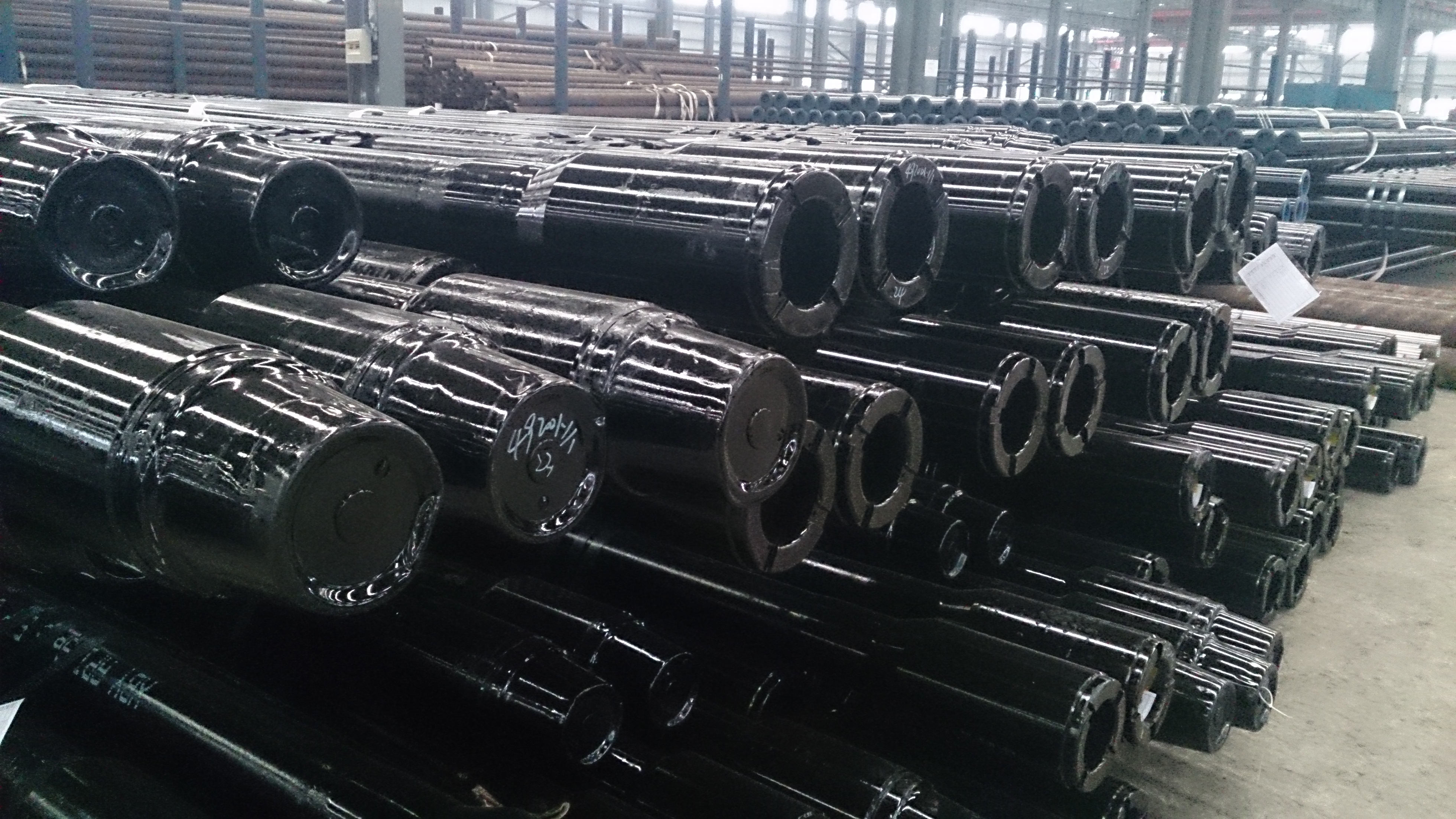 ZC drill pipe stacked in the warehouse, black-coated pipe bodies with the heavier upset tool-joint ends visible at the row faces.
On a North Africa directional drilling programme, the operator specified E75 drill pipe to save cost — the well was originally planned as a near-vertical 4,800 m test. Mid-campaign, the well was re-planned to 42° maximum inclination. The E75 drill pipe remained in the programme. A torsional fatigue crack opened at the pipe body mid-joint on the 12th directional run, requiring a 2-week fishing operation and a $380,000 recovery cost. The grade differential between E75 and S135 on 5-inch 19.5 lb/ft pipe is under $8/metre — a cost that would have paid for itself on the first directional run.
1. API 5DP Drill Pipe Grades
| Grade | Min YS (ksi) | Max YS (ksi) | Min TS (ksi) | Typical Application |
|---|---|---|---|---|
| E75 | 75 | 105 | 100 | Shallow wells, low-torque applications |
| X95 | 95 | 125 | 105 | Standard intermediate wells |
| G105 | 105 | 135 | 115 | High-torque directional drilling |
| S135 | 135 | 165 | 145 | Deep wells, high-torque, HPHT |
| V150 | 150 | 170 | 160 | Highest strength applications |
For directional drilling, the governing design criterion is fatigue limit — not minimum yield strength. S135 has approximately 80% higher torsional strength than E75 at the same OD and wall, but its fatigue endurance limit under rotating-bending is proportionally more important in extended-reach and horizontal wells where the drill string cycles through a dogleg with every rotation. An E75 drill pipe that is adequate for static tensile load in a vertical well may be running well below its safe fatigue life in a 30°+ directional section — and fatigue damage accumulates silently until crack initiation.
S135 is the most commonly specified grade for modern drilling operations. Its high yield strength provides the tensile capacity for deep strings and the torsional strength for extended-reach and horizontal wells.
Torsional Strength Comparison — E75 vs S135 at 5-inch 19.5 lb/ft
Step 1 — Pipe geometry: OD = 5.000 inches, WT = 0.362 inches, ID = 4.276 inches
Step 2 — Polar moment of inertia (J): J = π/32 × (OD⁴ − ID⁴) = π/32 × (5.000⁴ − 4.276⁴) = 16.35 in⁴
Step 3 — Torsional yield strength — E75 (YS = 75,000 psi): T_E75 = 0.577 × YS × J / (OD/2) T_E75 = 0.577 × 75,000 × 16.35 / 2.500 = 283,000 ft-lb (approx)
Step 4 — Torsional yield strength — S135 (YS = 135,000 psi): T_S135 = 0.577 × 135,000 × 16.35 / 2.500 = 509,000 ft-lb (approx)
Step 5 — Ratio: S135 / E75 = 509,000 / 283,000 = 1.80× higher torsional capacity
Conclusion: S135 provides 80% more torsional strength than E75 at identical OD and wall. In directional drilling where torque-and-drag loads are high and fatigue cycling is constant, this margin is not a luxury — it is the primary reason S135 is the standard grade for extended-reach and directional programmes.
2. Standard Sizes and Weights
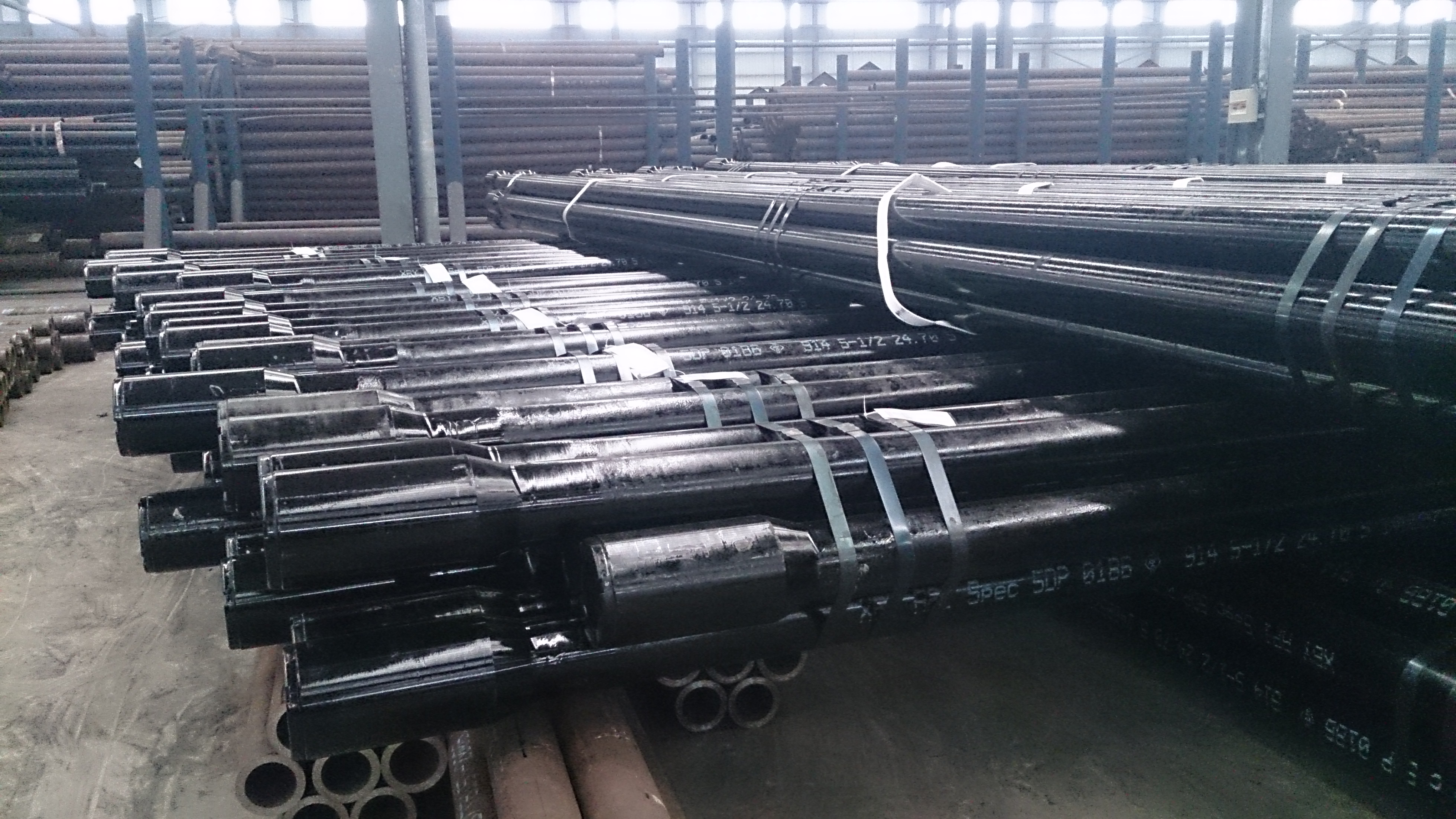 Bundled ZC drill pipe stencilled with the API "Spec 5DP" designation and size-weight marking (5-1/2 24.70) for size and grade traceability.
| OD (inches) | Weight (lb/ft) | Wall (inches) | ID (inches) | Grade range |
|---|---|---|---|---|
| 3-1/2 | 13.30 | 0.368 | 2.764 | E75–S135 |
| 4 | 14.00 | 0.330 | 3.340 | E75–S135 |
| 4-1/2 | 16.60 | 0.337 | 3.826 | E75–S135 |
| 5 | 19.50 | 0.362 | 4.276 | E75–S135 |
| 5 | 25.60 | 0.500 | 4.000 | E75–S135 |
| 5-1/2 | 21.90 | 0.361 | 4.778 | E75–S135 |
| 5-7/8 | 23.40 | 0.361 | 5.153 | E75–S135 |
| 6-5/8 | 25.20 | 0.330 | 5.965 | E75–S135 |
For the complete grade ladder with tensile and chemistry limits — plus every drill pipe size, tool joint dimension, and connection — see the API 5DP specification tables →
To match a grade to your well conditions, use the Pipe Grade Selector →
3. Tool Joints
Tool joints are the heavy-walled threaded connections at each end of the drill pipe body. They are inertia-welded to the pipe and are the primary structural connection in the drill string.
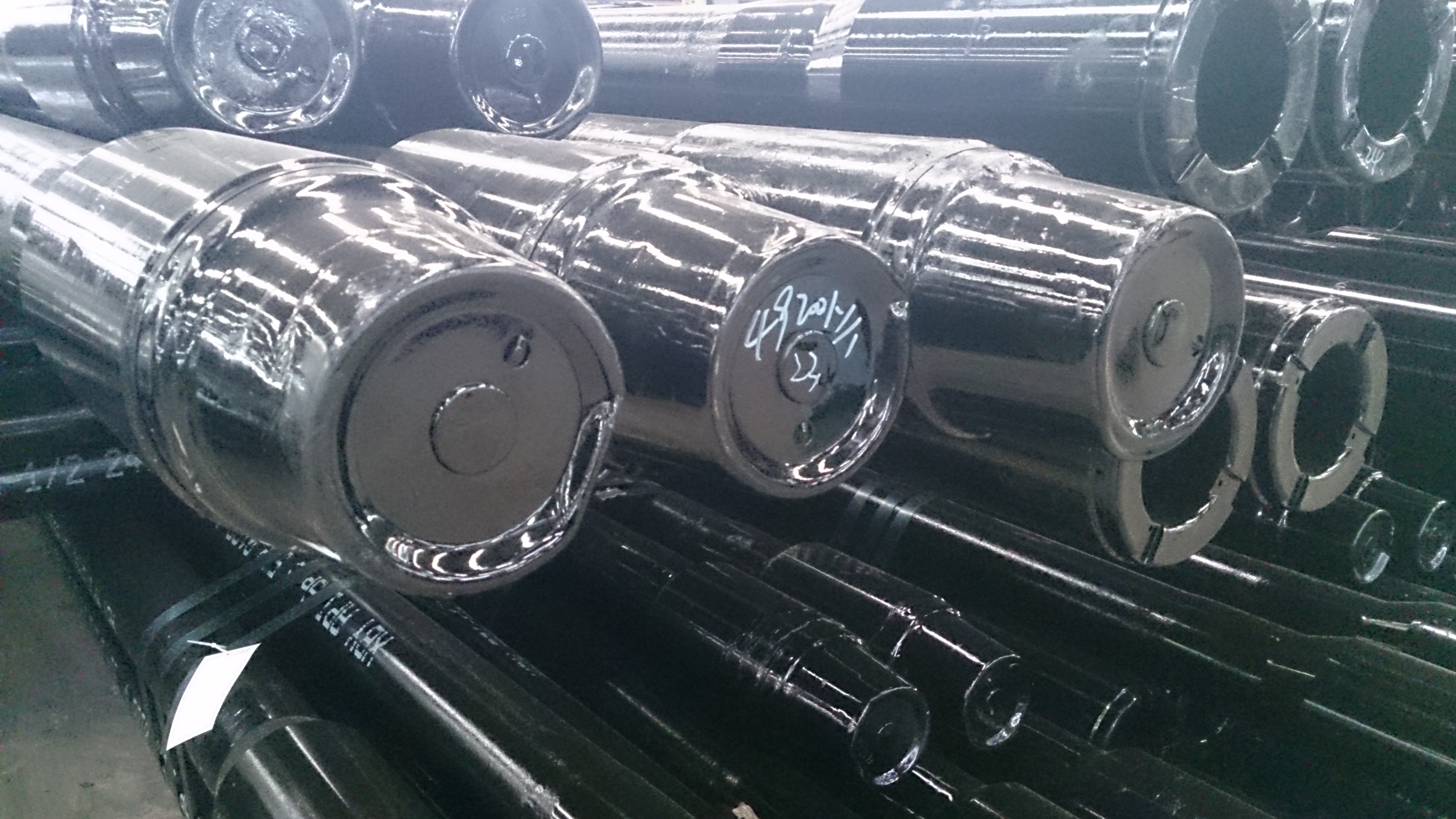 Close-up of black-coated tool-joint box ends on ZC drill pipe — the heavier-walled, larger-OD rotary shoulder connections welded to the pipe body.
Tool Joint Geometry
| Component | Description |
|---|---|
| Box | Female (upper) connection — receives the pin |
| Pin | Male (lower) connection — inserts into box |
| OD | Larger than pipe body — provides wear material |
| ID | Must not restrict flow below pipe body ID excessively |
| Bevel diameter | Critical for make-up and seal |
| Tong space | Length available for tong gripping during make-up |
Standard API Thread Forms
| Connection | OD range | Notes |
|---|---|---|
| NC31 | 3-1/2" pipe | Standard for 3-1/2" DP |
| NC38 | 4" pipe | Standard for 4" DP |
| NC40 | 4-1/2" pipe | Standard for 4-1/2" DP |
| NC50 | 5" pipe | Standard for 5" DP |
| NC50 / 5-1/2 FH | 5-1/2" pipe | Depends on ID requirement |
| NC56 | 5-7/8" pipe | Standard for 5-7/8" DP |
| NC61 | 6-5/8" pipe | Standard for 6-5/8" DP |
Tool Joint OD and ID Selection
Tool joint OD must be large enough to provide adequate torsional strength and wear life but not so large that it creates excessive annular pressure loss or restricts through-casing passage. Tool joint ID must provide adequate flow area without excessively reducing pipe body ID. API RP 7G and the drill string design engineer determine the optimum tool joint geometry for each application.
The through-casing clearance depends on the casing string the drill pipe runs inside — commonly N80 or P110 production casing, whose drift diameters are set in the API 5CT specification tables. Check the tool joint OD maximum against the tightest casing drift on the well before ordering, not against the nominal casing ID.
4. Drill Pipe Inspection Classes
New drill pipe is supplied to API 5DP Category 1 (equivalent to DS-1 Category 1) inspection requirements. Used drill pipe is classified by remaining wall thickness:
| Class | Min Wall | Application |
|---|---|---|
| Premium | ≥80% | Normal drilling service |
| Class 2 | 65–80% | Limited/low-stress service |
| Class 3 | 55–65% | Minimal stress only |
For new drill pipe procurement, confirm the following inspection is included:
- Full-length electromagnetic inspection (EMI) of pipe body
- Ultrasonic inspection of tool joint welds
- Dimensional inspection of tool joint OD, ID, tong space
- Thread inspection — API RP 7A1 gauge inspection of pin and box
- Hydrostatic pressure test
- Visual inspection per API 5DP
5. Heavy Weight Drill Pipe (HWDP)
HWDP is used in the transition zone between drill collars and standard drill pipe. It has:
- Thicker pipe body wall than standard drill pipe
- Centre upset for wear resistance and stiffness transition
- Standard tool joints at each end
- Typically 5" or 5-1/2" OD in common hole sizes
HWDP reduces fatigue damage at the top of the drill collar string — one of the most common failure locations in the drill string. Most BHA designs include 10–30 joints of HWDP above the drill collars.
When NOT to Use E75 or X95 Grade Drill Pipe
| Scenario | Risk | Correct Approach |
|---|---|---|
| Directional wells with inclination >25° | Fatigue cycle loading in dogleg sections rapidly approaches E75 endurance limit | Specify G105 or S135 for any directional programme planned above 25° |
| Extended-reach or horizontal wells | Combined torsion and bending loads; E75 torsional strength inadequate for high-WOB ERD | S135 is the standard grade for ERD and horizontal wells |
| HPHT wells requiring high torque-and-drag margin | Insufficient tensile margin with lower grades in deep HPHT strings | S135 provides maximum tensile and torsional capacity for deep high-angle wells |
| Tool joint OD not specified on PO | Mill can supply correct pipe body but tool joint OD may exceed casing clearance, causing casing wear | Specify tool joint OD maximum on every drill pipe order |
| Used drill pipe without DS-1 inspection | Wall thickness, fatigue damage, and tool joint wear unknown | Require DS-1 Category 1 or 2 inspection report for any non-new drill pipe |
| Mixed grades in one BHA run | Torsional and tensile discontinuity at grade transition; fatigue initiation at transition joint | Keep consistent grade throughout the drill string above the BHA |
6. Procurement Checklist
Procurement trap — tool joint OD not specified:
Wrong PO: "5-inch S135 drill pipe, 19.5 lb/ft, NC50 tool joint, Range 2, 120 joints."
What ships: S135 pipe body, NC50 threads — but tool joint OD may be 6.750 inches (171.5 mm). Running this string inside 7-inch 26 lb/ft L80 casing (ID = 6.276 inches) leaves only 0.24 inch (6 mm) radial clearance. Any dogleg causes the tool joint to contact and groove the casing bore, creating a stress concentration that initiates fatigue cracks in the casing — damage that only appears at the next caliper log.
Correct PO: "5-inch S135 drill pipe, 19.5 lb/ft, NC50 tool joint, Range 2, 120 joints. Tool joint OD maximum 6.500 inches (165.1 mm). Tool joint ID minimum 2.875 inches (73.0 mm). Confirm tool joint OD and ID on MTC before shipment."
- Grade: E75 / X95 / G105 / S135
- OD and weight per foot
- Tool joint connection: NC__ or proprietary thread form
- Tool joint OD and ID — confirm for your casing programme
- Length: Range 2 (27–30 ft) standard for drill pipe
- Inspection: API 5DP Category 1, DS-1 Category 1 or 2
- Hardbanding: specify type and location if required
- Mill test report: pipe body and tool joint chemistry, mechanical properties
- Drift: confirm drift diameter for completion tools
Failure Modes
Failure Mode 1 — E75 torsional fatigue failure in directional section
Mechanism: E75 drill pipe is run in a directional section with 35° inclination and a 3°/30m dogleg. Each pipe rotation cycles the drill pipe through a bending load at the dogleg. E75's lower torsional and fatigue strength means the cumulative fatigue damage reaches the endurance limit within the planned well footage. A fatigue crack initiates at the pipe body slip zone (the weakest cross-section), propagates, and causes a twist-off.
Diagnostic: Drill string twist-off recovered by fishing. Inspection of the broken end shows a classic fatigue fracture pattern — smooth, progressive crack face with a final fast-fracture zone. Crack origin is at the slip die mark on the pipe body, not at the tool joint.
Fix: Upgrade to G105 or S135 for all directional drilling above 25°. Fatigue life analysis using the API RP 7G design curve should be performed before committing a grade to a directional programme.
Failure Mode 2 — Tool joint OD causes casing wear in directional well
Mechanism: Drill pipe with tool joint OD 6.750 inches is run inside 7-inch 26 lb/ft casing with ID 6.276 inches. In a dogleg of 2°/30m, the tool joint contacts the casing ID at every rotation. The casing wear groove deepens progressively with rotating hours. After 200 rotating hours, the casing wall at the dogleg is reduced by 35%, creating a pressure integrity risk that only appears on the next casing wear caliper log.
Diagnostic: Casing wear caliper log after drilling shows a circumferential groove at the dogleg depth. The groove width corresponds to the tool joint tong space length. Dimensional comparison confirms tool joint OD exceeded the safe contact threshold for the casing ID.
Fix: For every drill pipe order, specify a maximum tool joint OD compatible with the minimum casing ID at the deepest dogleg. The recommended minimum diametral clearance is 1/8 inch (3.2 mm) per side for API casing — verify this against the casing programme before ordering.
Failure Mode 3 — Used drill pipe accepted without DS-1 re-classification
Mechanism: A used drill pipe string is acquired from a prior well and classified as "Premium Class" based on visual inspection only. No DS-1 Category 1 or 2 wall thickness measurement is performed. Actual remaining wall thickness at the slip zone and tool joint upset is 68% of new pipe — Class 2 service only. The pipe is run in a normal drilling programme. A mid-joint washout develops at a thin spot within the first run, requiring a fishing operation.
Diagnostic: Drilling returns show mud losses at a known depth. Fishing reveals a pipe body washout at a point where wall is 68% of new. Post-recovery UT inspection confirms this is below the 80% Premium Class threshold.
Fix: Require a full DS-1 Category 1 or 2 inspection (including full-length UT wall scan and tool joint gauge inspection) for any used drill pipe before accepting it into service. Accept only joints that individually meet the Premium Class wall requirement for normal drilling service.
Frequently Asked Questions
What grades of drill pipe are defined in API 5DP?
API 5DP defines five drill pipe grades: E75 (minimum yield 75,000 psi), X95 (minimum yield 95,000 psi), G105 (minimum yield 105,000 psi), S135 (minimum yield 135,000 psi), and V150 (minimum yield 150,000 psi) for ultra-high strength applications. E75 is the baseline grade used for shallow wells and low-stress applications. S135 is the most commonly specified grade for modern deep drilling operations requiring high torque and tensile capacity.
What is a tool joint on drill pipe?
A tool joint is the heavy-walled threaded connection at each end of a drill pipe joint. Tool joints are made from higher-strength steel than the pipe body and are welded onto the pipe ends by inertia or friction welding. The box (female) tool joint on one end connects to the pin (male) tool joint on the next pipe. Tool joints use API rotary shoulder connections (NC, IF, FH thread forms) or proprietary premium connections. Tool joint OD is larger than the pipe body to provide wear material and connection strength.
What are the inspection classes for used drill pipe?
API RP 7G and DS-1 (Drill Stem Design and Inspection Standard) define inspection classes for used drill pipe. Premium Class (Premium) has minimum wall thickness ≥80% of new pipe — suitable for normal drilling. Class 2 has minimum wall 65–80% — limited service applications. Class 3 has minimum wall 55–65% — low-stress service only. New drill pipe is inspected to API 5DP and DS-1 Category 1 requirements before shipment.
What OD sizes are available for drill pipe?
Standard API drill pipe OD sizes are: 2-3/8", 2-7/8", 3-1/2", 4", 4-1/2", 5", 5-1/2", 5-7/8", and 6-5/8". The most common sizes for modern drilling are 5", 5-1/2", and 5-7/8" for intermediate and production hole sections. Smaller sizes (3-1/2", 4") are used for slim-hole drilling and side-track operations.
What is the difference between drill pipe and heavy weight drill pipe?
Standard drill pipe provides the tensile capacity to suspend the drill string and transmit torque and rotation. Heavy weight drill pipe (HWDP) has a thicker wall, heavier central upset, and larger tool joints — it is used in the transition zone between the drill collars (which provide weight on bit) and the standard drill pipe above. HWDP reduces fatigue failures at the bottom of the drill pipe string by providing a gradual stiffness transition.
What thread forms are used on drill pipe tool joints?
API defines several rotary shoulder connection thread forms for drill pipe tool joints: NC (Numbered Connection) series — NC23, NC26, NC31, NC38, NC40, NC46, NC50, NC56, NC61, NC70; IF (Internal Flush) — 2-3/8 IF, 2-7/8 IF, 3-1/2 IF; FH (Full Hole) — 4 FH, 4-1/2 FH; and Reg (Regular) connections. The NC series is the most widely used. Proprietary premium connections (VAM, Grant Prideco) are also available for demanding directional drilling applications.