Duplex and super duplex stainless steel pipe has become the standard material specification for offshore topside and subsea piping where chloride corrosion, higher pressure, and weight savings are all design drivers. The combination of high corrosion resistance (PREN 35–45), high strength (yield approximately 450–550 MPa), and good weldability makes these alloys superior to austenitic stainless for most offshore applications.
ZC Steel Pipe supplies duplex 2205 and super duplex 2507 seamless and welded pipe to ASTM A790, covering a range of sizes from NPS ½ through NPS 12 and beyond for offshore topside, subsea, and chemical process projects in West Africa, the Middle East, and Southeast Asia. This guide covers the key metallurgical differences between grades, PREN analysis, NACE compliance, failure modes to specify against, and selection criteria for common offshore and chemical process applications.
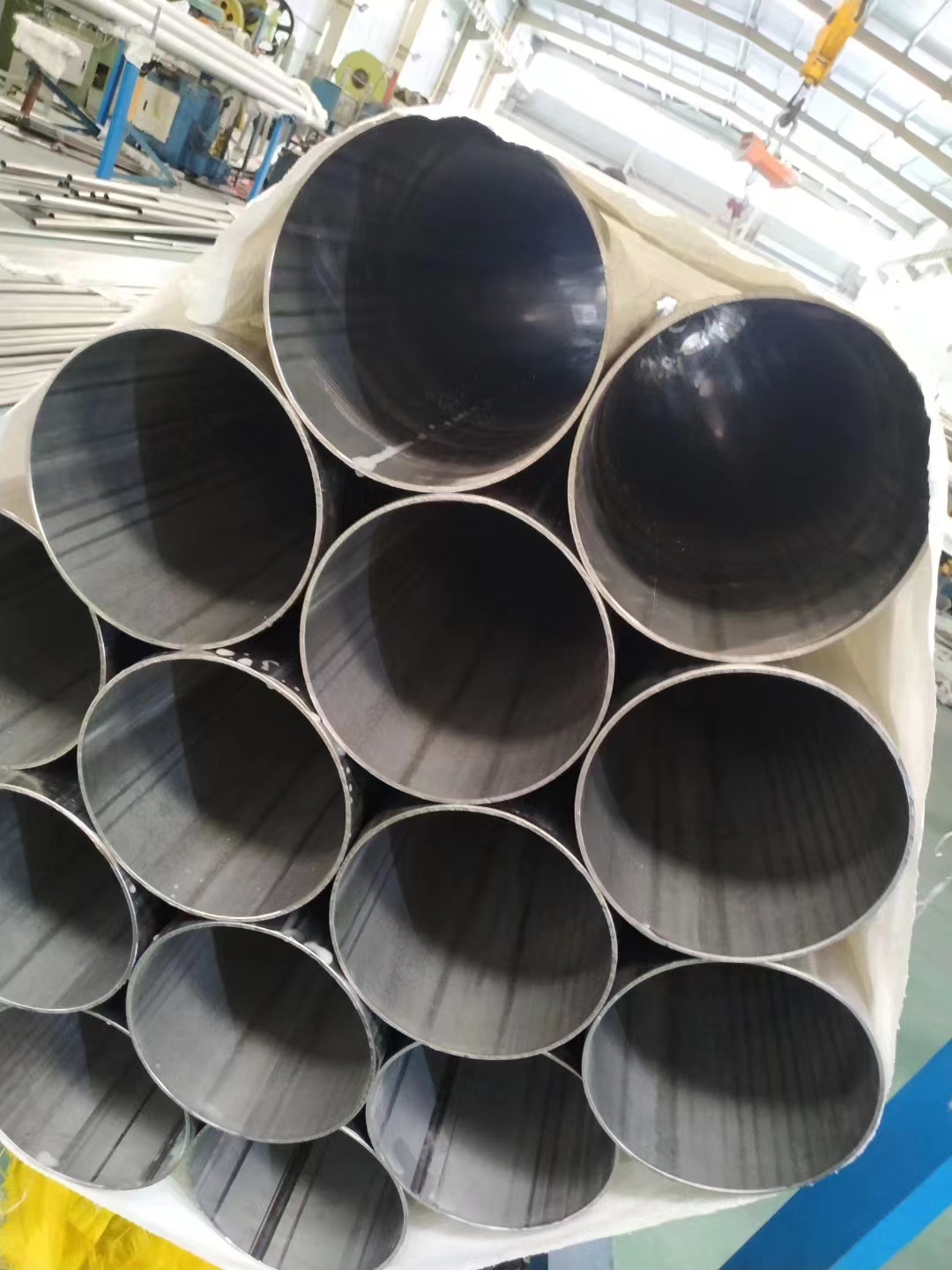 Large-diameter welded stainless pipes wrapped in white sheeting, staged for dispatch.
What we see on offshore projects: On a West Africa offshore produced water injection project, TP316L was specified for the topside injection headers to reduce cost versus duplex 2205 — a 28% material premium. The produced water analysis at project design showed 8,000 ppm chloride, which was considered borderline acceptable for TP316L with a conservative corrosion allowance. During commissioning, actual produced water sampled from separator outlets showed 42,000 ppm chloride at 78°C. Chloride stress corrosion cracking initiated at girth weld toes within 22 months. Total remediation cost — replacement headers, inspection programme, NPT on the injection pump, and lost injection revenue — exceeded the TP316L-to-2205 upgrade cost by approximately 15×. The chloride concentration that matters is the actual produced fluid at operating temperature, not the formation water sample from desk engineering.
1. Duplex Microstructure — Why It Matters
Duplex stainless steels have a two-phase microstructure: approximately 50% austenite and 50% ferrite. This combination gives properties that neither phase alone provides:
- From ferrite: High yield strength, resistance to chloride stress corrosion cracking (CSCC)
- From austenite: Toughness, weldability, resistance to hydrogen embrittlement
The austenitic stainless grades (TP304L, TP316L) are susceptible to CSCC at temperatures above approximately 60°C in chloride environments — this is the primary reason duplex is specified for offshore seawater service. The ferritic phase in duplex steels interrupts the continuous austenite grain boundary network that CSCC requires to propagate.
The ferrite-austenite balance is not passive — it must be actively managed during welding and heat treatment. A weld zone with ferrite content above 70% has lost its toughness advantage and may have developed sigma phase or secondary austenite zones with depleted PREN. Ferrite measurement is not a formality; it is the primary weld quality indicator for duplex piping.
2. Grade Comparison
| Property | Duplex 2205 (S32205) | Super Duplex 2507 (S32750) |
|---|---|---|
| Chromium | 22% | 25% |
| Nickel | 5% | 7% |
| Molybdenum | 3% | 4% |
| Nitrogen | 0.18% | 0.27% |
| PREN (typical) | 35 | 42 |
| Min Tensile (MPa) | 620 | 795 |
| Min Yield (MPa) | 450 | 550 |
| Max Hardness | 31 HRC | 32 HRC |
| Max Service Temp | 315°C | 300°C |
| Min Service Temp | −50°C | −20°C |
| NACE MR0175 | Yes (with conditions) | Yes (more restrictive) |
2205 is the cost-effective duplex grade for most offshore and chemical process applications. 2507 is reserved for the most aggressive environments — subsea seawater injection, high-chloride acid service, and applications where 2205 falls below its PREN threshold. The mechanical property difference between 2205 and 2507 is also meaningful: 2507's 550 MPa minimum yield supports thinner walls in the highest-pressure subsea applications.
The duplex 2205 yield strength advantage (450 MPa) over TP316L (170 MPa) is a ratio of 2.65×. For the same internal pressure in a process pipeline, the wall thickness in duplex can theoretically be 2.65× thinner than in TP316L. In practice, after accounting for minimum wall availability in standard schedules, corrosion allowance, and fabrication minimums, the wall saving is typically 35–50%. This weight and material saving partially offsets the duplex cost premium per kilogram. For large-diameter offshore piping (above NPS 4) operating above 10 MPa, the economics of duplex versus TP316L are frequently positive — not just on corrosion resistance, but on pure material tonnage cost.
3. Standards and Specifications
| Product | Standard |
|---|---|
| Seamless and welded pipe | ASTM A790 |
| Seamless and welded tube | ASTM A789 |
| Buttweld fittings | ASTM A815 |
| Flanges and forgings | ASTM A182 F51 (2205), F53/F55 (2507) |
| Plate, sheet, strip | ASTM A240 |
| European pipe (seamless) | EN 10216-5 |
| European pipe (welded) | EN 10217-7 |
All duplex and super duplex pipe per ASTM A790 is supplied in the solution annealed and water quenched condition. The solution annealing temperature is 1020–1100°C for 2205 and 1050–1125°C for 2507. Departing from these temperature windows — even slightly downward to reduce equipment cost — is one of the most consequential fabrication errors on duplex projects.
4. Mechanical Properties
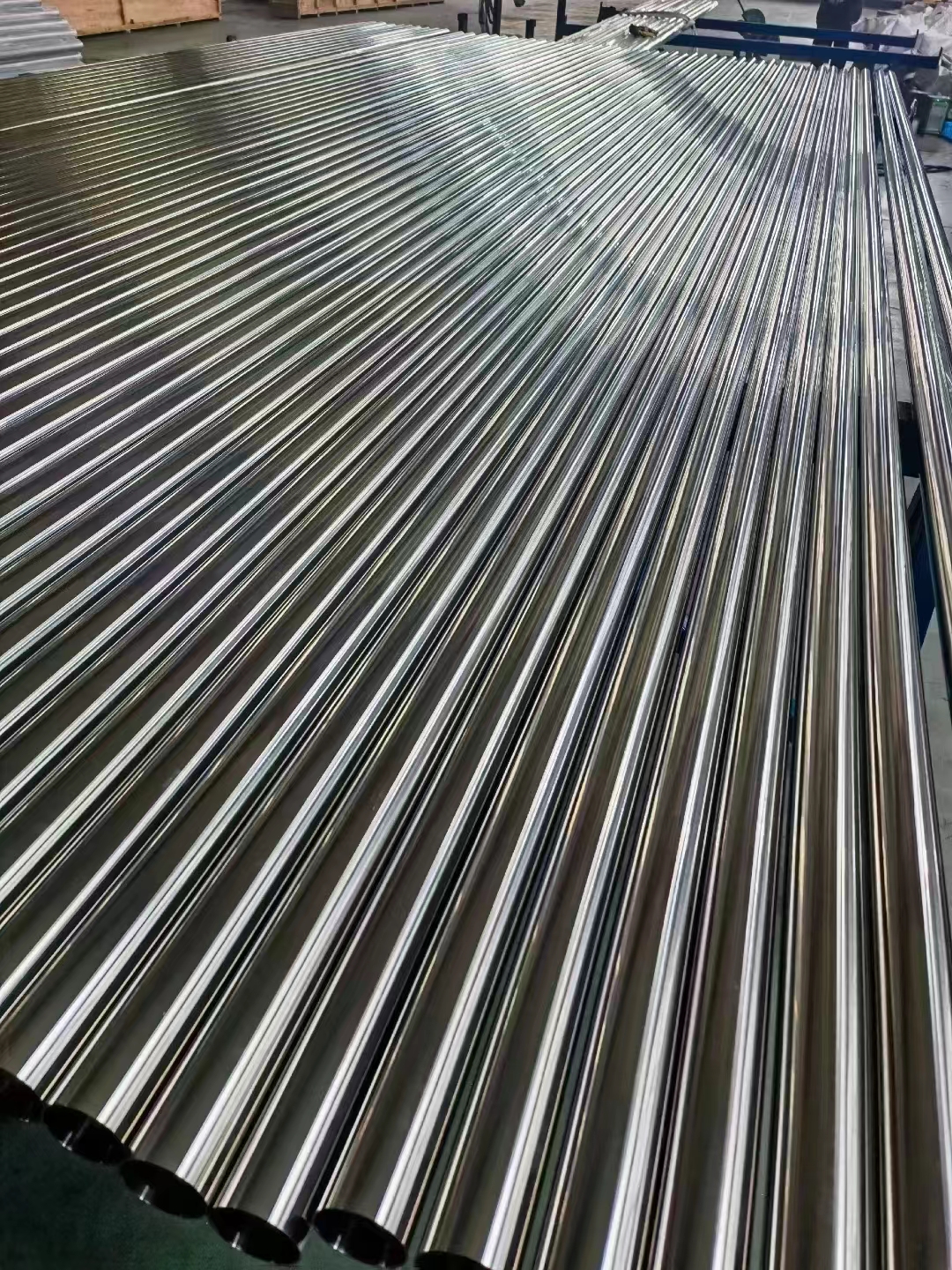 Polished seamless stainless tubes fanned out in the warehouse.
ASTM A790 — Pipe Properties
| Grade | UNS | Min Tensile (MPa) | Min Yield 0.2% (MPa) | Min Elong (%) | Max Hardness |
|---|---|---|---|---|---|
| S31803 / S32205 | — | 620 | 450 | 25 | 31 HRC (293 HB) |
| S32750 (2507) | — | 795 | 550 | 15 | 32 HRC (310 HB) |
| S32760 (Zeron 100) | — | 750 | 550 | 25 | 32 HRC |
The hardness limits in this table are not just quality markers — they are the NACE MR0175/ISO 15156-3 threshold for sour service acceptance. Any weld zone or HAZ that exceeds 31 HRC for 2205 is non-compliant for sour service regardless of other test results. We verify hardness on weld coupons, not only on base metal.
UNS S31803 is the original 2205 designation with slightly broader chemistry limits. UNS S32205 has a tighter nitrogen minimum (0.14% vs 0.08%), which better ensures the PREN meets 35 minimum. Always specify S32205 for new projects to guarantee PREN ≥35.
For pipe dimensions and schedule weights in the stainless system, refer to ASME B36.10M specification tables →
To match a duplex or stainless grade to your corrosive environment conditions, use the AI Pipe Grade Selector →
Wall Thickness Comparison: Duplex 2205 vs TP316L at High Pressure
The following calculation demonstrates the practical wall and weight saving duplex 2205 delivers versus TP316L for high-pressure offshore process piping. Using ASME B31.3 process piping design with E = 1.0, Y = 0.4 (for T < 482°C):
Formula: t = P × D / (2 × (S × E + P × Y))
Scenario: NPS 6 (OD 168.27 mm per ASME B36.10M), operating pressure 15 MPa.
TP316L — allowable stress S = 115 MPa (governed by UTS criterion: min of 485/3 = 162 MPa and 2/3 × 170 = 113 MPa → 113 MPa, rounded to 115 MPa per ASME tables):
t = 15 × 168.27 / (2 × (115 × 1.0 + 15 × 0.4)) = 2524.1 / (2 × 121) = 2524.1 / 242 = 10.43 mm required
Available schedule: Sch 80/XS (NPS 6) = 10.97 mm wall → 10.97 mm selected.
Duplex 2205 — allowable stress S = 207 MPa (governed by UTS criterion: min of 620/3 = 207 MPa and 2/3 × 450 = 300 MPa → 207 MPa):
t = 15 × 168.27 / (2 × (207 × 1.0 + 15 × 0.4)) = 2524.1 / (2 × 213) = 2524.1 / 426 = 5.92 mm required
Available schedule: 6.35 mm wall (0.250 in, ASME B36.19M Sch 10S for NPS 6) → 6.35 mm selected.
Results — NPS 6 at 15 MPa:
| Parameter | TP316L Sch 80/XS | Duplex 2205 Sch 10S | Saving |
|---|---|---|---|
| Wall thickness (mm) | 10.97 | 6.35 | 42% thinner |
| Pipe weight (kg/m) | 43.8 | 25.9 | 41% lighter |
| 1,000 m header weight | ≈ 43.8 tonne | ≈ 25.9 tonne | 17.9 tonne saved |
For 1,000 m of NPS 6 header, the duplex saves approximately 17.9 tonne of material — which substantially offsets the duplex premium per kilogram. At typical offshore pipe-in-pipe or topside installation costs, the installed-cost differential between TP316L Sch 80 and duplex 2205 Sch 10S for NPS 6 at high pressure is frequently negligible or positive in favour of duplex when the full material tonnage difference is accounted for.
5. PREN Calculation and Corrosion Service Limits
PREN = %Cr + 3.3×%Mo + 16×%N
Using nominal chemistry:
- 2205 (S32205): 22 + 3.3×3 + 16×0.18 = 22 + 9.9 + 2.9 = 34.8 ≈ 35
- 2507 (S32750): 25 + 3.3×4 + 16×0.27 = 25 + 13.2 + 4.3 = 42.5 ≈ 43
Practical service limits based on PREN:
| Environment | TP316L (PREN ≈ 25) | Duplex 2205 (PREN ≈ 35) | SD 2507 (PREN ≈ 43) |
|---|---|---|---|
| Freshwater | Suitable | Suitable | Suitable |
| Seawater, atmospheric splash | Marginal | Suitable | Suitable |
| Seawater, immersed <20°C | Not suitable | Marginal | Suitable |
| Seawater, immersed 20–40°C | Not suitable | Not suitable | Suitable |
| Seawater injection | Not suitable | Not suitable | Suitable with care |
| Produced water (moderate Cl) | Not suitable | Suitable | Suitable |
| Concentrated chloride acid | Not suitable | Not suitable | Marginal |
The critical point in this table is that 2205 becomes marginal for immersed seawater even at moderate temperatures. Projects that use 2205 in immersed seawater splash zones at tropical ambient temperatures (25–35°C) are operating at or near the limit. At those conditions, the decision between 2205 and 2507 should be driven by a site-specific PREN calculation using the actual MTC heat analysis, not nominal values.
6. Temperature Limits
Upper temperature limit: Duplex steels are sensitive to sigma phase embrittlement above approximately 300–315°C. Sigma phase (a brittle intermetallic) forms preferentially in the ferritic phase and causes loss of toughness and corrosion resistance. Design codes typically restrict duplex to 315°C maximum continuous service temperature.
Lower temperature limit: The ferritic phase in duplex steels loses toughness at low temperatures more rapidly than pure austenitic grades.
- Duplex 2205: typically qualified to −50°C with impact testing
- Super duplex 2507: typically limited to −20°C by codes
The sigma phase embrittlement risk is not limited to sustained elevated-temperature service. Even brief excursions into the 400–500°C range — from heat tracing failures, process upsets, or improper field PWHT — can initiate sigma formation in the ferritic phase. Any duplex system that has experienced a high-temperature excursion above 315°C requires metallographic assessment before return to service.
7. NACE MR0175 / ISO 15156-3 Compliance
Both 2205 and 2507 are listed in NACE MR0175/ISO 15156-3 Table A.3 for sour service, subject to conditions:
Duplex 2205 (S32205/S31803):
- Solution annealed and water quenched
- Hardness ≤31 HRC (310 HV)
- Conditions: subject to qualification testing for specific H2S partial pressure, chloride content, temperature, and pH per NACE MR0175/ISO 15156-3 Table A.3
Super Duplex 2507 (S32750):
- More restrictive conditions than 2205
- Higher alloy content means harder potential — hardness control during fabrication is critical
- Not recommended for high H2S partial pressure without specific qualification testing
The NACE MR0175/ISO 15156-3 hardness limit of ≤31 HRC for 2205 must be met in the weld and HAZ zones, not only in the base metal. For sour service piping, we require ferrite content measurements and hardness survey of weld coupons from the production WPS as part of weld procedure qualification — not just base metal MTC values.
8. Welding Requirements
Duplex stainless welding requires more care than austenitic stainless to maintain the 40–60% ferrite:austenite balance:
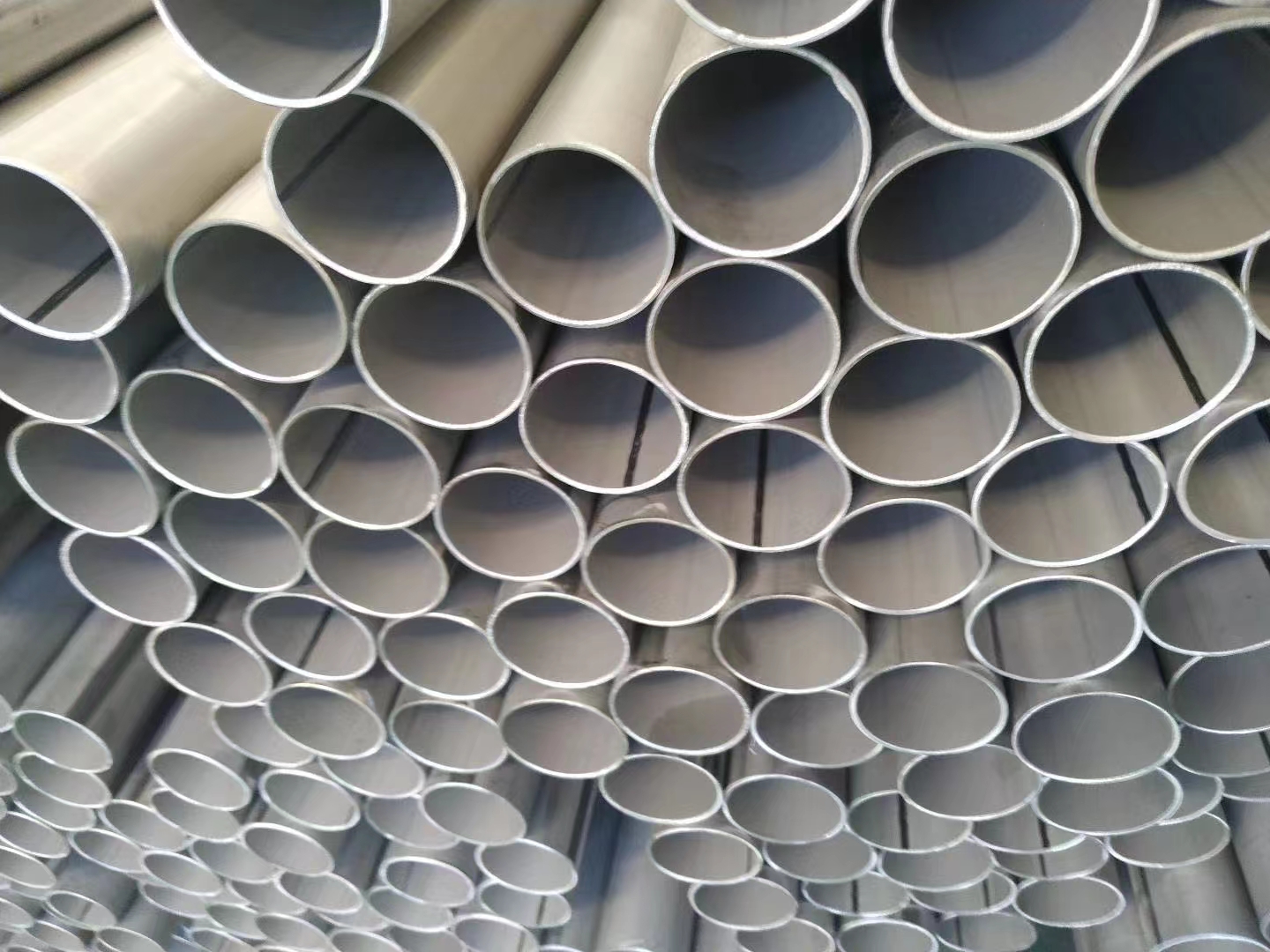 Stacked welded stainless pipes with visible longitudinal weld seams.
| Parameter | Requirement |
|---|---|
| Filler — 2205 | AWS A5.9 ER2209 (over-alloyed vs base) |
| Filler — 2507 | AWS A5.9 ER2594 |
| Heat input | 0.5–2.0 kJ/mm (avoid too low or too high) |
| Interpass temperature | Maximum 150°C |
| Preheat | Not required at room temperature |
| Post-weld heat treatment | Full solution anneal 1020°C minimum + water quench required for pressure piping |
| Shielding gas | Ar or Ar + N2 (nitrogen addition maintains N in weld pool) |
Ferrite content of the weld must be verified by ferrite measurement (Fischer scope or Magne Gauge) per WPS requirements. Typical target: 35–65% ferrite in weld metal, consistent with the ASTM A790 acceptance criteria. Weld zones that measure above 70% ferrite indicate incomplete re-austenitisation — typically caused by PWHT below the minimum solution anneal temperature — and must be assessed or rejected.
9. Application Selection Guide
| Application | Recommended Grade | Reason |
|---|---|---|
| Offshore topside process piping | 2205 | Adequate PREN, high strength, CSCC resistance |
| Seawater utility piping (topside) | 2205 | Cost-effective vs 2507 for topside |
| Subsea seawater injection | 2507 | PREN 43 needed for immersed seawater |
| Produced water handling | 2205 | Good Cl- and CO2 resistance |
| Chemical injection (acid) | 2507 | Higher Mo and PREN for acidic chloride |
| High-pressure process piping | 2205 | Yield 450 MPa reduces wall thickness |
| Cryogenic service | Not recommended | TP304L or TP316L preferred below −50°C |
| High-temperature >315°C | Not recommended | Use TP316L, TP321, or alloy steel |
When NOT to Use Duplex 2205
The conditions below are not edge cases — they are the selection boundaries that drive grade escalation to 2507, austenitic grades, or alloy steel. Specifying 2205 within these limits, even with a corrosion allowance, is not a conservative design.
| Condition | Required alternative | Why duplex 2205 fails |
|---|---|---|
| Sustained service temperature above 315°C | TP316L, TP321, or alloy steel | Sigma phase embrittlement in ferritic phase begins above 315°C — irreversible brittleness and loss of PREN |
| Cryogenic service below −50°C | ASTM A312 TP304L or 9% Ni steel | Duplex 2205 loses toughness in ferritic phase below −50°C; 2507 limited to −20°C |
| Immersed seawater above 25°C (long-term) | Super duplex 2507 (PREN 43) | Duplex 2205 PREN 35 is marginal for warm immersed seawater; 2507 provides adequate margin |
| NACE MR0175 H2S partial pressure above 2205 qualification limit | Engineering review and 2507 | 2205 NACE qualification has specific H2S, Cl, T, pH windows per ISO 15156-3 Table A.3 |
| Pipe operating in combined sigma phase risk zone (400–500°C brief exposure) | Engineering assessment required | Even brief excursions into 400–500°C range during process upset can initiate sigma formation |
| Application where S31803 (not S32205) is specified | Specify S32205 by UNS number | S31803 low-N heats may have PREN below 35 — not adequate for seawater or high-chloride service |
Duplex Stainless Steel Failure Modes to Specify Against
Failure Mode 1 — Sigma Phase Embrittlement from Sustained High-Temperature Service
Mechanism: A duplex 2205 pipeline operating with a heat tracing control failure was inadvertently maintained at 380°C for 14 days before the fault was detected. At 380°C, sigma phase (Fe-Cr intermetallic) nucleates in the ferritic phase of the duplex microstructure and grows progressively. The embrittled pipe section showed near-zero impact energy in the HAZ zone. During subsequent cold restart at 10°C, thermal shock caused brittle fracture at a weld zone.
Diagnostic: Metallographic cross-section shows sigma phase precipitation — a bright intermetallic phase at grain boundaries and ferrite-austenite interfaces — confirmed by etching with Murakami's reagent. Impact energy of the affected zone below 15 J at room temperature, well below the ASTM A790 minimum (typically 60 J). Ferrite content measurement may show reduced ferrite fraction as sigma phase forms at the expense of the ferrite phase.
Fix: For any process with potential excursions above 315°C, design the duplex system with high-temperature alarm/shutdown at 315°C. Inspect any pipe section that has been exposed to above 315°C by metallographic sampling before returning to service. Replace embrittled sections; do not attempt to restore properties in-situ — sigma phase dissolution requires full solution annealing at 1020°C minimum, which is not achievable in installed piping.
Failure Mode 2 — S31803 Specified Instead of S32205 — PREN Shortfall in Seawater Service
Mechanism: Offshore topside piping was specified as "duplex 2205, UNS S31803" — not S32205. The supplied heat had nitrogen at 0.09%, within the S31803 limit (0.08–0.20%) but below the S32205 minimum (0.14%). Calculated PREN = 22 + 3.3×3 + 16×0.09 = 22 + 9.9 + 1.44 = 33.3 — below the PREN 35 target for seawater splash zone. After three years of tropical seawater exposure, pitting corrosion initiated at crevices under pipe supports.
Diagnostic: Pitting corrosion concentrated at crevice locations — pipe supports, back of flanges, under gaskets. MTC review confirms nitrogen content at 0.09% and UNS S31803 designation. PREN calculation confirms shortfall versus the seawater requirement.
Fix: Specify S32205 (not S31803) on all purchase orders requiring PREN ≥ 35. Verify nitrogen content on MTC heat analysis against S32205 minimum (0.14%) before acceptance. If S31803 pipe with nitrogen below 0.14% has been installed in seawater service, assess pitting risk and implement an enhanced inspection programme until replacement is scheduled.
Failure Mode 3 — Weld HAZ Ferrite Imbalance from Inadequate Post-Weld Solution Anneal
Mechanism: Field-welded duplex 2205 piping joints were treated at 950°C — below the 1020°C minimum for duplex solution annealing — to save heating equipment cost. At 950°C, the duplex is not fully solution annealed: the ferrite-austenite balance is not restored, and some secondary austenite (chromium-depleted, lower PREN) forms at grain boundaries. The weld HAZ developed localised PREN below 30 at the secondary austenite zones, making it susceptible to pitting in the chloride service for which the system was designed.
Diagnostic: Ferrite content of weld zones exceeds 70% measured by Fischer scope — indicating incomplete re-austenitisation during PWHT. Pitting initiates at HAZ zones within two years of service in seawater or high-chloride produced water. Cross-section metallography shows secondary austenite formation at grain boundaries distinct from the normal balanced microstructure.
Fix: Specify duplex 2205 post-weld heat treatment at 1020–1100°C minimum, water quench, as mandatory for all pressure-containing welds in project specifications. Verify PWHT temperature from thermocouple records attached to the actual pipe surface, not from heater controller setpoints alone. Accept weld zones only after ferrite content measurement confirms 35–65% ferrite in the weld metal and HAZ.
Procurement Traps
Trap 1 — S31803 vs S32205: the UNS Number That Changes the PREN
Wrong PO: "Duplex stainless steel pipe, UNS S31803, NPS 6, seamless, ASTM A790."
What ships: The mill delivers UNS S31803 — the original 2205 designation — and is fully ASTM A790 compliant. S31803 allows nitrogen in the range 0.08–0.20%. A heat at the lower S31803 nitrogen limit (0.08%) calculates to PREN = 22 + 3.3×3 + 16×0.08 = 22 + 9.9 + 1.28 = 33.2 — below the PREN 35 minimum generally required for seawater or high-chloride produced water service.
Correct PO: Specify "UNS S32205 (duplex 2205), not S31803" — the UNS number, not the grade name. S32205 guarantees nitrogen ≥ 0.14%, ensuring PREN ≥ 35 minimum. Add the following to the MR or purchase order specification:
- Ferrite content 35–65% — measured on weld coupon per WPS requirements, documented on weld records
- Hardness ≤ 31 HRC per NACE MR0175/ISO 15156-3 for sour service — documented on MTC
- Solution annealed and water quenched — annealing temperature 1020°C minimum documented on MTC
Trap 2 — Welding 2205 Without Post-Weld Solution Anneal at the Correct Temperature
When duplex 2205 piping is welded in the field and the project specification does not require PWHT, the weld HAZ may develop ferrite content above 70% or sigma phase at the fusion boundary due to high heat input during SMAW or FCAW. The weld passes visual and NDE but fails a ferrite content check. Even when PWHT is specified, a temperature of 950°C instead of 1020°C produces the same incomplete re-austenitisation failure described in Failure Mode 3 above.
The project specification must state: "Full solution anneal 1020–1100°C minimum plus water quench required after all welds on pressure-containing duplex 2205 or 2507 components. PWHT temperature to be verified by thermocouple records from pipe surface. Ferrite content to be measured per WPS and documented prior to hydrostatic test."
10. Procurement Checklist
- Standard: ASTM A790 (pipe) or ASTM A789 (tube)
- Grade: S32205 (duplex 2205) or S32750 (super duplex 2507) — specify S32205 by UNS number, not S31803
- Pipe type: seamless or welded
- NPS and schedule or minimum wall thickness
- Heat treatment: solution annealed and water quenched — annealing temperature 1020°C minimum documented on MTC
- Ferrite content: verify 35–65% ferrite — measured on weld coupon per WPS requirements, documented on weld records
- NACE MR0175/ISO 15156-3: specify compliance if sour service — hardness ≤31 HRC documented on MTC
- Hardness: ≤31 HRC for 2205 per NACE MR0175/ISO 15156-3; verify on MTC and weld coupon
- PMI: positive material identification (XRF or OES) of all spools before installation
- Mill test certificate: EN 10204 3.1 minimum; EN 10204 3.2 for sour service or subsea applications
Frequently Asked Questions
What is the difference between duplex 2205 and super duplex 2507?
Both are duplex stainless steels with a two-phase ferritic-austenitic microstructure, but super duplex 2507 has higher alloy content. Duplex 2205 (UNS S32205): 22% Cr, 5% Ni, 3% Mo, 0.18% N — PREN approximately 35. Super duplex 2507 (UNS S32750): 25% Cr, 7% Ni, 4% Mo, 0.27% N — PREN approximately 42. The higher PREN of 2507 gives substantially better pitting and crevice corrosion resistance in aggressive chloride environments such as seawater at elevated temperature. 2205 is suitable for most offshore topside applications; 2507 is required for subsea and seawater injection service.
What is PREN and why does it matter for duplex pipe selection?
PREN (Pitting Resistance Equivalent Number) = %Cr + 3.3×%Mo + 16×%N. It is a calculated index used to screen stainless steel alloys for resistance to chloride pitting corrosion. A PREN above 40 is generally considered necessary for resistance to pitting in seawater at ambient temperature. Duplex 2205 (PREN approximately 35) is suitable for seawater splash and atmospheric service but may suffer pitting in immersed seawater above about 20°C. Super duplex 2507 (PREN approximately 42) is suitable for immersed seawater service up to approximately 40°C. PREN is a guide, not an absolute guarantee — actual corrosion performance depends on temperature, chloride concentration, flow velocity, and surface condition.
What are the mechanical properties of duplex 2205 compared to TP316L?
Duplex 2205 has minimum tensile strength of 620 MPa and minimum yield strength of 450 MPa per ASTM A790. This compares to TP316L's minimum tensile of 485 MPa and yield of 170 MPa. The roughly 2.6 times higher yield strength of 2205 over 316L allows the use of thinner wall pipe for equivalent design pressure, which offsets part of the higher material cost per kilogram. The yield advantage also improves resistance to flow-induced vibration and slug flow loading in offshore piping.
What specifications cover duplex and super duplex pipe?
Seamless and welded duplex and super duplex pipe is covered by ASTM A790 (pipe) and ASTM A789 (tube). For fittings, ASTM A815 covers buttweld fittings. For flanges and forgings, ASTM A182 Grade F51 (2205) and F53/F55 (2507) apply. European equivalent is EN 10216-5 or EN 10217-7. Pipe is supplied in the solution annealed and water quenched condition. All welds require full solution anneal after welding to restore corrosion resistance and toughness.
What is the maximum temperature for duplex stainless pipe service?
Duplex stainless steels should generally be limited to a maximum service temperature of approximately 315°C. Above this temperature, a precipitation reaction known as sigma phase formation begins in the ferritic phase, which causes embrittlement and loss of corrosion resistance. The rate of sigma formation increases rapidly between 400–500°C. For high-temperature process piping above 315°C, austenitic stainless TP316L, TP321, or TP347 is preferred. There is also a lower temperature limit: duplex 2205 is typically rated to −50°C for most applications, while 2507 should be limited to −20°C due to its higher alloy content.
Is duplex 2205 suitable for sour service per NACE MR0175?
Yes, duplex 2205 (UNS S32205) is acceptable for sour service under NACE MR0175/ISO 15156-3, subject to conditions. The standard allows 2205 in solution annealed condition with a hardness limit of 31 HRC (310 HV) maximum, and restricts its application based on partial pressure of H2S, chloride content, temperature, and pH. At higher H2S partial pressures or elevated temperatures, duplex may be restricted. Super duplex 2507 has more restrictive NACE limits due to its higher alloy content and higher hardness potential. Always review NACE MR0175 Table A.3 for the specific application conditions.
What welding considerations apply to duplex stainless pipe?
Duplex stainless steel welding requires careful control of heat input, interpass temperature, and post-weld heat treatment to maintain the correct austenite-ferrite balance (typically 40–60% ferrite) in the weld and heat-affected zone. Excess heat input or slow cooling favours excessive ferrite and possible sigma phase formation, while too-rapid cooling produces excessive austenite and reduces nitrogen content. Typical requirements: use 2209 (for 2205) or 2594 (for 2507) matching filler metals, heat input 0.5–2.0 kJ/mm, interpass temperature maximum 150°C, and — for critical service — full solution annealing of the weld joint.
Why must I specify S32205 instead of S31803 on purchase orders?
S31803 is the original 2205 UNS designation and allows nitrogen in the range 0.08–0.20%. S32205 is the revised designation that tightens the nitrogen minimum to 0.14%. A heat at the lower S31803 nitrogen limit (0.08%) calculates to a PREN of approximately 33, below the PREN 35 minimum needed for seawater or high-chloride produced water service. Specifying S32205 by UNS number ensures the nitrogen minimum is met and PREN is adequate. Never specify only the grade name 'duplex 2205' without the S32205 UNS designation.
What post-weld heat treatment temperature is required for duplex 2205?
Full solution annealing at a minimum of 1020°C, followed by water quench, is required for all pressure-containing welds in duplex 2205. Treatment at lower temperatures — such as 950°C sometimes used to reduce equipment cost — does not fully restore the ferrite-austenite balance, leaves secondary austenite at grain boundaries with depleted PREN, and may result in ferrite content above 70% in the weld HAZ. Thermocouple records from the actual pipe surface (not heater controller setpoints alone) should be retained as objective evidence.