CRA grade selection sits at the intersection of two entirely different corrosion mechanisms — CO₂ and H₂S — that demand different material responses, operate under different regulatory frameworks, and do not simply add together. CO₂ drives general and localised corrosion of the steel surface through carbonic acid attack; H₂S drives sulphide stress cracking (SSC) at stress concentrations through hydrogen embrittlement. A grade that handles high CO₂ partial pressure may be completely disqualified the moment any H₂S appears. Getting this distinction wrong in the early engineering phase leads either to premature tubular failure or to a specification so overbuilt that the economics of the well no longer work.
ZC Steel Pipe supplies CRA OCTG across the full range — from L80 13Cr specifications and Super 13Cr through 22Cr duplex, 25Cr super duplex, and nickel alloys — to EPC contractors and operators across West Africa, the Middle East, Southeast Asia, and South America. This guide provides the decision framework we use when a customer brings us well conditions and asks for a grade recommendation.
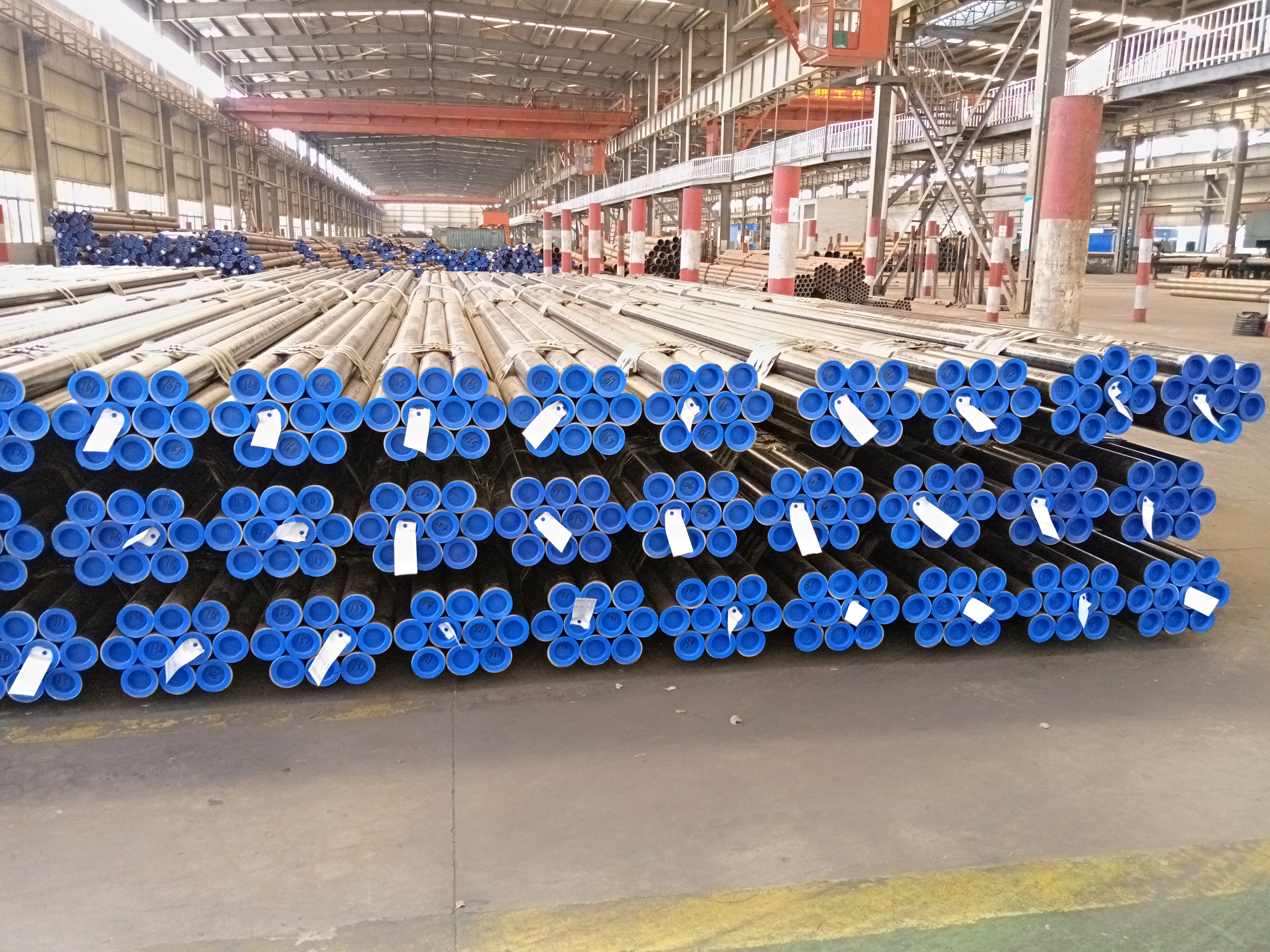 Seamless 13Cr pipe bundles with protective blue end caps in the ZC warehouse, staged for a West Africa L80-13Cr flowline shipment.
What we see on enquiries: When EPC contractors in West Africa or the Middle East bring well conditions asking for a grade recommendation, the first two numbers we examine are CO₂ partial pressure and H₂S partial pressure — those determine the quadrant in the selection matrix before any other parameter matters. We have seen enquiries arrive with full temperature, pressure, and chloride data, but no H₂S figure. Without it, we cannot confirm grade. A pCO₂ of 1.5 MPa with zero H₂S points to L80 13Cr. The same pCO₂ with H₂S at 0.05 MPa eliminates 13Cr entirely and points to 22Cr duplex at minimum. Those two scenarios produce price differences of 8–12× — so the missing number is not a detail.
CRA Grade Hierarchy
The CRA selection hierarchy for OCTG follows increasing corrosion resistance, H₂S tolerance, and cost. These are typical industry values — the exact envelope for any grade must be confirmed against the specific mill's corrosion qualification data and ISO 15156-3 limits.
| Grade | Cr% | Ni% | Mo% | PREN | H₂S Tolerance | Relative Cost vs L80-1 |
|---|---|---|---|---|---|---|
| L80 13Cr | 12–14 | ≤ 0.50 | — | ~13 | None — CO₂ grade only | 3–5× |
| Super 13Cr | 12–14 | 4–6 | 1.5–2.5 | ~20 | Very low (< 0.02 MPa, conditions apply) | 4–7× |
| 22Cr Duplex | ~22 | ~5 | ~3 | ~34 | Moderate (ISO 15156-3 limits) | 8–12× |
| 25Cr Super Duplex | ~25 | ~7 | ~4 | ~43 | Wider (ISO 15156-3 limits) | 12–18× |
| Alloy 825 | ~22 | ~40 | ~3 | > 30 | Broad — HPHT capable | 20–30× |
| Alloy 625 | ~22 | ~61 | ~9 | > 50 | Broadest — severe sour HPHT | 25–40× |
The PREN values here are calculated from the PREN formula using nominal alloy compositions — not claimed figures. The calculation is shown in the PREN section below. For the complete API 5CT grade ladder with tensile, hardness, and chemistry limits, see the API 5CT specification tables → and NACE MR0175 / ISO 15156 hardness limits →.
To match a grade to your well conditions using partial pressure inputs, use the Sour Service Selector → or generate a full grade recommendation with the Pipe Grade Selector →.
CO₂ Partial Pressure Thresholds
CO₂ partial pressure (pCO₂) is the primary driver of CRA selection in sweet or near-sweet wells. It is calculated as total system pressure multiplied by the CO₂ mole fraction in the produced gas. Below 0.05 MPa (0.5 bar), inhibited carbon steel is usually acceptable and the economics strongly favour that route. Above 0.2 MPa (2 bar), CRA is the standard engineering response.
| pCO₂ Range | Typical Response |
|---|---|
| < 0.05 MPa | Carbon steel with corrosion inhibitor injection — evaluate inhibitor cost vs CRA over well life |
| 0.05–0.2 MPa | Case-by-case — inhibited carbon steel or CRA depending on temperature, water cut, and well life |
| 0.2–2.5 MPa | L80 13Cr — the standard CRA grade for this range |
| 2.5–4.0 MPa | Super 13Cr — L80 13Cr passive film stability decreases at higher pCO₂ and temperature |
| > 4.0 MPa | 22Cr duplex or higher — 13Cr grades reach their practical upper limit |
Temperature interacts strongly with pCO₂: a well at 2.0 MPa pCO₂ and 120°C may be within L80 13Cr's envelope, while the same pCO₂ at 160°C may require Super 13Cr. Never evaluate pCO₂ without the operating temperature alongside it. For the 13Cr-versus-Super-13Cr tubing decision in detail, see L80 13Cr vs Super 13Cr and the Super 13Cr specifications for CO2 corrosion.
The economic comparison that matters at the 0.05–0.2 MPa boundary: at $0.80/barrel inhibitor cost over a 15-year well producing 500 bbl/day, inhibitor totals approximately $2.2 million — which may approach or exceed the CRA tubing premium, particularly for deeper strings. This calculation should be run explicitly before selecting inhibited carbon steel for borderline wells.
H₂S and NACE MR0175 Requirements
H₂S fundamentally changes the material selection problem. Under NACE MR0175 / ISO 15156, a well qualifies as sour service when H₂S partial pressure exceeds 0.0003 MPa (0.05 psia) — a very low threshold. At sour service conditions, the failure mode shifts from surface corrosion to hydrogen-induced cracking and SSC, and hardness limits govern material qualification rather than corrosion rate.
The H₂S qualification framework under ISO 15156 is split by material family:
- Part 2 covers carbon and low-alloy steels (L80-1, T95, C110, P110). These grades are qualified for sour service based on hardness limits and, for some grades, heat treatment requirements. See the sour service grade selection guide for the carbon steel side of the decision.
- Part 3 covers CRA grades. For CRA materials, the qualification framework specifies permitted alloy groups, temperature limits, H₂S partial pressure limits, and chloride concentration limits — all four must be within the qualified envelope simultaneously.
L80 13Cr under ISO 15156-3: L80 13Cr (12–14% Cr, ≤ 0.50% Ni, C ≤ 0.22%) has no ISO 15156-3 H₂S qualification. It is a CO₂ corrosion grade. When H₂S is present at sour service threshold, L80 13Cr is disqualified regardless of concentration — it is not a matter of "acceptable risk at very low H₂S." The grade simply does not have the qualification.
Super 13Cr under ISO 15156-3: Super 13Cr (12–14% Cr, 4–6% Ni, 1.5–2.5% Mo, C ≤ 0.03%) can be qualified under ISO 15156-3 for very limited H₂S service, typically below 0.02 MPa H₂S partial pressure and within specific temperature and in-situ pH limits. The exact limits depend on the mill's proprietary qualification data — always request the mill's ISO 15156-3 qualification report for the specific alloy and heat, not a generic product data sheet.
22Cr and 25Cr duplex under ISO 15156-3: Duplex grades have substantially wider H₂S envelopes than 13Cr grades, with limits specified by temperature and chloride content in ISO 15156-3 Annex tables. Even duplex grades have upper H₂S limits — they are not unconditionally sour-service qualified.
PREN — Calculation and Limits
PREN (Pitting Resistance Equivalent Number) is defined by the formula:
PREN = %Cr + 3.3 × %Mo + 16 × %N
Using nominal mid-range alloy compositions for each grade class:
| Grade | Cr | Mo | N | PREN calculation | PREN |
|---|---|---|---|---|---|
| L80 13Cr | 13.0% | 0% | 0% | 13.0 + 0 + 0 | 13 |
| Super 13Cr | 13.0% | 2.0% | 0.05% | 13.0 + 6.6 + 0.8 | 20 |
| 22Cr Duplex | 22.0% | 3.0% | 0.15% | 22.0 + 9.9 + 2.4 | 34 |
| 25Cr Super Duplex | 25.0% | 4.0% | 0.27% | 25.0 + 13.2 + 4.3 | 43 |
The step from 34 to 43 between 22Cr and 25Cr duplex is significant in environments where pitting is the dominant failure mode — particularly high-chloride offshore wells where the 25Cr grade's wider safety margin justifies its 20–40% cost premium over 22Cr.
PREN is a quick filter, not a selection criterion. L80 13Cr at PREN 13 is not "worse" than 22Cr duplex at PREN 34 in all circumstances — the two grades serve completely different environments. L80 13Cr was never designed for the conditions where 22Cr duplex is specified, and comparing their PREN numbers as if they were competing on the same axis misrepresents both grades. PREN only matters within the pitting-corrosion failure mode; SSC and CO₂ corrosion rates have different drivers entirely. A well with zero chlorides and low pCO₂ can be served by L80 13Cr regardless of PREN. A well with moderate H₂S, 50,000 ppm chloride, and 180°C needs 22Cr duplex regardless of any PREN comparison with 13Cr. Select the failure mode first, then use PREN to discriminate within a grade family.
Selection Matrix
This matrix is a first-pass screening tool. Temperature, chloride concentration, in-situ pH, and flow velocity all affect the final selection. A corrosion engineering assessment using recognised modelling tools (NORSOK M-506, de Waard-Milliams) is required before finalising CRA grade for any well.
| H₂S pH₂S → | No H₂S | < 0.003 MPa H₂S | 0.003–0.02 MPa H₂S | 0.02–0.1 MPa H₂S | > 0.1 MPa H₂S |
|---|---|---|---|---|---|
| pCO₂ < 0.05 MPa | Inhibited CS | Carbon steel sour grade (T95/C110) | T95 / C110 | C110 / CRA | Nickel alloy |
| pCO₂ 0.05–0.2 MPa | Inhibited CS or 13Cr | Super 13Cr (verify) | Super 13Cr (verify) | 22Cr Duplex | 25Cr / Nickel |
| pCO₂ 0.2–2.5 MPa | L80 13Cr | Super 13Cr (verify) | 22Cr Duplex | 22Cr Duplex | 25Cr / Nickel |
| pCO₂ 2.5–4.0 MPa | Super 13Cr | 22Cr Duplex | 22Cr Duplex | 25Cr Duplex | Nickel alloy |
| pCO₂ > 4.0 MPa | 22Cr Duplex | 22Cr Duplex | 25Cr Duplex | Nickel alloy | Nickel alloy |
"CS" = carbon steel. "Verify" = confirm against the specific mill's ISO 15156-3 qualification data before specifying. Sour service carbon steel grades follow a separate selection framework — see the sour service grade selection guide for that side of the matrix.
When NOT to Use Each Grade Class
Understanding the failure mode of each grade is as important as understanding its capabilities. Each grade class has a specific failure mode when taken outside its qualified envelope.
L80 13Cr — do not use when:
- H₂S is present at sour service threshold (≥ 0.0003 MPa). SSC risk is the disqualifying failure mode.
- pCO₂ exceeds 2.5 MPa combined with operating temperature above 150°C. Passive film breakdown and localised pitting become the failure mode.
- Chloride concentration is very high (above approximately 100,000 ppm) combined with elevated temperature. Crevice corrosion initiates under these conditions.
- Elemental sulphur is present in the production stream. Martensitic 13Cr grades are not suitable for elemental sulphur service.
Super 13Cr — do not use when:
- H₂S partial pressure exceeds the mill's ISO 15156-3 qualified limit for the specific alloy and heat treatment. The failure mode is SSC, which is brittle and fast — there is no slow degradation warning.
- pCO₂ exceeds 4.0 MPa at elevated temperature. Super 13Cr's passive film stability has an upper bound that high-CO₂, high-temperature service exceeds.
- The specification has no mill corrosion qualification data for the actual well conditions. Generic product data is insufficient for Super 13Cr selection.
22Cr Duplex — do not use when:
- H₂S and chloride concentrations together exceed the ISO 15156-3 limits for UNS S31803/S32205 at the operating temperature. Stress corrosion cracking is the failure mode.
- Operating temperature exceeds 220°C. Sigma phase embrittlement becomes a risk above this threshold in duplex microstructures.
- The well requires welding without qualified duplex welding procedures. Intermetallic phase precipitation during welding degrades both corrosion resistance and toughness.
25Cr Super Duplex — do not use when:
- Temperature exceeds the ISO 15156-3 qualified limit for UNS S32750/S32760. Super duplex is not immune to the temperature-corrosion relationship.
- Procurement cannot secure material with full corrosion qualification, ISO 15156-3 documentation, and third-party witnessed 3.2 MTC. Under-documented 25Cr duplex is a significant project risk given the cost of the material and the consequence of misapplication.
Nickel alloys (Alloy 825, Alloy 625) — do not use when:
- The well conditions are within the envelope of a lower CRA grade. Nickel alloys cost 25–40× carbon steel — over-specification at this level is an economic error that should require explicit sign-off from project management.
Procurement Trap and Correct PO Language
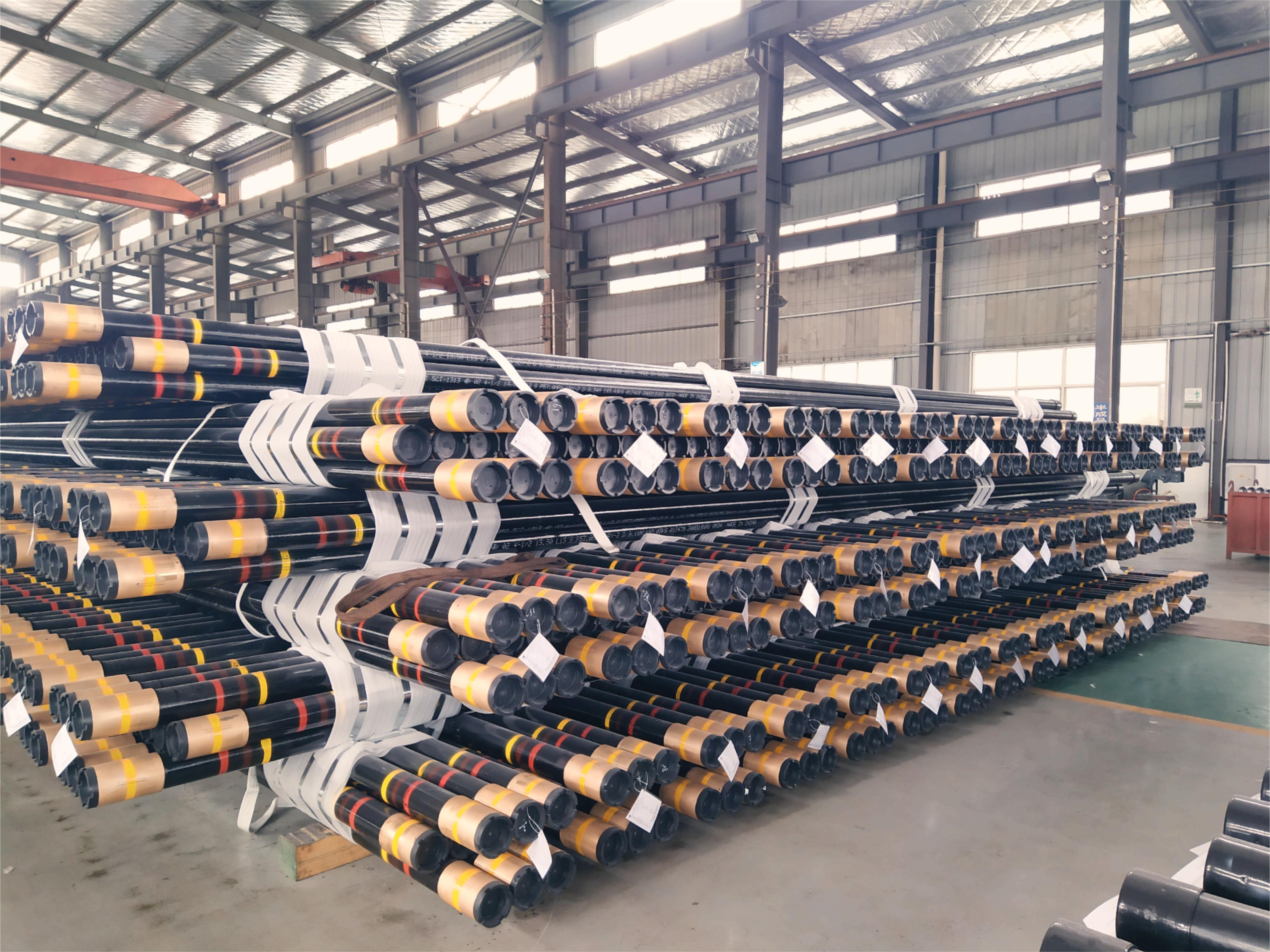 Premium 13Cr casing with copper coupling bands and black thread protectors, carrying the English "5CT … MADE IN CHINA" mill stencil — the grade and type marking a correct PO must confirm on the MTC.
The most common CRA procurement error we see is ordering CRA without specifying the corrosion qualification envelope in the purchase order. The consequence: the mill ships API-compliant material — or ISO 13680-compliant material for Super 13Cr and above — with an MTC that covers standard mill qualification conditions, not the project-specific combination of temperature, pH₂S, pCO₂, and chloride concentration that characterise the actual well.
A purchase order that reads "Super 13Cr-110, 3½ inch, 9.30 lb/ft, premium connection, EN 10204 3.2" is formally adequate to receive material. It is not adequate to confirm that the material is qualified for a well at 175°C, 3.0 MPa pCO₂, 0.01 MPa pH₂S, and 80,000 ppm chloride. The corrosion qualification data in the MTC will cover whatever conditions the mill routinely tests against — which may or may not bracket your well parameters.
Correct PO language adds the corrosion qualification requirement explicitly:
"Supplier to provide corrosion qualification data demonstrating acceptable corrosion rate and absence of localised attack at: temperature [X°C], pCO₂ [X MPa], pH₂S [X MPa] (or pH₂S = 0 if no H₂S), chloride concentration [X mg/L]. ISO 15156-3 qualification report to be included in MTC package. Mill qualification data to cover conditions equal to or more severe than the above parameters."
For 22Cr and 25Cr duplex orders, the MTC must include the ISO 15156-3 qualification with the specific UNS designation, the environmental limits covered, and the heat treatment record. Duplex grades from different heats can have slightly different microstructures; the MTC must tie the test results to the specific heat being supplied.
Supply and Documentation
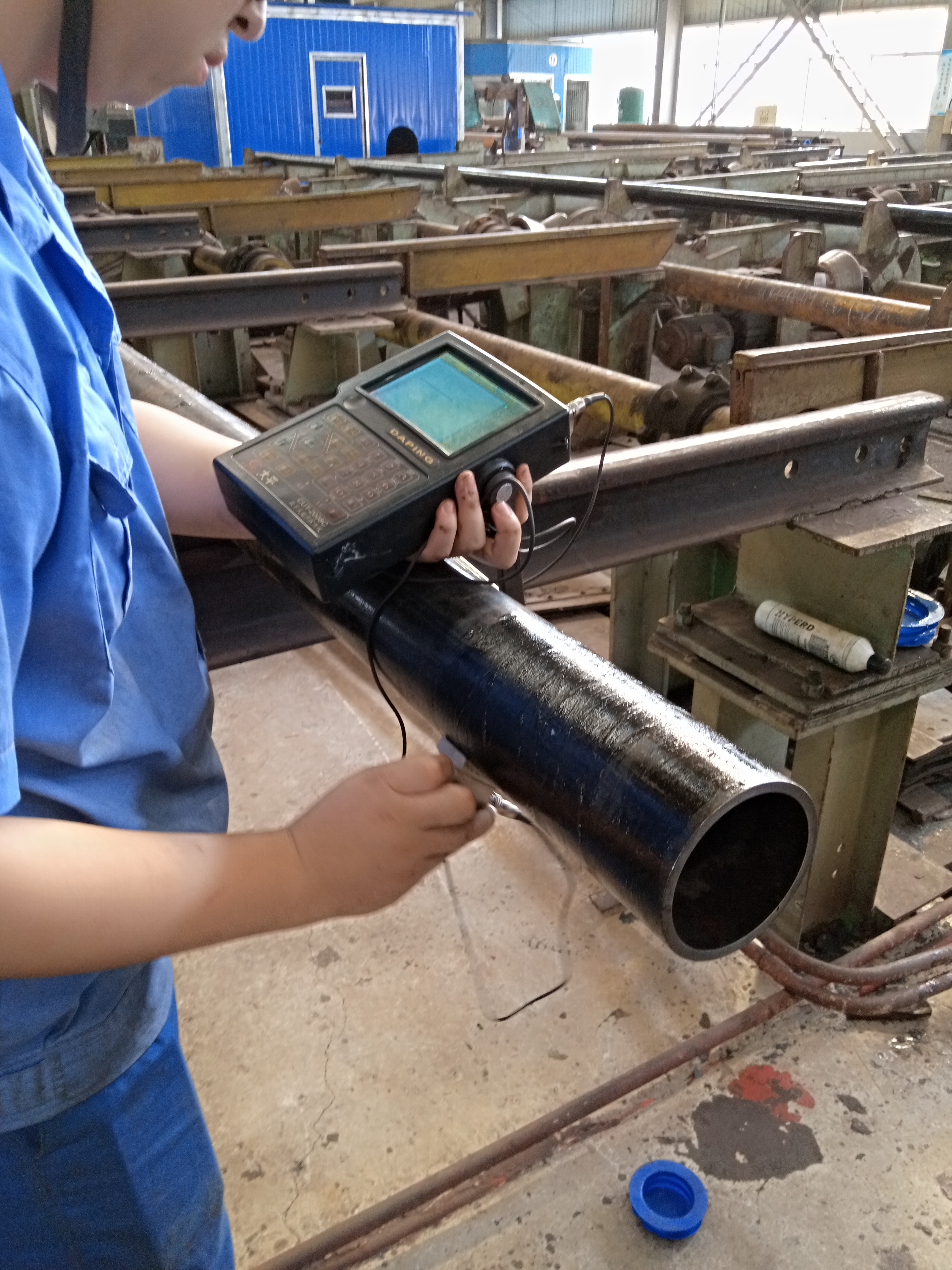 ZC technician running ultrasonic flaw detection on a pipe end — part of the NDT and MTC package supplied with CRA OCTG orders.
We supply CRA OCTG from L80 13Cr through Super 13Cr, 22Cr duplex, 25Cr super duplex, Alloy 825, and Alloy 625. For all grades above L80 13Cr, we request well conditions from the customer — pCO₂, pH₂S, operating temperature, and chloride concentration — before confirming grade and mill. For duplex and nickel alloy orders, we coordinate third-party inspection at the mill and compile MTC packages that include:
- Chemical analysis per heat, with chromium, nickel, molybdenum, and nitrogen confirmed
- Mechanical test results tied to heat number and heat treatment batch
- Corrosion qualification data for the project-specified conditions
- ISO 15156-3 qualification report for the specific UNS designation and heat treatment
- EN 10204 3.2 MTC with third-party witness signature
- Premium connection makeup torque data and field makeup procedure
For grade selection enquiries, contact our technical team with the four key parameters: CO₂ partial pressure, H₂S partial pressure (or confirmed absent), maximum operating temperature, and chloride concentration. With those numbers, we can place you in the selection matrix and confirm the appropriate grade, available sizes, and lead time.
Frequently Asked Questions
What is a CRA and when is it required for OCTG?
A Corrosion Resistant Alloy (CRA) is a metallic material with sufficient alloying elements — primarily chromium, nickel, and molybdenum — to resist corrosion in specific production environments. CRAs are required for OCTG when CO₂ partial pressure, H₂S concentration, temperature, or chloride levels exceed what carbon steel grades (L80, T95, P110) can handle without unacceptable corrosion rates or sulphide stress cracking risk. The economic threshold for CRA selection is typically when the cost of CRA tubulars is less than the cost of corrosion inhibitor injection, workover operations, or well failure over the field life.
What CO₂ partial pressure requires CRA tubing?
Industry practice generally requires CRA evaluation when CO₂ partial pressure exceeds 0.2 MPa (2 bar). Below 0.05 MPa CO₂ partial pressure, carbon steel with corrosion inhibitor is usually acceptable. Between 0.05 and 0.2 MPa, inhibited carbon steel or CRA may be appropriate depending on temperature and water cut. Above 0.2 MPa, CRA is typically required. Above 2.5 MPa, L80 13Cr may be insufficient and Super 13Cr or higher grades should be evaluated.
Can CRA grades be used in H₂S sour service?
CRA grades have varying H₂S tolerance. L80 13Cr is a CO₂ corrosion grade only and is not appropriate for H₂S service regardless of partial pressure — it has no NACE MR0175/ISO 15156-3 H₂S qualification. Super 13Cr can be qualified under ISO 15156-3 for very limited H₂S service — typically below 0.02 MPa H₂S partial pressure within specific temperature and pH limits. Duplex stainless steels (22Cr, 25Cr) have wider H₂S envelopes but are still restricted at higher H₂S concentrations and temperatures. Nickel alloys (Alloy 625, Alloy 825) provide the broadest H₂S + CO₂ resistance but at significantly higher cost. Always verify H₂S tolerance against ISO 15156-3 limits for the specific alloy and well conditions.
What is the difference between 22Cr duplex and 25Cr super duplex?
22Cr duplex (UNS S31803/S32205) contains approximately 22% chromium, 5% nickel, and 3% molybdenum with a PREN (Pitting Resistance Equivalent Number) of around 35. 25Cr super duplex (UNS S32750/S32760) contains approximately 25% chromium, 7% nickel, and 4% molybdenum with a PREN above 40. Super duplex provides significantly better pitting corrosion resistance, higher strength, and wider H₂S tolerance than standard duplex, at a cost premium of 20–40%. Super duplex is used in more aggressive environments — higher H₂S, higher chlorides, higher temperature.
How much more expensive is CRA tubing compared to carbon steel?
CRA tubing commands significant cost premiums over carbon steel grades. Approximate relative costs compared to L80-1 carbon steel: L80 13Cr is 3–5× L80-1; Super 13Cr is 4–7× L80-1; 22Cr Duplex is 8–12× L80-1; 25Cr Super Duplex is 12–18× L80-1; Nickel alloys (625, 825) are 25–40× L80-1. These premiums make CRA selection a significant economic decision, and the choice should be supported by a full life-of-field corrosion economics analysis comparing CRA capital cost against inhibited carbon steel operating cost.
What connection types are required for CRA tubing?
CRA tubing almost always requires premium metal-to-metal seal connections. Standard API BTC connections are not suitable for most CRA applications because: gas-tight integrity is critical in the CO₂-rich environments where CRAs are used; BTC relies on thread compound and elastomers that can degrade in corrosive environments; and the higher cost of CRA tubulars justifies premium connection investment. Connection material must also be compatible with the CRA tubing to prevent galvanic corrosion.
What is PREN and why does it matter for CRA selection?
PREN (Pitting Resistance Equivalent Number) is a formula-based index that predicts a CRA's resistance to pitting corrosion: PREN = %Cr + 3.3×%Mo + 16×%N. Higher PREN indicates better pitting resistance. Martensitic 13Cr grades have PREN around 12–14. Super 13Cr is slightly higher at 14–17. 22Cr duplex has PREN around 35. 25Cr super duplex has PREN above 40. Nickel alloy 625 has PREN above 50. PREN is a screening tool — not a definitive selection criterion — and must be combined with H₂S tolerance limits and temperature envelope evaluation.
Does ZC Steel Pipe supply duplex and nickel alloy OCTG?
Yes. ZC Steel Pipe supplies CRA OCTG across the full range from L80 13Cr through Super 13Cr, 22Cr duplex, 25Cr super duplex, and nickel alloys including Alloy 825 and Alloy 625. All CRA grades are supplied with full corrosion qualification data, EN 10204 3.2 MTC, and third-party inspection. Premium connections are available for all CRA grades. Contact our technical team with your well conditions — CO₂ partial pressure, H₂S partial pressure, temperature, chloride content — and we will recommend the appropriate CRA grade.