Austenitic stainless steel pipe to ASTM A312 is the default specification for corrosion-resistant process piping in oil and gas, chemical processing, petrochemical, pharmaceutical, and marine applications. The challenge is not whether to specify A312 — it is which grade. Choosing TP304L when TP316L is needed, or specifying a standard grade where a stabilised grade (TP321 or TP347) is required, results in corrosion failures that are expensive and operationally disruptive.
ZC Steel Pipe supplies ASTM A312 seamless and electric fusion welded pipe in grades TP304, TP304L, TP316, TP316L, TP317L, and TP321 across standard NPS ranges. This guide covers the full A312 grade landscape, a service-environment selection framework, mechanical and chemical requirements, worked PREN calculations, and purchase order guidance for avoiding the most common specification errors.
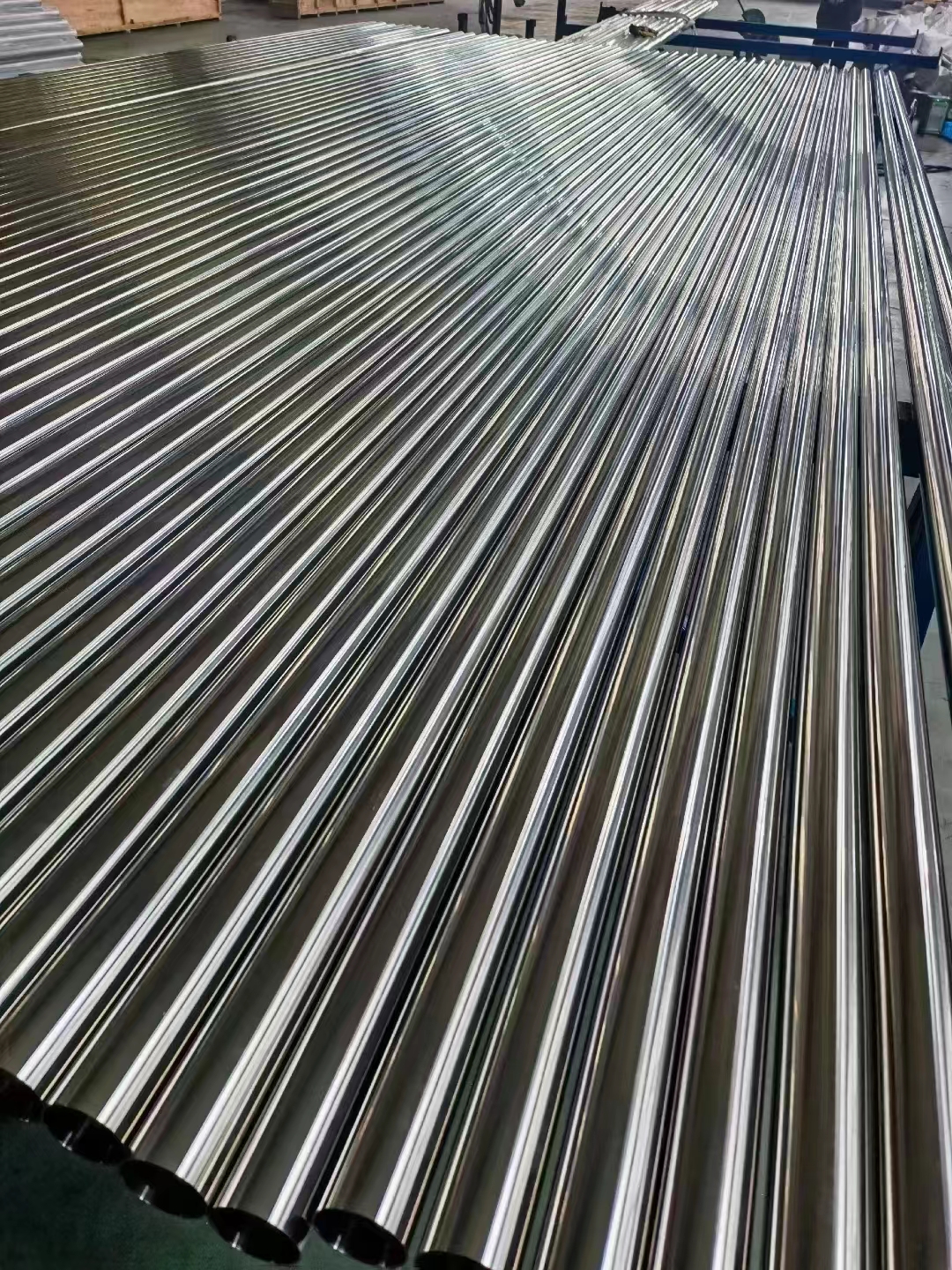 Polished seamless stainless steel tubes staged on the warehouse floor.
What we saw on a Middle East produced water injection project: TP304L was specified for a 6-inch header based on a corrosion engineer review that classified the produced water as "moderate chloride service." The produced water analysis used was from a pre-production formation water sample. At commissioning, the actual produced water chloride concentration measured 18,500 ppm at 72°C — well above the TP304L threshold for chloride stress corrosion cracking. Within 14 months, CSCC initiated at three girth weld HAZ zones. Complete replacement of the header with duplex 2205 (PREN 35) cost approximately 40× the cost of the original TP304L-to-TP316L upgrade that would have been needed even without going to duplex. Chloride concentration must be verified against produced water analyses from adjacent wells, not only from formation water samples, before selecting austenitic stainless.
What ASTM A312 Specifies
ASTM A312 is an ASTM International product specification for austenitic stainless steel pipe. It covers three product forms:
- Seamless (S): No weld seam; manufactured by hot extrusion or hot piercing followed by cold drawing and annealing. Sizes NPS ⅛ through NPS 30.
- Electric Fusion Welded (EFW or W): Longitudinally welded from strip or plate; seam must be solution annealed after welding. Sizes NPS ⅛ through NPS 72.
- Heavily Cold Worked (HCW): Cold worked after solution annealing to develop higher yield strength; less commonly specified and requires explicit purchaser agreement.
All A312 pipe must be furnished in the solution annealed condition — heated to between 1040°C and 1120°C (depending on grade) and rapidly quenched to dissolve carbide precipitates and restore the fully austenitic microstructure. Pipe that has been cut, formed, or heat-processed after solution annealing must be re-annealed unless the purchaser accepts otherwise.
Grade Overview
ASTM A312 covers over a dozen austenitic grades. The grades most relevant to oil and gas and industrial piping applications fall into three families:
Chromium-nickel grades (no molybdenum): TP304, TP304L, TP321, TP347. General-purpose corrosion resistance; TP304 and TP304L are the standard choices for non-chloride or low-chloride service. TP321 and TP347 add stabilising elements for high-temperature applications.
Chromium-nickel-molybdenum grades: TP316, TP316L, TP317L. The 2–3% molybdenum content provides substantially better resistance to pitting and crevice corrosion in chloride-containing environments. TP316L is the workhorse grade for oilfield and chemical plant piping.
High-alloy and specialty grades: TP904L, TP310S, and others. These address extreme corrosion environments and fall outside the scope of this guide.
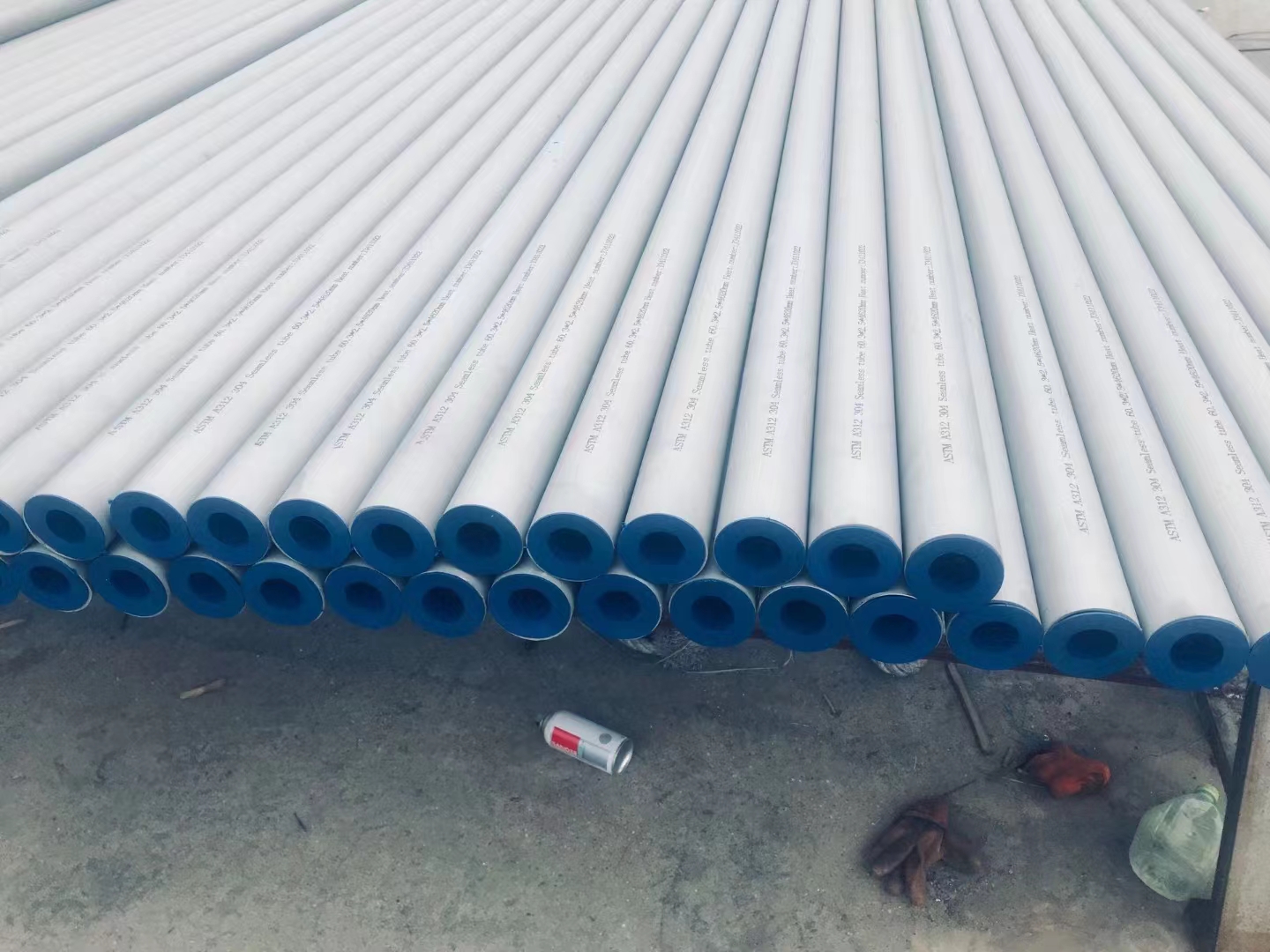 Pickled seamless stainless pipes with blue caps, stencilled "ASTM A312 304 Seamless".
For TP304L and TP316L chemistry, mechanical properties, PREN values, and detailed welding guidance, see the ASTM A312 TP304L and TP316L specifications article →
PREN Comparison: Selecting the Right Grade
PREN (Pitting Resistance Equivalent Number) is the standard screening index for chloride resistance. The formula is:
PREN = %Cr + 3.3 × %Mo + 16 × %N
The step-by-step calculation below uses typical composition mid-points for each grade. Chemistry ranges are per ASTM A312; verify exact values against the MTC for each heat.
TP304L (no Mo; N typically 0.05% — not specified in A312 but typical for the grade):
- PREN = 19.0 + 3.3 × 0 + 16 × 0.05
- PREN = 19.0 + 0 + 0.8
- PREN ≈ 20
TP316L (Mo 2.0–3.0%; use 2.5% typical; N 0.10% max; Cr minimum 16%, typical 17%):
- PREN = 17.0 + 3.3 × 2.5 + 16 × 0.08
- PREN = 17.0 + 8.3 + 1.3
- PREN ≈ 27
TP317L (Mo 3.0–4.0%; use 3.5% typical; Cr minimum 18%, typical 19%):
- PREN = 19.0 + 3.3 × 3.5 + 16 × 0.08
- PREN = 19.0 + 11.6 + 1.3
- PREN ≈ 32
Duplex 2205 (UNS S32205) (Cr 22%, Mo 3%, N 0.18%):
- PREN = 22 + 3.3 × 3 + 16 × 0.18
- PREN = 22 + 9.9 + 2.88
- PREN ≈ 35
| Grade | PREN (typical) | Practical service environment |
|---|---|---|
| TP304L | ≈ 20 | Freshwater, low-chloride process streams below 60°C |
| TP316L | ≈ 27 | Chloride service to ~1,000 ppm at moderate temperature; not adequate for immersed seawater above 20°C |
| TP317L | ≈ 32 | Aggressive chloride or acid service where TP316L margin is insufficient |
| Duplex 2205 | ≈ 35 | Seawater immersion above 20°C; produced water above 10,000 ppm Cl⁻; minimum for immersed seawater |
At 40°C in immersed seawater, TP316L (PREN ≈ 27) is typically not adequate — duplex 2205 (PREN ≈ 35) is the minimum for immersed service. For splash zone and tidal zone applications, even duplex 2205 may need evaluation against project-specific oxygen and chloride conditions.
Chemical Composition
All values are maximum % unless a range is shown. Verify all composition limits against the current edition of ASTM A312 before use in material qualification.
The chemical composition values in the table below are reference values for grade selection and engineering screening only. Verify all limits against the current edition of ASTM A312 before use in engineering work, material qualification, or purchase order preparation.
| Element | TP304L | TP316L | TP321 | TP347 |
|---|---|---|---|---|
| Carbon (max) | 0.035% | 0.035% | 0.08% | 0.08% |
| Manganese (max) | 2.00% | 2.00% | 2.00% | 2.00% |
| Phosphorus (max) | 0.045% | 0.045% | 0.045% | 0.045% |
| Sulfur (max) | 0.030% | 0.030% | 0.030% | 0.030% |
| Silicon (max) | 0.75% | 0.75% | 0.75% | 0.75% |
| Chromium | 18.00–20.00% | 16.00–18.00% | 17.00–19.00% | 17.00–19.00% |
| Nickel | 8.00–12.00% | 10.00–14.00% | 9.00–12.00% | 9.00–13.00% |
| Molybdenum | — | 2.00–3.00% | — | — |
| Titanium | — | — | 5 × C min | — |
| Niobium + Tantalum | — | — | — | 8 × C min, 1.00% max |
Key reads from this table:
- TP316L carries 2–3% Mo, which raises its pitting resistance significantly versus TP304L — this is the reason PREN jumps from ≈ 20 to ≈ 27.
- TP321 uses titanium to "getter" carbon — the Ti-C bond is more thermodynamically stable than Cr-C, preventing chromium carbide precipitation in the HAZ during welding.
- TP347 uses niobium (and tantalum) for the same purpose; Nb has a higher melting point and is preferred for service above approximately 700°C.
- Both stabilised grades still require the low-carbon L variant be specified in some codes for single-pass weld qualification.
Mechanical Properties
All standard austenitic grades under ASTM A312 share the following mechanical property floor. Verify all values against the current edition of ASTM A312 before use in engineering design.
The mechanical property values in the table below are reference values for grade selection and engineering screening only. Verify all values against the current edition of ASTM A312 before use in pressure design calculations or piping code compliance work.
| Property | TP304, TP316, TP321, TP347 | TP304L, TP316L |
|---|---|---|
| Tensile strength min | 515 MPa (74.7 ksi) | 485 MPa (70.3 ksi) |
| Yield strength min (0.2% offset) | 205 MPa (29.7 ksi) | 170 MPa (24.7 ksi) |
| Elongation min (gauge length 2 in / 50 mm) | 35% | 35% |
| Hardness max (Brinell) | 192 HBW | 192 HBW |
The lower minimum yield for L grades (170 MPa vs 205 MPa) reflects their lower carbon content. For pressure-rated piping, the allowable stress values at operating temperature — not the room-temperature minimums — govern wall thickness design. At temperatures above approximately 400°C, TP321 and TP347 have higher allowable stresses than TP316L because their stabilising elements improve creep resistance.
For the complete ASME B36.19M schedule dimensions, see the ASME B36.10M and B36.19M tables →
To check Barlow burst pressure for a given NPS, schedule, and grade, use the Barlow Pressure Calculator →
Grade Selection by Service Environment
| Environment | Recommended grade | Reasoning |
|---|---|---|
| Freshwater, atmospheric, general-purpose | TP304L | No Mo needed; L-grade ensures weld HAZ corrosion resistance |
| Chloride-containing process streams (< 200 ppm, < 60°C) | TP304L (borderline) or TP316L | Evaluate chloride concentration and temperature carefully |
| Chloride service > 200 ppm, or seawater, or > 60°C | TP316L minimum | Mo required for adequate PREN; evaluate duplex 2205 for aggressive conditions |
| Sulfuric acid or phosphoric acid service | TP316L or TP317L | Higher Mo in TP317L (3–4%) improves acid resistance |
| High-temperature process piping (425–870°C cycling) | TP321 or TP347 | Stabilised grades prevent sensitisation in thermal cycling |
| High-temperature service above 700°C | TP347 | Higher Nb-stabilisation; better creep strength than TP321 |
| Combined H2S + chloride above 60°C | Duplex 2205 or Super Duplex 2507 | Austenitic grades susceptible to CSCC; see duplex selection guide |
| Sour service (H2S only, no elevated chloride) | TP316L acceptable per NACE MR0175/ISO 15156 | Verify with NACE MR0175/ISO 15156 for your specific H2S partial pressure and pH |
For combined H2S and chloride environments, or when PREN above 35 is required, see the CRA grade selection guide → and the duplex 2205 and super duplex 2507 article →
PREN (Pitting Resistance Equivalent Number) is a screening index, not a binary pass/fail threshold. A TP316L pipe with PREN 25 in a produced water line at 90°C is not "safe" because the PREN is above 24 — it may still fail by chloride stress corrosion cracking, because CSCC in austenitic stainless depends on the combination of temperature, chloride concentration, dissolved oxygen, and tensile stress, not on PREN alone. PREN predicts resistance to pitting in a static chloride solution; it does not predict resistance to CSCC under tensile stress at elevated temperature. For service above 60°C with any measurable chloride, evaluate CSCC risk separately using the NACE MR0175/ISO 15156-3 environmental limits — PREN screening alone is insufficient.
When NOT to Use ASTM A312 Austenitic Stainless
| Service condition | Required alternative | Why austenitic A312 fails |
|---|---|---|
| Combined H2S + chloride > 1,000 ppm + temperature > 60°C | Duplex 2205 or super duplex 2507 | Austenitic susceptible to CSCC; PREN 25 insufficient for this combination |
| Seawater immersion above 20°C | Duplex 2205 (minimum PREN 35) | TP316L PREN ≈ 27 insufficient for immersed seawater above 20°C |
| High-temperature service 400–870°C (sustained) | TP321 (Ti-stabilised) or TP347 (Nb-stabilised) | Standard and L-grades sensitise; stabilised grades required |
| Cryogenic service below −200°C | ASTM A312 TP304L (impact tested) or 9% Ni steel | Verify impact test at service temperature — not all A312 is impact-qualified below −196°C |
| High-pressure piping where minimum yield is critical | Duplex 2205 (yield 450 MPa) | TP316L yield of 170 MPa requires thick walls; duplex allows 44% wall reduction |
| Acidic chloride service (H2SO4 or HCl with chloride) | TP317L or duplex 2205 | TP316L PREN insufficient for concentrated acid + chloride combination |
Schedule and Size Ranges
ASTM A312 stainless steel pipe is dimensioned per ASME B36.19M (stainless schedules), which uses the same nominal outside diameters as ASME B36.10M but defines stainless-specific schedule suffixes: 5S, 10S, 40S, and 80S.
For NPS ½ through NPS 12, Schedule 40S and 80S wall thicknesses are identical to B36.10M Schedule 40 and 80 respectively. Above NPS 12, the schedules diverge — do not assume interchangeability for large-diameter pipe without checking the actual tabulated wall.
Typical OD and wall thickness ranges for seamless A312 pipe at common schedules. Verify all dimensional values against ASME B36.19M before use in engineering design.
The dimensional values in the table below are reference values for grade selection and scheduling purposes only. Verify all OD and wall thickness values against the current edition of ASME B36.19M before use in engineering design, pressure calculations, or purchase orders.
| NPS | OD (mm) | Sch 10S wall (mm) | Sch 40S wall (mm) | Sch 80S wall (mm) |
|---|---|---|---|---|
| 1 | 33.4 | 2.77 | 3.38 | 4.55 |
| 2 | 60.3 | 2.77 | 3.91 | 5.54 |
| 4 | 114.3 | 3.05 | 6.02 | 8.56 |
| 6 | 168.3 | 3.40 | 7.11 | 10.97 |
| 8 | 219.1 | 3.76 | 8.18 | 12.70 |
| 12 | 323.9 | 4.57 | 10.31 | 17.48 |
ZC supplies seamless A312 in NPS ½ through NPS 12 and welded A312 EFW in NPS ½ through NPS 24, across schedules 10S, 40S, and 80S. Consult ZC for availability on heavier schedules (160, XXS) in specific grades.
Stainless Steel Pipe Failure Modes to Specify Against
Understanding the three most common ASTM A312 failure modes in process piping systems allows procurement teams and project engineers to write specifications that prevent them — before the pipe is ordered, not after it fails in service.
Failure Mode 1 — TP304L in High-Chloride Produced Water Service
Mechanism: TP304L pipe (PREN ≈ 20) installed in a produced water handling system where the actual chloride concentration is 15,000–25,000 ppm and service temperature is 65°C. At these conditions, TP304L is well above the threshold for chloride stress corrosion cracking. CSCC initiates at residual stress concentration zones — typically weld HAZs, external scratches, and support contact points. Cracking propagates transgranularly and accelerates with increasing temperature and chloride concentration.
Diagnostic: Cracking concentrated at or adjacent to girth welds, pipe supports, and mechanical damage points — not distributed randomly in the pipe body. Crack morphology is transgranular (not intergranular, which would indicate sensitisation). Metallographic cross-section shows branching crack pattern characteristic of CSCC.
Fix: Upgrade to TP316L (PREN ≈ 27) for moderately aggressive chloride service, or to duplex 2205 (PREN ≈ 35) for produced water above 10,000 ppm Cl⁻ at elevated temperature. Verify chloride concentration and temperature from actual produced water analyses, not formation water estimates.
Failure Mode 2 — Sensitisation of TP316 (Non-L) Weld HAZ
Mechanism: TP316 pipe (C up to 0.08%) welded into a process system operating at 200°C. During the welding cycle, the HAZ is exposed to temperatures in the sensitisation range (425–870°C) for a sufficient time to precipitate Cr₂₃C₆ carbides at grain boundaries. The carbide precipitation depletes adjacent metal of chromium below approximately 12% — the minimum for passivity. The chromium-depleted zones are susceptible to intergranular corrosion in dilute acid or chloride-containing environments.
Diagnostic: Intergranular corrosion attack visible in the HAZ of girth welds — a characteristic "trench" pattern along grain boundaries near the fusion line. Failure is adjacent to welds, not in the pipe body. Sensitisation confirmed by Huey test (ASTM A262 Practice C) on a weld sample.
Fix: Specify TP316L (C ≤ 0.035%) for any welded fabrication that will not undergo full solution re-annealing after welding. The 5% material premium for the L-grade eliminates sensitisation risk for single-pass weld cycles.
Failure Mode 3 — Dual-Marked 316/316L Pipe Used as TP316L with Non-Compliant Carbon
Mechanism: Mill ships dual-marked "TP316/316L" pipe with carbon content C = 0.047% — within the TP316 limit (0.08%) but above the TP316L limit (0.035%). The MTC carbon column shows "0.047%." The receiving inspector reviews the MTC and checks "TP316L" against the purchase order grade without checking the actual carbon value against the TP316L limit. The pipe is accepted as TP316L and used in a welded fabrication. The HAZ sensitises in service, initiating intergranular corrosion.
Diagnostic: MTC review after failure confirms C = 0.047% — above the TP316L limit of 0.035%. The pipe was dual-marked but only meets the standard carbon TP316 grade limits.
Fix: For any dual-marked pipe, check the actual carbon value on the MTC against the TP316L limit (0.035%) — not just against the grade designation. Add to the PO: "Dual-marked pipe is acceptable only if MTC carbon is confirmed ≤ 0.035% from heat analysis. Pipe where MTC carbon is between 0.035% and 0.08% will be accepted as TP316 only."
Welding ASTM A312 Pipe
Welding austenitic A312 pipe requires attention to three risks: sensitisation (carbide precipitation), distortion from high thermal expansion, and sigma-phase formation in prolonged high-temperature service.
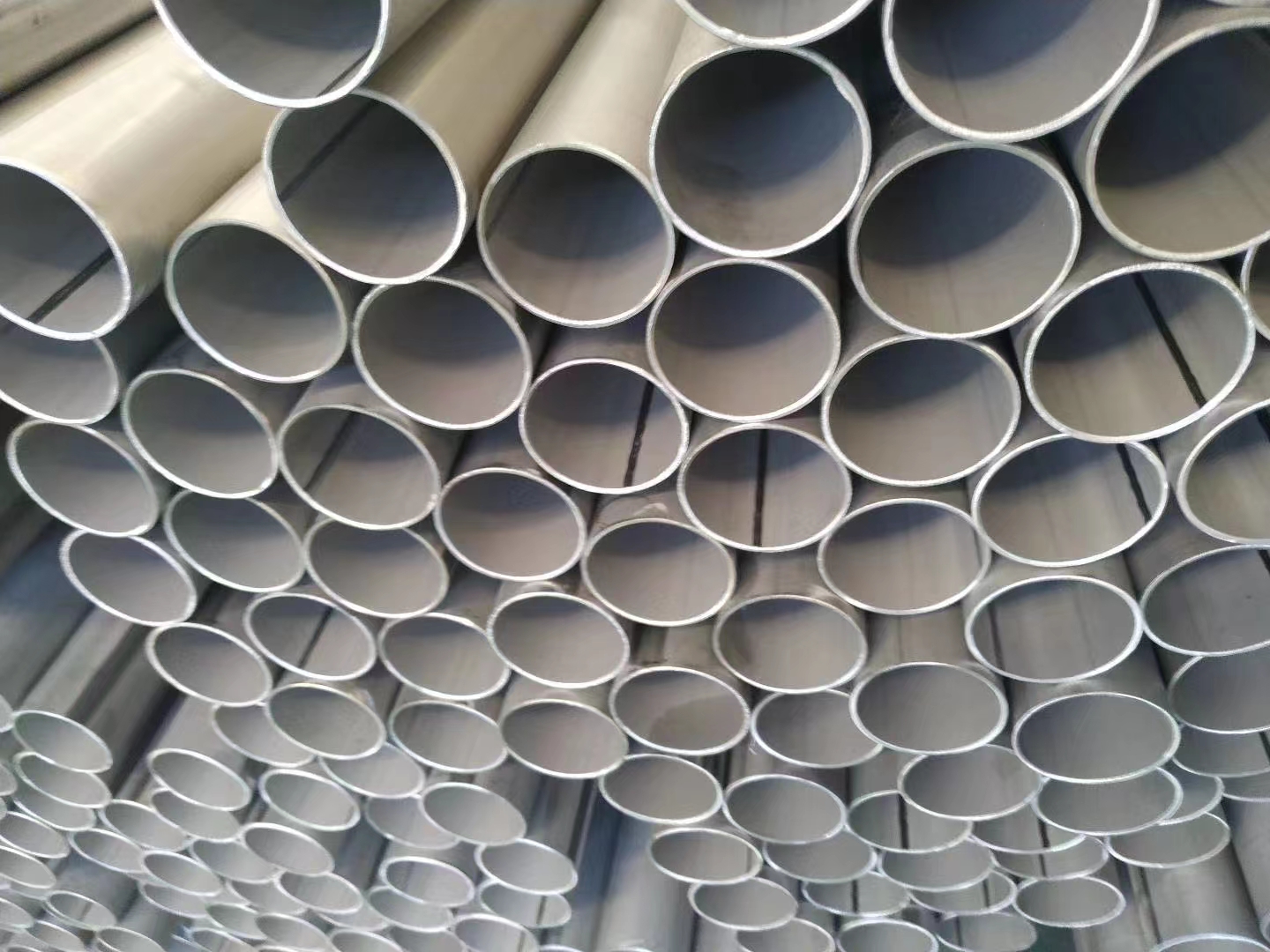 End view of stacked welded stainless pipes with visible longitudinal weld seams.
Back purging: Use argon or 90/10 Ar/N₂ to protect the weld root ID from oxidation. An unprotected root bead on austenitic stainless will show a dark oxide layer that compromises corrosion resistance.
Filler metal: ER308L for TP304L joints; ER316L for TP316L joints. The L-suffix filler is mandatory even when welding standard (non-L) base metal in fabricated equipment that will not be re-annealed.
Heat input control: Keep inter-pass temperature below 175°C to limit time in the sensitisation range. This is most critical for TP304 and TP316 (standard carbon). TP304L and TP316L tolerate a single thermal cycle without sensitisation, but prolonged or multi-pass welding in the 425–870°C band still degrades corrosion resistance.
Post-weld treatment: Solution annealing after welding fully restores corrosion resistance and relieves residual stress. Where solution annealing is not practical (field welds, large assemblies), specify TP316L or TP304L base metal and ER316L or ER308L filler to minimise sensitisation risk.
Purchase Order Guidance
A complete purchase order for ASTM A312 pipe must specify:
- Grade designation: e.g., "TP316L seamless" — not just "316L stainless steel pipe" (which may not require A312 compliance)
- Product form: Seamless (S) or EFW (W)
- NPS and schedule: e.g., "NPS 4, Schedule 40S"
- Heat treatment: "Solution annealed" (required by A312; confirm the MTR shows annealing temperature and quench method)
- Testing: Hydrostatic test or nondestructive electric test (NDET) — A312 requires one or the other; EFW pipe must also pass radiographic examination of the longitudinal weld
- Certification: EN 10204 3.1 or 3.2 MTC; third-party inspection available from ZC
Procurement trap — dual marking:
Wrong PO: "TP316 stainless steel pipe, NPS 6, Schedule 40S, seamless, ASTM A312."
What ships: Mill supplies TP316 with carbon content C = 0.06% — within the TP316 limit of 0.08% but above the TP316L limit of 0.035%. The MTC shows C = 0.06% against the TP316 limit. Pipe is used in welded fabrication for a heat exchanger piping system operating at 450°C in the high-temperature sensitisation zone. The weld HAZ sensitises (chromium carbide precipitates at grain boundaries). After 18 months in service, intergranular corrosion attack initiates at HAZ locations adjacent to girth welds.
Correct PO: "TP316L seamless, ASTM A312. Carbon max 0.035% — to be verified from heat chemistry on MTC, not estimated from grade designation. If dual-marked 316/316L, carbon on MTC must be ≤ 0.035%. Solution annealed and water quenched — annealing temperature to be documented on MTC."
Procurement trap — schedule mismatch: Stainless pipe ordered to "Schedule 40" without a B36.19M suffix may be supplied to ASME B36.10M wall thickness, which in larger NPS sizes (above 12) is thicker than 40S. For stainless pipe above NPS 12, always specify the B36.19M schedule suffix (e.g., "40S") explicitly.
Frequently Asked Questions
What does ASTM A312 cover?
ASTM A312 covers seamless, electric fusion welded (EFW), and heavily cold worked austenitic stainless steel pipe from NPS ⅛ to NPS 30 (seamless) and up to NPS 72 (welded). The specification defines chemical composition, mechanical properties, heat treatment, hydrostatic testing, and nondestructive examination requirements for all covered grades. Pipe must be supplied in the solution annealed condition.
Which ASTM A312 grade is most widely used?
TP316L is the most specified grade for oil and gas, chemical processing, and marine applications where chloride resistance matters. TP304L is used for general corrosive service, food and beverage, and pharmaceutical applications where chloride concentrations are low. Together, TP304L and TP316L account for the large majority of A312 pipe tonnage worldwide.
What is the difference between TP321 and TP347?
Both TP321 and TP347 are stabilised austenitic grades designed for high-temperature service where sensitisation from repeated thermal cycling is a concern. TP321 is stabilised with titanium (Ti ≥ 5 × C content), while TP347 is stabilised with niobium and tantalum (Nb+Ta ≥ 8 × C content). TP347 has marginally better creep strength above 650°C and is generally preferred for the most demanding high-temperature applications, while TP321 is more widely available and less expensive.
What is PREN and how does it affect grade selection?
PREN (Pitting Resistance Equivalent Number) quantifies a stainless steel's resistance to pitting corrosion in chloride environments. The formula is PREN = %Cr + 3.3 × %Mo + 16 × %N. TP304L has a PREN of approximately 18–20 (no molybdenum). TP316L has a PREN of approximately 24–26 (2–3% Mo). For seawater service or chloride concentrations above about 200 ppm at elevated temperature, TP316L is the minimum acceptable grade, and duplex 2205 (PREN ≥ 35) should be considered for aggressive chloride or combined chloride-H2S environments.
What welding process is recommended for ASTM A312 pipe?
Gas tungsten arc welding (GTAW) is the preferred process for the root pass in stainless pressure piping, with inert back purge using argon or nitrogen-argon blend to prevent oxidation of the weld root ID surface. Subsequent fill and cap passes may use GMAW or SMAW. Heat input should be controlled to minimise time in the sensitisation range (425–870°C) for standard (non-L, non-stabilised) grades. For TP316L and TP304L, back purging is still recommended to maintain corrosion resistance at the root bead.
When should I use TP321 or TP347 instead of TP316L?
Use TP321 or TP347 when the pipe will be repeatedly exposed to temperatures between 425°C and 870°C — the sensitisation range where chromium carbides precipitate at grain boundaries in standard grades. Typical applications include heat exchanger headers, high-temperature process piping, and exhaust manifolds that cycle thermally in service. TP316L and TP304L (low-carbon grades) are resistant to sensitisation for a single weld cycle but not for prolonged service in that temperature band.
Does ASTM A312 cover duplex stainless steel pipe?
No. ASTM A312 covers only austenitic stainless steels. Duplex and super duplex grades (such as UNS S31803 / 2205 and UNS S32750 / 2507) are covered by ASTM A790 for seamless and welded duplex stainless pipe. If your application involves combined H2S and chloride service above 60°C, or requires PREN above 35, refer to ASTM A790 and the article on duplex 2205 and super duplex 2507 selection.
What is the wall thickness system for ASTM A312 stainless pipe?
ASTM A312 pipe uses the schedule designations defined in ASME B36.19M: 5S, 10S, 40S, and 80S. For most NPS sizes below NPS 12, Schedule 40S and Schedule 80S wall thicknesses are identical to Schedule 40 and Schedule 80 in ASME B36.10M (the carbon steel standard). Above NPS 12, B36.19M schedules diverge from B36.10M. The outside diameter is identical across both standards for any given NPS, so flanges, fittings, and connectors are fully interchangeable.