Austenitic stainless steel pipe to ASTM A312 is the standard choice for corrosion-resistant piping in chemical processing, food and beverage, pharmaceutical, marine, and oil and gas applications. The TP304L and TP316L grades account for the large majority of industrial stainless pipe consumption. Specifying correctly — including grade, carbon limit, finish, and heat treatment — prevents in-service corrosion failures that are difficult and expensive to remediate.
ZC Steel Pipe supplies ASTM A312 seamless and welded austenitic stainless steel pipe in grades TP304, TP304L, TP316, TP316L, TP317L, and TP321 across a range of sizes and schedules. Our Southeast Asian chemical and petrochemical customers account for a significant portion of our TP316L volume, and the failure pattern we see most in that market is grade substitution — TP316 ordered or shipped in place of TP316L, with consequences that only become visible after the first welded joint goes into service. This guide covers the chemistry, mechanical properties, PREN analysis, heat treatment requirements, and application selection criteria for the most commonly specified grades.
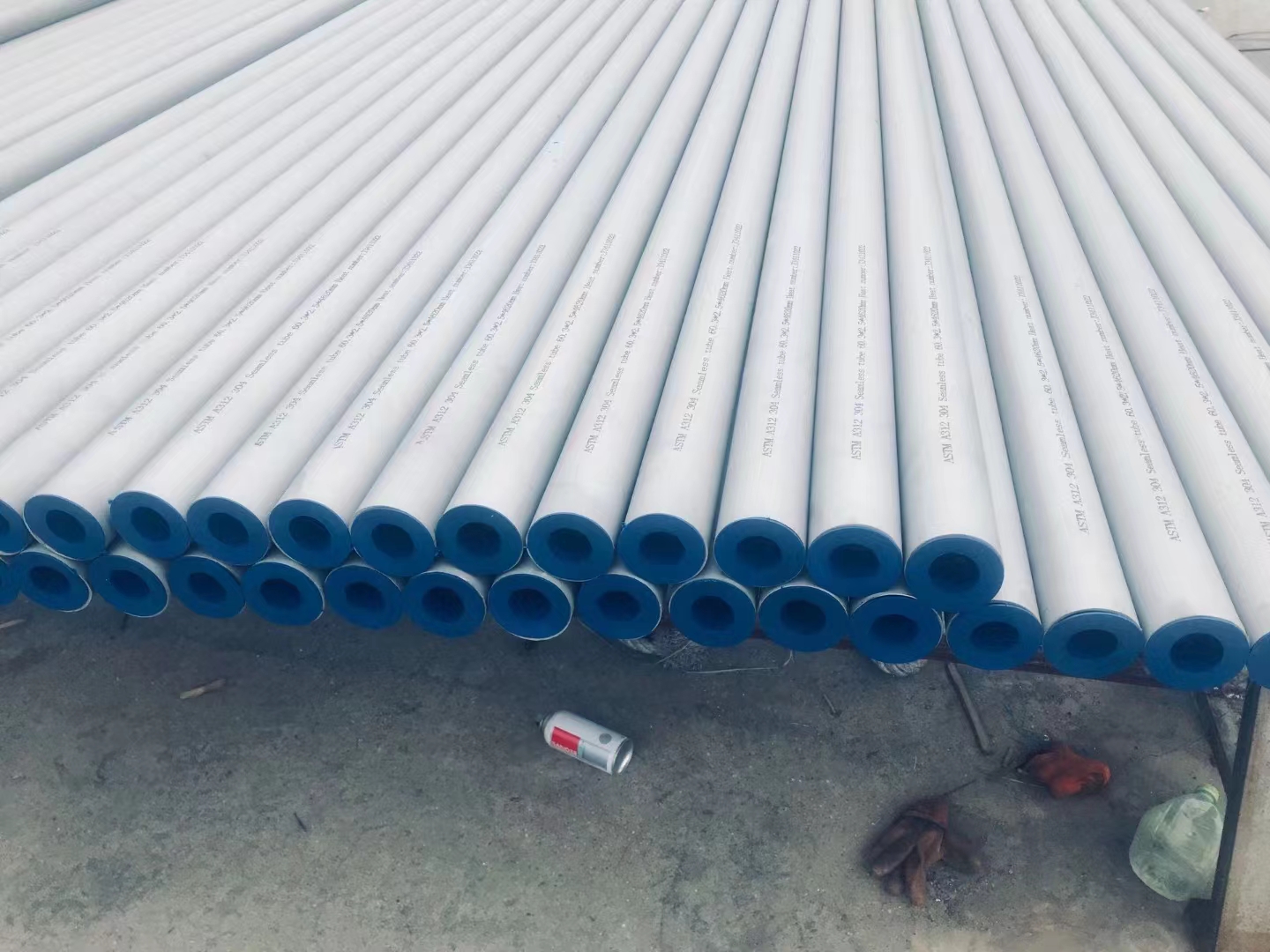 Seamless stainless pipe in a white pickled finish with blue end caps, stencilled "ASTM A312 304 Seamless" — grade and specification marked directly on each length for traceability.
What we saw on a Southeast Asia chemical plant order: A TP316 (non-L) pipe was specified for a dilute H₂SO₄ process line with girth welds throughout. The MTC showed carbon C = 0.065% — within the TP316 limit of 0.08% — and the pipe was accepted. During fabrication, the girth weld HAZ was exposed to the sensitisation range (425–870°C) for approximately 4 minutes per pass. After 2 years in service, intergranular corrosion initiated at every girth weld HAZ zone visible on the pipe ID. The root cause: Cr₂₃C₆ carbide precipitation at grain boundaries depleted chromium below the passivity threshold in the HAZ. Upgrading to TP316L (C max 0.035%) would have prevented sensitisation for a material premium of approximately 5%. The repair — cutting out and replacing every weld joint — cost more than a complete replacement with the correct grade from the outset.
1. Standard Scope and Pipe Types
ASTM A312 covers three product forms:
- Seamless (S): No weld seam; manufactured by hot extrusion or piercing and cold drawing
- Electric Fusion Welded (EFW or W): Longitudinally welded from strip or plate
- Heavily Cold Worked (HCW): Cold worked to significantly higher strength levels (less common)
Seamless pipe is preferred for pressure piping where weld seam integrity is critical. EFW pipe is used for larger diameters where seamless manufacture is uneconomical or unavailable. The distinction between seamless and EFW matters most for inspection and documentation — EFW pipe requires the weld seam to be solution annealed after welding, and the MTC must confirm this. We ask for the weld seam NDE method and post-weld heat treatment record as standard items on every EFW order; some mills only include them if explicitly requested.
2. Key Grades and Chemistry
TP304 and TP304L
| Element | TP304 | TP304L |
|---|---|---|
| Carbon (max) | 0.08% | 0.035% |
| Manganese (max) | 2.00% | 2.00% |
| Chromium | 18.00–20.00% | 18.00–20.00% |
| Nickel | 8.00–11.00% | 8.00–12.00% |
| Molybdenum | — | — |
| Nitrogen (max) | 0.10% | 0.10% |
TP304 is the most produced stainless steel composition worldwide (18Cr-8Ni). TP304L has lower carbon and is the welding-friendly variant, mandatory for fabricated equipment that will not be solution re-annealed after welding. Both grades have no molybdenum and limited resistance to chloride pitting. The practical selection rule: use TP304L wherever girth welds or branch connections will be made, and accept TP304 only for straight pipe-in-pipe runs with mechanical connections.
TP316 and TP316L
| Element | TP316 | TP316L |
|---|---|---|
| Carbon (max) | 0.08% | 0.035% |
| Chromium | 16.00–18.00% | 16.00–18.00% |
| Nickel | 10.00–14.00% | 10.00–14.00% |
| Molybdenum | 2.00–3.00% | 2.00–3.00% |
| Nitrogen (max) | 0.10% | 0.10% |
The 2–3% molybdenum addition to TP316 and TP316L provides significantly better pitting and crevice corrosion resistance than TP304/304L. TP316L is the default industrial specification — specify TP316L unless there is a specific reason to use the standard carbon TP316. The two grades are often dual-marked (316/316L) by mills where the heat satisfies both carbon limits, but the certificate must show the heat chemistry, not just the dual designation. A pipe marked 316/316L with C = 0.034% on the heat analysis is genuinely TP316L. A pipe marked 316/316L with C = 0.042% is TP316 only — the L designation is not valid for that heat.
The "L" in TP316L does not stand for "lower strength" — it stands for low-carbon, and the carbon limit of 0.035% is chosen specifically because Cr₂₃C₆ carbide precipitation becomes thermodynamically significant above approximately C = 0.03% in the sensitisation temperature band (425–870°C). At C = 0.065% (the mid-range of standard TP316), every weld creates a sensitised HAZ unless the pipe is solution re-annealed at 1040–1120°C after welding. In field fabrication, solution re-annealing is almost never practical. Specifying TP316L for any welded fabrication that will not be post-weld heat treated is the only reliable protection against HAZ sensitisation — not specifying TP316 and assuming the welder will control the heat input adequately.
TP317L
| Element | Limit |
|---|---|
| Carbon (max) | 0.035% |
| Chromium | 18.00–20.00% |
| Nickel | 11.00–15.00% |
| Molybdenum | 3.00–4.00% |
Higher molybdenum (3–4%) gives TP317L better pitting resistance than TP316L for aggressive acid and chloride service. PREN for TP317L runs 29–33, versus 24–26 for TP316L. However, for most applications where TP316L is insufficient, duplex 2205 (PREN 35) is a more cost-effective step up than TP317L, because duplex also eliminates the CSCC vulnerability that austenitic grades carry in high-chloride environments.
TP321 and TP347
TP321 (Ti-stabilised) and TP347 (Nb-stabilised) are used where welding sensitisation must be prevented without solution re-annealing, particularly in high-temperature service (400–800°C). These stabilised grades form stable Ti- or Nb-carbides that do not deplete chromium at grain boundaries. The sensitisation mechanism is chemically blocked by the stabilising element rather than managed by keeping carbon low. For sustained elevated-temperature service cycling repeatedly through the sensitisation range, TP321 or TP347 are more reliable than TP316L.
3. Mechanical Properties
| Grade | Min Tensile (MPa) | Min Yield (MPa) | Min Elongation |
|---|---|---|---|
| TP304 / TP316 | 515 | 205 | 35% |
| TP304L / TP316L | 485 | 170 | 35% |
| TP317L | 515 | 205 | 35% |
| TP321 | 515 | 205 | 35% |
| TP347 | 515 | 205 | 35% |
L-grades (TP304L, TP316L) have lower minimum yield strength (170 MPa versus 205 MPa) because the lower carbon content that prevents sensitisation also reduces solid-solution strengthening. For most standard process piping, this difference is absorbed by available schedule wall. The worked calculation below shows where the yield strength gap does and does not drive wall selection.
Wall Thickness Impact: TP316L vs TP316 Yield Strength
For NPS 4 (OD = 114.3 mm) process pipe at 10 MPa service pressure, using ASME B31.3 wall thickness formula (E = 1.0, Y = 0.4, for T < 482°C):
t = P × D / (2 × (S × E + P × Y))
TP316L — allowable stress S = 115 MPa (governed by yield criterion: 2/3 × 170 = 113 MPa; UTS criterion: 485 / 3 = 162 MPa → minimum governs at 113 MPa, rounded to 115 MPa per ASME B31.3 Table A-1):
t = 10 × 114.3 / (2 × (115 × 1.0 + 10 × 0.4)) = 1143 / (2 × 119) = 1143 / 238 = 4.80 mm
Schedule 40S (NPS 4) wall = 6.02 mm — acceptable with 1.22 mm margin.
TP316 — allowable stress S = 138 MPa (yield criterion: 2/3 × 205 = 137 MPa; UTS criterion: 515 / 3 = 172 MPa → minimum governs at 137 MPa, rounded to 138 MPa):
t = 10 × 114.3 / (2 × (138 × 1.0 + 10 × 0.4)) = 1143 / (2 × 142) = 1143 / 284 = 4.03 mm
| Parameter | TP316L | TP316 |
|---|---|---|
| Allowable stress S (MPa) | 115 | 138 |
| Required wall at 10 MPa (mm) | 4.80 | 4.03 |
| Available Sch 40S wall (mm) | 6.02 | 6.02 |
| Schedule required | 40S | 40S |
| Sensitisation risk (welded) | None | High |
Both grades use Schedule 40S at 10 MPa. The yield strength advantage of TP316 over TP316L becomes material at higher pressures — above approximately 30 MPa for NPS 4, the required wall begins to diverge between grades. For standard chemical and process piping applications below 30 MPa, specifying TP316L over TP316 costs approximately 5% more in material, requires no additional wall thickness, and eliminates sensitisation risk completely.
For the complete stainless pipe dimensions by NPS and schedule, see the ASME B36.10M pipe schedule tables →
To match a stainless or CRA grade to your corrosive service conditions, use the Pipe Grade Selector →
4. PREN Comparison and Corrosion Service Selection
Pitting Resistance Equivalent Number: PREN = %Cr + 3.3×%Mo + 16×%N
| Grade | Typical PREN | Suitable Chloride Environment |
|---|---|---|
| TP304L | 18–20 | Freshwater, mild atmospheric |
| TP316L | 24–26 | Seawater splash zone, Cl⁻ below 200 ppm at ambient temp |
| TP317L | 29–33 | Moderate chloride, dilute acid |
| Duplex 2205 | 34–38 | Offshore seawater, higher chloride |
| Super Duplex 2507 | 40–45 | Subsea, aggressive chloride |
PREN is a screening tool, not a corrosion guarantee. Actual corrosion resistance depends on temperature, pH, oxygen content, flow velocity, and crevice geometry. A TP316L pipe with PREN 26 that passes PREN screening may fail in stagnant seawater at 50°C because PREN does not capture the temperature and stagnancy effects on crevice corrosion. For critical chloride service decisions, use PREN to narrow the candidates and then evaluate with coupon test data at the actual service temperature.
5. Heat Treatment — Solution Annealing
All A312 pipe is supplied solution annealed. Typical solution annealing temperatures:
| Grade | Solution Anneal Temp (°C) | Quench Method |
|---|---|---|
| TP304 / TP304L | 1040–1120 | Water quench |
| TP316 / TP316L | 1040–1120 | Water quench |
| TP317L | 1040–1120 | Water quench |
| TP321 | 1040–1120 | Water quench |
| TP347 | 1040–1120 | Water quench |
After solution annealing, the pipe must not be heated above 425°C unless subsequently re-annealed. Heating in the sensitisation range (425–870°C) precipitates chromium carbides at grain boundaries and destroys intergranular corrosion resistance. The MTC must document the actual annealing temperature — not just confirm that solution annealing was performed — and the temperature must be 1040°C or above. We review this field on every MTC before accepting delivery; a mill that records 1010°C on the MTC has not satisfied A312, and the batch is held.
6. Surface Finishes
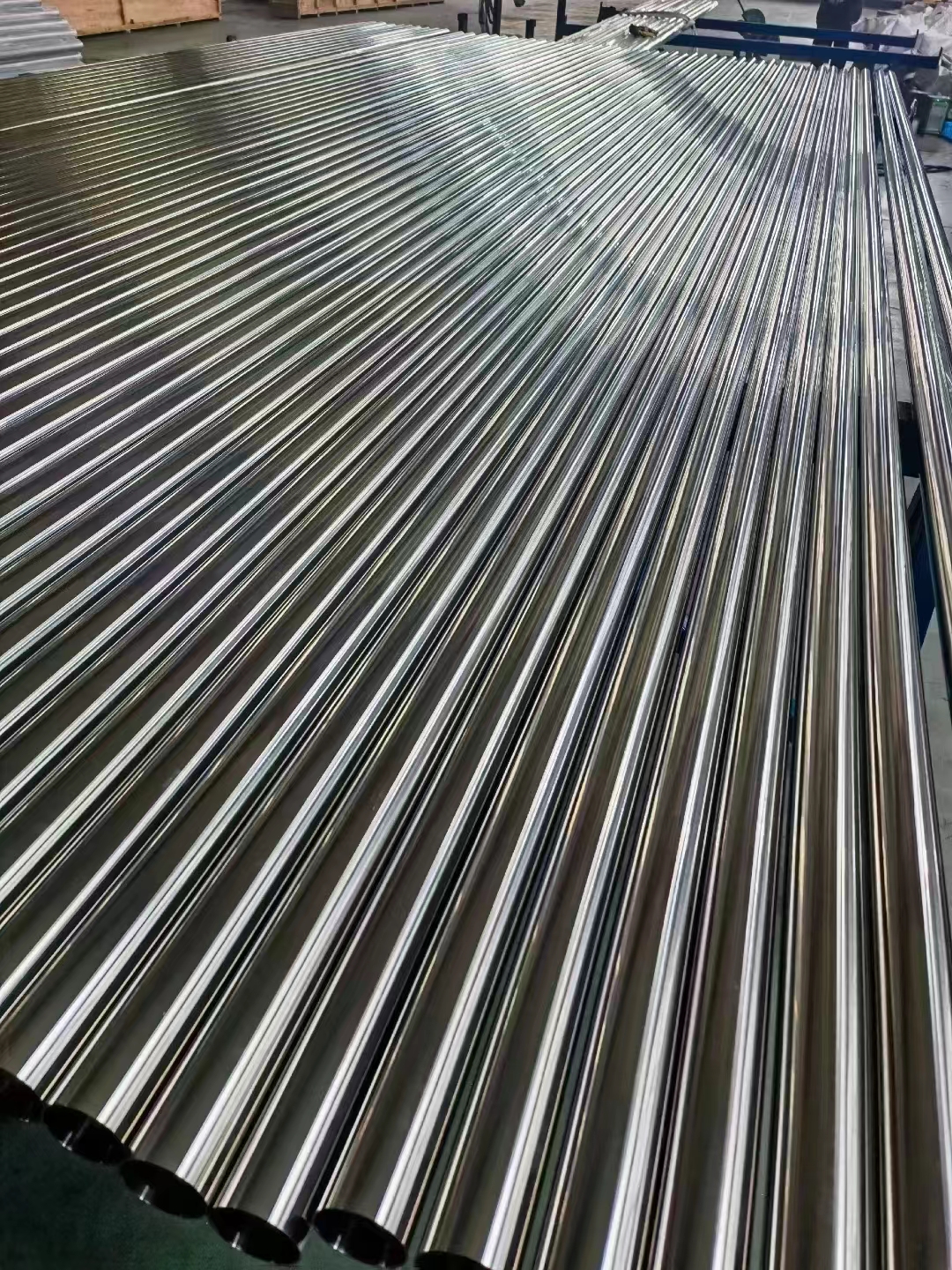 Bright polished seamless stainless tubes fanned across the warehouse floor — the mirror-bright finish contrasts with the standard 2B pickled-and-passivated finish used for most process piping.
ASTM A312 does not specify a surface finish — finish is agreed between purchaser and supplier:
| Designation | Description | Application |
|---|---|---|
| 1D | Hot rolled, annealed, pickled | Structural, low-visibility |
| 2B | Cold rolled, annealed, pickled, light skin pass | Most common industrial pipe finish |
| 2R | Bright annealed (BA) | Hygienic, pharmaceutical, food |
| Electropolished | Mechanically polished then electrolytically polished | Ultra-clean pharmaceutical and biotech |
For oil and gas process piping, 2B (pickled and passivated) is the standard finish. Confirm the passivation step is included — "pickled" and "pickled and passivated" are different on the mill order form, and some mills will ship pickled-only unless passivation is explicitly specified.
7. Applicable Standards and Related Specifications
| Specification | Scope |
|---|---|
| ASTM A312 | Seamless and welded austenitic SS pipe |
| ASTM A213 | Seamless austenitic SS tubes (boiler, heat exchanger) |
| ASTM A403 | Wrought austenitic SS buttweld fittings |
| ASTM A182 | Austenitic SS flanges and fittings forgings |
| ASTM A240 | Austenitic SS plate, sheet, strip |
| NACE MR0175 / ISO 15156-3 | SS suitability for H2S service |
When NOT to Use TP304L or TP316L
Both grades have well-established service limits. The table below lists the conditions where specifying TP304L or TP316L is wrong — not marginal, but definitively wrong — and the alternative required.
| Service condition | Required alternative | Why 304L/316L fails |
|---|---|---|
| Combined H₂S + chloride above 5,000 ppm + temp above 60°C | Duplex 2205 or super duplex 2507 | CSCC risk exceeds austenitic threshold; PREN 27 (316L) insufficient |
| Sustained high temperature 400–870°C | TP321 or TP347 (stabilised grades) | Standard and L-grades sensitise under repeated thermal cycling in this range |
| Service temperature above 870°C | TP310S, Inconel 625, or alloy steel | ASTM A312 grades lose corrosion resistance above 870°C from sigma phase and oxide breakdown |
| High-pressure piping where yield strength is limiting | Duplex 2205 (yield 450 MPa) | TP316L yield 170 MPa requires heavy wall; duplex allows significant wall reduction at equivalent pressure |
| Seawater immersion above 20°C | Duplex 2205 minimum | TP316L PREN approximately 27; immersed seawater at elevated temperature requires PREN 35 or above |
| Austenitic pipe in combined H₂S + chloride per NACE MR0175/ISO 15156-3 | Duplex 2205 per NACE conditions | Austenitic CSCC risk; duplex 2205 qualified per NACE MR0175/ISO 15156-3 Table A.3 |
These are not edge cases — each represents a service condition that appears regularly in chemical and oil and gas piping, and TP316L is genuinely disqualified in each one. Knowing the limits is as important as knowing the capabilities.
For a complete grade comparison including duplex and super duplex options, see the Duplex 2205 and Super Duplex 2507 selection guide →
TP304L/316L Failure Modes to Specify Against
Knowing the grade chemistry and PREN is not enough for specifying stainless pipe correctly. These three failure modes recur across Southeast Asian chemical plant and Middle East process piping projects — each is preventable at the specification stage.
Failure Mode 1 — Sensitisation of TP316 (non-L) weld HAZ in acid service
Mechanism: TP316 pipe (C = 0.065%) used in dilute sulfuric acid (5%) piping with multiple girth welds. Weld heat input creates HAZ exposure to 500–700°C for 3–5 minutes. At these conditions and carbon content, Cr₂₃C₆ carbides precipitate at grain boundaries, depleting adjacent zones below 12% Cr. In the dilute acid environment, the chromium-depleted zones dissolve preferentially, initiating intergranular corrosion.
Diagnostic: Corrosion concentrated at and adjacent to girth welds, with an undamaged pipe body between welds — the classic sensitisation pattern. Metallographic cross-section shows intergranular attack at grain boundaries in the HAZ zone, 1–3 mm from the fusion line. Huey test (ASTM A262 Practice C) on a weld coupon confirms sensitisation.
Fix: Specify TP316L (C ≤ 0.035%) for all welded fabrications. The 5% material premium eliminates sensitisation risk at a single weld cycle. For existing TP316 systems that cannot be replaced, solution annealing after every weld restores corrosion resistance — but this is rarely practical in the field.
Failure Mode 2 — CSCC of TP316L in high-chloride produced water above 60°C
Mechanism: TP316L pipe (PREN approximately 27) in a produced water system where operating temperature is 75°C and chloride concentration is 12,000 ppm. These conditions exceed the TP316L CSCC threshold. Stress corrosion cracking initiates at residual stress zones — girth weld toes, pipe-to-fitting bevel edges, and support contact points — and propagates transgranularly under the combined effect of tensile stress (residual from welding), temperature, and chloride.
Diagnostic: Cracking pattern concentrated at welds and support locations — not uniform in the pipe body. Transgranular crack morphology (not intergranular — rules out sensitisation). Multiple small cracks radiating from the same zone (typical of CSCC branching). No prior pitting before cracking (rules out pitting-initiated corrosion, which is a different failure mode).
Fix: Upgrade to duplex 2205 (PREN approximately 35) or super duplex 2507 (PREN approximately 43) for produced water above 5,000 ppm Cl⁻ at temperatures above 60°C. Duplex 2205 is resistant to CSCC because the ferritic phase interrupts the continuous austenite grain boundary network required for CSCC propagation.
Failure Mode 3 — Solution annealing not achieved during heat treatment
Mechanism: An order of TP316L pipe is solution annealed in a continuous furnace at 1010°C instead of the 1040°C minimum required by ASTM A312. The temperature difference is within instrumentation tolerance and goes undetected. At 1010°C, the Cr₂₃C₆ carbides are not fully dissolved — a small fraction remains at grain boundaries. The pipe passes room-temperature tensile and hardness tests but has reduced corrosion resistance in the HAZ after welding. After 12 months in service, intergranular attack initiates at weld zones in an environment where a properly heat-treated TP316L would not have sensitised.
Diagnostic: MTC review shows annealing temperature 1010°C — below the A312 minimum of 1040°C. The MTC passed QC inspection because the reviewer checked that the field was filled in but did not verify the value against the A312 minimum requirement.
Fix: Add to the MTC review procedure: "Verify solution annealing temperature is at or above 1040°C (for TP304L/316L) as documented on MTC — reject if temperature is below 1040°C or if the annealing temperature field is blank." This check takes 10 seconds per MTC and prevents this failure mode entirely.
Procurement Traps
Trap 1 — Grade designation without confirmed heat chemistry
Wrong PO: "TP316 stainless steel pipe, NPS 4 seamless, Schedule 40S, ASTM A312."
What ships: Mill delivers TP316 with carbon C = 0.06% — within spec. The material is correctly identified as TP316 on the MTC. Used in welded process piping fabrication without post-weld solution annealing, sensitisation follows in acid or chloride service.
Correct PO: "TP316L seamless, ASTM A312 latest edition, NPS 4, Schedule 40S. Carbon max 0.035% to be confirmed from heat chemistry on MTC (not estimated from grade designation). Solution annealed at 1040°C minimum, water quenched — annealing temperature and quench method to be documented on MTC. ER316L filler wire for all girth welds."
Trap 2 — Dual-marked pipe accepted without verifying the heat carbon
Dual-marked 316/316L pipe is common from mills where the heat incidentally falls within both carbon limits. The dual marking is legitimate — if the heat chemistry shows C ≤ 0.035%, the pipe qualifies as TP316L. The trap is accepting dual-marked pipe without checking the actual carbon value. We have seen 316/316L-marked pipe with C = 0.042% on the heat analysis — it satisfies TP316 but not TP316L, and the L designation is invalid for that heat. Add to your MTC acceptance checklist: confirm that the heat carbon value on the MTC is at or below 0.035% before accepting any pipe that must perform as TP316L.
Trap 3 — Specifying 316 stainless without ASTM A312 and without "L" designation
Specifying "316 stainless" by trade name only — without ASTM A312 and without the "L" designation — may result in receiving TP316 standard carbon, TP316Ti (titanium-stabilised, different composition, not interchangeable with 316L), or a non-standard composition that passes a chemical spot check but does not comply with ASTM A312 test and documentation requirements. The full PO designation must read "ASTM A312 TP316L" — all four components.
8. Procurement Checklist
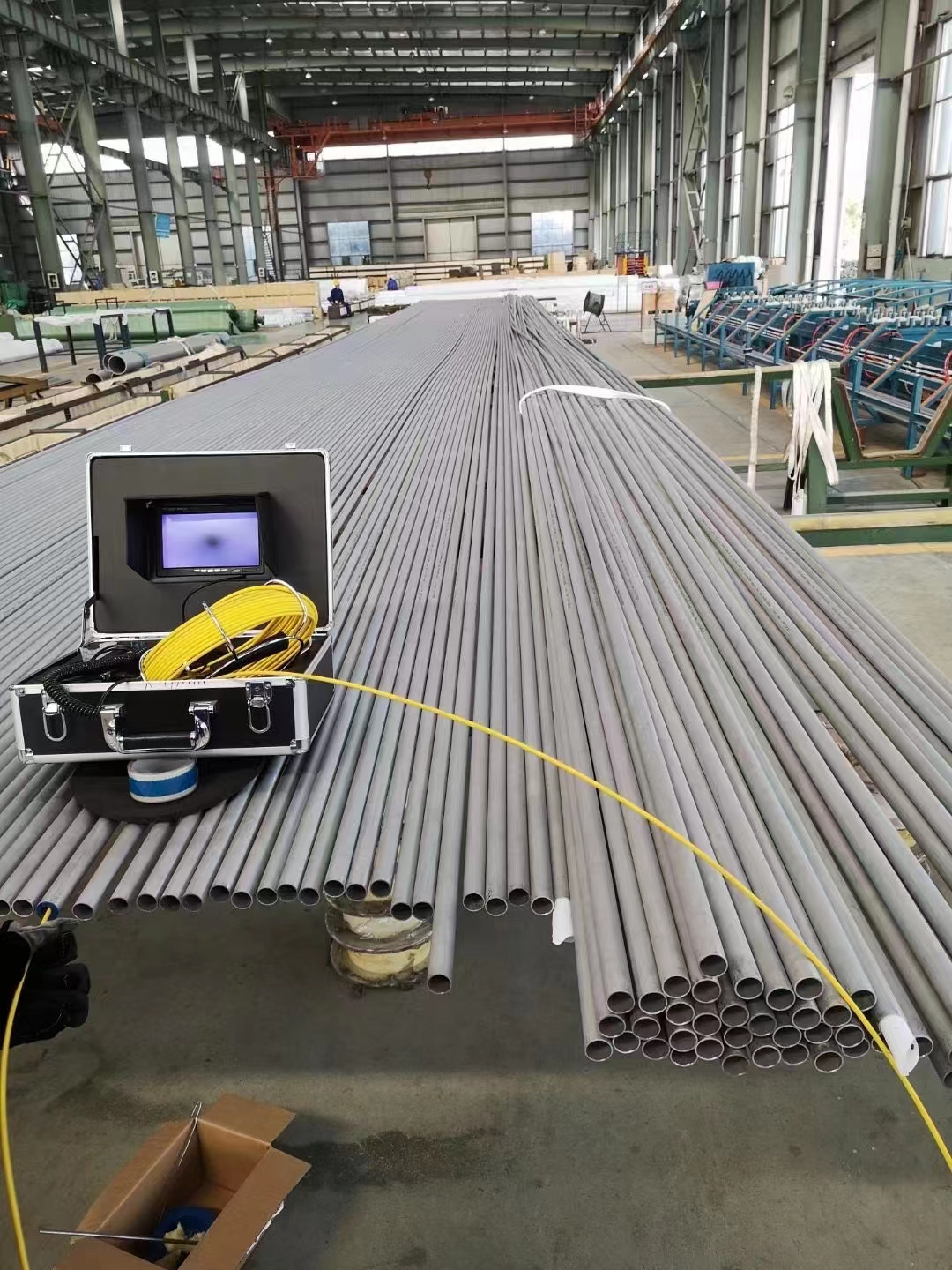 Seamless stainless pipe staged for borescope bore inspection — the kind of goods-receipt verification that confirms finish, cleanliness, and freedom from ID defects before acceptance.
- Standard: ASTM A312 (latest edition)
- Grade: TP304L / TP316L / TP317L / TP321 / TP347 (use L-grade for welded fabrications)
- Pipe type: seamless or EFW (welded)
- NPS and schedule (e.g. Schedule 40S, Schedule 10S)
- Surface finish: 2B (standard), pickled and passivated, or special finish — confirm passivation is included
- Heat treatment: solution annealed at 1040°C minimum (standard per A312) — require temperature on MTC
- NDE: specify UT or ET requirements if beyond standard
- Mill test certificate: EN 10204 3.1 — include solution anneal temperature (not just "solution annealed") on MTC
- NACE: specify NACE MR0175/ISO 15156-3 compliance if H₂S service
- Positive Material Identification (PMI): specify if required at project level
- For welded fabrications: require ER316L filler wire documentation — confirm filler wire matches pipe L-grade chemistry
Frequently Asked Questions
What does ASTM A312 cover?
ASTM A312 covers seamless, straight-seam electric fusion welded, and heavily cold worked austenitic stainless steel pipe in sizes NPS ⅛ through NPS 30 (seamless) and NPS ⅛ through NPS 72 (welded). The specification covers the most widely used grades including TP304, TP304L, TP316, TP316L, TP317L, TP321, TP347, and TP904L, among others. Pipe is supplied in the solution annealed condition.
What is the difference between TP316 and TP316L?
TP316 and TP316L have identical chromium (16–18%), nickel (10–14%), and molybdenum (2–3%) content. The key difference is carbon: TP316 allows C ≤0.08%, while TP316L limits C ≤0.035%. The low carbon in TP316L prevents carbide precipitation (sensitisation) in the heat-affected zone when welding — precipitated chromium carbides deplete the adjacent metal of chromium, creating a chromium-depleted zone susceptible to intergranular corrosion. For welded fabrications or any service involving thermal cycles, TP316L is strongly preferred over TP316.
What is the PREN of TP316L and how does it compare to TP304L?
PREN (Pitting Resistance Equivalent Number) = %Cr + 3.3×%Mo + 16×%N. For TP304L (no Mo): PREN ≈ 18–20. For TP316L (2–3% Mo): PREN ≈ 24–26. The higher PREN of TP316L reflects its significantly better resistance to pitting and crevice corrosion in chloride-containing environments. TP304L is adequate for freshwater and mild atmospheric service; TP316L is required for seawater environments, process streams with chloride concentrations above approximately 200 ppm, and acid cleaning services.
What heat treatment is required for ASTM A312 pipe?
ASTM A312 requires all austenitic stainless steel pipe to be furnished in the solution annealed condition. Solution annealing involves heating to 1040–1120°C (depending on grade) and rapid quenching — typically water quench. This dissolves all carbide precipitates and restores the single-phase austenitic microstructure, eliminating sensitisation from any prior working or thermal operations. Pipe that has been cut, welded, or heat processed after solution annealing must be re-annealed unless otherwise accepted by the purchaser.
What NPS sizes are available for seamless vs welded A312 pipe?
Seamless A312 pipe is available from NPS ⅛ to NPS 30 (DN 6 to DN 750). Welded (EFW) A312 pipe is available from NPS ⅛ to NPS 72 (DN 6 to DN 1800). For NPS above 12–14 inches, welded pipe is generally the only practical option since large diameter seamless stainless manufacture becomes technically challenging and uneconomical. The weld seam of A312 EFW pipe must be solution annealed after welding.
What is TP317L and when is it used instead of TP316L?
TP317L (C ≤0.035%, Cr 18–20%, Ni 11–15%, Mo 3–4%) has higher molybdenum than TP316L, giving it a PREN of 29–33 versus 24–26 for TP316L. TP317L is used in more aggressive chloride environments, concentrated sulfuric acid service, and chemical process applications where TP316L is borderline or marginal. However, for most oil and gas applications, duplex 2205 (PREN 35) is a more cost-effective choice over TP317L at elevated chloride concentrations.
Can ASTM A312 stainless pipe be used for sour service?
Austenitic stainless steels (TP304, TP316, TP316L) are generally immune to sulfide stress cracking (SSC) due to their non-magnetic austenitic microstructure, and are acceptable for H2S service in most conditions per NACE MR0175/ISO 15156-3. However, they are susceptible to chloride stress corrosion cracking (CSCC) at temperatures above approximately 60°C in the presence of chlorides, and to pitting in high-chloride sour environments. For combined H2S and high-chloride service above 60°C, duplex or super duplex stainless steel is usually preferred.
How do I verify solution annealing was correctly performed on an MTC?
Review the MTC heat treatment section and confirm the recorded solution annealing temperature is at or above 1040°C for TP304L and TP316L (ASTM A312 minimum). Reject any MTC where the annealing temperature field is blank or records a temperature below 1040°C — a temperature of 1010°C, for example, is within furnace instrument tolerance but will not fully dissolve Cr23C6 carbides, leaving residual sensitisation susceptibility after welding. Also confirm that water quench (or equivalent rapid cooling) is documented, not air cool.