Casing connection selection is one of the few decisions that cannot be corrected after the cement job. A connection that leaks under gas pressure requires a workover that may cost ten to fifty times the price difference between a commodity thread and a premium one. API BTC — the 60° buttress thread that has served the industry for decades — provides excellent value for a specific envelope of service conditions, but it has a fundamental limitation: it has no metal-to-metal seal. Proprietary premium connections such as VAM TOP (Vallourec) and Tenaris Blue (Tenaris) were developed specifically to close that gap, delivering gas-tight integrity under combined axial, bending, and pressure loads that BTC cannot reliably tolerate. Understanding how these three connections differ technically — not just commercially — is essential for any EPC drilling or completion engineer specifying casing strings for gas, HPHT, sour, or deviated wells.
ZC Steel Pipe supplies API 5CT casing in grades H40 through Q125, including sour-service grades L80 Type 1, C90, and T95, with threading coordinated through licensed shops for both API and premium connections. The green pipe body and the thread brand are two separate procurement decisions, and getting both right matters.
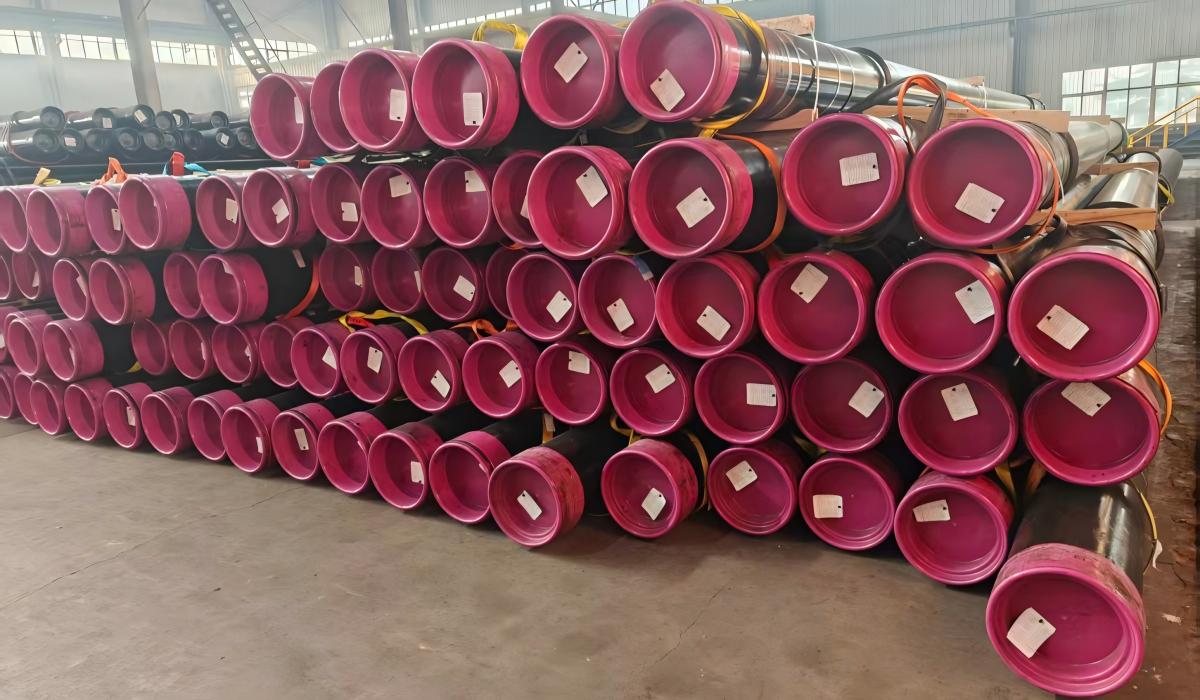 ZC2 gas-tight S-95 casing ends with thread-protector caps fitted — a high-pressure gas string shipped to a Nigerian operator, where the metal-to-metal seal is what holds gas that BTC cannot.
At a Glance — Which One, and When
The short answer: API BTC has no metal-to-metal seal, so it is not gas-tight. Both VAM TOP and Tenaris Blue add a metal-to-metal seal and a positive torque shoulder, so both hold gas. Use BTC for liquid-service, low-pressure, near-vertical strings; upgrade to a premium connection once gas, HPHT, sour, or significant deviation enters the picture.
| API BTC | VAM TOP | Tenaris Blue | |
|---|---|---|---|
| Seal | Thread compound only | Radial metal-to-metal | Pin-nose metal-to-metal |
| Gas-tight | No | Yes | Yes |
| ISO 13679 | Not tested | Typically CAL IV | CAL II–IV (varies) |
| Best at | Liquid / low-pressure / vertical | HPHT, sour, subsea, deviated | Deviated / compression, cost-sensitive premium |
| Cost index | 1× | 2–4× | 1.5–3× |
VAM TOP has the longer HPHT and deepwater track record; Tenaris Blue's dovetail thread resists jump-out under compression. The full technical breakdown, load-case logic, and a worked cost calculation follow — and for the connection families behind this choice, see the casing connection types guide (STC, LTC, BTC, premium) →.
What Makes a Casing Connection Gas-Tight?
Three mechanical elements determine whether a threaded casing connection will hold gas pressure without leaking.
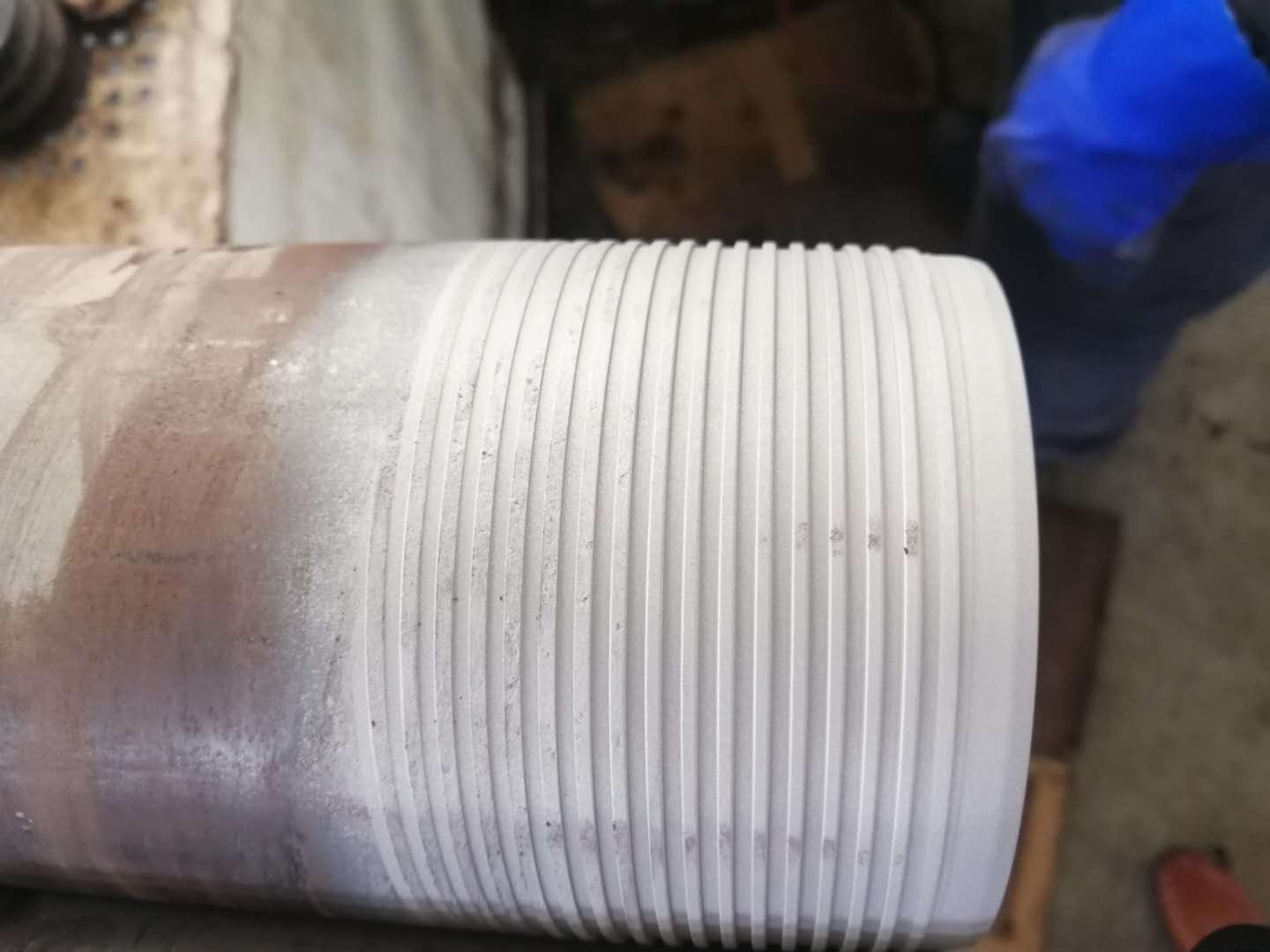 Sandblasted thread on a pipe end — the matte finish exposes the machined flanks and seal surface for inspection before thread compound is applied to the threads only.
Thread form and taper. The thread form controls how load is distributed along the engaged length and whether the flanks create a metal-to-metal interference path. API buttress thread has a 60° thread angle with a small lead taper. It generates high radial contact stress under make-up torque, but the helical thread path still allows gas to migrate along the thread helix if the compound fails or washes out under sustained pressure.
Seal mechanism. A compound-dependent seal relies on thread sealant filling the microscopic gaps in the thread form. This works acceptably for liquids, which have much lower molecular mobility than gas. For gas service — particularly high-pressure gas or gas containing H₂S — the only reliable seal is a metal-to-metal (MtM) interference fit between precisely machined surfaces on the pin and box. The MtM seal creates a continuous metal contact band that gas cannot bypass regardless of compound condition.
Positive torque shoulder. A torque shoulder — a flat or angular face at the end of the thread make-up path — stops further advancement of the pin when the target torque is reached. This protects the MtM seal from over-torque and establishes a repeatable make-up position. API BTC has a defined make-up torque but no dedicated torque shoulder in the premium sense; the thread itself provides the rotational stop. Premium connections with a positive torque shoulder give the field crew a clear indicator of correct make-up and protect the seal geometry.
The metal-to-metal seal in premium connections is not a backup to the thread compound — it is the primary sealing mechanism, and the thread compound is the backup. This is the opposite of BTC, where compound is the only seal. The practical consequence is that a premium connection that is incorrectly made up (under-torque, wrong compound, galled seal nose) loses its primary seal mechanism while still having the compound. The result is a connection that passes a cold water pressure test but leaks gas in production — because gas permeates micro-gaps that water cannot, and the compound film that water "sees" as a seal is not a gas barrier.
For the complete grade and connection-class specification tables, see the API 5CT specification tables →
To match a connection type to your well conditions, use the Pipe Grade Selector →
API BTC: The Baseline
API Buttress Thread Casing (BTC) is defined under API Spec 5B. It uses a 60° buttress thread form on a taper of 1 inch per foot on diameter, with thread dimensions standardized across manufacturers. The connection is made up with API modified or similar compound filling the thread roots.
Seal mechanism: compound-dependent only. There is no metal-to-metal seal surface. The connection integrity depends entirely on the thread compound remaining in place under service conditions. Under sustained gas pressure, gas molecules work through the compound along the thread helix path. High make-up torque improves radial contact stress on the thread flanks but does not create a sealed metal interface.
Strengths of BTC:
- Very low connection cost — machined by any licensed API thread shop worldwide
- Wide spare parts availability (couplings stocked in most oil country tubular distribution hubs)
- Tolerant of field handling and moderate make-up variation
- Adequate for liquid-service wells, surface casing in low-pressure formations, and non-gas strings where integrity requirements are met by completion design
Limitations of BTC:
- Not suitable for gas-tight service without additional measures (such as a metal seal ring, special compound, or downgraded pressure rating)
- Performance degrades under combined bending and pressure loads — bending opens the thread flanks on the tension side and can break the compound seal
- Not qualified under ISO 13679 — no CAL rating applies
- Deviated wells above approximately 30–45 degrees inclination present elevated risk due to bending-induced thread separation
For the full cost-and-performance trade between buttress and premium, see BTC vs premium connections →; for where BTC's thread seal actually breaks down in high-angle sections, see BTC in deviated and horizontal wells →.
VAM TOP: Metal-to-Metal Seal Premium Connection
VAM TOP is a proprietary premium connection developed and licensed by Vallourec. It is one of the most widely specified premium casing connections globally, with an established track record in gas, HPHT, and sour service across deepwater and land well environments.
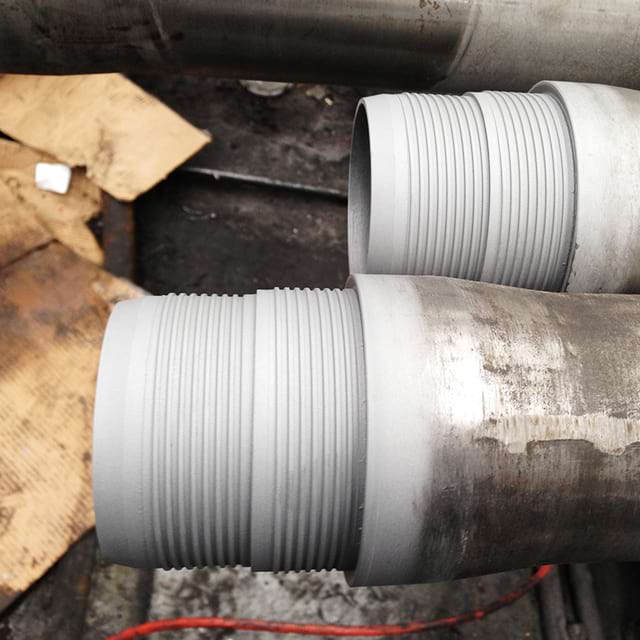 Machined premium threads on two pipe ends at the thread shop — VAM TOP and equivalents pair a load-bearing thread body with a separate metal-to-metal seal at the pin nose.
Thread design: VAM TOP uses a two-step thread form — a tapered thread body that handles axial load and a separate radial metal-to-metal seal at the pin nose. The radial MtM seal creates a continuous metal contact band independent of the thread compound. A positive torque shoulder at the pin nose end stops make-up at the correct position and locks the MtM seal geometry in place.
ISO 13679 qualification: VAM TOP is typically qualified to CAL IV, the most demanding level under ISO 13679, covering combined tension, compression, bending, internal pressure, and external pressure loading. For what each CAL level actually tests and how to read a qualification envelope, see the premium connection CAL ratings & ISO 13679 guide →.
CAL IV is the typical VAM TOP qualification, but CAL rating depends on the specific connection series, OD, weight, and grade. Always verify the applicable CAL level in the current VAM TOP Connection Design Document (CDD) for the exact combination being specified. Never assume CAL IV applies to all sizes.
Applications:
- Gas production strings where wellhead gas pressure requires hermetic seal integrity
- HPHT wells (BHST above 150°C or BHCP above 70 MPa)
- Sour service strings (H₂S partial pressure meeting NACE MR0175/ISO 15156 criteria) — specify appropriate grade (L80, C90, T95, or Q125 per well conditions)
- Deviated and horizontal wells where bending loads require a connection with a positive torque shoulder and MtM seal
- Subsea casing strings where workover access is impractical or economically prohibitive
Procurement of VAM TOP requires engaging a Vallourec-licensed thread shop. Make-up torque values, seal interference specifications, and running procedure are defined in the VAM TOP Connection Design Document (CDD). Always specify the connection revision when ordering.
Where we see this class run: The metal-to-metal, gas-tight requirement VAM TOP was built for is the same one we fill with our ZC-2 connection (VAMTOP-equivalent geometry). We shipped 11¾″ 65 ppf S-95 ZC-2 gas-tight casing to a Nigerian operator for a high-pressure gas string with sour capability — the connection reaches ISO 13679 CAL III gas-tightness through a two-step metal seal, not thread compound. What drove the premium spec was not the grade but the gas: on a BTC string in that service, the helical leak path is the first thing to fail.
Tenaris Blue: Dovetail Thread Premium Connection
Tenaris Blue is a proprietary premium connection from Tenaris, designed as an accessible premium option for wells that require better performance than BTC but where the full complexity of the most demanding HPHT connections may not be necessary.
Thread design: Tenaris Blue uses a dovetail thread form — a modified trapezoidal profile that provides both tensile and compressive load capacity without the need for a separate thread body and pin nose combination. The connection uses a pin nose metal-to-metal seal and a positive torque shoulder. The dovetail thread geometry resists thread jumpout under compression, making it well-suited for deviated wells with compressive loading on the lower sections of the casing string.
ISO 13679 qualification: Tenaris Blue carries ISO 13679 qualification across its size range, but the applicable CAL level is not uniform.
Tenaris Blue CAL rating varies by size, weight, and grade — CAL II through CAL IV coverage depends on the specific connection variant. Verify the applicable CAL level in the current Tenaris Blue CDD before specifying for HPHT or gas-tight service.
Applications:
- Gas wells requiring gas-tight seal integrity
- Deviated wells — particularly strings that will experience compressive loading in kick-off and build sections
- Cost-sensitive projects where premium performance is required but budget pressure limits the connection upgrade premium
- Production casing in moderate-HPHT conditions (verify temperature and pressure envelope against the applicable CDD)
Like VAM TOP, Tenaris Blue threading requires a Tenaris-licensed thread shop. The CDD governs make-up torque, seal interference, and running procedure. Do not mix running tools from different connection families.
Side-by-Side Comparison
| Property | API BTC | VAM TOP | Tenaris Blue |
|---|---|---|---|
| Thread form | 60° buttress, API Spec 5B | Two-step tapered thread | Dovetail trapezoidal thread |
| Seal type | Thread compound only | Radial metal-to-metal + compound | Pin nose metal-to-metal + compound |
| Torque shoulder | No dedicated MtM shoulder | Positive torque shoulder | Positive torque shoulder |
| ISO 13679 CAL rating | Not applicable | Typically CAL IV (confirm in CDD for exact size/weight/grade) | CAL II–IV, varies by size/grade (per CDD) |
| Gas-tight | No | Yes | Yes |
| Make-up method | Torque table per API RP 5C1 | CDD-defined torque window with MtM shoulder stop | CDD-defined torque window with MtM shoulder stop |
| Compressive load capacity | Low | Moderate | High (dovetail resists jumpout) |
| Typical application | Liquid service, surface casing, low-pressure formations | Gas, HPHT, sour, subsea, deviated wells | Gas, deviated, moderate-HPHT, cost-sensitive premium |
| Relative cost index | 1× (baseline) | 2–4× [varies by size and licensor] | 1.5–3× [varies by size and licensor] |
The cost index values are indicative only. Total installed cost depends on pipe OD, wall thickness, licensor pricing, and thread shop location. Obtain budgetary quotes for any specific project. The table also shows a compression-loading split worth noting: if the well design places the lower casing string in net compression (kick-off below a salt body, for example), Tenaris Blue's dovetail thread form is structurally advantaged over VAM TOP's two-step form for that specific load case. For tension-dominated strings in deep HPHT wells, VAM TOP's track record in those environments and its broad operator approved-vendor-list coverage often makes it the lower-risk choice from a procurement standpoint.
Which Connection to Choose
The correct connection choice follows directly from the well service conditions and the consequences of a connection leak — the same logic worked through in detail for HPHT, sour, and deviated wells →.
Use API BTC when:
- The string is liquid-only service (water injection, surface casing in a non-gassy formation, cement casing in shallow intervals)
- Well inclination stays below approximately 30–35 degrees with moderate axial and pressure loads
- The project is cost-driven and the formation pressure and fluid composition do not impose gas-tight or sour requirements
- The annulus pressure buildup risk is acceptable under the well design basis
Upgrade to a premium connection (VAM TOP, Tenaris Blue, or equivalent) when:
- Gas is present at the wellhead or the casing will be exposed to gas migration
- HPHT conditions apply: BHST above 150°C (300°F) or BHCP above 70 MPa (10,000 psi)
- H₂S is present and the well meets NACE MR0175/ISO 15156 sour service criteria
- Well inclination exceeds 30–45 degrees or the string passes through a horizontal section
- The completion is subsea, where workover access is limited by cost or logistics
- Local regulation or company well design standards mandate gas-tight integrity ratings
VAM TOP vs Tenaris Blue: Both connections solve the gas-tight requirement. VAM TOP has the longer track record in HPHT and deepwater applications and appears on more operator-approved vendor lists. Tenaris Blue's dovetail thread form offers a structural advantage in strings with significant compressive loading. For a specific project, the selection should be driven by: the applicable CDD performance envelope (confirm size, weight, grade, and CAL rating cover the design load cases), thread shop access and lead time in the procurement region, and any operator-mandated approved connection list. Do not select a connection brand based on cost alone if the performance envelopes differ for the loads in question.
Neither VAM TOP nor Tenaris Blue can be ordered as generic "premium connection" — procurement must specify the brand, connection name, revision level, size, nominal weight, and grade. Both are proprietary threading systems requiring licensed thread shops with brand-specific tooling and quality systems.
Named Failure Modes
Compound on Seal Nose — Failed Gas-Tight Test
Mechanism: Thread compound applied to the pin nose seal surface (not just to the threads) creates a compressible layer between the metal-to-metal seal contact faces. During makeup, the compound layer prevents the pin nose from seating at full metal-to-metal contact stress. The design contact stress — which must exceed the maximum differential gas pressure to prevent seal bypass — is not achieved. On a cold water pressure test, the compound layer may act as a sealant and the test passes. Under gas pressure, gas molecules penetrate the compound-contaminated seal interface.
Diagnostic: Gas-tight failure on first gas pressure test after a successful cold water test. Post-run: compound residue visible on pin nose seal surface after breakout. Galling marks on seal face from partial metal contact through compound.
Fix: Apply compound to threads only — never to the pin nose seal surface or box counterbore. Manufacturer running manuals specify this explicitly. If the seal surface is galled, replace the connection — a galled MtM seal surface cannot be dressed and returned to service.
Missing CDD Revision — Wrong Torque Table
Mechanism: Premium connection CDDs are updated when seal geometry or thread form is revised. Different revisions carry different optimum torque values and make-up window parameters. A thread shop using an older CDD revision applies the wrong torque target, resulting in the pin nose being under- or over-loaded at the seal. Under-loaded seal allows gas migration; over-loaded shoulder can yield the pin nose, permanently deforming the seal geometry.
Diagnostic: Post-run: gas-tight test failure despite "correct" torque per the workshop record. On investigation: the CDD revision in the workshop files differs from the current revision in the licensor's database. Seal surface shows distortion consistent with over-torque if the torque target was higher than the current revision specifies.
Fix: Specify the CDD revision on the PO and require the thread shop to confirm they are using the current revision. Request written confirmation from the connection licensor that the CDD revision on file at the thread shop matches the current manufacturing standard. This confirmation is a 10-minute email exchange that costs nothing but is routinely skipped.
We have seen this failure mode on orders where the customer specified VAM TOP by name but not by revision. The thread shop used the revision they had on file — which was two revisions old. The torque window had narrowed in the interim revision due to a seal geometry refinement. Every joint in that string was made up to a torque that was within the old window but outside the new one.
The NPT Case for Premium Connections: A Worked Calculation
For a 200-joint 9-5/8-inch production string at an offshore day rate of USD 150,000 per day (USD 6,250 per hour):
BTC rejection rate in a deviated section at 60° inclination is approximately 4%, based on industry field data for buttress thread in bending-dominated service. That gives 8 rejected joints per string. Each rejection requires pick-up, break-out, visual and gauge inspection, re-stab, and remake — a sequence that averages 3 hours per event at a well-run offshore rig. The NPT cost per event is 3 × USD 6,250 = USD 18,750. Total BTC NPT for 8 events: USD 150,000.
The premium connection material upgrade over BTC for 200 joints at USD 250 per joint average (threading premium only, not pipe body): USD 50,000. Premium connection rejection rate in the same deviated section is approximately 0.5–1%, giving 1–2 events of NPT. NPT cost for 2 events: USD 37,500.
Net NPT saving from premium: USD 150,000 − USD 37,500 = USD 112,500. Net cost after adding material premium: USD 50,000 − USD 112,500 = −USD 62,500. The premium connection is cheaper in total installed cost by approximately USD 62,500 on this string, before accounting for the value of avoided gas migration remediation or sustained casing pressure events — which would further favor premium in a gas well.
This calculation uses conservative assumptions. At higher day rates, higher inclinations, or with a gas well requiring downhole shut-in and a wireline inspection before restarting production, the economics move further in favor of premium connections.
When NOT to Upgrade to Premium Connections
Premium connections are not universally the correct choice. Over-specifying premium connections wastes budget without improving well integrity.
| Condition | Why Premium Is Not Required | Use Instead |
|---|---|---|
| Liquid-only injection (water or polymer) | No gas-tight requirement; CAL II sufficient | API BTC or CAL I/II |
| Sweet oil producer, vertical, < 3,000 m | BTC tensile rating adequate; no gas seal needed | API BTC |
| Surface casing (conductor or surface string) | Low pressure, non-producing | BTC or LTC |
| Temporary strings (drill-in liner, packer mandrel) | Short service life, removable | BTC acceptable |
| Budget-constrained project where BTC load analysis passes | Cost savings justify BTC where engineering supports it | API BTC with load analysis |
The decision rule is: if gas is present, HPHT conditions apply, the well is deviated above 45 degrees, or H₂S is present — premium is required. For liquid-only, sweet, low-pressure, vertical wells, BTC performs adequately and premium adds cost without added integrity. A written load analysis signed by a responsible drilling engineer is the correct gate for this decision, not a blanket policy in either direction.
Purchase Order Guidance
Specifying a casing connection correctly on the purchase order prevents field substitutions, threading errors, and the administrative burden of re-ordering. The minimum specification for a premium-threaded casing joint is:
- Connection brand and name: e.g., "VAM TOP" or "Tenaris Blue" — not "premium connection"
- Connection revision: confirm from the licensor's current CDD (revisions update seal geometry and make-up parameters)
- Size, nominal weight, and grade: e.g., 9 5/8 in, 47.00 lb/ft, L80 Type 1
- CAL rating required: state the minimum CAL level from the well design basis (CAL III or CAL IV for gas/HPHT service)
- Make-up torque reference: specify "per manufacturer CDD [revision number]" — never use a generic torque table for a premium connection
- Make-up supervision: specify whether an independent inspector or the connection licensor's field technician is required at the thread shop and/or rig floor
In about 30% of premium connection enquiries we receive, the specification reads only "premium connection, CAL IV." That is a performance requirement, not a connection specification. Every thread shop in our network has two or three CAL IV-qualified connection series in their licensed portfolio, and they will supply whichever one fills their current production slot. If the operator's approved vendor list requires a specific brand or the well design was validated against a specific CDD, a substitution at the thread shop can introduce a performance gap that is not visible until the string is run.
Procurement Traps — Wrong and Correct PO Language
Wrong: "Premium connection, CAL IV, 9-5/8" 47 lb/ft P110"
What happens: The thread shop supplies whichever CAL IV connection they have in their licensed portfolio at the time the order enters their production schedule. The supplied connection is a different brand from what was validated against the operator's load analysis. Performance envelope differences — tension efficiency, bending rating, temperature range — are not visible until the connection is run. If the operator's well design was signed off against a VAM TOP CDD and the thread shop supplies a different CAL IV connection, the engineering basis for the string design is no longer matched to what is in the ground.
Correct: "VAM TOP [revision number], 9-5/8" 47 lb/ft, P110, ISO 13679 CAL IV. CDD [revision] to be confirmed at order. Make-up torque per CDD [revision] for this size, weight, and grade. Thread shop must be Vallourec-licensed. Substitution of alternate premium connection brand NOT ACCEPTABLE without written engineering review."
Missing CAL rating on the inquiry: A thread shop can cut any connection in their licensed portfolio. Unless the CAL rating is specified as a requirement, the supplied connection may be qualified only to CAL I or CAL II, which will not cover the load cases for gas or HPHT service. State the minimum CAL level explicitly on every line item.
MTR and grade verification: For sour-service strings (L80 Type 1, C90, T95), confirm on the mill test report that hardness is within the NACE-compliant limit for the grade. L80 Type 1 requires a maximum hardness of 23 HRC per API 5CT. C90 and T95 have additional SSC testing requirements. Verify that the pipe OD and wall tolerance match the thread shop's stated input dimensions — some thread shops maintain tighter OD tolerances than the API 5CT mill tolerance to maintain seal interference at assembly.
For sourcing enquiries, contact ZC Steel Pipe with the full connection specification including brand, revision, size, weight, grade, and required CAL rating. ZC supplies the green pipe body and can coordinate with a certified thread shop to deliver fully threaded and inspected joints.
Frequently Asked Questions
Is API BTC a gas-tight connection?
No. API BTC relies on thread compound to fill the 60° buttress thread form and has no metal-to-metal seal. Under gas pressure, thread compound can migrate, making BTC unsuitable for gas-tight service without additional sealant or a premium backup ring.
What CAL rating does VAM TOP achieve?
VAM TOP is typically qualified to CAL IV under ISO 13679, which covers combined axial, bending, and internal/external pressure loads, the most demanding qualification level for gas and HPHT casing.
What is the difference between VAM TOP and Tenaris Blue?
Both are premium connections with metal-to-metal pin nose seals and positive torque shoulders, but they differ in thread form geometry, make-up window, and interference fit philosophy. VAM TOP uses a two-step thread with a radial metal-to-metal seal; Tenaris Blue uses a dovetail thread form with a pin nose seal. Specific performance data should be verified against each manufacturer's Connection Design Document.
When should I specify a premium connection instead of BTC?
Specify premium when the well involves gas service with leak integrity requirements, deviated or horizontal trajectory with bending loads, HPHT conditions (BHST > 150°C / 300°F or BHCP > 70 MPa / 10,000 psi), sour gas (H2S), or subsea wellheads where remediation is impractical.
Can API BTC be used in deviated wells?
BTC can be used in deviated wells up to approximately 30–45 degrees inclination under moderate loads, but its performance degrades under combined axial, bending, and pressure loads. Above that inclination or in horizontal sections, a premium connection with a metal-to-metal seal and positive torque shoulder is strongly preferred.
What is ISO 13679 and why does it matter for connection selection?
ISO 13679 defines four Combined Axial Load levels (CAL I through CAL IV) for testing casing and tubing connections under combined tension, compression, bending, and pressure. CAL IV is the most demanding and is required for gas-tight premium connections in challenging wells. API BTC is not tested to ISO 13679.
Does ZC Steel Pipe supply VAM TOP or Tenaris Blue connections?
ZC Steel Pipe is an OCTG mill supplier. Premium connection threading is performed at licensed thread shops using proprietary tooling. When enquiring, specify the connection brand, CAL rating, size, weight, and grade; ZC can coordinate threading at a certified shop and supply the green pipe body.
How do I compare the total installed cost of BTC vs premium connections?
Total installed cost includes pipe price, thread cost (premium threading adds USD 150–400 per joint depending on size and licensor), running tool rental, and make-up supervision. For a 9 5/8-inch production string of 100 joints, premium threading can add USD 20,000–40,000 over BTC. That cost is usually justified by one avoided remedial workover, which costs multiples of the connection upgrade.