Connection selection for challenging well conditions — HPHT, sour service, and deviated wells — requires a systematic evaluation of the combined loads the connection must sustain, the sealing performance required, and the material compatibility with the well environment. Standard BTC connections, while adequate for most conventional sweet service wells, have clearly defined limits beyond which premium connections are the only engineering-sound choice.
ZC Steel Pipe supplies premium connections for HPHT, sour service, and deviated wells across its full ZC connection series (ZC-1 through ZC-6), all qualified to API 5C5 CAL IV with metal-to-metal gas-tight sealing. We supply these to EPC drilling programmes across West Africa, the Middle East, and Southeast Asia — markets where HPHT gas and sour gas wells are common, and where a connection specification error discovered after a string is run means a workover, not a phone call.
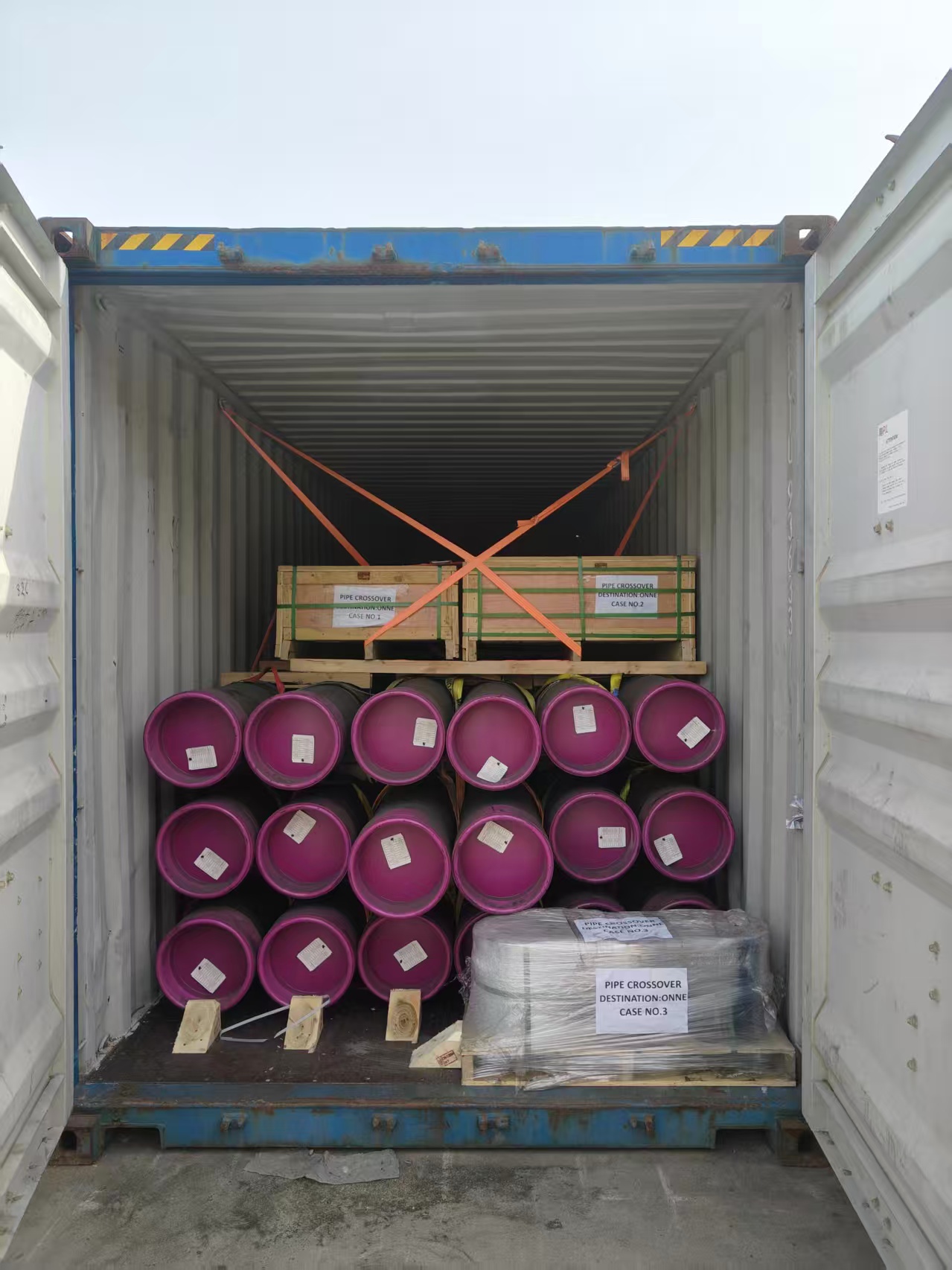 ZC-3 semi-flush L80 casing loaded for Egypt — crates stencilled for destination Onne ahead of the sea leg.
1. Load Conditions That Govern Connection Selection
Before selecting a connection type for any well, identify the governing load conditions — the same collapse, burst, and tension loads covered in casing design basics:
| Load Type | Source | BTC Capability | Premium Capability |
|---|---|---|---|
| Axial tension | String weight, overpull | ~100% pipe body | 100% pipe body |
| Axial compression | Landing loads, thermal growth | Limited | Full pipe body |
| Internal pressure (burst) | Kick, test pressure | Good | 100% pipe body |
| External pressure (collapse) | Annular fluid, cement | Good in most sizes | 100% pipe body |
| Bending | Dog-leg severity, wellbore curvature | Limited | Full combined load |
| Thermal cycling | HPHT temperature changes | Compound degradation | Metal-to-metal seal stable |
| Gas-tight seal | Gas production or injection | Not gas-tight | Gas-tight metal-to-metal |
| H₂S environment | Sour service | Compound degradation | Qualified CRA grades |
The table above summarises the seven load types where BTC and premium connections diverge. Read the last three rows together: thermal cycling, gas-tight sealing, and H₂S compatibility all trace back to the same root cause — BTC seals with thread compound on a helical leak path, and that compound is not stable in the conditions where HPHT gas and sour gas wells operate. If any governing load exceeds BTC capability, premium connections are required.
In about 30% of enquiries we receive for HPHT casing packages, the connection type is listed as "BTC or equivalent." The procurement team has matched the grade correctly — P110 or Q125 — but left the connection unspecified. When we flag this, the well engineer almost always responds that the well is a gas producer at 170°C. BTC in that context is not "equivalent" to anything — it is the wrong connection for a gas well at any temperature.
When NOT to Use BTC — Hard Limits
BTC is appropriate for sweet oil production in conventional vertical wells; the BTC-versus-premium tradeoff sets out where the line falls. It is not appropriate for any of the following conditions — engineering judgement does not change these limits:
| Condition | Why BTC Fails | Required Alternative |
|---|---|---|
| Any gas producer or injector | Helical leak path — thread compound cannot contain gas | Premium, metal-to-metal seal |
| HPHT (BHT > 150°C) | Compound degrades under thermal cycling | Premium, CAL IV |
| Q125 casing any service | Connection becomes governing element | Premium mandatory |
| C110 casing any service | BTC not qualified for severe sour + high load | Premium mandatory |
| DLS > 2°/30m production string | Combined load exceeds BTC performance envelope | Premium, combined load rated |
| Sour gas (any H₂S + gas) | Compound degradation + gas migration combined | Premium, H₂S-compatible |
These six conditions are not a grey zone requiring case-by-case analysis — they are hard exclusions. Any one of them eliminates BTC from the connection selection. A well that meets two or more conditions simultaneously (sour gas at HPHT, Q125 in a deviated well) reinforces the same conclusion without changing it.
2. HPHT Wells — Connection Requirements
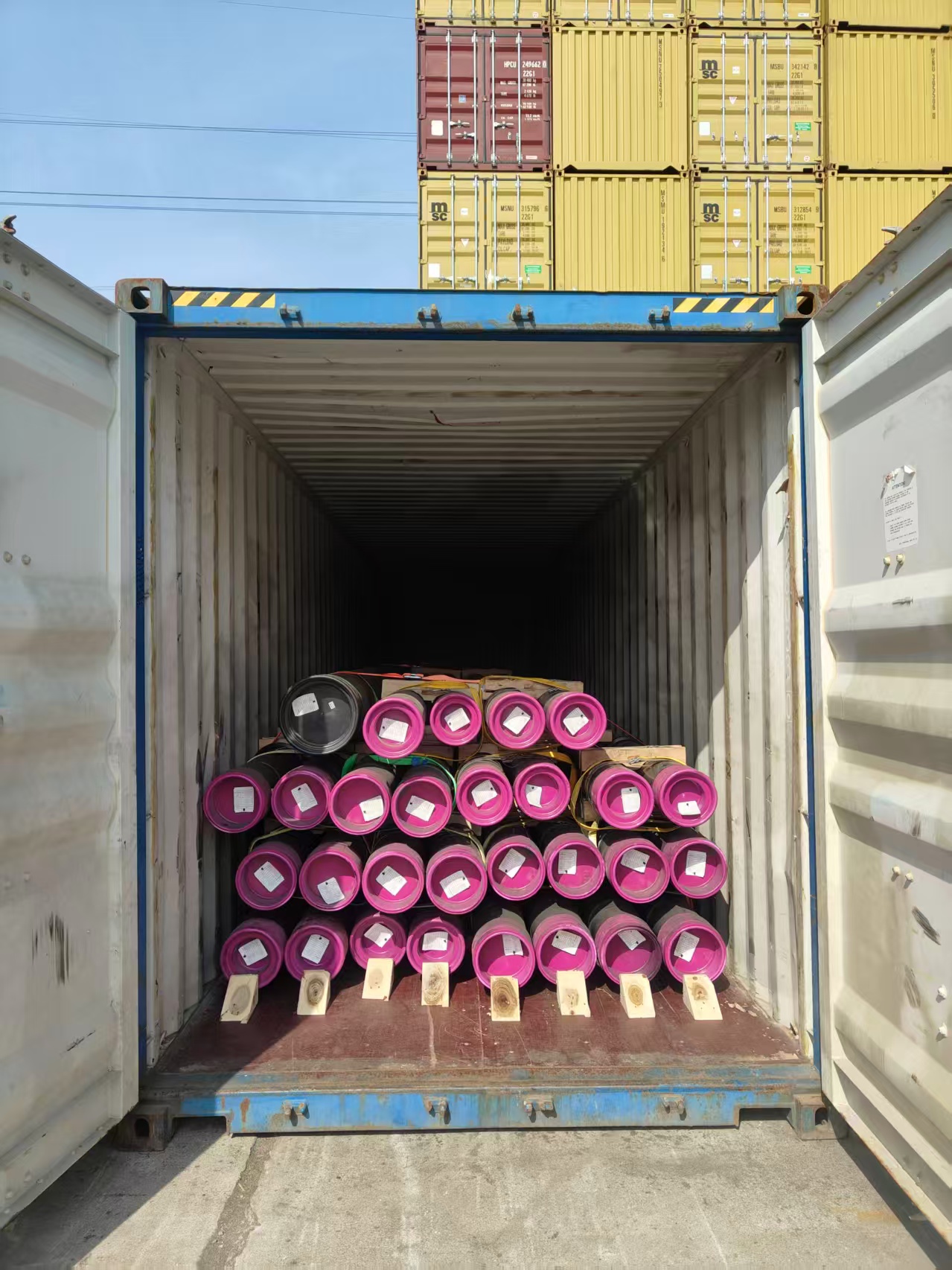 P110 9⅝-inch casing loaded for an HPHT string, thread protectors fitted before containerised shipment.
HPHT wells (typically defined as bottomhole temperature above 150°C and pressure above 69 MPa / 10,000 psi) impose the most demanding connection conditions.
Temperature cycling effects: HPHT wells experience significant temperature changes between drilling, cementing, production, and workover phases. These temperature cycles cause repeated thermal expansion and contraction — a 7-inch P110 casing string can grow several metres during heating. BTC thread compound, already under load from makeup, flows under sustained temperature and pressure, progressively losing its sealing capability.
Combined loading at high grades: P110 and Q125 casing strings in HPHT wells approach pipe body limits in collapse, burst, and tension simultaneously. BTC connection efficiency, while close to 100% in tension, is lower in combined load scenarios. Premium connections qualified to full pipe body performance eliminate the connection as the governing element.
Connection requirements for HPHT:
| Well Parameter | Connection Requirement |
|---|---|
| BHT > 150°C | Premium with metal-to-metal seal |
| BHSP > 69 MPa (10,000 psi) | Premium — full burst rating required |
| Gas producer or injector | Premium — gas-tight mandatory |
| P110 production casing | Premium recommended |
| Q125 any string | Premium mandatory |
| Combined DLS + HPHT | Premium mandatory |
For the complete grade and connection-class specification tables, see the API 5CT specification tables →
To match a connection type to your well conditions, use the Pipe Grade Selector →
To check connection joint strength against the pipe body, use the Joint Strength Calculator → — the rating basis follows the API 5C3 formulas.
Named Failure Mode: HPHT Thermal Cycling Compound Failure
Mechanism: At BHT above 150°C, the base oil fraction of thread compound vaporises and migrates out of the helical leak path during the first 3–5 temperature cycles (drilling, cementing, production heat-up). Remaining compound thickens into a dry paste that provides no gas-tight seal. The next pressure cycle opens a gas migration path through the thread helix.
Diagnostic: Sustained casing pressure 6–18 months into production in HPHT gas wells. Casing pressure rebuilds after bleed-down — confirming thread compound sealing loss, not a static event.
Fix: Cannot remediate in-hole. Pull and re-run with premium connections. The cost of a workover on a 5,000 m HPHT well typically exceeds USD 2–4 million — against a premium connection upgrade cost of USD 50,000–150,000 on the original string.
Named Failure Mode: BTC Jump-Out Under HPHT Combined Load
Mechanism: HPHT wells load P110 and Q125 strings near pipe body burst simultaneously with high tension from thermal expansion. At full burst pressure, the BTC box expands radially, reducing thread engagement. Combined with axial tension from thermal growth (a 5,000 m string at 170°C can grow 2–3 m), the load flank engagement drops below the jump-out threshold.
Diagnostic: Sudden loss of wellbore pressure integrity during production testing. No surface casing rupture — the string has jumped, not burst.
Fix: Pull and re-run. Specify premium connection with full combined load rating (ISO 13679 CAL IV) for any HPHT well above 150°C.
Worked Cost Comparison
At 200 joints of 9-5/8-inch P110 for an HPHT gas producer, the premium connection upgrade from BTC adds approximately USD 400 per joint × 200 joints = USD 80,000 total. A single workover to retrieve and re-run with premium connections after a connection failure at 5,000 m typically costs USD 1.5–3 million in rig time alone. The cost-benefit ratio of the upfront upgrade is approximately 20:1 to 40:1 — before accounting for deferred production, well integrity risk, and HSE exposure. The USD 80,000 is not a premium on the connection; it is insurance against the most expensive intervention a drilling programme can face on a completed well.
Flush connections we run on HPHT and deviated strings: Two recent orders show where this ends up on the PO. For Egyptian deep gas wells we shipped 13⅜″ 68 ppf L-80 with the ZC-3 full-flush connection, specified for its metal-to-metal taper seal and high torque capacity in horizontal, thermally cycled wells. For an African deep production string we ran 9⅝″ 53.5 ppf P-110 with ZC-31 full flush — full-flush OD so it passes through the 13⅜″ intermediate string with clearance for centralisers, gas-tight by metal seal rather than thread compound. On neither string was BTC ever a candidate. See more in our project records.
3. Sour Service Wells — Connection Requirements
Sour service (H₂S environments per NACE MR0175 / ISO 15156) imposes specific connection requirements beyond grade selection.
Thread compound degradation in H₂S: Standard API thread compound contains sulphur-bearing additives. In H₂S environments, these additives can act as a sulphur source at the thread-compound-metal interface, accelerating stress corrosion cracking on already hydrogen-charged steel. The compound loses cohesion as the additive package degrades, creating a progressive gas migration path on sour gas producers.
Grade-to-connection compatibility: The connection material must be compatible with the same NACE MR0175 / ISO 15156 requirements as the pipe body:
- L80-1 BTC or premium: acceptable for mild sour
- T95 BTC: acceptable for moderate sour in non-gas wells — premium required for gas
- C110: premium mandatory — BTC never appropriate for C110 in sour service
- L80-13Cr: premium required for gas wells
Sour service connection selection matrix:
| Grade | H₂S Level | Well Type | Connection |
|---|---|---|---|
| L80-1 | Low | Oil producer | BTC acceptable |
| L80-1 | Low-moderate | Gas producer | Premium required |
| T95 | Moderate | Oil producer | BTC acceptable |
| T95 | Moderate | Gas producer | Premium required |
| T95 | High | Any | Premium required |
| C110 | Any | Any | Premium mandatory |
| L80-13Cr | Any | Gas producer | Premium required |
Read this matrix from right to left: the well type (oil or gas) and H₂S level together determine the connection requirement, not the grade alone. A procurement team that selects T95 for moderate sour service and specifies BTC is making the correct grade decision and the wrong connection decision simultaneously — both errors appear on the same line of the PO.
Named Failure Mode: Sour Service Compound Degradation
Mechanism: Standard API thread compound contains sulphur-bearing additives. In H₂S environments, these additives can act as a sulphur source at the thread-compound-metal interface, accelerating SSC on already hydrogen-charged steel. The compound loses cohesion as the additive package degrades, creating a progressive gas migration path on sour gas producers.
Diagnostic: Casing pressure buildup in sour gas wells, combined with visible corrosion at coupling faces during intervention. H₂S-specific corrosion products (black iron sulphide) around connection faces confirm the failure mode.
Fix: For mild sour, specify H₂S-compatible compound. For any sour gas application (gas plus H₂S at any partial pressure), specify premium connection — compound degradation cannot be controlled in-hole once the well is on production.
4. Deviated and Horizontal Wells — Connection Requirements
Deviated and horizontal wells add bending loads to the casing connection that BTC thread geometry was not designed to resist efficiently.
Dog-leg severity and bending moment: The bending moment imposed on a casing connection depends on the dog-leg severity (DLS in degrees per 30m), casing OD, and axial load. As DLS increases, the bending load on the connection increases. BTC connections can accommodate low DLS without significant performance reduction, but at higher DLS the connection becomes the governing element.
General DLS thresholds for connection evaluation:
| String | DLS Threshold for Premium Evaluation |
|---|---|
| Surface casing | > 5°/30m |
| Intermediate casing | > 3°/30m |
| Production casing | > 2°/30m |
| Liner | > 3°/30m |
These are screening thresholds — actual connection selection requires combined load analysis using the connection performance envelope from the manufacturer. A production casing string in a well with planned DLS of 2.5°/30m is past the screening threshold; that does not automatically mean BTC fails, but it means the combined load calculation is required before specifying BTC.
Horizontal wells: All production casing and liner in horizontal sections should use premium connections. The combination of high DLS in the build section, axial loads from string weight and landing, and production loads make BTC unreliable in horizontal completions.
5. Connection Selection Decision Framework
The decision tree for connection selection in challenging wells has one gate that eliminates all others: gas production or injection. If the well produces or injects gas at any pressure, BTC is eliminated — not because of its load rating, which is adequate for many HPHT strings, but because its sealing mechanism (thread compound on a helical leak path) cannot prevent gas migration. No compound specification, no friction factor adjustment, and no enhanced makeup procedure changes this. The gas-tight gate comes before the HPHT gate, the sour gate, and the deviated gate — all of which are load-path questions, not sealing-mechanism questions.
Step 1: Is the well a gas producer or injector?
- Yes — Premium connection required. Stop here.
- No — Continue to Step 2.
Step 2: Is the grade C110 or Q125?
- Yes — Premium connection required. Stop here.
- No — Continue to Step 3.
Step 3: Is the well HPHT (BHT > 150°C or BHSP > 69 MPa)?
- Yes — Premium connection required. Stop here.
- No — Continue to Step 4.
Step 4: Is the maximum DLS above the threshold for the string?
- Yes — Perform combined load analysis. Premium likely required.
- No — Continue to Step 5.
Step 5: Is H₂S partial pressure above 0.01 MPa?
- Yes (moderate-high) — Premium connection recommended.
- No (mild sour) — BTC with H₂S-compatible compound may be acceptable.
- No H₂S — BTC is acceptable for this string.
The framework is designed to be used in this order. The gas-tight gate at Step 1 is not a load question; it is a sealing-mechanism question, and it is answered before any load analysis begins. Steps 2 through 5 are load-path and environment questions — they are only reached if Step 1 is clear.
6. Combined Load Analysis — Using Connection Performance Envelopes
Premium connection manufacturers publish performance envelopes — plots of axial load vs internal pressure (or external pressure) that define the connection's rated performance boundary. The well design loads must fall inside this envelope.
Steps for combined load analysis:
- Calculate maximum axial loads (tension from string weight plus overpull; compression from landing loads plus thermal growth)
- Calculate maximum internal pressure (burst from kick, test pressure)
- Calculate maximum external pressure (collapse from annular fluid or lost returns)
- Calculate bending load from maximum DLS × pipe OD × axial load
- Plot combined load point on the connection performance envelope
- If load point falls outside the envelope — upgrade to a higher-rated premium connection
ZC Steel Pipe provides connection performance envelopes for all ZC premium connection series on request. Send your well parameters — grade, OD, BHST, BHSP, DLS, H₂S partial pressure, and production fluid — and we will verify whether the ZC connection series meets your design loads before the purchase order is placed.
7. Procurement Trap — The Incomplete Connection Specification
The most common connection specification error we see is not a wrong grade — it is an incomplete specification that leaves the connection type undefined or underspecified.
Wrong PO: "200 joints 9-5/8" 47 lb/ft P110, BTC or equivalent, sour service"
The mill ships P110 BTC. The words "sour service" in the grade section refer to the material; they do not impose any connection sealing requirement. BTC is shipped with no gas-tight capability. The purchase order is fully compliant — the error is in the specification, not the supply.
Correct PO: "200 joints 9-5/8" 47 lb/ft P110 casing. Connection: premium, ISO 13679 CAL IV, metal-to-metal gas-tight seal, BTC NOT ACCEPTABLE. H₂S partial pressure: 0.08 MPa. BHST: 165°C. BHSP: 75 MPa. Connection qualification documentation required with MTC."
The difference between these two PO lines is not negotiation language — it is engineering requirement language. The second version specifies the sealing mechanism, the qualification level, and the well conditions that govern the selection. A mill receiving the second PO cannot ship BTC and be compliant. A mill receiving the first PO can.
We recommend that procurement teams building HPHT or sour gas casing packages add well condition fields (BHST, BHSP, H₂S partial pressure) directly to the connection line of the PO — not as a note or attachment. These numbers in the body of the PO make clear that the connection specification is driven by downhole conditions, not by price.
8. ZC Premium Connection Recommendation by Well Type
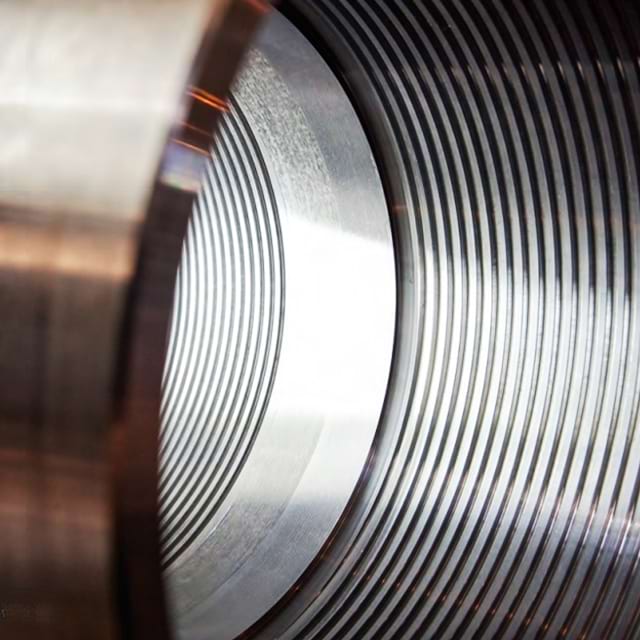 Machined thread flanks on a ZC premium connection — the metal-to-metal seal geometry that gives gas-tight integrity where BTC cannot.
| Well Type | Recommended ZC Connection |
|---|---|
| Conventional sweet gas | ZC-1 (coupled, standard gas-tight) |
| HPHT sweet gas | ZC-2 (coupled, HPHT/deviated) |
| Deviated gas well | ZC-2 (combined load rated) |
| Horizontal production | ZC-2 or ZC-3 (flush if clearance critical) |
| Sour gas (T95) | ZC-1 or ZC-2 with sour service compound |
| Severe sour HPHT (C110) | ZC-2 (full combined load qualification) |
| Gas storage (high cycle) | ZC-4 or ZC-5 (multi-cycle seal durability) |
| Deepwater/subsea | ZC-2 (external pressure rated) |
| Liner (tight clearance) | ZC-3 (flush integral — maximum clearance) |
Contact ZC Steel Pipe with your well parameters for a specific connection recommendation and performance envelope verification before placing the order.
Frequently Asked Questions
Why is BTC not suitable for HPHT wells?
BTC connections rely on thread compound and thread surface contact for sealing. Under HPHT conditions, thermal cycling causes repeated expansion and contraction of the connection, which degrades thread compound and can open micro-leakage paths. BTC also has no positive torque shoulder, so the makeup position is not precisely defined — this leads to variability in connection performance under combined loading. For HPHT wells, premium connections with metal-to-metal seals and positive torque shoulders are required to maintain gas-tight integrity through the full thermal and pressure cycling envelope.
What is combined loading and why does it govern connection selection in deviated wells?
Combined loading refers to the simultaneous application of axial load (tension or compression), internal pressure, external pressure, and bending moment on the casing connection. In vertical wells, bending is minimal and connections are primarily designed for axial and pressure loads. In deviated and horizontal wells, the bending moment from the wellbore curvature (dog-leg severity) adds a significant cyclic load component that BTC thread geometry cannot efficiently resist. Premium connections with trapezoidal thread profiles and positive torque shoulders are designed to maintain seal integrity under combined loading including bending.
What API standard governs connection performance qualification for challenging wells?
API 5C5 (Evaluation Procedures for Casing and Tubing Connections) governs connection performance qualification. CAL IV (Calibration Level IV) is the most comprehensive qualification level, requiring testing under combined loading — simultaneous tension, compression, internal pressure, external pressure, and bending — that represents realistic downhole conditions in HPHT, deviated, and sour service wells. Premium connections for challenging applications should be specified as API 5C5 CAL IV qualified.
Can L80 BTC be used for sour service wells?
L80 BTC can be acceptable for mild sour service wells — low H₂S partial pressure, moderate depth, and no gas production — where the primary sour service requirement is material grade compliance with NACE MR0175, not gas-tight seal integrity. However for gas producers or injectors in sour environments, for wells with moderate to high H₂S, or for HPHT sour wells, premium connections with metal-to-metal seals are required. The connection sealing mechanism in BTC (thread compound) can be compromised by H₂S environments and is not reliable for long-term gas containment.
What dog-leg severity requires premium connections instead of BTC?
There is no single threshold dog-leg severity that triggers the requirement for premium connections — the decision depends on the combination of DLS, string weight, grade, OD, and wall thickness. As a general industry guideline, dog-leg severities above 3–5°/30m in the production string, or above 8–10°/30m in the intermediate string, typically require premium connection evaluation. Wells with planned dog-legs above these thresholds should have the connection combined load envelope checked against the BTC or premium connection performance envelope using a connection load rating chart.
What is the connection efficiency factor and how does it affect HPHT well design?
Connection efficiency is the ratio of connection performance (collapse, burst, tensile) to pipe body performance for the same load type. BTC typically achieves near-100% tensile efficiency but lower collapse efficiency in some sizes. For HPHT wells where collapse, burst, and tensile loads all approach pipe body limits simultaneously, any reduction in connection efficiency can make the connection the governing element in casing design. Premium connections qualified to full pipe body performance (100% efficiency in tension, burst, and collapse) eliminate the connection as a design constraint.
Should C110 casing always use premium connections?
Yes — C110 casing should use premium connections in virtually all applications. C110 is specified for severe sour HPHT wells where H₂S, high pressure, and temperature impose the most demanding combined loading conditions. BTC's lack of gas-tight sealing and limited combined load resistance make it unsuitable for the environments where C110 is required. The cost premium of C110 material also justifies the additional investment in premium connections — a BTC connection failure on a C110 string in a severe sour well creates significant well integrity risk.
How are premium connections tested for gas-tight performance?
Gas-tight performance of premium connections is qualified during API 5C5 testing using gas or supercritical fluid as the test medium at rated pressure. The connection must show zero measurable leakage through the metal-to-metal seal under the full combined load envelope — tension, compression, internal pressure, external pressure, and bending applied simultaneously. Field verification of gas-tight performance is typically done by pressure testing the string after running, at a test pressure specified by the well design.