ISO 13679 is the qualification standard that defines what a premium connection has actually been tested to perform. Without understanding the Connection Acceptance Level (CAL) system, specifying a "premium connection" provides no assurance that the connection will perform in the intended well environment. A CAL II connection and a CAL IV connection may look identical from the outside — the difference is in what pressure, fluid, and load combination each has been tested to sustain. Getting this wrong in either direction creates either unnecessary cost or well integrity risk.
ZC Steel Pipe supplies premium connections qualified to ISO 13679 CAL IV for HPHT, gas, and sour service applications across the Middle East, West Africa, and Southeast Asia. This guide explains the ISO 13679 CAL rating system, what each level means for well design, and how to match the CAL specification to your well conditions.
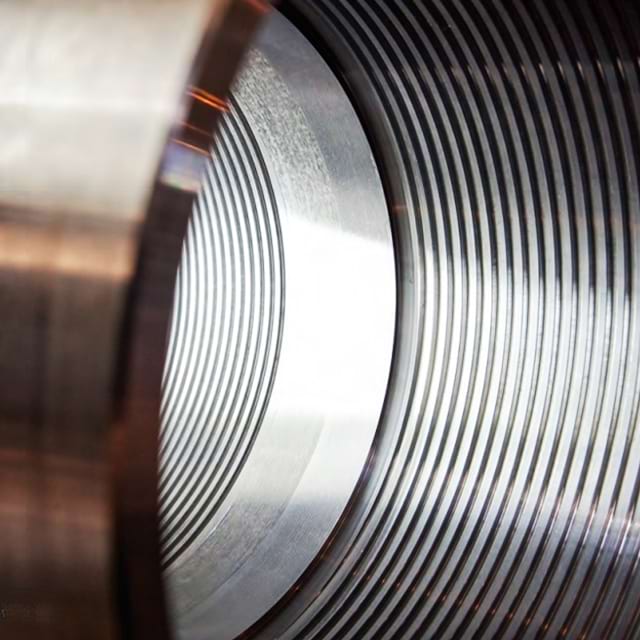 Machined premium-connection thread — the metal-to-metal seal surface that CAL III and CAL IV qualification validates against gas is cut to precise tolerances alongside the thread.
Roughly 40% of purchase orders we receive for "premium connections" specify no CAL rating. Of those, about half specify CAL II when the well is a gas producer — which means they've specified the wrong qualification level and don't know it. CAL II is water-tested only; it provides no gas-tight validation. We flag these at order entry, but without the CAL rating on the PO, many suppliers will ship a CAL II or even an unqualified connection without raising the issue.
1. Why Premium Connection Qualification Matters
Standard API connections (STC, LTC, BTC) are defined by API 5B — a dimensional and threading standard, not a performance standard. API 5B does not test connections under pressure, does not test for gas-tight performance, and does not evaluate combined loading. BTC connections have never been qualified to any pressure containment standard — their sealing performance in the field is empirical, not validated.
Premium connections are different — their performance is defined by a qualification test program conducted to ISO 13679 or API 5C5. The qualification results are documented in a qualification report that is available from the connection manufacturer. When specifying a premium connection, the CAL rating tells you precisely what the connection has been tested to do.
The critical distinction:
| Connection | Sealing Mechanism | Qualification Standard | Gas-Tight? |
|---|---|---|---|
| BTC | Thread compound only | None — dimensional only | No |
| Enhanced API | Thread compound + seal ring | API 5C5 CAL I or II | No |
| Premium CAL II | Metal-to-metal | ISO 13679 CAL II | No — water tested |
| Premium CAL IV | Metal-to-metal | ISO 13679 CAL IV | Yes — gas tested |
The table above captures why "metal-to-metal seal" on a PO is not a gas-tight specification. Both CAL II and CAL IV connections use metal-to-metal seals — the physical mechanism is the same. The difference is what those seals have been validated to contain. For the broader tradeoff between standard and premium connections, see the BTC vs premium comparison.
2. ISO 13679 CAL Ratings Explained
ISO 13679 defines four Connection Acceptance Levels:
CAL I — Water Test at 80% Yield
Test medium: Water Test pressure: 80% of minimum yield pressure Combined loading: Basic — limited load path Gas-tight: No
CAL I is the lowest qualification level. The connection is tested with water (not gas) at 80% of yield pressure. No combined axial and bending loads are applied simultaneously. CAL I validates that the connection can contain liquid at moderate pressure — nothing more.
Appropriate for: Non-critical water injection strings, low-pressure liquid service, temporary or workover strings where premium connections are specified for tensile capacity rather than sealing performance.
CAL II — Water Test at 100% Yield
Test medium: Water Test pressure: 100% of minimum yield pressure Combined loading: Full load path — tension, compression, internal and external pressure Gas-tight: No — water tested only
CAL II tests the connection at full rated pressure with water under the complete combined load envelope. This validates structural integrity and liquid sealing performance at 100% of yield. It does not validate gas-tight performance.
Appropriate for: Sweet oil production strings, liquid injection wells, intermediate casing in non-gas wells, and any application where liquid containment at full pressure is required but gas-tight sealing is not.
Not appropriate for: Any gas producer or injector, HPHT gas wells, deepwater completions where wellbore gas is present.
CAL III — Gas Test at 80% Yield
Test medium: Gas Test pressure: 80% of minimum yield pressure Combined loading: Full load path Gas-tight: Partial — gas tested but at reduced pressure
CAL III uses gas as the test medium, which is more demanding than water because gas molecules can permeate micro-gaps that liquid cannot. However the test pressure is only 80% of yield — the connection is not fully pressure-tested.
Appropriate for: Moderate-pressure gas applications where the maximum wellbore pressure does not approach yield pressure, gas lift strings at moderate operating pressure, and onshore gas wells with moderate bottomhole static pressure.
Not appropriate for: HPHT gas wells, deepwater gas wells where wellbore pressure approaches pipe yield, sour gas service, or any application where the design requires confidence at full pressure with gas.
CAL III and CAL IV are often described as "gas-tested" versus "water-tested" — the distinction that matters most is what that means for the pressure level. CAL III tests at 80% of minimum yield pressure. For a P110 connection rated to 110 ksi minimum yield, 80% is 88 ksi equivalent pressure. Most HPHT wells operate at wellbore pressures approaching or exceeding 100% yield equivalent — which means CAL III leaves the top 20% of the operating envelope unvalidated. For an HPHT gas well, specifying CAL III instead of CAL IV is specifying a connection that has not been tested at the pressures the well will actually reach.
CAL IV — Gas Test at 100% Yield, Full Combined Loading
Test medium: Gas Test pressure: 100% of minimum yield pressure Combined loading: Full combined load path — simultaneous tension, compression, internal pressure, external pressure, and bending Gas-tight: Yes — full gas-tight qualification
CAL IV is the most comprehensive qualification level and the industry standard for HPHT, deepwater, and sour service applications. The connection is tested with gas at 100% of yield pressure under the full combined load envelope — reproducing the worst-case downhole conditions the connection will experience.
Appropriate for: All gas wells, HPHT wells (temperature above 150°C or pressure above 69 MPa), deepwater and subsea completions, sour service gas strings, any application where gas-tight integrity under combined loading must be guaranteed.
The mandatory minimum for:
- Any well producing or injecting gas
- P110 and Q125 production strings in HPHT wells
- C110 strings in severe sour HPHT service
- Subsea and deepwater completions
- Deviated gas wells with combined bending and pressure loading
For the complete grade and connection-class specification tables, see the API 5CT specification tables →
To match a connection type to your well conditions, use the Pipe Grade Selector →
To check connection tensile efficiency against the pipe body, use the Joint Strength Calculator →
3. CAL Rating Comparison Table
| Parameter | CAL I | CAL II | CAL III | CAL IV |
|---|---|---|---|---|
| Test fluid | Water | Water | Gas | Gas |
| Test pressure (% yield) | 80% | 100% | 80% | 100% |
| Tension loading | Partial | Full | Full | Full |
| Compression loading | No | Full | Full | Full |
| Bending loading | No | Full | Full | Full |
| External pressure | No | Full | Full | Full |
| Gas-tight qualification | No | No | Partial | Yes |
| Makeup/breakout cycles | 1 | Multiple | Multiple | Multiple |
| Required for gas wells | No | No | Marginal | Yes |
| Required for HPHT | No | No | No | Yes |
| Required for deepwater | No | No | No | Yes |
Reading across the table, the step from CAL II to CAL III is a change in test fluid — water to gas. The step from CAL III to CAL IV is a change in pressure level — 80% to 100% of yield — and is the difference between a connection that has been tested within the HPHT operating envelope and one that has not. These two transitions are not equivalent. Changing the test fluid matters; reaching full yield pressure matters more.
4. The Metal-to-Metal Seal — How CAL IV Gas-Tight Performance Is Achieved
CAL IV gas-tight performance requires a metal-to-metal (MTM) seal — a precision-machined contact between the pin nose and the box counterbore that provides a pressure barrier independent of thread compound.
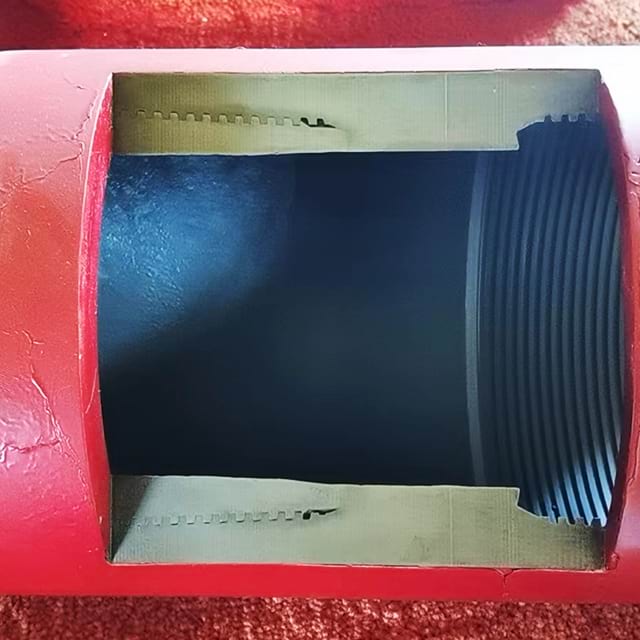 Internal threads inside a coupling box — the box counterbore is where the pin nose is compressed to form the metal-to-metal seal, kept clear of thread compound.
How the MTM seal works: When the connection is made up to the correct torque and shoulder position, the pin nose is compressed radially against the box counterbore, creating metal-to-metal contact over a defined seal surface area. The contact stress at this surface is designed to exceed the maximum differential pressure the connection will experience — preventing gas migration through the seal zone.
Key properties of the MTM seal:
- Independent of thread compound — compound lubricates threads but is not the seal
- Self-energizing — higher internal pressure increases contact stress at the seal face, improving integrity as pressure increases
- Repeatable — designed to maintain seal integrity through multiple makeup/breakout cycles
Critical field point: Thread compound must never be applied to the pin nose seal surface. Compound on the seal face prevents full metal-to-metal contact and compromises gas-tight integrity. Apply compound to threads only — per the connection manufacturer's procedure.
5. Named Failure Modes
Understanding how CAL under-specification fails in the field is more useful than understanding CAL ratings in the abstract. Three failure patterns appear repeatedly.
Under-Specified Connection Seal Failure (CAL II on Gas Well)
Mechanism: A CAL II connection has metal-to-metal seal contact validated only with water at 100% yield. When exposed to gas — which permeates seal micro-gaps too small for water — the same contact stress that passed the water test may be insufficient to block gas migration. Gas molecular size is approximately 1/10 that of water, so gas can migrate through seal gaps that appear water-tight.
Diagnostic: Sustained casing pressure in gas wells after the string is cemented, appearing during or shortly after initial pressure testing. Characteristic slow pressure buildup to a stable value — not a catastrophic leak. The connection has not failed structurally; it is leaking past the seal.
Fix: Cannot remediate in-hole without pulling the string. Prevention: specify CAL IV for any gas well. The cost of a CAL IV upgrade at the PO stage is a small fraction of a workover.
Metal-to-Metal Seal Galling from Wrong Compound Application
Mechanism: Thread compound applied to the pin nose seal surface (not just the threads) prevents full metal-to-metal contact. The compound layer acts as a compressible spacer, reducing contact stress below design value. Under gas pressure, the insufficient contact stress allows gas migration. The galling occurs when the compound partially adheres to the seal surface and is sheared during makeup, damaging the precision-machined contact zone.
Diagnostic: Gas-tight test failure on first pressure test. On breakout inspection: compound residue on seal nose, irregular galling marks on the seal contact surface. The connection may have been made up to the correct torque, but contact stress is uncontrolled because compound is in the seal zone.
Fix: Never apply compound to the pin nose seal surface — apply compound to threads only. If the seal surface is galled, the connection must be replaced; a damaged seal surface cannot be remediated in the field.
CAL III Pressure Gap Failure
Mechanism: CAL III qualification tests to 80% of minimum yield pressure. If downhole wellbore pressure exceeds 80% yield equivalent at any point, the connection is operating outside its validated performance range. At this pressure level, even a connection that passed CAL III testing can fail to maintain seal integrity because the load-path extrapolation beyond the test envelope may not be conservative.
Diagnostic: Gas leak appearing when wellbore pressure builds above the CAL III test pressure — typically during kick events or pressure testing at above-design pressures. The connection was performing within its validated range during routine production, then failed when pressure exceeded the 80% yield test limit.
Fix: Specify CAL IV for all HPHT wells and any well where the maximum anticipated pressure exceeds 80% of the pipe body yield equivalent. CAL III has a role in moderate-pressure gas applications; it is not appropriate where wellbore pressure can reach full yield equivalent.
6. When NOT to Specify a Lower CAL Rating
| Application | Minimum Required | What Happens if Under-Specified |
|---|---|---|
| Any gas producer or injector | CAL IV (gas-tight mandatory) | Thread compound sealing only — gas migration progressive |
| HPHT gas well | CAL IV mandatory | CAL III pressure gap — 20% of operating range unvalidated |
| Deviated gas well | CAL IV mandatory | Bending not tested in CAL III |
| Sour gas (H₂S + gas) | CAL IV mandatory | Compound degradation eliminates CAL III sealing |
| Deepwater / subsea | CAL IV mandatory | External pressure combined load not covered by lower CALs |
| Sweet oil production | CAL II acceptable | Over-specifying CAL IV wastes USD 50–200 per joint |
| Water injection only | CAL I or CAL II acceptable | CAL IV unnecessary and overpriced |
The practical rule: if gas is present anywhere in the well at any time, specify CAL IV. The cost of a CAL IV over-spec on a liquid-only well is negligible; the cost of a CAL II under-spec on a gas well is a workover.
7. Connection Geometry Types and CAL Capability
Premium connections come in three geometric families, each with different CAL capability:
| Type | OD vs Pipe Body | Tensile Efficiency | CAL IV Capable | Typical Application |
|---|---|---|---|---|
| Coupling type | Larger (coupled) | ~100% | Yes | Standard HPHT, gas, deepwater |
| Semi-flush | Slightly larger | 85–95% | Yes | Tight annulus, deviated wells |
| Flush integral | Same or smaller | 60–80% | Yes | Maximum clearance, multilateral |
Coupling-type connections provide the highest structural efficiency and are the standard choice for most HPHT and gas well applications. Flush connections are specified when OD clearance inside the casing or through packer bores is the governing constraint. All three geometric families can be qualified to CAL IV — the flush geometry is not a reason to accept a lower CAL rating.
What the CAL line looks like on real orders: CAL is an ordered test level, not a fixed property of a connection family. On our 9⅝″ P-110 ZC-31 full-flush casing to an African operator, the connection was supplied to ISO 13679 CAL II or CAL III depending on the level the customer specified — the flush geometry is CAL-capable, but the buyer sets the test fluid and pressure. Where the well is a gas producer we push for the gas-tested level up front, as on our 11¾″ S-95 ZC-2 gas-tight casing to a Nigerian operator, which reaches CAL III gas-tightness by metal contact alone. See more in our project records.
8. Worked Cost Comparison — CAL II vs CAL IV
For a 150-joint string of 7-inch 26 lb/ft P110 premium connections:
- CAL II price premium over BTC: approximately USD 80–150 per joint = USD 12,000–22,500 total
- CAL IV price premium over CAL II: approximately USD 50–120 per joint = USD 7,500–18,000 additional
- Total CAL IV premium over BTC: USD 19,500–40,500 for 150 joints
The workover comparison: cost of one workover to pull and re-run with CAL IV after a gas leak = USD 1.5–4 million in rig time, plus deferred production at 5,000 bbl/day at USD 70/bbl = USD 350,000 per day of lost production.
The CAL IV upgrade pays back within the first 12 hours of a prevented workover. The decision is not a cost-performance tradeoff — it is a risk-management question about whether the well contains gas.
9. Purchase Order Guidance and the Procurement Trap
The Wrong PO
"150 joints 7" 26 lb/ft P110 premium connection, metal-to-metal seal"
What happens: the supplier ships CAL II. "Metal-to-metal seal" is a physical description, not a performance specification. Both CAL II and CAL IV connections have metal-to-metal seals — the physical feature is present in both. The connection passes visual inspection, dimensional verification, and the supplier's internal QC. It is not gas-tight to CAL IV standard. Gas migration is discovered during the first pressure test or early production.
This is not a supplier error. The PO was ambiguous and the supplier was compliant. The cost of remediation falls on the operator.
The Correct PO
"150 joints 7" 26 lb/ft P110 premium connection. ISO 13679 CAL IV gas-tight qualification mandatory. Gas test at 100% yield with combined tension, compression, and bending loading. Full qualification report to be supplied with MTC. CAL II or CAL III NOT ACCEPTABLE for this well."
The correct PO names the standard (ISO 13679), the level (CAL IV), the test fluid (gas), the pressure basis (100% yield), the load combination (tension, compression, bending), and explicitly rejects lower CAL ratings. There is no ambiguity. Any supplier reading this PO knows exactly what qualification documentation is required and what cannot be substituted.
Minimum Specification Checklist
When ordering from ZC Steel Pipe or any supplier, the PO line item for a CAL IV connection should include:
- Connection designation (manufacturer's series designation)
- CAL rating: ISO 13679 CAL IV explicitly stated
- Qualification documentation: full ISO 13679 qualification report available on request
- OD, weight, grade, PSL level
- Connection end finish (pin, box, or both)
- MTC: EN 10204 3.2 with connection qualification records
- Makeup torque table and torque-turn reference curve for the specific size and grade
What to Verify from the Manufacturer
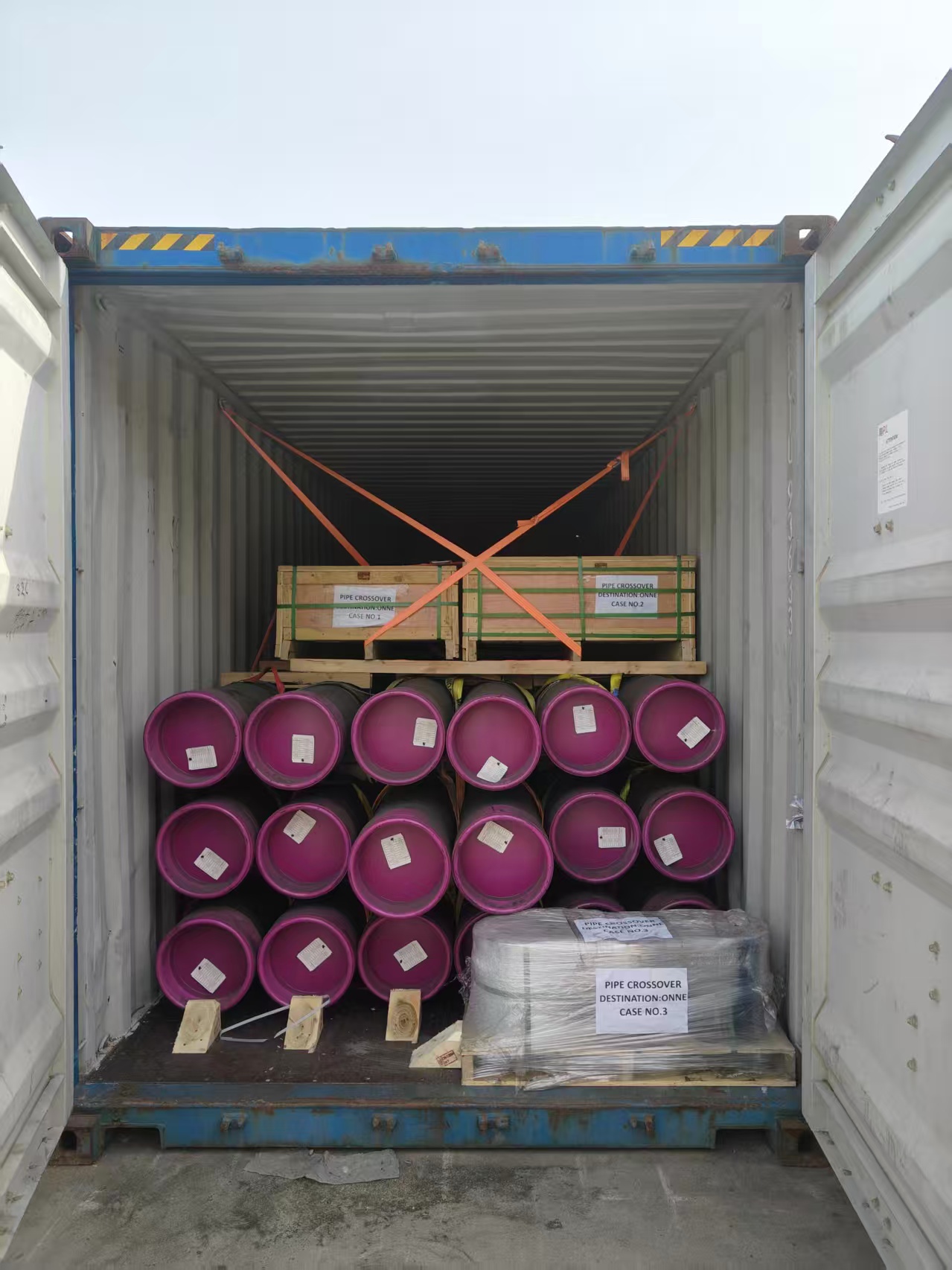 ZC3 semiflush L80 casing with thread protectors fitted, loaded for export — from a ZC casing shipment routed to Onne. Thread protectors stay on until the joint is stabbed to keep the seal surface undamaged.
Before accepting a shipment of premium connections for a gas or HPHT well:
- ISO 13679 qualification report for the specific connection series — not a generic series report, the specific OD and weight range covered
- Qualification temperature range — confirm it covers the bottomhole static temperature
- Qualification load path envelope — confirm bending is included
- Thread compound specification — compound type affects seal performance at temperature
- Cycle rating — number of makeup/breakout cycles the connection is qualified through
ZC Steel Pipe provides full qualification documentation with each premium connection shipment for gas and HPHT applications. For wells with non-standard load combinations — extreme deviation, unusual temperature gradients, combined gas and high H₂S partial pressure — we provide a connection performance summary against the specific well loads before order confirmation.
Contact ZC Steel Pipe with your well conditions — grade, OD, weight, bottomhole static temperature, bottomhole static pressure, H₂S partial pressure, and deviation — for a specific connection series recommendation and full qualification documentation.
Frequently Asked Questions
What is ISO 13679 and why does it matter for premium connection selection?
ISO 13679 (Petroleum and natural gas industries — Procedures for testing casing and tubing connections) is the international standard that defines how premium casing and tubing connections are qualified through testing. It replaced API 5C5 as the primary qualification standard. ISO 13679 defines four Connection Acceptance Levels (CAL I through CAL IV) with increasing test severity. The CAL rating tells engineers precisely what pressure, temperature, load combination, and fluid type the connection has been tested against — without knowing the CAL rating, a 'premium connection' specification provides no assurance of actual performance.
What is the difference between CAL I, CAL II, CAL III and CAL IV?
CAL I: Water tested at 80% of minimum yield pressure — lowest qualification level, suitable for non-critical water injection strings. CAL II: Water tested at 100% of minimum yield pressure — suitable for oil production and liquid-only wells. CAL III: Gas tested at 80% of minimum yield pressure — partial gas-tight qualification, suitable for moderate pressure gas applications. CAL IV: Gas tested at 100% of minimum yield pressure under combined loading (simultaneous tension, compression, internal pressure, external pressure, and bending) — full gas-tight qualification, required for HPHT, deepwater, and sour service gas wells. CAL IV is the mandatory minimum for any gas well or HPHT application.
Is API 5C5 the same as ISO 13679?
API 5C5 and ISO 13679 cover the same subject — connection performance qualification testing — but are not identical. ISO 13679 was developed as an international harmonization of API 5C5 with additional rigor in test methodology and load application. Most modern premium connection qualification programs use ISO 13679. Some older connections are qualified only to API 5C5. For most oil company and national oil company project specifications, ISO 13679 CAL IV is the accepted standard. Always verify which standard applies to your project specification.
What does gas-tight mean for a premium connection?
A gas-tight premium connection has been qualified to seal against gas at rated pressure under the full combined load envelope — tension, compression, internal pressure, external pressure, and bending applied simultaneously. The gas-tight qualification uses gas (not water) as the test medium, which is more demanding because gas molecules are much smaller than liquid molecules and can migrate through micro-gaps that would be sealed against liquid. A CAL IV gas-tight connection has a validated metal-to-metal seal that maintains integrity under all specified downhole load conditions.
Do all premium connections have metal-to-metal seals?
Most premium connections designed for gas-tight service use metal-to-metal seals — machined contact surfaces on the pin nose and box that create a pressure-independent seal. However not all connections marketed as 'premium' are gas-tight or have metal-to-metal seals. Some enhanced API connections add features like seal rings or modified thread geometry but do not qualify to ISO 13679 CAL IV. Always verify the CAL rating and test documentation before specifying a premium connection for gas-tight service.
What combined loading conditions are tested in ISO 13679 CAL IV?
ISO 13679 CAL IV tests the connection under a load path that simultaneously applies: axial tension (up to 100% of pipe body tensile rating), axial compression, internal pressure (up to 100% of minimum yield pressure using gas), external pressure (collapse loading), and bending moment (to simulate deviated wellbore conditions). The load path covers the full operational envelope the connection would experience in service. This combined load testing is what distinguishes CAL IV from lower qualification levels — it validates performance under realistic worst-case downhole conditions, not just simple uniaxial pressure testing.
How many makeup and breakout cycles are tested in ISO 13679?
ISO 13679 qualification testing includes multiple makeup and breakout cycles before and during the pressure test sequence to demonstrate that the connection maintains seal integrity through repeated assembly and disassembly. The number of cycles varies by connection type and qualification program — typically 3 to 5 complete makeup/breakout cycles. Field-rated connections (for wells requiring multiple interventions) may be qualified through additional cycle testing beyond the standard ISO 13679 program.
Should I specify ISO 13679 CAL IV for all premium connections?
Not necessarily — CAL IV is required for gas wells, HPHT applications, deepwater, and sour service. For non-critical liquid service applications (water injection, sweet oil production strings), CAL II may be sufficient and carries lower cost. The correct approach is to match the CAL rating to the well condition: identify the governing requirement (gas-tight, combined load, temperature) and specify the minimum CAL rating that meets that requirement. Over-specifying (CAL IV for a simple water injection string) wastes money. Under-specifying (CAL II for a gas well) creates well integrity risk.