

BTC (Buttress Thread Casing) is the standard API connection for production and intermediate casing in most conventional well designs. Its trapezoidal thread profile provides approximately 100% pipe body tensile efficiency — the primary reason it displaced STC and LTC for most deep casing applications. However BTC has clearly defined limits: it is not gas-tight, it is susceptible to jump-out under combined loading, and its makeup procedure requires position verification using the triangle stamp rather than torque alone. Understanding these limits — and the field conditions under which they become governing — is the difference between a BTC string that runs without incident and one that fails during pressure testing.
ZC Steel Pipe supplies API 5CT casing and tubing with BTC connections across the grade range from J55 through P110, primarily for intermediate and production casing applications in West Africa, the Middle East, and Southeast Asia. This guide covers BTC technical specifications, field makeup procedure, structured failure mode analysis, and the conditions under which BTC should be replaced with premium connections.
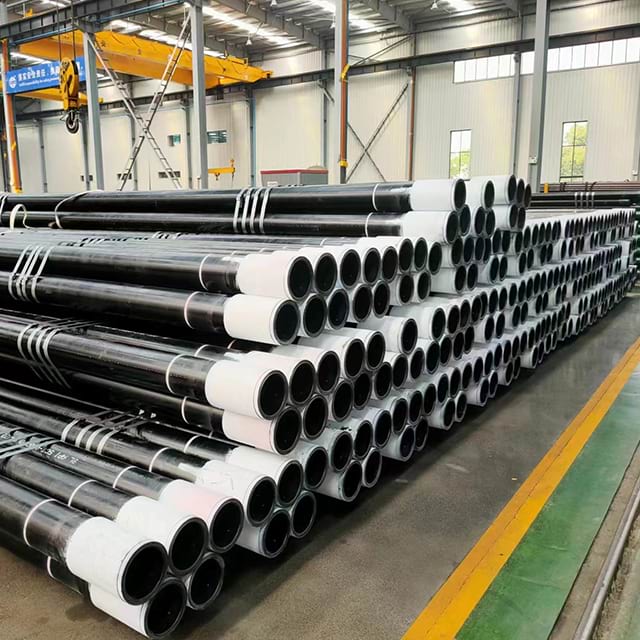 API 5CT casing with factory-applied BTC couplings and thread protectors.
1. BTC Technical Specifications
BTC is defined in API Specification 5B (threading, gauging and thread inspection) and referenced in API Specification 5CT, 11th Edition (casing and tubing specification):
| Property | BTC Specification |
|---|---|
| Thread form | Trapezoidal (square buttress) |
| Thread pitch | 5 threads per inch (TPI) |
| Thread taper | 1:16 ratio (6.25%) |
| Load flank angle | 3° — locks under tension |
| Stabbing flank angle | 10° — allows easy engagement |
| Tensile efficiency | ~100% of pipe body |
| Available OD range | 4-1/2″ to 20″ |
| Gas-tight | No — thread compound seal only |
| Governing standard | API 5CT / API 5B |
The 3° load flank angle is what gives BTC its tensile performance advantage over STC and LTC. Under axial tension, that nearly perpendicular face engages the box with minimal outward radial force — the thread cannot cam out. The steeper 10° stabbing flank allows fast, easy engagement during stabbing but contributes nothing to tensile resistance. Read this table in terms of design intent: BTC was engineered to carry tension loads, not to seal gas.
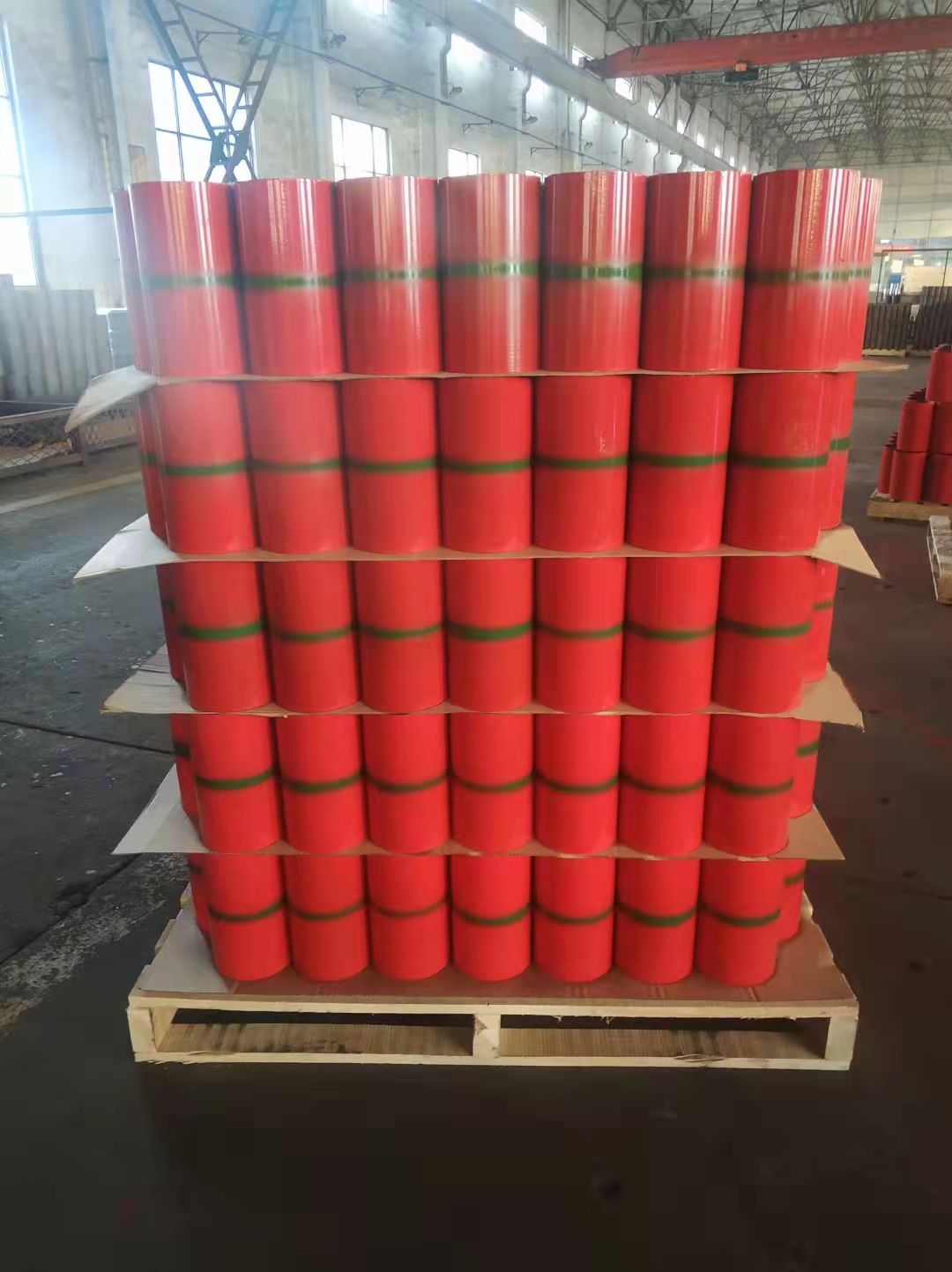 BTC couplings — the box half of the connection — protected and ready for dispatch; the buttress thread's flat load flank is what delivers ~100% tensile efficiency.
For the complete grade and connection-class data, see the API 5CT specification tables; to match a connection type to your well conditions, run it through the Pipe Grade Selector; and to benchmark connection tensile capacity against the pipe body, use the Joint Strength Calculator.
What we run BTC on: BTC is the workhorse across our K55 casing orders — 9⅝″ 47 ppf K55 BTC to a Middle East operator as an intermediate string, and 20″ 106.5 ppf K55 BTC to Colombia as surface casing. Both are liquid-service, moderate-pressure strings where tensile capacity governs and BTC is the correct call. Note the 20″ size sits at the top of the BTC range: we ship it with thread compound pre-applied and stress slow, plumb stabbing, because at that diameter the 5 TPI pitch turns any wobble into cross-threading. See more in our project records.
2. The Helical Leak Path — Why BTC Is Not Gas-Tight
BTC's fundamental sealing limitation is the helical leak path inherent in its thread geometry. When the pin is fully made up in the box, the thread profile creates a continuous spiral channel running the length of the connection. Thread compound fills this channel and provides the only barrier against fluid or gas migration.
This works adequately for liquid-only service at moderate pressure, where thread compound forms a continuous viscous plug. It fails for gas service for four compounding reasons:
- Gas molecules are small enough to permeate thread compound under differential pressure, even when the compound appears intact
- Thermal cycling causes the pipe body to expand and contract, pumping thread compound out of the helical path progressively over 5–20 production cycles
- Repeated makeup and breakout cycles physically displace compound from the thread crests, reducing the sealing cross-section
- There is no metal-to-metal contact anywhere in the BTC connection that would provide a compound-independent seal
Standard BTC carries no gas-tight qualification. It has never been tested to ISO 13679 or API 5C5 for gas-tight performance — not because it has failed such tests, but because the connection is not designed to pass them. The absence of a qualification statement is itself the warning.
3. Triangle Stamp Makeup — Position Over Torque
BTC makeup is governed by position — not torque alone. The triangle stamp machined into the pin end is the primary acceptance criterion. Torque is a monitoring tool; the triangle is the pass/fail gate.
Triangle stamp acceptance zones:
| Zone | Interpretation | Required action |
|---|---|---|
| Coupling face before triangle base | Under-made up | Continue makeup — investigate if torque limit already reached |
| Coupling face at triangle base | Minimum acceptable | Acceptable — verify torque is within range |
| Coupling face within triangle | Correct makeup zone | Acceptable |
| Coupling face at triangle apex | Maximum acceptable | Stop — do not exceed |
| Coupling face past apex | Over-made up | Reject — box may be yielded |
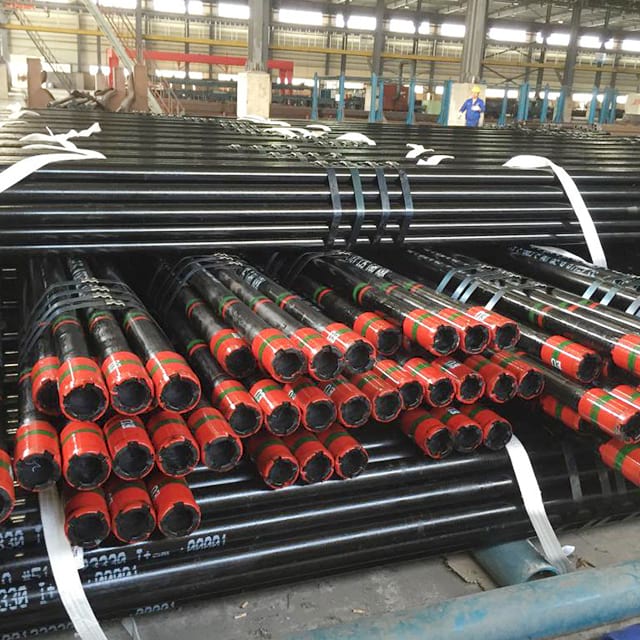 Thread protectors stay on until makeup — position against the triangle stamp, not torque alone, is the acceptance gate.
Experienced field engineers target the midpoint of the triangle — "half the triangle buried." Stopping exactly at the base leaves insufficient margin for machining tolerance stack-up and compound friction variation between drums. A connection made up to the midpoint has the same thread engagement quality as one made to the base, but with a tolerance buffer that absorbs the variables below.
Torque is monitored during BTC makeup to detect cross-threading, yielding, and compound behaviour — not to define the makeup endpoint. API 5C1 provides torque reference values as guidance. If the coupling face reaches the triangle base before minimum torque is achieved, do not force additional torque — investigate for cross-threading or dimensional non-conformance before proceeding.
In reviewing running logs from three BTC casing jobs in Nigeria — 7-inch N80 at 2,800 m — roughly half of all joints that failed triangle acceptance had compound applied from a drum with a different lot number than what was on the torque worksheet. The friction factor mismatch was the invisible cause of under-makeup that looked like dimensional non-conformance.
4. BTC Makeup Torque Reference Values
API 5C1 torque values assume API-modified thread compound at friction factor 1.0. Use these as a planning baseline, not as a substitute for the triangle stamp on the floor:
| OD (in) | Weight (lb/ft) | Grade | Min Torque (N·m) | Optimal Torque (N·m) |
|---|---|---|---|---|
| 4-1/2 | 11.60 | J55 | 2,700 | 3,100 |
| 5-1/2 | 17.00 | N80 | 5,600 | 6,500 |
| 5-1/2 | 20.00 | L80 | 6,800 | 7,800 |
| 7 | 23.00 | N80 | 10,800 | 12,400 |
| 7 | 26.00 | P110 | 13,300 | 15,200 |
| 9-5/8 | 40.00 | N80 | 22,400 | 25,600 |
| 9-5/8 | 47.00 | P110 | 27,500 | 31,500 |
| 13-3/8 | 68.00 | K55 | 47,000 | 54,000 |
The torque column is not a target — it is a window. Reaching minimum torque before the triangle base means either the connection is near-fully engaged (acceptable), or there is a dimensional issue reducing thread contact (investigate). Reaching the optimal torque value while the coupling face is still well below the triangle base is a red flag: compound friction may be higher than specified, or thread damage is adding resistance.
Friction factor adjustment: Low-friction green compound typically carries a friction factor of 1.1–1.2 versus 1.0 for API-modified compound. With lower friction, the same number of turns generates less torque — the connection can reach triangle-midpoint while the torque gauge reads below minimum. Adjust the torque window for the actual compound, not the default API 5C1 table. The triangle position does not change.
5. BTC Failure Modes
Failure Mode 1 — Jump-Out
Mechanism: Internal pressure balloons the box radially — box ID grows by 0.5–2 mm at full burst pressure — reducing thread engagement below the minimum for load flank resistance. With insufficient engagement, the pin load flanks disengage suddenly. The connection does not strip threads; it jumps clean.
Diagnostic: Paint marks applied at the coupling face shift axially during pressure testing. Audible pop at surface. Sudden pressure bleed-down without casing rupture.
Fix: Pull the string. BTC jump-out cannot be remediated in-hole. Confirm triangle position was at or above the base before re-running; if the connection was correctly made up, investigate box dimensional conformance.
Jump-out risk concentrates at three points: insufficient makeup (coupling face below triangle base), high internal pressure combined with high tensile load, and boxes that have been yielded by over-torque on a previous run. Very large OD — 13-3/8″ and above — amplifies all three risks because the larger box has more absolute radial expansion under the same internal pressure.
Failure Mode 2 — Galling
Mechanism: Point contact at thread crests during misaligned or high-speed makeup generates localised contact pressures exceeding thread compound film strength. Metal transfers from pin to box threads. Each makeup thereafter worsens the damage.
Diagnostic: Torque spike during makeup followed by sudden drop. Metallic grinding sound. Metal shavings in compound around the coupling face after breakout.
Fix: Galled BTC connections cannot be field-repaired. Pull the joint from the string. Have pin and coupling threads re-cut if the damage is shallow; retire if thread form is destroyed.
Galling is progressive. A connection that was galled lightly on one run, backed out, and inspected superficially will gall more aggressively on the next makeup — the prior metal transfer creates raised asperities that concentrate contact pressure. The correct action after any galling indication is removal, not re-running.
Failure Mode 3 — Helical Leak Path Gas Migration
Mechanism: Gas molecules permeate thread compound under differential pressure. Thermal cycling pumps compound out of the helix over 5–20 production cycles. Once compound depletes on the high-pressure side, gas migration begins.
Diagnostic: Sustained casing pressure at surface in gas wells. Pressure bleeds to a stable value — characteristic of a thread leak, not a pipe body leak.
Fix: Cannot be remediated in-hole for a producing gas well. Primary prevention: specify a premium connection for gas service from the outset.
Failure Mode 4 — Cross-Threading
BTC's coarse 5 TPI pitch makes it more susceptible to cross-threading than STC or LTC. If the pin wobbles significantly after 2–3 initial rotations during stabbing, cross-threading has likely occurred. Forcing a cross-threaded BTC pin shaves the starting threads and creates a permanent leak path. Back out immediately, inspect the starting threads with a thread gauge, and re-stab carefully with the pin held plumb.
BTC's 5 TPI thread pitch has an underappreciated size-scaling consequence: the same angular misalignment that produces a minor catch on a 4-1/2-inch pin causes a full load-flank shear on a 13-3/8-inch pin. The helix pitch is identical — the lateral thread displacement per degree of misalignment scales with OD. This is why large-OD BTC cross-threading almost always destroys the connection on the first rotation, while small-OD cross-threading is sometimes recoverable.
Burst Pressure vs. Connection Sealing — A Worked Calculation
To illustrate why connection sealing governs over pipe body burst in gas service BTC applications, consider 7" 26 lb/ft P110 casing. The Barlow formula for minimum burst pressure under API 5C3 applies a 0.875 wall tolerance factor:
P_burst = 0.875 × (2 × SMYS × t / OD)
For 7" 26 lb/ft P110: wall thickness t = 0.362 in, OD = 7.000 in, SMYS = 110,000 psi.
P_burst = 0.875 × (2 × 110,000 × 0.362 / 7.000) = 0.875 × 11,354 = 9,935 psi ≈ 9,940 psi
This is the pipe body burst rating. The BTC connection does not add burst resistance — it relies entirely on thread compound for sealing. At 9,940 psi internal pressure, gas migration through an under-compounded BTC connection is the governing failure mode, not pipe body burst. A string that passes Barlow analysis can still leak gas through the connections before the pipe body yields.
When NOT to Use BTC
BTC is a sound connection for the conditions it was designed for, but those conditions exclude a growing share of modern well designs. The logic for excluding BTC is not arbitrary conservatism — each condition below removes a load assumption that BTC's design depends on. Applying BTC where compound sealing is unreliable, where combined loading exceeds the jump-out threshold, or where large OD makes consistent makeup impossible is not a cost saving; it is a deferred well integrity event. For the full decision framework across HPHT, sour, and deviated wells, see the dedicated selection guide.
| Condition | Reason | Alternative |
|---|---|---|
| Gas wells | Not gas-tight — compound is the only seal | Premium connection, metal-to-metal seal |
| HPHT wells | Jump-out risk at high pressure; compound degrades at temperature | Premium connection |
| Deviated wells with high DLS | Bending loads combined with tension exceed jump-out threshold | Premium connection |
| Thermal cycling wells | Compound pumped out of helix over time, gas migration begins | Premium connection |
| Grade Q125 strings | BTC becomes the strength-limiting element in the string | Premium connection |
| Sour HPHT (C110) | H₂S + high pressure + temperature defeat compound sealing | Premium connection |
| Sizes above 13-3/8″ | Cross-threading risk becomes difficult to manage consistently | Premium connection or BTC with strict slow-speed procedure |
BTC remains appropriate for: deep vertical wells in sweet service at moderate pressure; intermediate and production casing in N80, L80, and T95 grades where tensile capacity governs string design; and any application where the design limiting condition is axial tension, not pressure containment.
7. BTC vs Premium — Connection Upgrade Decision
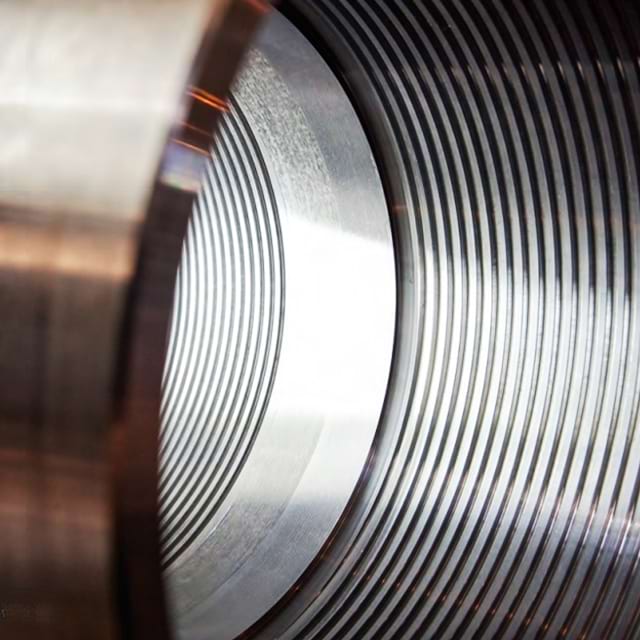 Where BTC's envelope is exceeded — gas, HPHT, C110/Q125 — a premium metal-to-metal connection is the upgrade path.
Upgrade from BTC to premium when the governing well condition exceeds BTC's design envelope — the head-to-head BTC vs premium comparison covers the full tradeoff:
| Well Condition | BTC | Premium |
|---|---|---|
| Sweet oil producer, vertical | Acceptable | Not required |
| Sweet gas producer | Not gas-tight | Required |
| Sour service, L80, oil | Mild sour acceptable | Moderate-severe sour |
| HPHT, P110 | Jump-out risk | Required |
| Deviated > 30° | Evaluate combined load | Recommended |
| C110 any service | Not suitable | Required |
| Q125 any service | Not suitable | Required |
The upgrade decision should be driven by the well's governing load case — not by a generic "premium is safer" assumption. Premium connections add cost and require manufacturer-specified compound and torque procedures. Specifying premium connections for a vertical sweet oil producer where tensile load governs is an unnecessary cost. Specifying BTC for a gas producer is a well integrity risk.
8. Procurement Trap — PO Language for BTC and Gas Service
Most BTC gas-service failures are traceable to a PO that was technically correct but operationally wrong. The connection is applied to a well it was never designed for, and the mill bears no responsibility because the PO did not exclude it.
Wrong: "7" 26 lb/ft P110 BTC casing, 300 joints" — the mill supplies BTC; the string has no gas-tight qualification. The mill is API 5CT compliant. The operator carries all well integrity risk.
Correct: "7" 26 lb/ft P110 casing, BTC connections NOT ACCEPTABLE for gas service on this well; premium connection required, ISO 13679 CAL IV or API 5C5 CAL IV, metal-to-metal seal, qualification documentation required."
The correct PO language does three things: excludes BTC explicitly, specifies the qualification standard and level (not just "premium connection"), and requires documentation. A PO that reads only "premium connection required" without naming a standard still allows the mill to supply a connection with no gas-tight test record.
9. Storage and Handling
BTC connections require consistent handling from mill to rig floor to prevent thread damage before running:
- Keep thread protectors installed at all times until makeup begins
- Inspect pin threads and coupling threads for damage after transport — pay particular attention to the first 2–3 threads at the pin nose, which absorb most handling contact
- Apply fresh thread compound at the rig site from the designated drum for that job — never use compound from a drum with a different lot number than what is on the torque worksheet
- Maintain BTC maximum makeup speed at 20 RPM for sizes up to 9-5/8″, 15 RPM for larger sizes; cross-threading risk increases sharply above these speeds
- For sizes 13-3/8″ and above — slow stabbing, careful alignment, and reduced speed are essential; the heavy pipe weight causes the pin to wobble during stabbing, and the 5 TPI pitch amplifies any angular misalignment into lateral thread displacement
ZC Steel Pipe supplies API 5CT casing with BTC connections in all standard sizes and grades. Contact us with your OD, weight, grade, PSL level, and quantity for availability and lead time.
Frequently Asked Questions
What is BTC casing connection and how does it differ from STC and LTC?
BTC (Buttress Thread Casing) is an API-standard connection defined in API 5CT and API 5B, using a trapezoidal (square buttress) thread profile at 5 threads per inch. Unlike STC and LTC which use triangular round threads at 8 TPI, BTC's flat load flank locks under tension to provide approximately 100% pipe body tensile efficiency. STC achieves only 60-80% tensile efficiency and LTC 80-85%, making BTC the standard choice for deep wells and heavy strings where tensile loads govern design.
What is the triangle stamp on BTC casing and how is it used for makeup?
The triangle stamp is a machined mark on the BTC pin end that serves as the primary position reference for connection makeup. API 5CT requires that makeup is complete when the coupling face lands between the base and apex of the triangle — not based on torque alone. Minimum makeup: coupling face at or beyond the triangle base. Maximum makeup: coupling face must not pass the triangle apex. Torque is monitored to detect cross-threading or yielding, but the triangle stamp is the primary acceptance criterion. If minimum torque is reached before the base of the triangle, the connection is under-made up and must be investigated.
Can BTC connections be used for gas wells?
Standard BTC connections are not gas-tight and should not be relied upon for gas containment in gas wells. BTC seals rely entirely on thread compound (dope) to block the helical leak path created by the thread geometry. Gas molecules can migrate through thread compound under differential pressure, particularly after thermal cycling or repeated makeup/breakout cycles that displace the compound. For gas wells, premium connections with metal-to-metal seals are required.
What causes BTC jump-out failure?
BTC jump-out occurs when the pin disengages from the box under high combined tensile load and internal pressure. The mechanism is: internal pressure causes the box to expand radially (ballooning), reducing thread engagement. Simultaneously, high tension loads the load flanks. When box expansion reduces thread engagement below the critical value, the pin jumps out — often without stripping threads. Jump-out is most common when internal pressure and tension are applied simultaneously, when makeup position is insufficient (below the triangle base), or when the box has been yielded by over-torque.
What torque should be used for BTC casing connections?
BTC makeup torque per API 5C1 depends on OD, weight, and grade. Torque values assume API-modified thread compound with friction factor 1.0. If using modern low-friction (green) thread compounds with friction factor 1.1-1.2, the same torque values will result in under-makeup — insufficient thread engagement — because the lower friction allows more turns for the same torque. Always adjust torque targets for the actual compound friction factor. The triangle stamp position remains the primary acceptance criterion regardless of torque.
How many times can a BTC connection be made up and broken out?
API 5CT typically allows 3-5 makeup and breakout cycles for BTC connections before thread damage risk becomes unacceptable. Each cycle wears the load flanks slightly and can displace thread compound. After breakout, inspect threads with a thread gauge before re-running. Any galling, thread damage, or significant wear requires the connection to be removed from service. BTC connections that have been run in sour service require particularly careful inspection before re-use.
What thread compound should be used for BTC connections?
API-modified thread compound is the standard for BTC connections in sweet service. For sour service (H₂S environments), specify H₂S-compatible thread compound — standard API compound may contain sulphur-bearing additives that can accelerate SSC in sour service grades. For high-temperature applications, verify the compound temperature rating. Never use standard API compound on premium connections — use only the compound specified by the premium connection manufacturer.
What is the maximum recommended size for BTC connections?
BTC connections are available up to 20-inch OD, but become increasingly difficult to handle above 13-3/8 inch due to the coarse 5 TPI pitch and heavy pipe weight. Above 13-3/8 inch, cross-threading risk increases significantly because the heavy pipe causes the pin to wobble during stabbing. For sizes 16 inch and above, slow makeup speed (below 15 RPM) and experienced crews are essential. Some operators specify premium connections above 13-3/8 inch to avoid BTC handling difficulties.