J55 and K55 are the lowest-strength standard grades in the API 5CT casing family. Engineers specifying surface and conductor casing encounter these grades at virtually every well — yet the distinction between them is frequently misunderstood by procurement teams. Both grades share the same yield strength range. The difference that matters is tensile strength, and that single specification difference determines which connection type is appropriate for each grade.
ZC Steel Pipe supplies J55 and K55 casing in standard sizes from 4½ inch to 20 inch OD, with STC, LTC, and BTC connections respectively, for surface, conductor, and shallow intermediate casing applications across West Africa, Southeast Asia, and the Middle East.
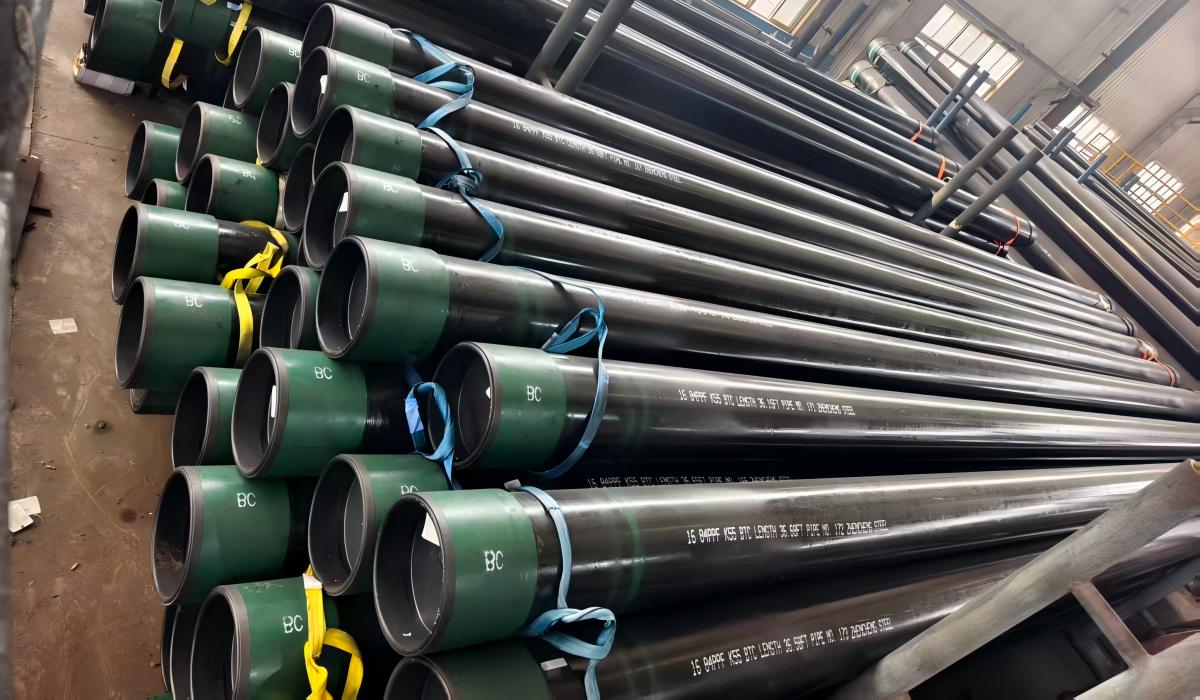 K55 BTC casing from a real ZC shipment to a Colombian operator — the pipe-body stencil records the K55 grade and BTC connection.
Quick Answer
J55 and K55 share an identical yield range — 379 to 552 MPa (55 to 80 ksi) — so neither is the "stronger" grade in the yield-limited sense that drives collapse and burst. The one specification that separates them is minimum tensile strength: J55 is 517 MPa (75 ksi), K55 is 655 MPa (95 ksi). That 138 MPa (20 ksi) gap is why K55 carries BTC buttress thread on surface and intermediate strings, while J55 runs STC or LTC round thread on shallow, low-tension strings. Neither grade is qualified for sour service. The practical rule: if the string needs BTC, specify K55 BTC — "J55 BTC" is the classic ordering error, because BTC coupling tables are calibrated to K55's tensile minimum, not J55's.
What we see on orders: Procurement teams new to API 5CT occasionally write "J55 BTC" on the purchase order — specifying J55 pipe body with BTC (buttress thread) connections. Technically, the mill will typically reject this combination or supply K55 BTC instead, because BTC connection tables are designed around K55's tensile requirement. We flag this before production begins. The correct specification for a BTC intermediate casing string is K55 BTC, not J55 BTC. If the intent is a lower-cost string and the tensile loads allow J55, the connection should be LTC, not BTC.
What Sets J55 and K55 Apart
The spec differences between J55 and K55 under API Specification 5CT, 11th Edition are narrow — but specific. Both grades share a yield strength range of 379 MPa to 552 MPa (55 ksi to 80 ksi). This is why both grades carry the "55" designation. The yield floor and ceiling are identical.
The critical difference is minimum tensile strength:
- J55: minimum tensile 517 MPa (75 ksi)
- K55: minimum tensile 655 MPa (95 ksi)
That 138 MPa (20 ksi) tensile gap was placed deliberately in the API 5CT specification to match each grade to its appropriate connection type. BTC buttress thread couplings, which provide higher tensile efficiency than round-thread alternatives, require the pipe body to have adequate tensile capacity for the coupling makeup and axial loads to work correctly. K55's higher tensile minimum meets that requirement; J55's does not.
Mechanical Properties — API 5CT Verified Data
The following values are taken directly from API 5CT 11th Edition specifications (the full grade sheet for both grades is in the J55, K55 and H40 specifications):
| Property | J55 | K55 |
|---|---|---|
| Min yield strength | 379 MPa (55 ksi) | 379 MPa (55 ksi) |
| Max yield strength | 552 MPa (80 ksi) | 552 MPa (80 ksi) |
| Min tensile strength | 517 MPa (75 ksi) | 655 MPa (95 ksi) |
| Max hardness | No limit | No limit |
| Mandatory heat treatment | None | None |
| Sour service qualified | No | No |
| API color code | One bright green band | Two bright green bands |
The absence of hardness limits and heat treatment requirements for both grades is significant. A mill can produce J55 or K55 as-rolled, normalized, or normalized-and-tempered — any process that achieves the minimum mechanical requirements satisfies API 5CT. This manufacturing freedom reduces cost but also means less microstructural consistency between heats compared to quench-and-tempered grades.
Both grades carry only P_max 0.030% and S_max 0.030% as chemistry restrictions under API 5CT. Carbon, manganese, chromium, and all other elements are unrestricted for these grades — the specification controls only the outcome (tensile and yield), not the metallurgical route.
The shared yield range between J55 and K55 creates a common misassumption: that the grades are essentially equivalent and the choice between them is arbitrary. It is not. The tensile strength difference is the structural requirement for the BTC connection design. The connection tables in API 5CT Table C.14 that define BTC coupling ODs, thread engagement depths, and torque values are calibrated to K55 tensile properties. Running J55 in a BTC string means the connection geometry is designed for a pipe that is 27% stronger in tension — a margin that disappears in high-load situations.
Connection Compatibility — Why Tensile Strength Determines Thread Choice
API 5CT defines three standard connection types for low-strength casing grades — covered in depth in the casing connection types guide:
STC (Short Thread Coupling): Round thread profile, short engagement length, lower make-up torque. Tensile efficiency approximately 60% of pipe body tensile strength for J55. Used with J55 for shallow strings where string weight and tensile loads are modest.
LTC (Long Thread Coupling): Round thread profile, longer engagement than STC, higher make-up torque. Tensile efficiency approximately 70% of pipe body tensile strength for J55. Preferred over STC for J55 strings where additional engagement length provides margin against washout or vibration.
BTC (Buttress Thread Coupling): Flat-bottom buttress thread profile, heavier coupling, higher make-up torque. Tensile efficiency approximately 85% of pipe body tensile strength for K55. This is the standard connection for K55 surface and intermediate casing strings where the string weight creates significant axial loading.
The practical consequence: for a string where tensile loading drives the design, K55 BTC delivers meaningfully higher joint tensile strength than J55 LTC despite the two grades having identical yield strength.
Worked Tensile Load Example
Consider a 9-5/8 inch intermediate casing string at 3,000 m (9,843 ft) total depth, using 53.5 lb/ft pipe, with 1.44 SG drilling fluid in the annulus. Buoyancy factor for steel in 1.44 SG fluid ≈ 0.82.
Buoyed string weight = 53.5 lb/ft × 9,843 ft × 0.82 ≈ 431,000 lbf
Applying a design factor of 1.8 for tensile: Required joint tensile capacity ≥ 431,000 × 1.8 ≈ 776,000 lbf
For 9-5/8 inch 53.5 lb/ft K55, approximate pipe body tensile yield load = 1,086,000 lbf (from API 5CT tables). K55 BTC joint tensile strength ≈ 85% × 1,086,000 ≈ 923,000 lbf → exceeds 776,000 lbf requirement.
For J55 LTC at the same size: J55 pipe body tensile yield load ≈ 839,000 lbf (lower yield; same OD and wall). LTC joint tensile strength ≈ 70% × 839,000 ≈ 587,000 lbf → below 776,000 lbf requirement.
This example shows why J55 with round thread connections is not appropriate for a 3,000 m intermediate string. The connection would be the limiting element, and the design factor would be approximately 1.4 — below the typical 1.8 minimum. K55 BTC is the correct grade and connection combination. To run the numbers for your own size and grade, use the joint strength calculator →; the underlying axial, collapse, and burst logic is walked through in casing design basics.
For the full API 5CT casing load tables including pipe body tensile, burst, and collapse ratings, see the API 5CT specification tables →
Standard Casing Sizes and Applications
J55 and K55 cover the same OD range under API 5CT — from 4½ inch (114.3 mm) to 20 inch (508.0 mm). The typical use cases differ by depth and load environment:
| OD | Typical Weight (lb/ft) | Grade Typically Ordered | Connection | Common Application |
|---|---|---|---|---|
| 4½" (114.3 mm) | 9.5–13.5 | J55 | STC or LTC | Shallow production casing |
| 5½" (139.7 mm) | 14.0–20.0 | J55 or K55 | LTC or BTC | Shallow well production casing |
| 7" (177.8 mm) | 17.0–32.0 | J55 or K55 | LTC or BTC | Intermediate casing, shallow production |
| 9-5/8" (244.5 mm) | 36.0–58.4 | K55 | BTC | Intermediate casing |
| 13-3/8" (339.7 mm) | 48.0–68.0 | K55 | BTC | Surface casing |
| 16" (406.4 mm) | 65.0–84.0 | K55 | BTC | Surface casing, conductor |
| 20" (508.0 mm) | 94.0–133.0 | K55 | BTC | Conductor, large-diameter surface |
The sizes above 9-5/8 inch — 13-3/8 inch, 16 inch, and 20 inch — are almost exclusively K55 BTC in practice. The string weight at these sizes and depths makes BTC the appropriate connection, and K55's tensile minimum is required to develop the BTC joint strength.
To match grade and connection to your specific well geometry, use the Pipe Grade Selector →
Applications: Where J55 Works and Where K55 Is Required
J55 Applications
J55 STC or LTC is appropriate in:
- Shallow conductor pipe in land wells where the string is short enough that tensile loads are well within STC/LTC joint capacity
- Shallow surface casing in soft formations with low collapse requirements
- Water well surface casing where API 5CT material is specified but HPHT loads are absent
- Short liner strings near surface where tensile loading is limited
The common thread (no pun intended) across all J55 applications is low tensile load, shallow depth, and non-sour service. When any one of those changes, J55 typically needs to be upgraded.
K55 Applications
K55 BTC is the standard grade for:
- Standard surface casing strings in land and offshore wells — the 13-3/8 inch surface string in the vast majority of land wells is K55 BTC
- Conductor pipe where string weight requires BTC tensile efficiency
- Shallow intermediate casing (500–2,000 m) in non-sour, low-HPHT environments
- Liner tops for shallow, non-demanding applications
K55 is appropriate up to approximately 2,000–2,500 m TVD in non-sour environments. Beyond that depth, or in wells with elevated collapse requirements, N80 or L80 becomes the better choice based on the collapse and burst ratings the well design requires. Check the crossover for your string with the collapse pressure calculator →.
A representative K55 surface string: A recent 208-joint order we shipped to a Colombian operator was 20" 106.5 ppf K55 BTC in R3 — surface and conductor casing for conventional onshore wells. At that diameter the choice is never J55: the governing load is hook load during running and cementing, and BTC on K55 is the only combination that keeps the coupling from becoming the weak point in tension. R3 length also cut the number of connections in the string.
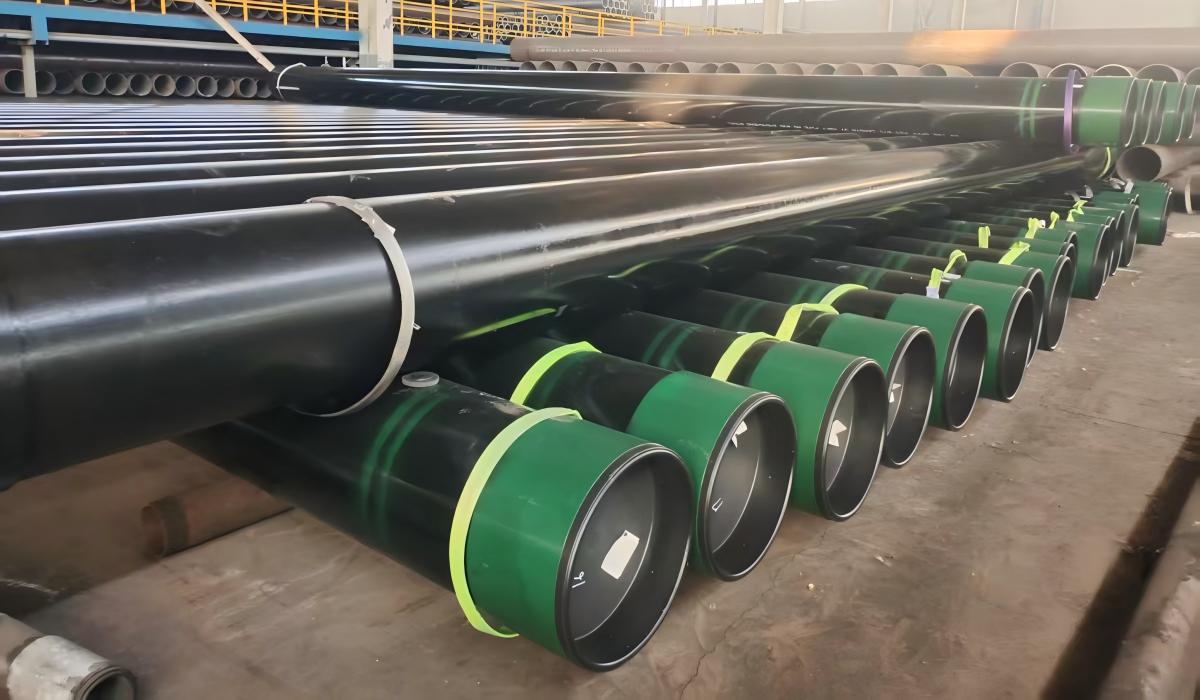 K55 casing joints staged in long rows with green thread protectors, from a real ZC surface-casing shipment.
When NOT to Use J55 or K55
1. Any well with H2S present. Neither grade is sour service qualified. Even trace H2S can cause sulphide stress cracking (SSC) in uncontrolled-hardness steel. L80 is the minimum grade for sour service, without exception.
2. Intermediate casing deeper than approximately 2,000–2,500 m TVD. The collapse resistance of J55 and K55 at typical D/t ratios decreases rapidly with depth. N80 or L80 provides meaningfully higher collapse and burst ratings at these depths.
3. High-temperature wells. Both grades have no specified minimum elevated temperature yield data. API 5CT does not de-rate these grades for temperature in the same way HPHT well designs require. For wells above 120°C, request elevated temperature mechanical data from the mill.
4. HPHT wells. The mechanical property floor for J55 and K55 is insufficient for HPHT applications. P110, Q125, or high-CRA grades are appropriate for HPHT.
5. Any string requiring predictable minimum yield. Both grades have a wide yield band (379–552 MPa / 55–80 ksi). Mills can legally ship pipe anywhere in this range. For strings where yield-limited collapse or internal yield calculations drive the design, the 173 MPa uncertainty in actual yield makes these grades difficult to use with confidence. N80Q or L80 (both with tighter yield ranges) are preferable where predictable yield matters.
6. Deviated or horizontal wells with high bending stress. J55 and K55 are not recommended for high-inclination intermediate strings where bending stress combines with compression loading. Premium connections or N80Q should be evaluated.
J55 vs K55 — Grade Comparison Table
| Attribute | J55 | K55 |
|---|---|---|
| Min yield | 379 MPa (55 ksi) | 379 MPa (55 ksi) |
| Max yield | 552 MPa (80 ksi) | 552 MPa (80 ksi) |
| Min tensile | 517 MPa (75 ksi) | 655 MPa (95 ksi) |
| Standard connection | STC, LTC | BTC |
| Typical joint tensile efficiency | ~60–70% (LTC) | ~85% (BTC) |
| Heat treatment required | No | No |
| Hardness limit | None | None |
| Sour service qualified | No | No |
| Color code | One bright green band | Two bright green bands |
| Typical OD range in practice | 4½" to 7" | 9-5/8" to 20" |
| Premium connection compatible | Not standard practice | Available but uncommon |
Purchase Order Guidance
Minimum PO line items for J55/K55 casing
A correct purchase order for J55 or K55 casing should specify:
- API Specification 5CT, 11th Edition
- Grade (J55 or K55 — be explicit)
- PSL level (PSL1 is standard; PSL2 requires Charpy impact testing)
- OD and nominal weight (lb/ft)
- Connection type (STC, LTC, or BTC — match to grade as above)
- Length range (R1, R2, or R3)
- Pipe type (seamless or ERW — ERW is common for surface/conductor)
- Coupling grade (same as pipe body — do not mix grades)
- Mill MTC level (EN 10204 3.1 minimum)
The J55 BTC procurement trap
The most common ordering mistake with these grades is writing "J55 BTC" on the purchase order. Because J55 and K55 share a similar name and identical yield range, the grade confusion is understandable. But BTC connections are not designed around J55's tensile minimum. A reputable mill will correct this to K55 BTC before manufacturing — but this adds time and requires a revised order. Write K55 BTC when BTC connection is required.
A second trap: ordering "J55" when the well design requires any sour service qualification. There is no J55 sour service grade. If sour service is required, the order must specify L80 (and the type: L80-1 for SSC service, L80-13Cr for CO2 corrosion service). No amount of supplementary testing on J55 creates a sour service qualified pipe.
What to check on the MTC
For J55 and K55, the MTC review is straightforward but should confirm:
- Yield and tensile values are within the API 5CT range for the grade (not just above minimum — check the maximum yield limit also; yield above 552 MPa / 80 ksi is out of spec)
- Heat number traceability to the certificate
- Chemistry showing P ≤ 0.030% and S ≤ 0.030%
- Connection type matches order (STC, LTC, or BTC)
- Coupling grade matches pipe grade
- Length range conforms to order
Grade marking on the pipe should show the grade designation and the number of green bands (one for J55, two for K55). Misidentification at the yard is the field error to guard against — ensure the markings are legible and agree with the MTC.
For the complete API 5CT grade ladder including J55, K55, and all other OCTG grades, see the API 5CT specification tables →
Frequently Asked Questions
What is the main difference between J55 and K55 casing?
J55 and K55 have identical yield strength ranges under API 5CT — both have a minimum yield of 379 MPa (55 ksi) and a maximum of 552 MPa (80 ksi). The defining difference is tensile strength: J55 requires a minimum tensile of 517 MPa (75 ksi), while K55 requires 655 MPa (95 ksi). This 138 MPa (20 ksi) tensile gap determines which connection type each grade is compatible with — J55 with STC or LTC round thread, K55 with BTC buttress thread.
Can J55 be run with BTC couplings?
Running BTC couplings on J55 pipe is not recommended. BTC achieves its joint efficiency by threading into a heavier coupling — the tensile efficiency of the BTC connection is designed around K55's minimum tensile of 655 MPa (95 ksi). Using BTC on J55 (517 MPa tensile) results in the connection being stronger than the pipe in compression but weaker than the pipe body in tension. The correct combination is K55 BTC. Specifying J55 BTC on a purchase order is likely to either be rejected by the mill or result in a substandard connection.
Why does K55 have higher tensile strength than J55 if the yield is the same?
The higher tensile minimum for K55 exists specifically to support BTC buttress thread connections. BTC coupling makeup loads and the tensile efficiency of the buttress thread form require the pin and pipe body to have adequate tensile capacity to prevent thread jump-out under axial loading. By requiring K55 for BTC strings, API 5CT ensures that the pipe body and connection work together at the intended load levels. J55's lower tensile minimum (75 ksi) was sized for the lower-efficiency STC and LTC connections where the thread engagement is smaller.
Are J55 and K55 qualified for sour service?
No — neither J55 nor K55 is qualified for sour service under NACE MR0175 / ISO 15156. API 5CT does not require hardness testing for either grade, and there is no SSC testing requirement in their manufacturing specification. Even if a specific heat happens to test below 22 HRC, the grade does not meet the full sour service qualification pathway. For any well with H2S present, L80 is the minimum acceptable casing grade, with T95 or C110 required for higher H2S concentrations or well depths.
What heat treatment is applied to J55 and K55 casing?
API 5CT does not mandate any specific heat treatment for J55 or K55. Pipe may be supplied as-rolled, normalized, or normalized-and-tempered at the manufacturer's discretion, provided it meets the minimum yield and tensile requirements. This manufacturing flexibility contributes to the lower cost of these grades but results in more variability in microstructure and mechanical properties compared to quench-and-tempered grades like L80 or P110. No hardness testing is required for either grade under API 5CT.
What are the color codes for J55 and K55 casing?
Under API 5CT, J55 casing is marked with one bright green band and K55 casing is marked with two bright green bands. These color bands are applied at the mill on the pipe body and must be legible at the receiving yard. The similar color family (both green) reflects their shared yield range — a common source of misidentification at the yard. Always verify the number of bands and the grade marking stencil on arrival, not just the color.
What sizes are available for J55 and K55 casing?
J55 and K55 are available across the standard API 5CT casing size range from 4½ inch to 20 inch OD. The most common surface casing sizes in practice are 13-3/8 inch and 20 inch OD for K55 BTC, and 9-5/8 inch for intermediate casing applications. J55 is most commonly ordered in 4½ to 7 inch OD for shallow production strings where STC or LTC connections are sufficient and tensile loads are low.
Can J55 or K55 replace N80 for cost savings?
Substituting J55 or K55 for N80 is not appropriate for intermediate or production casing where collapse resistance and tensile load are the design drivers. N80 has a minimum yield of 552 MPa (80 ksi) versus J55/K55's 379 MPa (55 ksi) — the collapse resistance difference is significant for well depths beyond a few hundred metres. J55 and K55 are appropriate for surface and conductor casing in shallow wells, not as a cost-saving substitute for N80 in deeper strings.