J55 and K55 are the two grades we supply most often for surface casing and conductor work across West Africa and the Middle East. The question we get most frequently from procurement is: what is actually different between them? The answer is the connection type and — less well known — the tensile strength minimum. Both grades have 379 MPa minimum yield and 552 MPa maximum yield. But K55 has a 655 MPa minimum tensile (95 ksi) compared to J55's 517 MPa (75 ksi). This difference matters for coupling and thread tensile efficiency calculations, especially for large-diameter surface casing strings.
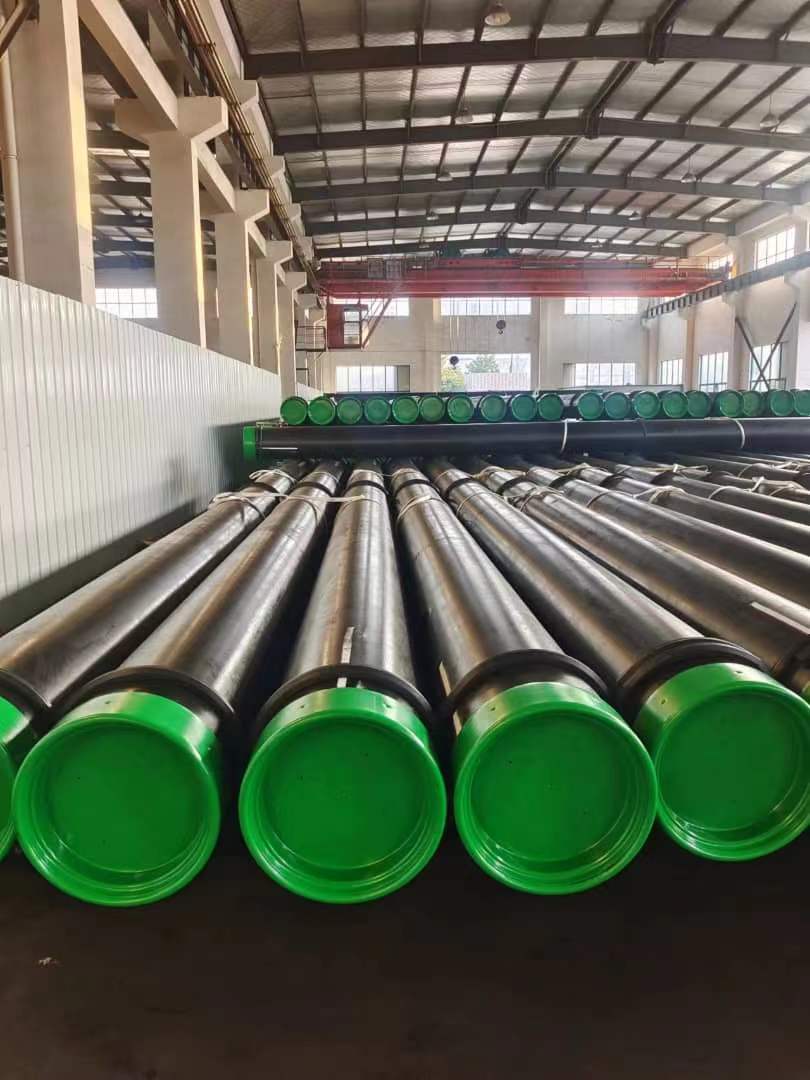 K55 surface casing staged in the yard ahead of a real ZC shipment to a Middle East project — green thread protectors and overhead crane handling.
That 20 ksi tensile gap is not a footnote. It is the engineering rationale for why K55 is paired with BTC and J55 is paired with STC and LTC. BTC's trapezoidal thread profile achieves near pipe-body tensile efficiency — but only when the coupling material has sufficient tensile capacity to match. The K55 grade designation is the signal that this tensile capacity is present. An engineer specifying K55 BTC for a 13-3/8" surface string is not simply asking for a different thread form — they are specifying a grade-and-connection combination designed to perform together.
H40 comes up occasionally in enquiries, usually from buyers working from an older design specification. In practice we rarely have orders for it — J55 at 379 MPa has largely replaced H40 for any real casing application, and lead times for H40 from mills are longer because it is no longer a standard stock product at most facilities. For any project where H40 is still on the specification sheet, the first question to ask is whether the application actually requires anything weaker than J55, because the material cost difference between the two grades is negligible and the sourcing disadvantage of H40 is not.
Quick Answer
All three grades sit at the bottom of the API 5CT ladder — none are hardness-controlled, none are sour-service qualified, all are sweet, shallow-service grades. What separates them is minimum tensile strength and the connection system it supports.
| Grade | Min yield | Defining trait | Specify it for |
|---|---|---|---|
| H40 | 276 MPa (40 ksi) | Lowest grade; near-obsolete | Almost nothing — J55 has replaced it |
| J55 | 379 MPa (55 ksi) | 517 MPa (75 ksi) min tensile → STC / LTC | Shallow sweet production, liner |
| K55 | 379 MPa (55 ksi) | 655 MPa (95 ksi) min tensile → BTC | Surface and conductor casing (the default) |
Bottom line: for 13⅜″ and larger surface strings, specify K55 BTC — its higher tensile floor is what makes the buttress coupling work. Use J55 only for small, shallow, sweet strings. Treat H40 as a sourcing liability, not a saving. The full spec, chemistry and dimensional tables are below.
What we see on J55/K55 orders: The most consistent specification question we receive on surface casing orders is whether to specify J55 or K55. The short answer for 13⅜" and larger surface casing is always K55 BTC — BTC's trapezoidal thread gives near-pipe-body tensile efficiency, which matters when calculating the total string weight in tension. J55 with STC or LTC on large-diameter surface casing is a thread design that is undersized for the tensile load of a full string. We flag this before production.
Grade Specifications
The three grades covered in this article span the lowest tier of the API Specification 5CT, 11th Edition grade ladder. H40 at 276 MPa, J55 and K55 at 379 MPa — none of these grades carry a hardness limit, none require a specific heat treatment, and none are qualified for sour service. What separates J55 from K55 is not yield strength, but minimum tensile strength and the connection system that tensile strength is designed to support.
| Property | H40 | J55 | K55 |
|---|---|---|---|
| Min yield strength | 276 MPa (40 ksi) | 379 MPa (55 ksi) | 379 MPa (55 ksi) |
| Max yield strength | 552 MPa (80 ksi) | 552 MPa (80 ksi) | 552 MPa (80 ksi) |
| Min tensile strength | 414 MPa (60 ksi) | 517 MPa (75 ksi) | 655 MPa (95 ksi) |
| Heat treatment | Not specified | Not specified | Not specified |
| Hardness limit | None | None | None |
| Sour service | No | No | No |
| Standard connections | STC, LTC | STC, LTC | BTC |
| PSL levels | PSL-1 | PSL-1 | PSL-1 |
| Typical application | Rare — very shallow conductor | Surface, conductor | Surface, conductor |
Read this table with K55's tensile column in mind. At 655 MPa, K55's minimum tensile is 27% higher than J55's 517 MPa. This is not a minor rounding difference — it is the structural foundation for the BTC connection system. For the complete API 5CT grade ladder including N80, L80, and higher grades, see the API 5CT specification tables →
To match a grade to your well conditions and casing string requirements, use the Pipe Grade Selector →
J55 vs K55 — Tensile Strength and Connection Design
The yield strength of J55 and K55 is identical: 379 MPa (55 ksi) minimum, 552 MPa (80 ksi) maximum. An engineer reading only the yield values would reasonably conclude that J55 and K55 are the same material with different thread forms applied. That conclusion is wrong, and it leads to procurement errors on large-diameter surface casing.
API 5CT separates J55 and K55 at the tensile strength level precisely because the connection systems they use require different tensile capacity from the coupling material. J55 at 517 MPa minimum tensile is sufficient for STC and LTC round-thread couplings, where thread engagement is distributed across a tapered round profile and tensile efficiency in the coupling runs at approximately 60–80% of pipe body depending on size. K55 at 655 MPa minimum tensile is required for BTC, where the square-shoulder trapezoidal thread achieves near 100% tensile efficiency — but only because the coupling is manufactured from material with higher tensile capacity to match.
The practical consequence: if a string of 13-3/8" surface casing is specified as J55 STC, the weakest point in the string under tensile load is the connection, not the pipe body. For a 13-3/8" 48 lb/ft string, the pipe body tensile strength runs at approximately 3,800 kN. STC coupling tensile efficiency on 13-3/8" sits at approximately 60%, meaning the coupling fails in tension at around 2,280 kN. In a well where the total string weight in tension approaches that value — common in medium-depth wells with a heavy mud column — the connection becomes the governing failure mode. K55 BTC on the same string achieves close to full pipe body tensile capacity in the coupling and removes the connection as the weak point.
This is not a theoretical concern. On long surface strings in West Africa and the Middle East, we see engineers arrive at K55 BTC through the casing design calculation — not simply because "that is what is normally specified." The calculation drives the choice. Understanding why K55 exists separately from J55 in the API 5CT grade ladder makes the calculation outcome predictable before the design is run.
The tensile strength difference between J55 and K55 is often treated as a footnote — 75 ksi vs 95 ksi — but it has real procurement implications. K55 BTC 13⅜" surface casing achieves close to 100% pipe body tensile efficiency in the coupling. J55 STC 13⅜" achieves approximately 60% of the same pipe body tensile strength in the coupling. If your casing design calculates surface string tensile loads against pipe body strength, the connection efficiency assumption must match the actual connection — and the grade designation (K55 vs J55) signals which tensile tier the coupling design was built for.
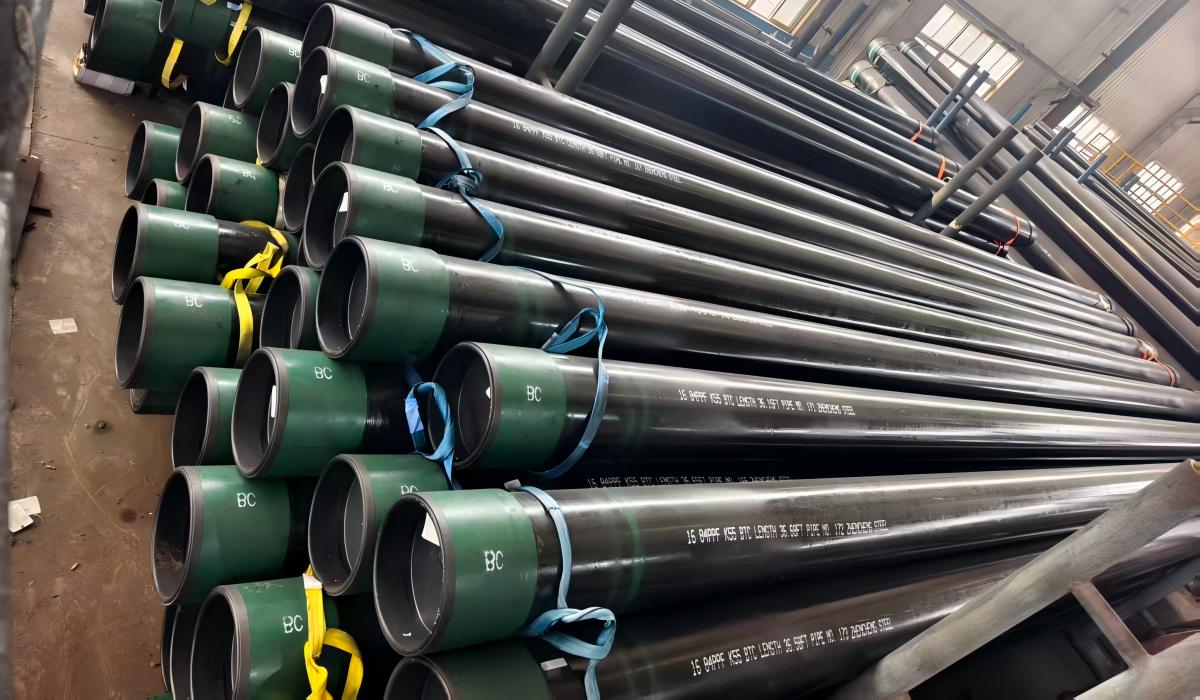 K55 BTC casing from a real ZC delivery to a Colombian operator — the clear English stencil records grade and connection type on the pipe body.
Chemical Composition
API 5CT restricts only two chemistry elements for H40, J55, and K55: phosphorus and sulfur, both at a maximum of 0.030%. All other elements — carbon, manganese, silicon, chromium, nickel, copper, molybdenum, niobium — are not restricted by the specification.
| Element | H40 | J55 | K55 |
|---|---|---|---|
| Carbon (C) | Not restricted | Not restricted | Not restricted |
| Manganese (Mn) | Not restricted | Not restricted | Not restricted |
| Silicon (Si) | Not restricted | Not restricted | Not restricted |
| Chromium (Cr) | Not restricted | Not restricted | Not restricted |
| Nickel (Ni) | Not restricted | Not restricted | Not restricted |
| Copper (Cu) | Not restricted | Not restricted | Not restricted |
| Molybdenum (Mo) | Not restricted | Not restricted | Not restricted |
| Phosphorus (P) | 0.030% max | 0.030% max | 0.030% max |
| Sulfur (S) | 0.030% max | 0.030% max | 0.030% max |
This minimal chemistry restriction is intentional, not an oversight. H40, J55, and K55 are designed for structural performance in shallow, low-pressure, sweet service applications — containment of formation fluids, wellhead support, and conductor protection. They are not designed for corrosion service, sour environments, or microstructure control. Since no heat treatment is specified, and hardness is not measured, the mill has full discretion over alloy additions and rolling practice — provided the finished pipe meets yield and tensile targets.
The absence of chemistry controls is also the reason these grades cannot be used in sour service. Controlling SSC resistance in carbon steel OCTG requires chemistry management — principally sulfur content below 0.010%, controlled manganese distribution, and in some grades Ca treatment for inclusion shape control. None of that is required for J55 or K55, and none of it can be assumed from the grade designation alone.
Common Applications by Casing String
The table below reflects where J55 and K55 are actually used in well designs, not simply where the specification would permit them:
| Casing String | Typical OD | Grade | Connection | Notes |
|---|---|---|---|---|
| Conductor | 20–36 inch | K55 or structural steel | BTC or welded | Large OD, wellhead support, structural loads |
| Surface casing | 13-3/8 – 20 inch | K55 | BTC | Standard globally for most onshore wells |
| Shallow intermediate | 9-5/8 – 13-3/8 inch | K55 | BTC | Where collapse and burst loads are low |
| Shallow production | 5-1/2 – 7 inch | J55 or K55 | STC / LTC / BTC | Shallow sweet wells only |
| Liner (very shallow) | 4-1/2 – 5-1/2 inch | J55 | STC / LTC | Minimal load applications |
The column that matters most in this table is "Notes." Every application listed is shallow and sweet. The moment a well design introduces H₂S, significant depth, or high collapse loads, the appropriate grade steps up to N80 or L80 at minimum — see the N80 vs L80 selection guide for where each fits. K55 BTC is an excellent surface casing grade — and a poor choice for everything below the surface string in a well with any complexity.
What we actually ship as K55: Recent K55 BTC strings we have supplied bracket exactly this table — 13⅜" 68 ppf into an African development as part of a ~2,000-tonne mixed OCTG and line pipe package, and 20" 106.5 ppf surface casing to a Colombian operator. Both ran R3 BTC — the surface-and-conductor profile every row here describes. We rarely quote J55 above 9⅝"; the tensile-efficiency argument settles it on the PO before the design review runs. See more in our project records.
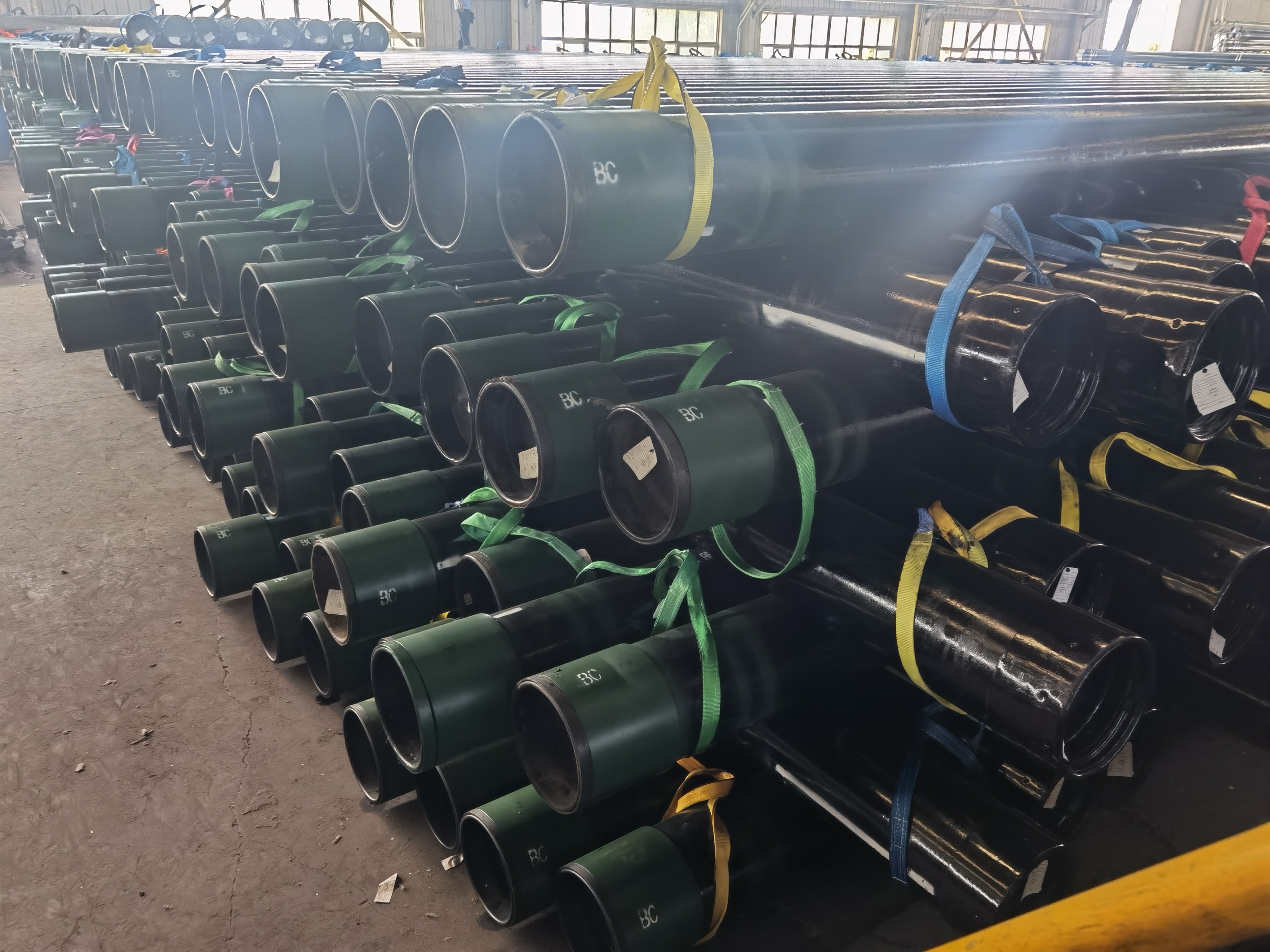 Mixed OCTG casing with buttress couplings and green protectors from a real ZC package supplied into Africa.
Standard Dimensions and Weights
J55 and K55 are dimensionally identical to the higher OCTG grades at any given OD and weight — an API 5CT 9⅝ inch 36 lb/ft joint has the same wall, ID, and drift whether it is K55 or P110; only the mechanical grade and price differ. The table below gives one representative common weight for each OD where J55/K55 is actually used, with wall thickness, inside diameter, and calculated drift, per API 5CT 11th Edition, Table C.18. Multiple weights exist for each OD.
| OD (in) | OD (mm) | Weight (lb/ft) | Wall (mm) | ID (mm) | Drift (mm) | Typical string |
|---|---|---|---|---|---|---|
| 4½ | 114.30 | 11.60 | 6.35 | 101.60 | 98.42 | J55 shallow production, liner |
| 5½ | 139.70 | 17.00 | 7.72 | 124.26 | 121.08 | J55 / K55 shallow production |
| 7 | 177.80 | 23.00 | 8.05 | 161.70 | 158.52 | Shallow production / intermediate |
| 8⅝ | 219.08 | 32.00 | 8.94 | 201.20 | 198.02 | K55 intermediate / surface |
| 9⅝ | 244.48 | 36.00 | 8.94 | 226.60 | 222.63 | K55 surface, shallow intermediate |
| 13⅜ | 339.72 | 54.50 | 9.65 | 320.42 | 316.45 | K55 surface casing — the most common J55/K55 size |
| 16 | 406.40 | 75.00 | 11.13 | 384.10 | 379.37 | K55 surface / conductor |
| 20 | 508.00 | 94.00 | 11.13 | 485.70 | 480.97 | K55 conductor |
Read this as a starting point, not the full menu: each OD is produced in several weights, and the surface strings where K55 dominates — 13⅜ inch and 20 inch — carry heavier options (13⅜ inch runs to 72 lb/ft, 20 inch to 133 lb/ft) for deeper setting depths or higher external loads. For the complete weight ladder and drift for every size, see the API 5CT casing sizes and weights guide →.
J55 Tubing Sizes — 2⅜, 2⅞, and 3½ Inch
J55 is supplied as production tubing for shallow sweet wells as well as casing — the grade is identical in both forms, only the size tables differ. The most common J55 tubing sizes are 2⅜ inch and 2⅞ inch (73.02 mm OD). The table gives nominal weight for non-upset (NU) and external-upset (EU) end finishes, wall thickness, and inside diameter, per API 5CT 11th Edition, Table C.19.
| OD (in) | OD (mm) | Weight NU / EU (lb/ft) | Wall (mm) | ID (mm) | End finish |
|---|---|---|---|---|---|
| 2⅜ | 60.32 | 4.60 / 4.70 | 4.83 | 50.66 | NU / EU |
| 2⅜ | 60.32 | 5.80 / 5.95 | 6.45 | 47.42 | NU / EU |
| 2⅞ | 73.02 | 6.40 / 6.50 | 5.51 | 62.00 | NU / EU |
| 2⅞ | 73.02 | 7.80 / 7.90 | 7.01 | 59.00 | NU / EU |
| 2⅞ | 73.02 | 8.60 / 8.70 | 7.82 | 57.78 | NU / EU |
| 3½ | 88.90 | 9.20 / 9.30 | 6.45 | 76.00 | NU / EU |
For 2⅞ inch J55 tubing, the 6.40 lb/ft (5.51 mm wall, 62.00 mm ID) weight is the workhorse for shallow sweet production — the heavier walls raise pressure ratings at the cost of flow area, so read the weight column against the ID column. Unlike casing, API 5CT sets no fixed drift for tubing — drift is specified on the purchase order per API 5B. For the complete tubing ladder from 1.9 inch through 4½ inch, see the API 5CT tubing sizes and weights guide →.
Worked Burst Pressure Calculation
The API Bulletin 5C3 burst formula for casing is:
P = 0.875 × (2 × Yp × t / D)
where P is burst pressure, Yp is minimum yield strength (psi), t is wall thickness (inches), and D is OD (inches). The 0.875 factor is the API safety factor accounting for wall thickness tolerance.
For a 13-3/8" 48 lb/ft string — one of the most common surface casing configurations we supply — the wall thickness is 0.330 inches (8.38 mm) and OD is 13.375 inches:
K55 burst (Yp = 55,000 psi): P = 0.875 × (2 × 55,000 × 0.330 / 13.375) = 0.875 × 2,715 = 2,380 psi
N80 burst at the same dimensions (Yp = 80,000 psi): P = 0.875 × (2 × 80,000 × 0.330 / 13.375) = 0.875 × 3,948 = 3,450 psi
K55 delivers 69% of N80's burst capacity at this size. For surface casing in a typical onshore well, 2,380 psi burst rating is more than adequate — surface strings are rarely burst-critical in normal well designs. The reason engineers do not specify N80 for surface casing is not that K55 is marginally stronger than needed; it is that N80 adds cost with no load-case benefit at the surface string depth and pressure environment. The well design calculates what the string actually sees, and K55 consistently covers it.
Use the Barlow pressure calculator → to calculate burst ratings for other sizes and grades, and the API 5CT specification tables → for the full dimensional data.
H40 — The Rarely Used Grade
H40 sits below J55 in the API 5CT grade ladder at 276 MPa (40 ksi) minimum yield and 414 MPa (60 ksi) minimum tensile. It exists in the specification for historical reasons — it predates modern well design practice and was used when shallow conductor pipe and surface casing were sized conservatively and structural loads were minimal.
In current practice, H40 appears on specification sheets mainly when an older well program is being re-used without revision, or when a cost exercise has been run without checking sourcing reality. The material cost difference between H40 and J55 is small — J55 provides 37% higher minimum yield and meaningfully higher pressure ratings for negligible premium. The sourcing difference is larger: most mills no longer carry H40 in standard inventory. Enquiring for H40 typically results in longer lead times, minimum order quantity requirements, and occasionally a suggestion from the mill that J55 is available immediately.
Before placing an H40 enquiry, verify that the well design actually requires anything below J55 yield. In practice, this is almost never the case. If the design calls for H40 based on a collapse or burst check, run the same check with J55 — the difference is sufficient that J55 will pass, and the sourcing penalty for H40 disappears.
Pressure Ratings — J55/K55 vs N80
The yield strength difference between J55/K55 at 379 MPa (55 ksi) and N80 at 552 MPa (80 ksi) translates directly into burst and collapse rating differences for the same pipe dimensions. The table below uses 9-5/8" 47 lb/ft (11.99 mm wall) as a representative intermediate casing size:
| Grade | Approx collapse | Approx burst | Approx pipe body tensile |
|---|---|---|---|
| K55 | ~24 MPa (3,480 psi) | ~37 MPa (5,370 psi) | ~1,800 kN |
| N80 | ~35 MPa (5,080 psi) | ~54 MPa (7,830 psi) | ~2,640 kN |
| P110 | ~48 MPa | ~74 MPa | ~3,630 kN |
K55 provides approximately 67% of N80's pressure ratings at this dimension. For a shallow intermediate string where formation pressure is low and casing depth is modest, K55 covers the load case. For deeper intermediate strings — where collapse load from a mud column above 1,800 m begins to govern — N80 is required, and no amount of wall thickness increase will make K55 the right choice at depth. The grade step from K55 to N80 is a yield strength step, not a wall thickness question.
When Not to Use J55/K55
Five specific conditions make J55 and K55 the wrong choice regardless of what the collapse and burst numbers show:
H₂S at any level. J55 and K55 have no hardness control and no sour service qualification. NACE MR0175/ISO 15156 disqualifies both grades for service in the presence of H₂S. The threshold is not a minimum H₂S concentration — the NACE standard does not permit J55 or K55 in any H₂S environment regardless of partial pressure. Even trace H₂S requires L80 at minimum.
Deep intermediate or production casing where collapse load governs. J55/K55 collapse ratings at the same wall thickness are substantially below N80 at depths where mud column pressure becomes the governing load. Running a collapse calculation for strings deeper than approximately 1,500 m TVD with a significant mud density typically shows K55 is inadequate before the burst or tensile case is even evaluated.
Gas wells requiring a gas-tight connection. API STC and LTC connections — used with J55 — are not gas-tight. K55 BTC is better than round-thread connections in this respect, but BTC is still not rated for sustained gas-tight service. Any well where gas migration through the casing-to-coupling interface is a well integrity concern requires a premium connection with metal-to-metal sealing, regardless of grade — see the casing connection types guide for how STC, LTC, BTC and premium connections compare.
Wells where Q+T heat treatment is mandated. Some project specifications require quench-and-tempered pipe for all strings to ensure microstructure uniformity and predictable toughness. J55 and K55 have no heat treatment requirement — the mill may supply as-rolled or normalized pipe and be fully API-compliant. If the specification requires Q+T, neither J55 nor K55 can meet it.
Wells where sour service requirements may be added after the casing is set. Once J55 or K55 is cemented in place, it cannot be substituted. If there is any possibility that later well work — stimulation, recompletion, gas lift — introduces H₂S exposure to the casing string, that string must be specified as L80 from the outset. This is particularly relevant for exploration wells in regions where the sour status of reservoirs is uncertain.
Sour Service Limitation
J55, K55, and H40 are not acceptable for sour service under any interpretation of NACE MR0175/ISO 15156-2. The grades lack all three requirements for carbon steel sour service qualification: maximum hardness control (22 HRC for zone 2), SSC resistance testing, and chemistry management for H₂S resistance.
The hardness qualification pathway matters here. Even if a specific J55 heat happens to test below 22 HRC on the finished pipe — which is possible, since some J55 microstructures are relatively soft — that measurement does not qualify the pipe for sour service. NACE MR0175 compliance requires not just hardness test results but a complete qualification framework: testing protocol, sampling requirements, heat-to-heat consistency, and documentation that J55 and K55 simply do not carry. A heat of J55 that tested 20 HRC is still not sour-service-qualified J55 — it is non-compliant pipe that happened to test soft.
For any well where H₂S is confirmed or suspected, use L80 Type 1 as the minimum grade for carbon steel strings, and discuss the H₂S partial pressure and temperature environment before selecting higher grades.
Procurement Trap — Grade and Connection
The most common error on J55/K55 surface casing purchase orders is one of two things: specifying the grade without the connection type, or specifying K55 and allowing the mill to select the connection.
The trap — vague PO language:
"API 5CT J55, 13-3/8", Range 2"
A PO written this way gives the mill discretion to supply STC, LTC, or BTC. On large-diameter surface casing, STC or LTC supplied against this PO is API-compliant — but it is the wrong connection for the tensile loads on a full surface string. The mill has met the specification. The buyer has received pipe that may not meet the design intent.
The trap — specifying K55 without BTC explicitly:
"API 5CT K55, 13-3/8" × 54.5 lb/ft, Range 2, PSL-1"
K55 conventionally implies BTC, but "conventionally implies" is not a specification requirement. If there is any ambiguity in the order, it resolves in the mill's favor.
What to write — complete K55 surface casing specification:
"API 5CT K55, 13-3/8" × 54.5 lb/ft, BTC connection, Range 2, PSL-1, EN 10204 3.1 MTC"
This language eliminates ambiguity on grade, size, wall weight, connection type, length range, quality level, and documentation. The BTC connection is explicit. The MTC type is specified. No interpretive gaps remain.
An additional trap: specifying J55 for a surface string that may later be re-entered with heavier loads — workover operations, liner tieback, well deepening. Surface strings set with J55 STC are not easily reclassified for higher tensile loads. If there is any reasonable possibility that the well will be re-entered with loads that approach the STC coupling tensile limit, specify K55 BTC from the outset. The surface string is cemented and cannot be recovered.
Purchase Order Specification
K55 Surface Casing — Standard Specification
When ordering K55 for surface or conductor casing, the purchase order should include:
- Standard and grade: API 5CT K55
- Size and weight: [OD] × [weight] lb/ft (e.g., 13-3/8" × 54.5 lb/ft)
- Connection: BTC, Range 2
- PSL level: PSL-1
- MTC: EN 10204 3.1 (specify 3.2 if third-party witnessed inspection is required)
- Quantity: [number of joints] / [estimated tonnes]
- Delivery: [port of discharge or mill gate]
J55 Shallow Production or Liner Casing
When ordering J55 for shallow sweet service production or liner applications:
- Standard and grade: API 5CT J55
- Size and weight: [OD] × [weight] lb/ft
- Connection: [STC / LTC] — specify explicitly; do not leave to mill discretion
- PSL level: PSL-1
- MTC: EN 10204 3.1
- Confirm: Sweet service only — no H₂S, no sour service application
Contact ZC Steel Pipe with your OD, wall weight, connection type, and quantity for availability and lead time for J55 and K55 casing. ZC Steel Pipe supplies surface casing for onshore and near-shore projects across West Africa and the Middle East from ISO-certified mills with EN 10204 3.1 documentation as standard.
Frequently Asked Questions
What is the difference between J55 and K55 casing?
J55 and K55 share identical minimum yield strength of 379 MPa (55 ksi) and identical maximum yield of 552 MPa (80 ksi). The critical difference is tensile strength: J55 has a minimum tensile of 517 MPa (75 ksi), while K55 has a minimum tensile of 655 MPa (95 ksi). This tensile difference determines which connection type each grade is designed for — J55 with STC or LTC, K55 with BTC. K55 BTC achieves near pipe-body tensile efficiency in the coupling; J55 STC does not.
Can J55 or K55 be used in sour service wells?
No — J55 and K55 are not qualified for sour service per NACE MR0175/ISO 15156. They have no hardness control and no sour service testing requirements under API 5CT. Even if a specific J55 heat tests below 22 HRC, it does not qualify for sour service — NACE MR0175 compliance requires a complete qualification pathway that J55 and K55 do not have. For any well with H₂S present at any level, L80 is the minimum acceptable grade.
What is H40 casing and when is it used?
H40 is the lowest-strength API 5CT casing grade with minimum yield of 276 MPa (40 ksi). It is rarely specified in modern well designs — J55 has largely replaced it for shallow conductor and surface casing. Most mills no longer stock H40 as a standard product, which means lead times are longer and minimum order quantities apply. Before specifying H40, verify whether the application actually requires anything less than J55, because the material cost difference is negligible and the sourcing disadvantage is real.
What OD sizes are available for J55 and K55 casing?
J55 and K55 are available across the full API 5CT casing size range from 4-1/2 inches to 20 inches OD. The most common sizes in practice are 13-3/8 inch and 20 inch for surface casing (K55 BTC), 9-5/8 inch for intermediate casing (K55 BTC), and 4-1/2 to 7 inch for shallow production casing (J55 STC/LTC or K55 BTC). For large-diameter conductor pipe above 20 inches, K55 or structural steel LSAW pipe is typical.
What heat treatment is applied to J55 and K55?
API 5CT does not mandate a specific heat treatment for J55 or K55. Pipe can be supplied as-rolled, normalized, or normalized-and-tempered at the manufacturer's discretion, provided it meets the minimum mechanical property requirements. This manufacturing flexibility reduces cost but results in variable microstructure compared to quench-and-tempered grades. No hardness testing is required under API 5CT for J55 or K55.
What connections are used with J55 and K55?
J55 is supplied with STC (Short Thread Casing) or LTC (Long Thread Casing) round-thread connections. K55 is supplied with BTC (Buttress Thread Casing) connections. This connection pairing reflects the tensile strength difference between the two grades — BTC's trapezoidal thread relies on the higher coupling tensile capacity that K55's 655 MPa minimum tensile provides. For surface casing, K55 BTC is the standard specification in most markets.
Is J55 or K55 suitable for conductor pipe?
K55 BTC is the standard grade and connection for conductor and surface casing in most onshore wells globally. The conductor's primary function is wellhead support and shallow formation isolation, not high collapse or burst resistance. K55's 379 MPa minimum yield is more than adequate for low-pressure shallow applications. For large-diameter offshore conductors, structural steel or K55 LSAW pipe is commonly used. J55 STC is not recommended for conductor or large-diameter surface casing because of the lower tensile efficiency at the coupling.
Why does K55 have a higher minimum tensile strength than J55 if both have 55 ksi yield?
API 5CT sets J55 minimum tensile at 517 MPa (75 ksi) and K55 minimum tensile at 655 MPa (95 ksi) because the two grades are designed for different connection systems. BTC connections — the standard for K55 — rely on higher coupling tensile capacity to achieve near pipe-body tensile efficiency. If K55 were allowed to be supplied at J55's tensile level, BTC coupling performance would be compromised. The tensile tier is built into the grade designation so that specifying K55 automatically guarantees the tensile capacity the BTC thread profile requires.