Couplings are the connecting elements that join individual casing and tubing joints into a continuous wellbore string. While the pipe body receives most of the engineering attention in casing design, couplings are equally critical — a coupling failure causes the same well integrity consequences as a pipe body failure. Understanding API 5CT coupling specifications, dimensional requirements, grade matching rules, and sour service requirements is essential for correct OCTG procurement.
ZC Steel Pipe supplies API 5CT couplings for all standard casing and tubing sizes in grades J55 through Q125, with STC, LTC, BTC, and EUE/NUE thread forms. Couplings are supplied as part of complete casing and tubing string packages. This guide covers coupling specifications, OD dimensions, grade requirements, and procurement guidance.
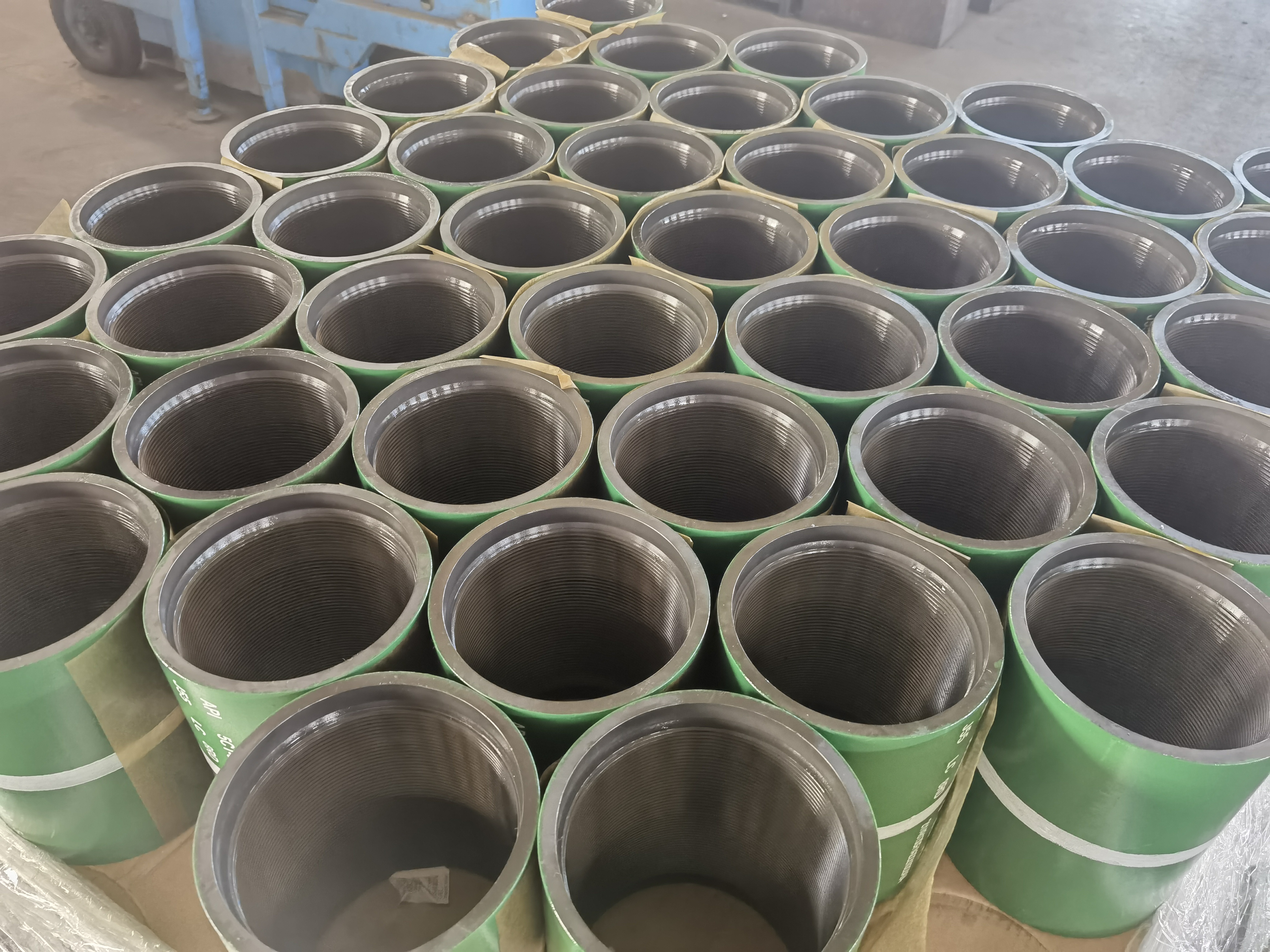 A batch of ZC API 5CT couplings from a South American order, stood on end to show the internal threads — J55 and N80 stock ready for thread inspection before dispatch.
On a 3,800 m L80 PSL-2 sour service string ordered for a Middle East gas well, couplings arrived marked L80 but the MTC showed yield 380 MPa — below the L80 minimum of 379 MPa. The couplings were from a different heat than the pipe body; the heat passed, but the coupling heat was borderline. Our mill re-tested the coupling heat to product analysis and confirmed yield 391 MPa, resolving the dispute. The lesson: never assume coupling heat = pipe heat. They are separate stock items with separate test records.
1. Coupling Types and Thread Forms
API 5CT defines couplings for each standard connection type:
| Connection | Coupling Designation | Thread Form | Primary Application |
|---|---|---|---|
| STC | Short Thread Coupling | 8-round, 8 TPI | Shallow surface casing |
| LTC | Long Thread Coupling | 8-round, 8 TPI | Intermediate casing |
| BTC | Buttress Thread Coupling | Buttress, 5 TPI | Production/intermediate casing |
| EUE | External Upset End (tubing) | 8-round, 8 TPI | Production tubing |
| NUE | Non-Upset End (tubing) | 8-round, 8 TPI | Tubing, tight clearance |
Each coupling type has specific OD and length dimensions defined in API 5CT and API 5B. For the pipe-side thread forms and their load ratings, see the casing connection types guide, the BTC buttress thread field guide, and the EUE/NUE tubing connections guide.
2. Coupling OD Dimensions
Coupling OD is always larger than pipe body OD. The coupling OD determines wellbore clearance and must be checked against centralizer bore, liner hanger bore, and any downhole equipment the string must pass through. Look up pipe body OD, wall, and drift for any size with the Size & Weight Lookup →.
BTC casing coupling OD (regular couplings):
| Pipe OD (in) | Pipe OD (mm) | BTC Coupling OD (in) | BTC Coupling OD (mm) |
|---|---|---|---|
| 4-1/2 | 114.3 | 5.000 | 127.0 |
| 5 | 127.0 | 5.563 | 141.3 |
| 5-1/2 | 139.7 | 6.050 | 153.7 |
| 6-5/8 | 168.3 | 7.390 | 187.7 |
| 7 | 177.8 | 7.656 | 194.5 |
| 7-5/8 | 193.7 | 8.500 | 215.9 |
| 8-5/8 | 219.1 | 9.625 | 244.5 |
| 9-5/8 | 244.5 | 10.625 | 269.9 |
| 10-3/4 | 273.1 | 11.750 | 298.5 |
| 13-3/8 | 339.7 | 14.375 | 365.1 |
| 16 | 406.4 | 17.000 | 431.8 |
| 18-5/8 | 473.1 | 19.625 | 498.5 |
| 20 | 508.0 | 21.000 | 533.4 |
EUE tubing coupling OD:
| Pipe OD (in) | Pipe OD (mm) | EUE Coupling OD (in) | EUE Coupling OD (mm) |
|---|---|---|---|
| 2-3/8 | 60.3 | 2.875 | 73.0 |
| 2-7/8 | 73.0 | 3.500 | 88.9 |
| 3-1/2 | 88.9 | 4.250 | 107.9 |
| 4 | 101.6 | 4.750 | 120.7 |
| 4-1/2 | 114.3 | 5.200 | 132.1 |
For the complete grade ladder with tensile, hardness, and chemistry limits, see the API 5CT specification tables →
To match a grade to your well conditions, use the Pipe Grade Selector →
Coupling Quantity Calculation — Worked Example
For a 3,000 m production casing string in 7-inch 26 lb/ft L80-1 BTC, sour service:
Step 1 — Calculate joint count: Average R3 joint length = 12.19 m (API 5CT minimum average) Joints required = 3,000 m ÷ 12.19 m/joint = 246 joints
Step 2 — Add spare couplings: Spare factor = 5% (for damaged or rejected couplings during running) Spare couplings = 246 × 0.05 = 12.3 → round up to 13 spares
Step 3 — Total coupling order: Total couplings = 246 + 13 = 259 couplings
Step 4 — Verify coupling OD clearance: 7-inch BTC regular coupling OD = 7.656 inches (194.5 mm) Liner hanger bore (if applicable): confirm bore ID > 194.5 mm, or specify SC coupling with tensile rating check.
Note: Always order coupling quantity separately from pipe joints — couplings arrive loose (not made up) on sour service strings to allow thread inspection before running.
3. Coupling Grades and Material Requirements
Grade matching rules:
| Pipe Grade | Required Coupling Grade | Notes |
|---|---|---|
| J55 | J55 or higher | Standard shallow wells |
| K55 | K55 or higher | Same yield as J55 |
| N80-1 | N80 or higher | Standard production |
| N80Q | N80Q or N80-1 or higher | Quenched — coupling same or higher |
| L80-1 | L80 or higher | Sour service — exact grade required |
| L80-13Cr | L80-13Cr | CRA grade — exact grade required |
| T95 | T95 or higher | Sour service |
| P110 | P110 or higher | High strength |
| C110 | C110 | Severe sour — exact grade |
| Q125 | Q125 | Ultra-deep — exact grade |
Coupling mechanical properties must meet the same minimum yield and tensile requirements as the pipe body for the specified grade. Couplings are typically manufactured from the same heat of steel as the pipe or from qualified coupling stock. Grade selection for the string itself is covered in the N80 casing grades and L80 sour-service casing guides.
A coupling-only order that shows the grade split: Couplings ship as their own line item, and grade discipline runs right through them. For a South American operator we supplied 15,000 API 5CT couplings in N80Q and J55 across 3½″, 4½″ and 5½″, in EU thread for the tubing strings and LTC for the larger casing. The N80Q couplings went to the deeper, higher-pressure wells and the J55 to shallower, budget-driven strings — a reminder that on a mixed order the coupling grade has to be matched string by string, not set once for the whole shipment.
4. Coupling Types — Regular, Long, and Special Clearance
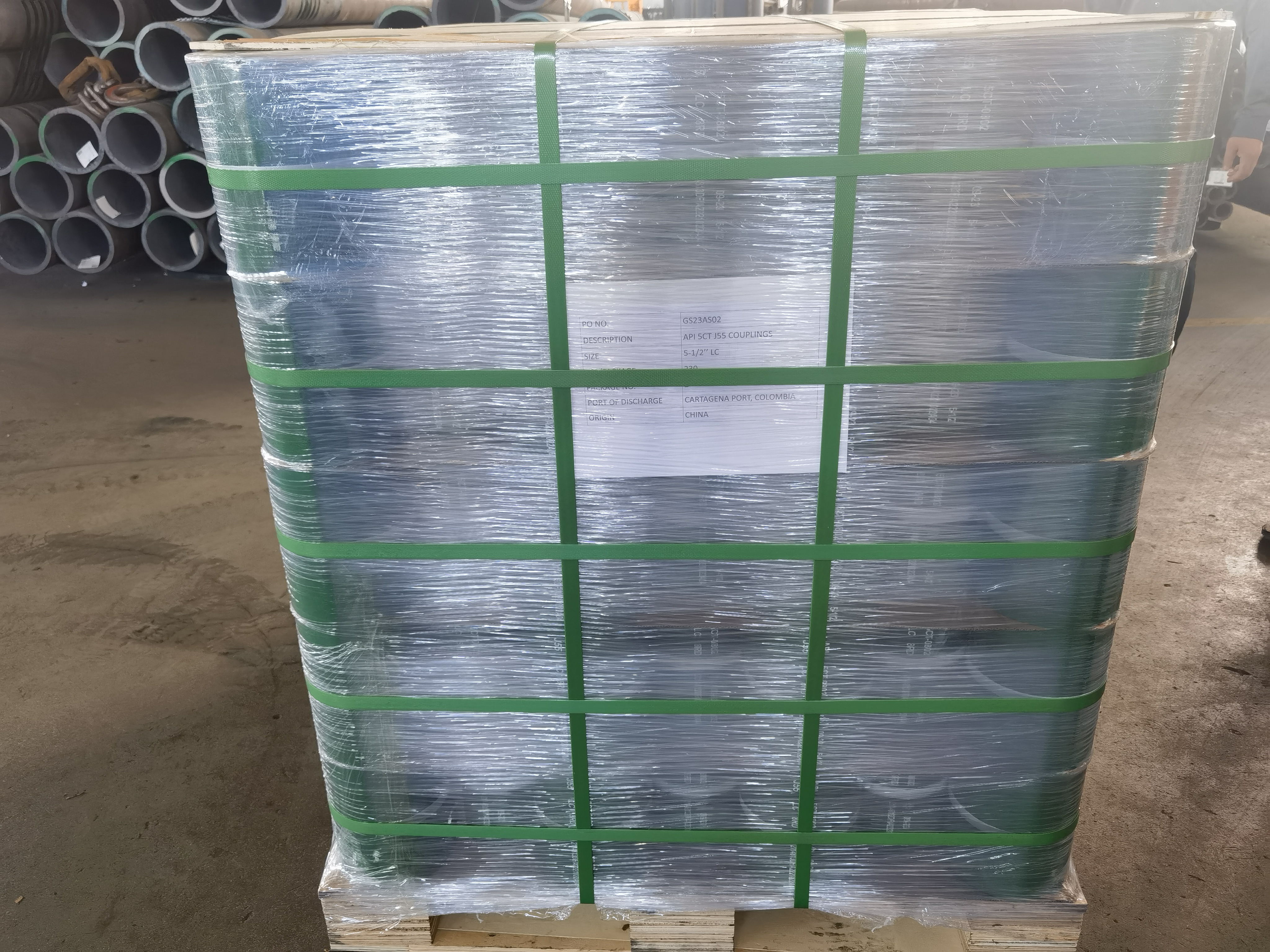 Shrink-wrapped and labelled coupling pallet from a ZC shipment — the English label reads "API 5CT J55 COUPLINGS 5-1/2 LC," identifying grade, size, and the long-coupling (LC) thread form.
Regular coupling (R): Standard OD and thread engagement length as defined in API 5CT. Used for the vast majority of casing and tubing applications.
Long coupling (LC): Increased thread engagement length compared to regular coupling. Provides higher tensile rating and is specified for:
- High tensile load applications
- Strings subject to thermal cycling
- Applications where additional thread engagement margin is required
Special clearance coupling (SC): Reduced OD compared to regular coupling — allows passage through tight wellbore restrictions. Trade-off: reduced thread engagement and lower tensile rating than regular coupling. Used when:
- Regular coupling OD exceeds wellbore clearance
- String must pass through a liner hanger with restricted bore
- Tight casing-in-casing clearance requires reduced OD
Always verify SC coupling tensile rating against string design loads before specifying — the Joint Strength Calculator → gives connection tensile capacity for comparison.
5. PSL Requirements for Couplings
PSL-2 couplings have additional requirements beyond PSL-1:
| Requirement | PSL-1 | PSL-2 |
|---|---|---|
| Charpy impact test | Not required | Required |
| Hardness test | Not required | Required |
| Chemical analysis | Heat analysis | Product analysis |
| Maximum yield strength | Not controlled | Controlled |
| NDE | Not required | UT or flux leakage |
| MTC | 3.1 | 3.2 |
For gas wells, HPHT applications, and any application requiring PSL-2 pipe, PSL-2 couplings must be specified.
6. Sour Service Coupling Requirements
Sour service couplings must meet the full NACE MR0175/ISO 15156 requirements:
- Grade: L80-1, T95, or C110 (matching the string)
- PSL: PSL-2
- Maximum hardness: 22 HRC (250 HV) — pipe body AND coupling
- Supplementary requirements: SR15A (SSC testing) if specified for the string
- Chemical analysis: product analysis with controlled sulphur and phosphorus
- MTC: EN 10204 3.2
Critical point: Coupling hardness must be independently verified — the coupling is machined from different stock than the pipe body and its hardness must be separately measured and documented. Do not assume coupling hardness meets NACE limits based on pipe body hardness data alone.
Coupling hardness must be independently tested — it cannot be inferred from the pipe body MTC. Couplings are machined from bar stock or from a different pipe heat than the string, heat-treated separately, and may cool at a different rate. We have seen cases where the pipe body hardness was 19 HRC (well within NACE limits) but the coupling hardness was 24 HRC on the same order. Always require a separate hardness test record for the coupling in the MTC.
When NOT to Use Standard or Special Clearance Couplings
| Scenario | Risk | Correct Approach |
|---|---|---|
| Sour service string with standard sweet-service couplings | SSC cracking at connection — highest stress point in string | Specify L80/T95 PSL-2 coupling with NACE hardness ≤22 HRC |
| SC (special clearance) coupling without tensile check | SC coupling tensile rating may not match string design | Calculate SC coupling tensile rating and compare to string design load before specifying |
| PSL-1 couplings in gas well or HPHT application | No impact, hardness, or NDE verification | Specify PSL-2 couplings with full test documentation |
| Coupling grade assumed equal to pipe body | Coupling from different heat — may be lower grade in practice | Require separate coupling MTC showing grade, heat number, and test results |
| BTC couplings specified without checking wellbore clearance | BTC OD 10–30 mm larger than pipe body — may not pass through liner hanger | Verify coupling OD against all downhole equipment bore diameters before ordering |
| Reusing pulled couplings without inspection | Thread wear and SSC damage not visible to eye | Full API 5B thread gauge inspection + hardness test before any coupling reuse |
7. Purchase Order Specification
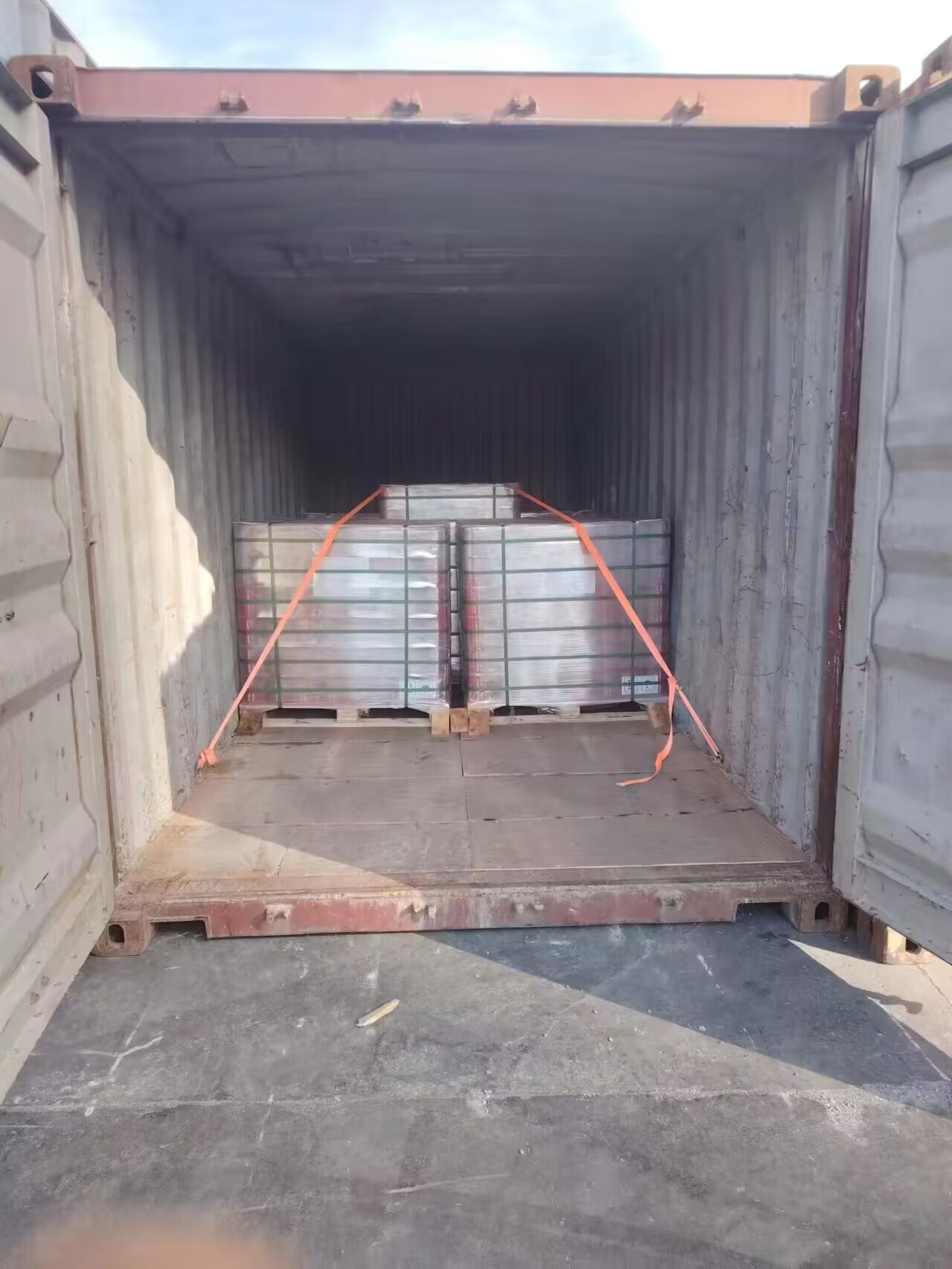 Strapped coupling pallets loaded into a shipping container on a ZC order — couplings ship as their own line item so they can be thread-inspected before the string is run.
When ordering couplings as part of a casing or tubing string, specify:
Procurement trap — coupling grade not explicitly matched:
Wrong PO: "Supply L80 casing couplings, BTC, 7-inch 26 lb/ft, PSL-2." No sour service requirements stated.
What ships: L80 BTC couplings meeting PSL-2 dimensional and mechanical requirements, but without SR15A SSC testing, without hardness ≤22 HRC verification, and without EN 10204 3.2 certificate. Technically compliant with the PO as written.
Correct PO: "Supply L80-1 casing couplings, BTC, 7-inch 26 lb/ft, PSL-2, sour service per NACE MR0175/ISO 15156. Coupling hardness ≤22 HRC verified by product analysis. SR15A (SSC test) required. MTC: EN 10204 3.2. Separate MTC for coupling heat required."
Failure Modes
Failure Mode 1 — Sweet-service coupling in sour string
Mechanism: Standard J55 or N80 coupling installed in an L80 sour service string. The coupling has no hardness control, and HRC may be 28–32. Under H₂S partial pressure, SSC initiates at the connection thread roots within weeks of production start.
Diagnostic: Connection leak or tensile failure shortly after production startup in a sour well. MTC review shows coupling grade does not include SR15A or hardness ≤22 HRC. Coupling hardness testing on pulled string confirms HRC >22.
Fix: Pull the affected string section. Re-specify all couplings as L80-1 or T95 PSL-2 with full NACE compliance. Add coupling hardness ≤22 HRC and SR15A to the next purchase order explicitly.
Failure Mode 2 — Special clearance coupling tensile overload
Mechanism: SC coupling specified to pass a tight liner hanger bore. The reduced OD lowers thread engagement, reducing the tensile rating below the regular coupling. If the string design load is not recalculated with the SC coupling rating, the connection may yield or separate under tensile load during running.
Diagnostic: Connection parting or severe make-up difficulty during running. Engineering review finds SC coupling tensile rating was not recalculated for the new engagement length. The SC coupling rating may be 15–25% lower than the regular coupling rating.
Fix: For all SC coupling applications, require the coupling manufacturer to provide the tensile, compressive, and internal pressure ratings for the SC coupling geometry. Verify these against the worst-case string design loads before running.
Failure Mode 3 — Coupling hardness assumed from pipe body MTC
Mechanism: The MTC shows pipe body hardness 19 HRC on all records. The procurement team assumes coupling hardness is within NACE limits. Couplings are from a different heat with no separate hardness test. Actual coupling hardness is 24.5 HRC. SSC initiates at the sour well connection within 3 months.
Diagnostic: Connection SSC cracking with pipe body intact. Hardness test of a pulled coupling confirms HRC >22. MTC shows no separate coupling hardness record.
Fix: For all sour service orders, require a separate coupling heat MTC that includes: heat number, product analysis, and coupling hardness test results (HRC or HV). Reject any coupling delivery where the coupling MTC is absent or references the pipe body heat number rather than the coupling stock heat number.
- Standard: API 5CT / ISO 11960
- Grade: [matching pipe grade]
- Pipe OD and weight (lb/ft): determines coupling dimensions
- Connection type: STC / LTC / BTC / EUE / NUE
- Coupling type: Regular (R) / Long (LC) / Special Clearance (SC)
- PSL level: PSL-1 or PSL-2
- Quantity: typically 1 coupling per pipe joint + 5-10% spare
- Sour service requirements: SR15A if applicable
- Hardness: ≤22 HRC if sour service
- MTC: EN 10204 3.1 or 3.2
- Marking: per API 5CT — grade, size, connection type, heat number
Typical quantity calculation: Number of couplings = number of pipe joints × 1.05 (5% spare for damaged or rejected couplings during running)
ZC Steel Pipe supplies API 5CT couplings for all standard casing and tubing sizes in all grades. Couplings are typically supplied as part of a complete pipe string package. Contact us with your pipe OD, weight, grade, connection type, and quantity for availability and pricing.
Frequently Asked Questions
What is an API 5CT coupling?
An API 5CT coupling is a short cylindrical sleeve with internal threads machined at both ends, used to connect two joints of threaded casing or tubing pipe. The pin end of one pipe joint is made up into one end of the coupling, and the pin end of the next joint is made up into the other end. The coupling provides the mechanical connection and sealing between joints. API 5CT and API 5B define the dimensional requirements, thread form, and mechanical properties for standard casing and tubing couplings.
What are the OD dimensions for BTC casing couplings?
BTC (Buttress Thread Casing) coupling OD is larger than the pipe body OD to accommodate the longer thread engagement. For example: 5-1/2 inch casing BTC coupling OD is 6.050 inches (153.7mm); 7 inch casing BTC coupling OD is 7.656 inches (194.5mm); 9-5/8 inch casing BTC coupling OD is 10.625 inches (269.9mm); 13-3/8 inch casing BTC coupling OD is 14.375 inches (365.1mm). Always verify coupling OD against the wellbore diameter and any centralizer or cement head equipment clearance requirements.
Must couplings be the same grade as the pipe?
Per API 5CT, couplings must be the same grade as the pipe they are used with — or a higher grade. Using a lower-grade coupling in a higher-grade string reduces the connection strength below the pipe body rating and is not permitted. For sour service strings, couplings must meet the same sour service material requirements as the pipe — same grade, same PSL, and same supplementary testing requirements (SR15A, SR15C). Never use standard sweet service couplings on sour service pipe.
What is a long coupling and when is it used?
A long coupling (also called an LC or L coupling) has greater thread engagement length than the standard coupling for the same pipe OD and connection type. Long couplings are specified when additional tensile strength or sealing performance is required beyond what the standard coupling provides — for example in high-tensile load situations or when the string will experience significant thermal cycling. Long couplings are also sometimes specified for sour service applications to provide additional thread engagement margin.
What is the difference between a regular coupling and a special clearance coupling?
A regular coupling has the standard OD defined in API 5CT for the connection type. A special clearance coupling (SC coupling) has a reduced OD compared to the standard coupling, allowing it to pass through restrictions in the wellbore — for example through a liner hanger or a tight annulus — that would not accommodate the standard coupling OD. Special clearance couplings have reduced thread engagement compared to regular couplings, which reduces their tensile rating. Always verify the tensile rating of SC couplings against the string design loads.
Can couplings be reused after a string is pulled?
Couplings can be reused if they pass inspection after the string is pulled — but this requires careful evaluation. Thread gauging must confirm threads are within tolerance. Any galling, corrosion damage, or thread wear detected during inspection requires the coupling to be replaced. For premium connection couplings, manufacturer inspection criteria apply. For sour service couplings, additional inspection for SSC cracking is required before reuse. Never reuse couplings that show visible damage, cracking, or thread wear beyond API 5B tolerance.
What marking is required on API 5CT couplings?
API 5CT requires couplings to be marked with: manufacturer's name or mark, size (OD in inches), weight (lb/ft of the pipe the coupling is designed for), grade, thread form (STC, LTC, BTC), and heat or lot number for traceability. For PSL-2 couplings, additional markings indicate the PSL level. Sour service couplings are marked with the sour service grade designation (e.g. L80 for sour service L80). Always verify coupling markings match the pipe order specification before running.
What is the wall thickness of a casing coupling?
Coupling wall thickness is greater than the pipe body wall thickness to provide adequate thread engagement and structural strength at the connection. The coupling is machined from heavier bar stock or from an upset pipe end to achieve the required OD and wall. The exact wall thickness depends on the connection type and coupling type (regular, long, special clearance). API 5CT Table C.14 provides coupling dimensional requirements for all standard connection types and pipe sizes.