Abrasion from sand, grit, and slurry solids is one of the most accelerated failure modes for pipeline coatings and the steel beneath them. A standard 300 μm FBE internal coating that would provide 25 years of corrosion protection in clean liquid service can wear through in 18 months in a gas well producing 200 ppm sand at 12 m/s. Once the coating fails at elbows, tees, and reducers, bare steel erodes at rates that cannot be arrested with corrosion inhibitors. Abrasion resistant coatings — formulated with harder fillers, greater film thickness, or energy-absorbing elastomers — extend service life in these environments by orders of magnitude compared to standard coatings.
ZC Steel Pipe supplies internally coated line pipe in reinforced FBE, ceramic epoxy, glass flake epoxy, and polyurethane systems for oil and gas gathering lines, produced water injection pipelines, and industrial slurry service. External abrasion resistant coatings for HDD installation and rocky soil environments are also available. This guide covers coating types, performance characteristics, selection criteria, and procurement guidance.
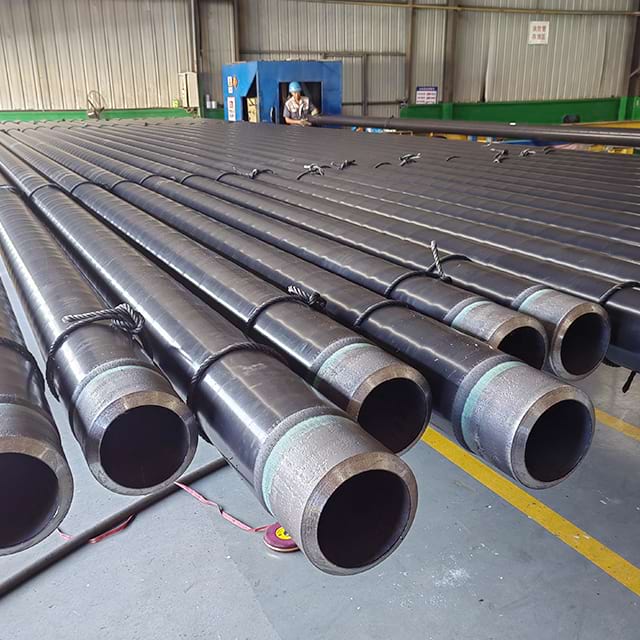
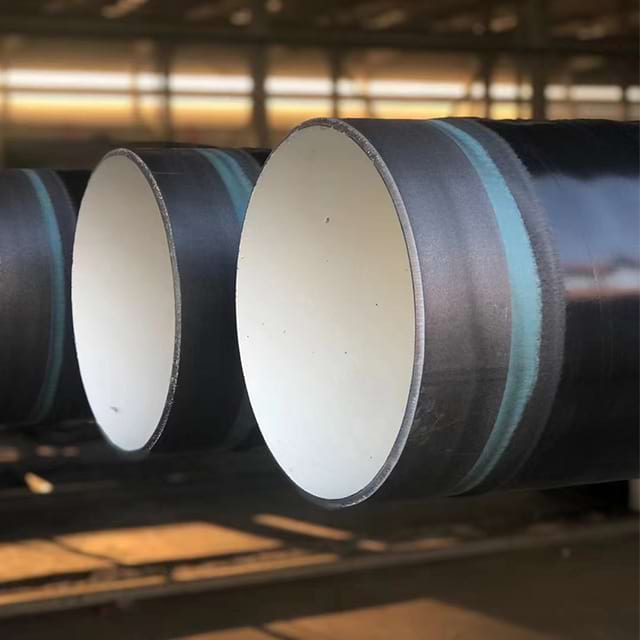 Coated line pipe on the rack — the outer polyethylene jacket and the lined bore that carries the abrasion- and corrosion-protection duty are both visible at the cut end.
At a Glance
Match the coating to the wear mechanism and severity, not just the fluid. Reinforced FBE handles light solids; ceramic and glass-flake epoxy cover moderate-to-severe sand and slurry; polyurethane and polyurea absorb impact where hard coatings crack; and thick HDPE or UHMWPE liners take extreme mining slurry.
| Coating | Typical DFT | Best for |
|---|---|---|
| Reinforced FBE | 350–600 μm | Produced water <50 ppm solids, low-sand gathering lines |
| Ceramic-filled epoxy | 400–1,000 μm | Moderate-to-severe sand impingement at bends and tees |
| Glass flake epoxy | 400–600 μm | Sliding abrasion with chemical attack (low pH, H2S) |
| Polyurethane / polyurea | 350–800 μm | Impact-dominated and thermal-cycling service |
| HDPE / UHMWPE liner | 4–12 mm | Extreme mining slurry, tailings, and dredge lines |
What we see on project specifications: Slurry line specifications frequently define the coating system only as "internal epoxy coating per ISO 15741" without specifying whether the formulation should be abrasion resistant. For a 50-km water injection line carrying clean produced water, standard liquid epoxy is adequate. For a 30-km gathering line handling gas condensate with 500 ppm sand from a tight-formation well, it is not. We ask for sand production data and flow velocity before recommending a coating system — the difference in coating cost between standard epoxy and ceramic-filled AR epoxy is typically USD 8–15/m² of internal surface area, which is negligible compared to the cost of a shutdown and reline 18 months into operation.
What Causes Abrasion Damage in Pipelines
Abrasion in pipelines operates through two distinct mechanisms, and the dominant mechanism determines which coating type performs best.
Sliding abrasion occurs when particles move along the pipe wall in continuous contact — the dominant mechanism in dense slurry (mining tailings, cement, dredge lines) and horizontal liquid pipelines carrying settled solids. The coating must have high hardness to resist surface scoring and must maintain film integrity rather than fracturing.
Erosive impingement occurs when particles entrained in a gas or liquid stream strike the pipe wall at high velocity, particularly at direction changes (elbows, tees, plug valves). This is the dominant failure mode in sand-laden gas pipelines and multiphase gathering systems. The energy of impact is proportional to particle velocity squared — a doubling of gas velocity quadruples the erosive wear rate. Coatings for erosive service need a balance of hardness (to resist penetration) and toughness (to absorb impact without fracturing).
Understanding which mechanism dominates guides coating selection more reliably than knowing only the solids concentration or particle size.
Abrasion Resistant Coating Types and Specifications
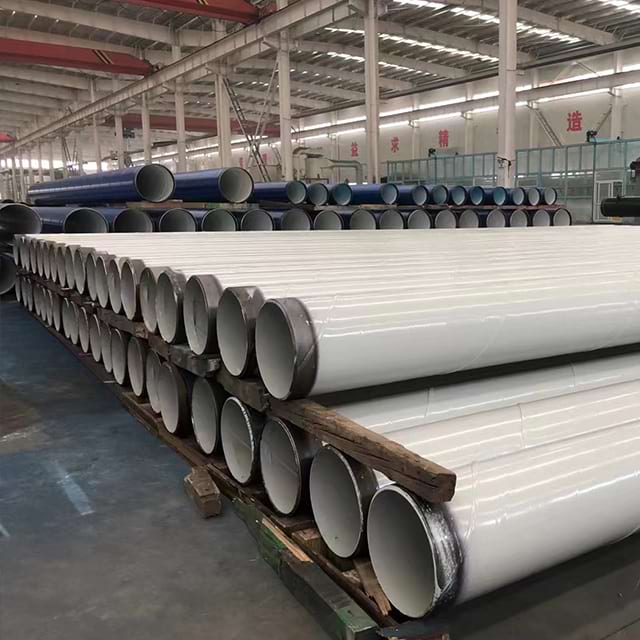 Coated large-diameter line pipe staged in the warehouse. Coating type and film thickness — not diameter — determine how the bore stands up to sand and slurry.
Reinforced Fusion Bonded Epoxy (RFBE)
Standard FBE at 300–450 μm is the most commonly applied internal coating for oil and gas pipelines. Reinforced FBE incorporates glass fiber or silica ceramic particles into the FBE matrix to increase hardness and wear resistance while retaining the excellent adhesion and cathodic disbondment resistance of the standard system.
| Property | Standard FBE | Reinforced FBE |
|---|---|---|
| DFT range | 300–450 μm | 350–600 μm |
| Hardness (Shore D) | 75–80 | 80–85 |
| Temperature range | -40°C to 110°C | -40°C to 110°C |
| Abrasion resistance | Baseline | 30–50% improvement vs standard FBE |
| Application method | Factory electrostatic powder | Factory electrostatic powder |
| Field joint repair | Limited | Limited |
RFBE is appropriate for low-to-moderate solids content — produced water with <50 ppm sand, gas gathering at low sand production rates, or liquid lines where occasional solid slugs are expected. For high sand concentrations or dense slurry service, the improvement over standard FBE is insufficient.
Ceramic-Filled Epoxy
Ceramic epoxy coatings are two-component solvent-free or low-solvent formulations filled with ceramic particles (typically alumina, silicon carbide, or ceramic bead) dispersed throughout the epoxy matrix. The ceramics provide dramatically higher hardness and wear resistance than standard or reinforced FBE.
| Property | Ceramic Epoxy |
|---|---|
| DFT range | 400–1,000 μm (applied in multiple passes) |
| Hardness (Vickers, HV) | 200–350 HV (comparable to mild steel) |
| Temperature range | -40°C to 120°C continuous; some formulations to 150°C |
| Abrasion resistance | 5–10× improvement vs standard FBE in sliding abrasion tests |
| Application method | Factory spray or brush; field-repairable |
| Holiday detection | Required per ISO 15741 (10 V/μm up to 250 V max) |
Ceramic epoxy is the preferred system for:
- Produced water injection pipelines carrying solids above 100 ppm
- Sand-laden gas gathering headers and inlet separators
- Elbows and tees in multiphase systems with significant sand production
- Industrial slurry lines at moderate solid concentrations
The limitation of ceramic epoxy is brittleness: high ceramic loading increases hardness but reduces impact resistance. Coatings with >60% ceramic loading can fracture under point loading during installation or pigging operations. For service involving impact (slurry pumping systems, pig-launched lines), a glass flake or polyurethane system may be more durable.
Glass Flake Epoxy
Glass flake epoxy uses oriented glass platelets as the reinforcing medium rather than ceramic particles. The platelets create a lamellar barrier that resists both abrasion and permeation more effectively than isotropic epoxy, while maintaining better flexibility than high-ceramic formulations.
| Property | Glass Flake Epoxy |
|---|---|
| DFT range | 400–600 μm |
| Temperature range | -40°C to 120°C |
| Abrasion resistance | 3–5× improvement vs standard FBE |
| Chemical resistance | Excellent; suitable for acidic or alkaline produced water |
| Impact resistance | Better than ceramic epoxy at equivalent thickness |
| Application method | Factory spray; field-repairable |
Glass flake epoxy performs well in horizontal slurry pipelines where sliding abrasion is the dominant mechanism and the media has significant chemical aggression (acid mine drainage, H2S-bearing produced water, low pH fluids). The lamellar structure also makes it suitable for mixed abrasion + corrosion service where ceramic epoxy alone would be the wrong choice.
Glass flake epoxy's key advantage over ceramic epoxy is rarely discussed in specification documents: the glass platelet orientation creates a tortuous path for permeating water molecules, dramatically slowing cathodic disbondment if the coating is scratched or holidays appear during service. For buried pipelines handling corrosive slurry, this permeation resistance extends the coating life even after localised mechanical damage — the damage zone does not immediately become a site of aggressive corrosion undermining the surrounding coating. Ceramic epoxy does not provide this permeation barrier; once abraded through, corrosion progresses more rapidly beneath the adjacent intact coating.
Polyurethane and Polyurea Elastomers
Polyurethane (PU) and polyurea (PUA) coatings take a fundamentally different approach to abrasion resistance: instead of hard particles resisting penetration, an elastomeric matrix absorbs impact energy and deforms around abrasive particles without fracturing. The coating is softer than ceramic systems but harder to break.
| Property | Polyurethane | Polyurea |
|---|---|---|
| DFT range | 400–800 μm | 350–600 μm |
| Hardness (Shore A) | 85–95 | 90–97 |
| Temperature range | -40°C to 100°C | -40°C to 150°C |
| Abrasion resistance | Good for impingement; moderate for sliding | Good for both; better at elevated temperature |
| Elongation at break | 200–400% | 150–300% |
| Application method | Factory spray; fast-curing PUA field-repairable |
Polyurethane and polyurea are the preferred systems for:
- Gas pipelines with sand production where impingement at elbows is the failure mode
- Pipelines transporting large, irregular particles (rock cuttings, coarse sand) where impact governs
- Lines where thermal cycling creates expansion and contraction stress that would crack harder coatings
- Offshore riser tubes and flexible joints where movement is expected
Polyurea cures faster than polyurethane and has higher temperature tolerance — an important advantage for sand-laden gas gathering where flowing temperatures can reach 80–100°C in shallow fields.
HDPE and UHMWPE Liner Systems
High-density polyethylene (HDPE) and ultra-high molecular weight polyethylene (UHMWPE) liners are thick-film systems — not coatings in the thin-film sense — typically 4 to 12 mm thick. They are inserted into the pipe as a continuous sleeve or applied as a spray-fused inner layer. The liner is the barrier; the outer steel pipe provides the pressure containment.
| Property | HDPE Liner | UHMWPE Liner |
|---|---|---|
| Liner thickness | 4–12 mm | 6–12 mm |
| Max continuous service temperature | 60°C (HDPE) | 80°C (UHMWPE) |
| Hardness (Brinell) | 60–70 HB | 65–75 HB |
| Abrasion resistance (ASTM G65 weight loss) | 3–6 mg | 1.5–3 mg |
| Chemical resistance | Excellent | Excellent |
| Application | Factory insertion; site lengths limited by pipe ID | Factory; shorter sections for bends |
UHMWPE specifically has the best abrasion resistance of any polymer coating system — its molecular weight (typically >3 × 10⁶ g/mol) creates an extremely tough, low-friction surface that particles slide across rather than cutting into. It is used in:
- Mining slurry transport (tailings, concentrate, ore slurry)
- Dredge pipelines
- Cement and concrete slurry lines
- Coal slurry transport
The limitation of liner systems is that bends and fittings cannot be lined continuously — custom-bent sections with internal lining at the factory are required, and field joint areas are typically protected with ceramic epoxy overlay rather than liner.
External Abrasion Resistant Coatings
 Beveled-end coated pipe ready for dispatch. External abrasion protection matters most where the pipe is dragged through rocky ground during HDD pull-back.
Horizontal Directional Drilling (HDD)
Standard 3LPE and 3LPP coatings provide good corrosion protection but can be abraded and gouged during the pull-back phase of HDD installation, particularly in rocky ground or where the bore is drilled through abrasive formations. The outer polyethylene jacket fractures under point loading, and disbondment follows.
Abrasion resistant outer layer (AROL) systems for HDD include:
- Polypropylene abrasion protection layer: 4–8 mm extra-thick PP outer jacket applied over standard 3LPP, providing a sacrificial outer layer that absorbs abrasion without compromising the corrosion-protection layers beneath
- Abrasion resistant sleeve: factory-installed HDPE sleeve slid over the coated pipe, held in place at each joint; allows limited independent movement relative to the pipe
- Concrete weight coating (CWC): provides both abrasion resistance and weight for buoyancy control; used in river crossings and wet environments
For long HDD pulls (>300 m) in rocky terrain, it is standard practice to specify a 6-mm AR outer jacket or a full concrete coating, as the pull tension can drag the pipe across borehole walls at forces that would strip a standard 3LPE coating.
Rocky Trench and Unstable Soil
For conventional buried pipelines in rocky, gravelly, or limestone trench conditions, three options are used:
- Concrete coating: provides both weight and physical armoring; standard for offshore pipelines and rocky onshore terrain
- Rock shield / PVC sleeve: lightweight abrasion protection over the anti-corrosion coating during backfill operations; does not provide long-term protection
- Thick-film mastic coating: coal tar or bituminous mastic at 6–12 mm provides mechanical protection during backfill and some abrasion resistance in rocky soil; less common now due to environmental regulations on coal tar
Coating Selection Guide — Matching Coating Type to Service
| Service Condition | Dominant Mechanism | Recommended Coating |
|---|---|---|
| Clean liquid, no solids | Corrosion only | Standard FBE or liquid epoxy |
| Produced water <50 ppm solids | Low sliding abrasion | Reinforced FBE |
| Gas gathering, low sand production | Low impingement | Reinforced FBE or glass flake epoxy |
| Gas gathering, moderate sand (50–500 ppm) | Impingement at bends | Ceramic epoxy at bends; RFBE on straight |
| Multiphase with >500 ppm sand | Mixed impingement + sliding | Ceramic epoxy or polyurea (full bore) |
| Produced water injection, >100 ppm solids | Sliding abrasion | Glass flake or ceramic epoxy |
| Mining slurry, moderate density | Severe sliding abrasion | UHMWPE liner or ceramic epoxy at 800+ μm |
| Mining tailings, dense slurry | Extreme sliding abrasion | UHMWPE or rubber lining |
| HDD installation, rocky bore | External impact + abrasion | 3LPP + 6 mm AR outer jacket |
When NOT to Use Standard Internal FBE for Abrasion Service
Standard FBE internal coating — the most common internal coating on oil and gas gathering lines — is appropriate for clean liquid service. The following conditions should trigger specification of an abrasion resistant system instead:
1. Sand production above 50 ppm by weight sustained. FBE at 300–450 μm wears through at bends within 12–24 months in steady sand service above 50 ppm.
2. Gas velocities above 3–4 m/s in wells with any sand production. Gas velocity amplifies erosive wear by the square of velocity. FBE that would last years at 2 m/s fails in months at 10 m/s with the same sand concentration.
3. Any pigging frequency above monthly. Foam pigs running through FBE-coated pipe wear the coating progressively at each pigging run — the pig seal contact area scores the FBE surface. For frequently pigged lines, a minimum RFBE or glass flake epoxy is appropriate.
4. Direct injection or multiphase slug flow with solids. Slug flow creates periodic high-momentum impact events. Slug catcher inlet pipework and slug flow gathering lines in tight gas fields are candidates for ceramic epoxy or polyurea.
5. Temperature cycling service. If the pipeline is repeatedly heated and cooled (steam tracing, insulated hot oil lines), the differential thermal expansion between steel and a hard ceramic coating can cause microcracking. Polyurethane or polyurea coatings accommodate thermal cycling better than rigid ceramic systems.
Purchase Order Guidance
Minimum specification items for abrasion resistant internal coating
A correct PO for AR-internally coated line pipe must define:
- Coating type and trade name or qualified system (not just "abrasion resistant epoxy")
- Target DFT with tolerance (e.g. 600 μm nominal, 500 μm minimum per ISO 15741)
- Holiday detection voltage (10 V per μm of DFT is standard for liquid epoxy; FBE uses 10 V/μm up to 100 V maximum)
- Adhesion test requirement (pull-off adhesion per ISO 4624 or BS 4624, typically ≥8 MPa for ceramic epoxy)
- Service conditions: fluid type, solids concentration and particle size, pH, temperature range
- Field joint repair method and qualification requirement
- MTC requirement for coating material (batch certificate from coating manufacturer)
The coating type ambiguity trap
Many specifications state only "internal epoxy coating to ISO 15741" without defining whether the formulation is standard, reinforced, or ceramic-filled. ISO 15741 covers the application and testing of liquid epoxy coating for pipelines — it does not define the abrasion resistance level of the specific product. A standard liquid epoxy at 300 μm and a ceramic-filled epoxy at 600 μm both comply with ISO 15741. For abrasion-critical service, add a clause specifying minimum DFT and minimum abrasion resistance measured by a standard method (ASTM D4060 Taber abrasion, or ASTM G65 dry sand abrasion) against a performance threshold, not just a product type.
For line pipe specifications and grade selection to complement your coating system, see the API 5L specification tables →, or narrow the base pipe grade with the pipe selector.
Use the Pipeline Design Calculator → to calculate pressure drop and wall thickness requirements for your pipeline — abrasion-resistant lined pipe has a slightly reduced internal bore that affects hydraulic calculations.
Frequently Asked Questions
What is abrasion resistant coating for pipes?
Abrasion resistant coating (ARC) is an internal or external pipe coating formulated to withstand mechanical wear from solid particles — sand, grit, rock fragments, or slurry solids — that erode standard coatings under flow conditions. The coating protects the pipe steel from both direct abrasive wear (particle impingement) and the corrosion that follows once the base coating is worn through. Standard FBE or liquid epoxy internal coatings wear relatively quickly in sand-laden or slurry service; ARC formulations use harder fillers, thicker application, or more flexible matrices to resist that wear mechanism.
What types of abrasion resistant coatings are available for pipeline use?
The main types are: reinforced FBE (glass or ceramic-filled fusion bonded epoxy at 350–600 μm); ceramic-filled epoxy (applied at 400–800 μm, very hard, for severe impingement service); glass flake epoxy (400–600 μm, good for horizontal abrasion and chemical exposure); polyurethane and polyurea elastomers (350–600 μm, flexible, absorb impact energy rather than fracturing); and thick-film HDPE or UHMWPE liner (4–12 mm, for severe mining slurry where particle hardness is extreme). Each type suits a different severity level and service condition.
When should I specify abrasion resistant coating instead of standard FBE?
Standard FBE internal coating is appropriate for clean liquid hydrocarbon or water service. Abrasion resistant coating is required when the pipeline carries sand-laden gas or oil at flow velocities above 3–4 m/s, slurry with particle concentration above 2–5% by weight, multiphase flow with high sand production rates, produced water with suspended solids, or any dry bulk or mining slurry. The threshold is not always obvious — a well producing 100 ppm sand at 15 m/s gas velocity erodes standard FBE at the bend ahead of a pigging receiver much faster than at straight-run sections.
What temperature range do abrasion resistant coatings cover?
Ceramic epoxy and glass flake epoxy coatings typically operate from -40°C to approximately 120°C continuous service, with some formulations rated to 150°C. Standard polyurethane covers -40°C to 100°C continuous. High-temperature polyurea extends to 150°C. HDPE and UHMWPE liners are limited to approximately 80°C for continuous service due to creep behaviour at elevated temperature. For service above 120°C with abrasive media, ceramic-filled novolac epoxy or internally clad pipe (typically 316L or alloy 625) should be evaluated.
How thick should abrasion resistant internal coating be?
Dry film thickness (DFT) targets depend on the coating type and service severity. Reinforced FBE: 350–600 μm typical. Ceramic epoxy: 400–800 μm; for severe slurry service 600–1000 μm is sometimes specified. Glass flake epoxy: 400–600 μm. Polyurethane: 400–800 μm. HDPE or UHMWPE liner: 4–12 mm — these are not thin-film coatings but full liner systems. Specifying a target DFT without defining the coating type is not sufficient — 400 μm of standard liquid epoxy behaves very differently from 400 μm of ceramic-filled epoxy in abrasive service.
What external abrasion resistant coating is used for horizontal directional drilling?
Pipe pulled through HDD borings experiences external abrasion from the borehole wall and drilling cuttings. Standard 3LPE and 3LPP outer jackets are susceptible to gouging and disbondment during the pull. Abrasion resistant outer layer (AROL) systems — typically concrete weight coating, polypropylene-based AR jackets at 4–8 mm, or a sacrificial outer HDPE sleeve — are used for HDD pulls in aggressive geology. The key property is resistance to point loading (impact) and sliding abrasion, not the continuous chemical resistance that standard coatings are optimised for.
Can abrasion resistant coatings be applied in the field for repairs?
Yes, for moderate service conditions. Two-component cold-applied ceramic epoxy and glass flake epoxy coatings can be applied at field joints and repairs by abrasive blast preparation (Sa 2.5 minimum) followed by brush or spray application. NACE SP0394 and ISO 21809-4 cover field-applied internal coating qualification. HDPE and UHMWPE liner systems cannot be practically repaired in the field — liner sections must be cut out and replaced. For critical abrasion service, factory application with holiday detection testing gives better DFT consistency than field repair, so field joints are often the weak point of an AR coating system.
What standards cover abrasion resistant pipeline coatings?
External coatings for pipelines are covered by ISO 21809-1 (3LPE/3LPP) and ISO 21809-2 (single-layer FBE); specific abrasion resistance testing is part of these standards. Internal coatings are covered by ISO 15741 (liquid epoxy internal coating for pipelines) and NACE SP0394 / NACE RP0399 for qualification and application. For slurry and mining applications, there is no single unified standard — coating selection is typically based on manufacturer qualification data and site-specific testing of candidate systems against representative slurry media.