Choosing between L80 13Cr, Super 13Cr, and inhibited carbon steel for a CO2-corrosive gas condensate well is not a spec-sheet exercise — it is a whole-life economic decision that depends on CO2 partial pressure, wellbore temperature, H₂S presence, chloride concentration, deviation profile, and planned production life. Get the selection wrong in either direction and the consequences are severe: specify carbon steel on a high-CO2 well without adequate inhibition and you get catastrophic wall thinning within months; over-specify duplex when L80 13Cr would have been adequate and you add cost that does not buy additional well integrity. The three-way selection — standard 13Cr, Super 13Cr, or inhibited carbon steel — covers the majority of gas condensate wells where that choice is genuinely open.
We supply L80 13Cr and Super 13Cr casing and tubing to operators in West Africa, Brazil, and the Arabian Gulf, with ZC premium connections qualified for CRA gas service. The observations in this guide come from the actual orders we process and the well data we review alongside them.
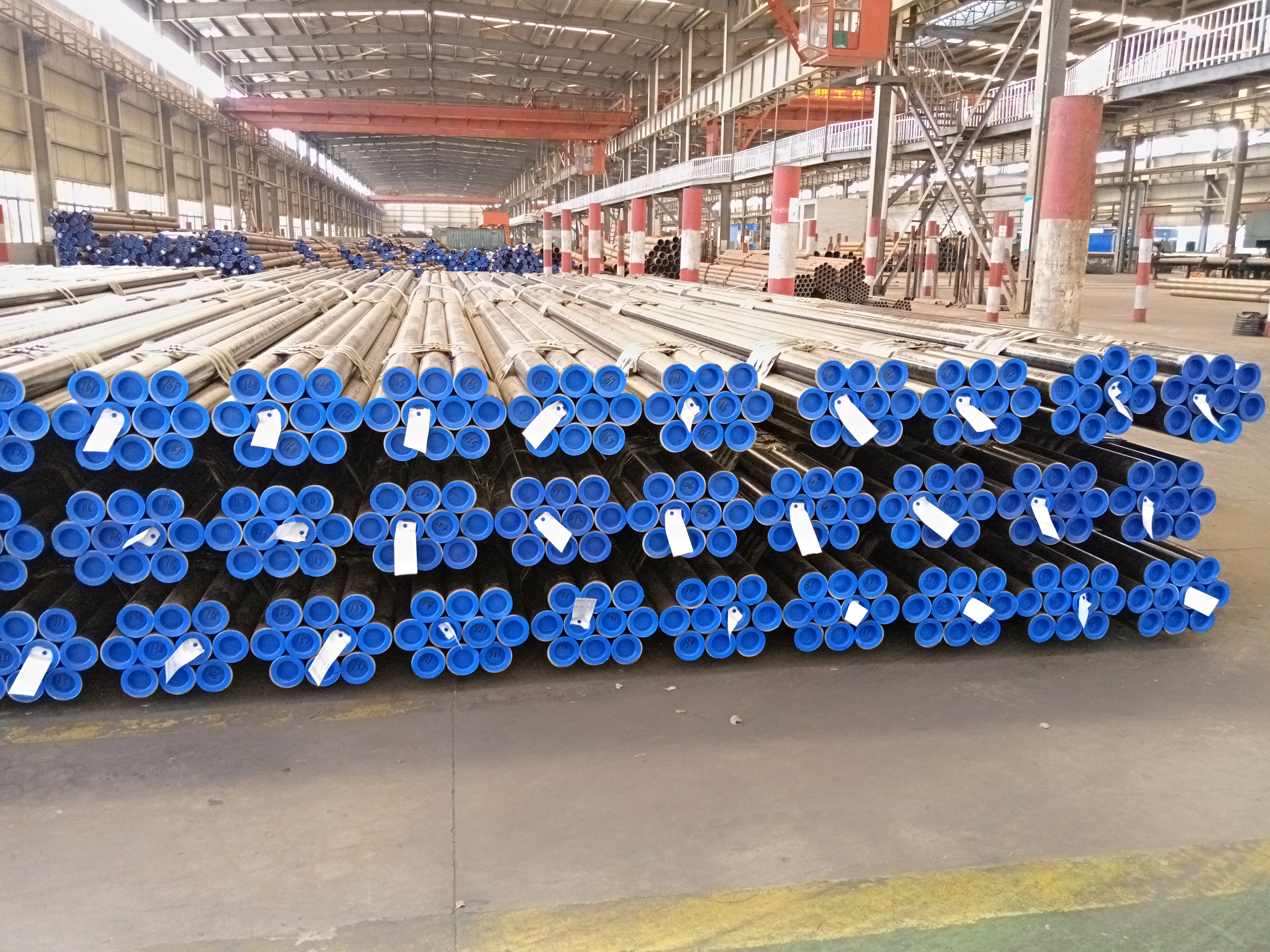 Seamless L80-13Cr pipe bundled with protective end caps in the ZC warehouse, staged for an African flowline order.
Quick Answer
Match the material to the well's confirmed H₂S first, then CO2 and temperature. With no H₂S, run inhibited carbon steel only on short-life (roughly under 8–12 years), near-vertical wells below ~60°C and pCO₂ under ~0.1 MPa; specify L80 13Cr up to ~150°C, pCO₂ ~0.5 MPa and chloride ~50,000 mg/L; step up to Super 13Cr once any one of temperature (to ~180°C), pCO₂ (to ~1.0 MPa), chloride, or trace H₂S exceeds the standard 13Cr envelope. The moment confirmed H₂S appears at sour-service threshold, neither inhibited carbon steel nor L80 13Cr qualifies — move to the CRA selection framework. The screening table below sets it out parameter by parameter.
What we see on orders: The most common error we encounter is engineers treating inhibited carbon steel as a permanent solution on wells with a 20-year design life. We receive POs for standard N80 or L80 tubing, with a note that corrosion inhibitor will be injected. When we ask for the injection philosophy, it usually specifies a batch treatment schedule — not continuous injection. For production tubing in contact with a continuous CO2 stream at temperatures above 60°C, batch inhibition is inadequate. The inhibitor film breaks down between treatments, and the underlying carbon steel corrodes at an accelerated rate. The operator discovers this at the first workover — or when the string fails early. On any well with a design life beyond 10 years and CO2 partial pressure above 0.1 MPa, the economics almost always favour 13Cr despite the higher material cost.
Three Corrosion Management Options
CO2 dissolved in produced water forms carbonic acid (H₂CO₃), which attacks carbon steel at rates that can exceed 10 mm/year at elevated partial pressures and temperatures. Three strategies address this:
Strategy 1 — CRA tubing (13Cr or Super 13Cr): The chromium content forms a self-healing passive oxide film that resists CO2 corrosion without continuous chemical treatment. The passive film is the corrosion protection — once formed, it requires no operational intervention.
Strategy 2 — Inhibited carbon steel: Standard carbon steel tubing with continuous injection of a film-forming corrosion inhibitor. The inhibitor adsorbs onto the pipe wall and forms a barrier between the steel and the corrosive fluid. The protection is entirely dependent on maintaining the inhibitor film — any interruption allows rapid corrosion.
Strategy 3 — Hybrid: Carbon steel casing (less directly exposed to produced fluid) with 13Cr production tubing. This is the most common configuration on moderate-to-high CO2 gas wells, and the one we supply most frequently.
The table below compares the three options across the key selection parameters. Read it as a screening tool, not a final decision — every cell has conditional limits that the footnotes below explain.
| Grade | CO2 Mechanism | Temp Limit | H₂S Tolerance | Approx Cost Multiple | Typical Application |
|---|---|---|---|---|---|
| L80 13Cr (API 5CT) | Passive Cr₂O₃ film | ~150°C | None — sweet wells only | 3–5× carbon steel | Sweet gas condensate, pCO₂ 0.05–0.5 MPa |
| Super 13Cr (ISO 13680) | Modified martensitic, Ni+Mo | ~180°C | Very limited per ISO 15156-3 | 4–7× carbon steel | Higher-temp CO2, trace H₂S, higher Cl⁻ |
| Inhibited N80 / L80 | Film-forming inhibitor | ~60°C effective | Full sour service if grade qualified | 1× material + OPEX | Short-life wells, low CO2, vertical wells |
For complete API 5CT mechanical properties and grade ladder, see the API 5CT specification tables. For CRA grade selection against combined CO2 and H₂S environments, use the CRA grade selection guide.
Inhibited Carbon Steel — When It Works and When It Fails
Inhibited carbon steel works well in a narrow set of conditions: vertical or near-vertical wells where inhibitor distribution across the full pipe bore is predictable; operating temperatures below 60°C where the inhibitor film is thermally stable; CO2 partial pressures below 0.1 MPa where base corrosion rates are low enough that film efficiency gaps cause only moderate wall thinning; and production lives short enough that a single workover to replace a corroded string is economically acceptable.
Outside those conditions, failure follows one of two named modes.
Film Breakdown in Deviated Wells. In wells deviating beyond approximately 45°, gravity stratifies the fluid — liquid accumulates on the low side of the tubing and gas flows on the high side. Film-forming inhibitors rely on the inhibitor dissolving into the liquid phase and being carried to all internal surfaces. In deviated wells, the gas-phase tubing wall on the high side of the bore receives inadequate inhibitor contact, and the protective film does not form reliably. Corrosion on the high side of the bore then proceeds uninhibited. This failure is insidious because the well continues producing normally until wall thinning reaches a critical point — at which stage a complete string workover is required.
Thermal Film Degradation. Organic film-forming inhibitors are temperature-sensitive. Above approximately 80°C, most commercially available inhibitors begin to degrade or desorb from the steel surface before they can re-adsorb from the next injection cycle. The film efficiency drops from the 90%+ required for adequate corrosion control to levels where the residual corrosion rate causes unacceptable wall thinning over a 10-year production life. Operators sometimes compensate by increasing injection frequency and concentration, which adds OPEX without reliably solving the problem.
Continuous injection is the required methodology for production tubing, not batch. Continuous injection requires a chemical injection valve (CIV) at the wellhead, a dedicated pump and chemical tank on surface, and ongoing chemical procurement. For flowlines and surface facilities, batch pigging with inhibitor is sometimes used as a supplementary measure, but it is not a substitute for continuous injection in the tubing string.
L80 13Cr — The API-Defined Standard
L80 13Cr is defined under API Specification 5CT, 11th Edition as a Group 2 grade, Type 13Cr. The mechanical requirements from the JSON-verified specification are:
| Property | API 5CT Value |
|---|---|
| Min yield strength | 552 MPa (80 ksi) |
| Max yield strength | 655 MPa (95 ksi) |
| Min tensile strength | 655 MPa (95 ksi) |
| Max hardness | 23.0 HRC / 241 HBW |
| Heat treatment | Quench and temper (Q+T only) |
| CO2 corrosion grade | Yes |
| Sour service (H₂S) | No |
The chemistry limits from API 5CT are: Cr 12.0–14.0%, C 0.15–0.22%, Ni max 0.50%, Mo — API 5CT does not restrict molybdenum for L80-13Cr, Mn 0.25–1.0%, Si max 1.0%, P max 0.020%, S max 0.010%, Cu max 0.25%.
The relatively high carbon ceiling (0.22% C max) is a key differentiator from Super 13Cr. It enables the martensitic microstructure through the quench-and-temper cycle, but it also limits the grade's H₂S tolerance — the higher carbon content raises SSC susceptibility in the hardened martensite. This is why L80 13Cr carries no sour service qualification under API 5CT: sour_service: false in the spec. The grade was designed for CO2 corrosion resistance in sweet gas condensate wells, and that is where it should be used.
Super 13Cr's near-zero carbon (≤0.03% C max) is as important to its performance as the nickel and molybdenum additions. Standard L80 13Cr has a carbon range of 0.15–0.22% — necessary to develop the martensitic microstructure through conventional Q+T, but it also makes the martensite more susceptible to sulphide stress cracking and limits the upper temperature at which the passive Cr₂O₃ film remains stable. Super 13Cr achieves its modified martensitic microstructure with carbon suppressed to ≤0.03% by increasing nickel to 4–6% as an austenite stabiliser — nickel substitutes for carbon in the phase transformation. The result is a softer, tougher martensite with better SSC resistance and a passive film that remains stable at higher temperatures. When operators ask why Super 13Cr costs 20–40% more than standard 13Cr, the answer is partly in the higher alloy content, but also in the tighter carbon control required throughout steelmaking — low-carbon martensitic stainless is harder to manufacture consistently than the standard 13Cr composition.
The CO2 operating envelope for L80 13Cr is approximately: temperature up to 150°C, CO2 partial pressure up to 0.5 MPa (verify with corrosion engineering for higher pressures), chloride concentration up to ~50,000 mg/L at temperatures below 100°C. Above any of these thresholds, the grade requires additional corrosion engineering assessment or upgrade to Super 13Cr.
Both L80 13Cr and Super 13Cr require premium connections with metal-to-metal seals for gas service. BTC is not acceptable for 13Cr gas producers — thread compound sealing in CO2-containing gas environments is unreliable for gas-tight service, and the connection material must be compatible with the chromium content of the pipe body to avoid galvanic effects.
A 13Cr flowline we shipped instead of inhibited carbon steel: One West African operator moved a corrosive flowline run onto L80-13Cr — 3,800 joints of 4½″ (114.3 mm) × 7.37 mm rather than run inhibited carbon steel with continuous injection. The driver was exactly the one in the economics below: the passive Cr₂O₃ film carries the corrosion duty with no chemical-injection infrastructure to build or maintain over the field life. We shipped it plain-end in black coating for in-country threading — a reminder that once you commit to 13Cr, the CO2 management problem effectively leaves the OPEX budget.
Super 13Cr — When 13Cr Is Not Enough
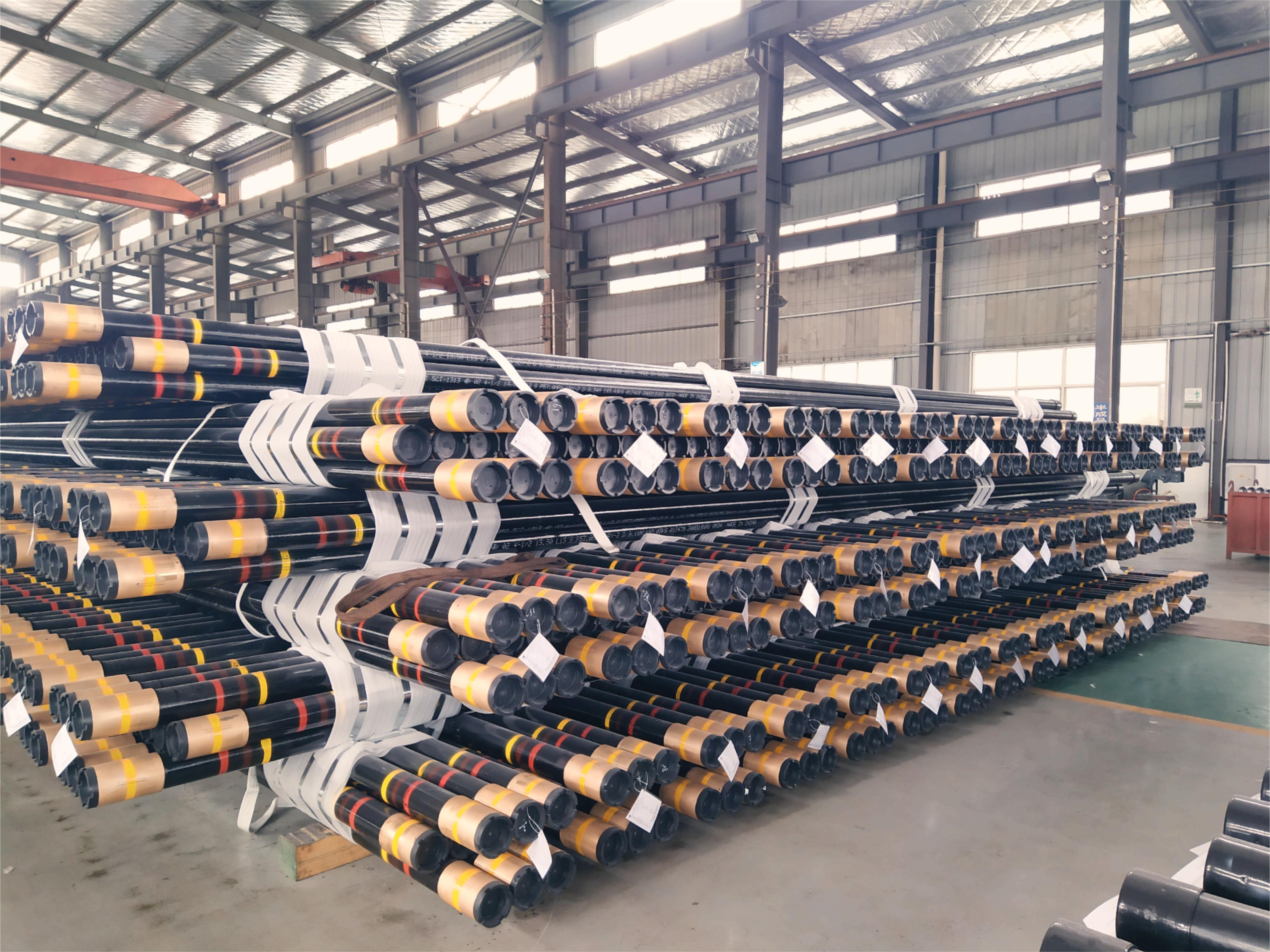 Premium 13Cr casing with copper-plated pin threads and black connection protectors, English "5CT … MADE IN CHINA" stencil — from a ZC premium-casing order.
Super 13Cr (sometimes designated 13Cr-5Ni-2Mo or modified 13Cr) is not an API grade — it is defined under ISO 13680 or as proprietary mill grades qualified under that standard. The composition typically specifies Cr 12–14%, Ni 4–6%, Mo 1.5–2.5%, C ≤ 0.03%. Typical minimum yield is 758 MPa (110 ksi) for the standard grade, though some mills offer lower-yield variants at 655 MPa (95 ksi) for specific applications.
The performance improvements over L80 13Cr are:
- Temperature limit: extended to approximately 180°C versus ~150°C for standard 13Cr. The Ni and Mo additions stabilise the passive film at higher temperatures.
- CO2 partial pressure: handling up to ~1.0 MPa versus ~0.5 MPa for standard 13Cr.
- Chloride tolerance: the Mo content provides pitting resistance in chloride-containing environments, extending the usable chloride range to approximately 100,000 mg/L at moderate temperatures.
- H₂S tolerance: Super 13Cr can be qualified under ISO 15156-3 for very low H₂S environments — typically H₂S partial pressure below 0.01–0.02 MPa within specific temperature and pH limits. This is a narrow envelope and must be confirmed by actual mill ISO 15156-3 qualification documentation, not assumed.
The combination of low carbon, higher Ni, and Mo content makes Super 13Cr the correct choice when the well environment exceeds the L80 13Cr envelope on any single parameter — temperature, CO2 partial pressure, chloride concentration, or trace H₂S. For a side-by-side of the two grades on tubing selection, see L80 13Cr vs Super 13Cr tubing selection.
When NOT to Use Each Option
Do not use inhibited carbon steel when:
- Well deviation exceeds 45° and the inhibitor distribution across the full bore cannot be verified.
- Operating temperature exceeds 80°C — most film-forming inhibitors degrade above this point.
- The well design life exceeds 15 years — the cumulative OPEX and workover risk typically exceeds the cost premium for 13Cr.
- Continuous injection infrastructure cannot be reliably maintained for the well life.
- CO2 partial pressure exceeds 0.3 MPa — at this level, a brief inhibitor film failure causes rapid wall thinning that cannot be recovered.
Do not use L80 13Cr when:
- Any H₂S is present at meaningful partial pressure — the grade is not sour service qualified and has no NACE MR0175 / ISO 15156 envelope. For the sour-service grade route, see the OCTG sour service grade selection guide.
- Operating temperature exceeds 150°C — the passive film is unstable above this threshold.
- Chloride concentration exceeds 50,000 mg/L at temperatures above 80°C — pitting risk increases significantly.
- Elemental sulfur is present in the produced fluid — sulfur causes pitting attack on the 13Cr passive film.
- The project specification requires a NACE MR0175-compliant material — L80 13Cr does not qualify.
Do not use Super 13Cr when:
- H₂S partial pressure exceeds the specific ISO 15156-3 qualified limits for the mill's material — the qualification envelope is narrow and must be verified against actual well data.
- Temperature exceeds 180°C — at this point, duplex stainless steel or a higher CRA alloy is required.
- Elemental sulfur is present — same pitting risk as standard 13Cr.
- The budget does not justify the premium over L80 13Cr without corresponding improvement in well conditions — if the well environment fits within L80 13Cr's envelope, the additional cost of Super 13Cr does not add well integrity.
Economic Comparison — Worked Example
These are typical order-of-magnitude figures based on our quoting experience. They are illustrative — actual numbers depend on OD, weight, string design, well depth, and operator inhibitor contract rates.
Scenario: 3½" tubing string, 3,000 m total depth, CO2 partial pressure 0.3 MPa, operating temperature 120°C, 15-year well design life.
Option A — Inhibited N80 tubing:
- Material cost: approximately $90,000 (3,000 m of 3½" N80, including couplings)
- Corrosion inhibitor (continuous injection): approximately $30,000/year in chemical cost, pump maintenance, and chemical injection valve servicing
- 15-year OPEX: $30,000 × 15 = $450,000
- Workover risk: at 120°C with CO2 pCO₂ 0.3 MPa, film efficiency at this temperature is marginal — one or two remedial workovers over 15 years is a realistic assumption for most inhibitor programs, adding $200,000–$500,000 in workover cost
- Indicative 15-year cost: $90,000 + $450,000 + workover risk = $540,000 minimum, higher with workover
Option B — L80 13Cr tubing (no inhibitor required):
- Material cost: approximately $450,000 (3–5× N80, mid-range assumption at 4×, including ZC premium connections)
- OPEX: no corrosion inhibitor required — chemical injection system eliminated
- Workover risk: very low if the grade is correctly specified within its CO2/temperature envelope
- Indicative 15-year cost: approximately $450,000
At these conditions — 15 years, 120°C, pCO₂ 0.3 MPa — L80 13Cr wins on whole-life cost even at a 4× material premium, once OPEX and workover risk are included. The crossover point where 13Cr becomes more economical than inhibited carbon steel typically falls between 8 and 12 years depending on inhibitor costs and workover frequency assumptions. Below that design life, inhibited carbon steel is usually the better economic choice.
Procurement Trap and Correct PO Language
The trap: An engineer specifies "L80 13Cr tubing" for a gas condensate well based on the CO2 partial pressure from the reservoir model. The reservoir data they reviewed was a pre-drill study. Actual production data from an offset well in the same field shows 15 ppm H₂S in produced gas — a concentration that produces an H₂S partial pressure of approximately 0.008 MPa at reservoir conditions. The engineer has not updated the material specification. The PO is raised for L80 13Cr, which is correct per API 5CT for CO2 service. The mill ships fully API-conforming L80 Type 13Cr pipe. That pipe is then installed in a well with trace H₂S that exceeds the safe operating envelope for L80 13Cr — a grade with sour_service: false per API 5CT. The consequence is sulphide stress cracking in the tubing body or connections, potentially leading to string failure.
The correct protocol: Before writing a PO for 13Cr or Super 13Cr, the H₂S partial pressure in the actual well environment must be confirmed — not assumed to be zero because the field is a "gas condensate well." If any H₂S is confirmed in the produced gas:
- H₂S pCO₂ < 0.01 MPa, temperature within envelope: specify Super 13Cr with ISO 15156-3 qualification documentation from the mill, not L80 13Cr
- H₂S above Super 13Cr qualified envelope: escalate to 22Cr duplex or higher CRA
Correct PO language for L80 13Cr sweet service:
API 5CT, 11th Edition, Grade L80 Type 13Cr, [OD × weight lb/ft], PSL-2, Q+T heat treatment, MTC per EN 10204 3.2, premium connection [connection designation] ISO 13679 CAL IV qualified, for CO2 service — NO H₂S tolerance, sweet service only.
The explicit "sweet service only" statement on the PO forces the engineering review to confirm that the H₂S data supports that classification before the order is issued.
Supply and Grade Verification
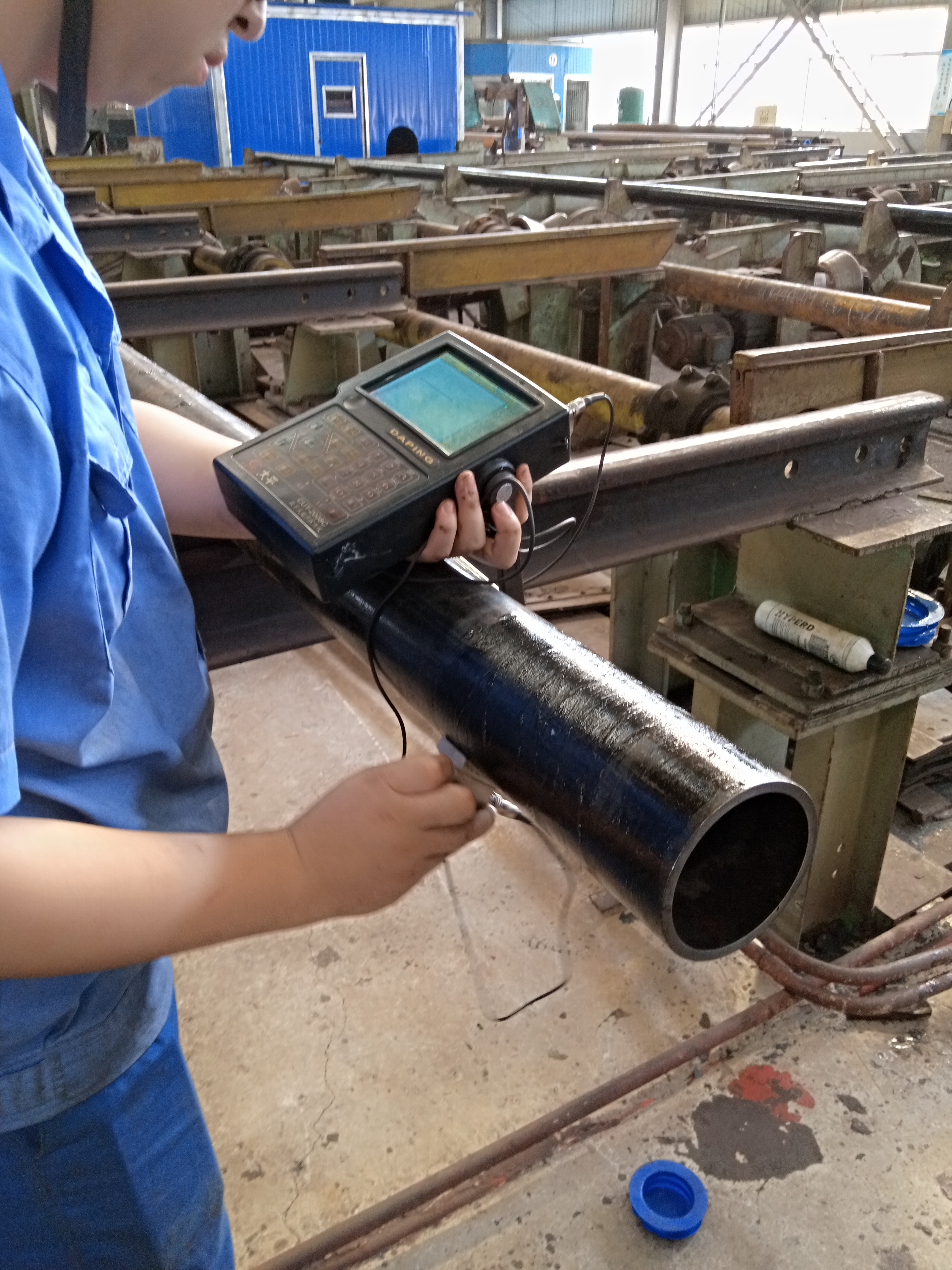 Ultrasonic flaw detection on a pipe end during pre-shipment inspection — part of the third-party verification ZC applies to CRA orders.
ZC Steel Pipe supplies L80 13Cr and Super 13Cr tubing and casing with ZC premium connections for CO2-corrosive gas condensate wells in West Africa, Brazil, and the Gulf region. For L80 13Cr, we supply MTC per EN 10204 3.2 as standard for export orders — not 3.1. For Super 13Cr, we require the operator to provide confirmed H₂S partial pressure and temperature data so we can verify the mill's ISO 15156-3 qualification documentation covers the actual well environment. You can pre-screen a grade against your CO2, H₂S, temperature, and chloride figures with the pipe grade selector or the sour service selector before sending the enquiry. We have held orders pending that confirmation and will do so again — an incorrect material specification is a liability for everyone in the supply chain.
When comparing 13Cr quotes, verify that the chemistry limits on the MTC are within API 5CT limits — Cr 12.0–14.0%, C 0.15–0.22%, Ni ≤ 0.50%. We have seen third-party inspection hold 13Cr shipments at the mill where the Cr content came in at 11.8% — technically outside the 12.0% minimum and requiring a disposition decision before shipment. For Super 13Cr, confirm the mill's ISO 15156-3 qualification report covers your specific H₂S partial pressure, temperature, and chloride concentration — not just the grade designation.
For complete API 5CT mechanical properties, chemistry limits, and hardness tables, see the API 5CT specification tables.
Related articles:
Frequently Asked Questions
When should I choose 13Cr over inhibited carbon steel for CO2 service?
Choose 13Cr over inhibited carbon steel when: CO2 partial pressure exceeds 0.5 MPa (5 bar); operating temperature is above 60°C where inhibitor film stability decreases; the well is deviated or horizontal where inhibitor distribution is unreliable; the production rate is high enough that inhibitor injection becomes operationally complex; or the design life requires >20 years without workovers. Inhibited carbon steel is economically attractive for short-life wells, low CO2 concentrations, or where continuous chemical injection infrastructure already exists.
What is the maximum temperature for L80 13Cr in CO2 service?
L80 13Cr (standard martensitic 13% chromium) is generally limited to operating temperatures below 150°C for CO2 corrosion protection. Above 150°C, the passive chromium oxide film becomes unstable and corrosion rates increase significantly. For temperatures above 150°C, Super 13Cr (modified martensitic with higher Ni and Mo) extends the operating envelope to approximately 180°C. Above 180°C, duplex stainless steel or higher CRA alloys are required.
Does L80 13Cr have a NACE MR0175 H2S envelope?
No — L80 13Cr is a CO₂ corrosion resistance grade for sweet wells and is not qualified under NACE MR0175/ISO 15156-3. It has no NACE MR0175 H₂S envelope. The 13% chromium passive film resists CO₂ attack but provides no resistance to sulphide stress cracking (SSC) in H₂S environments. L80 13Cr should not be used where H₂S is present at any meaningful concentration, regardless of partial pressure. For combined CO₂ and H₂S service, Super 13Cr can be qualified under ISO 15156-3 for very low H₂S environments within specific limits. For significant H₂S, 22Cr duplex stainless steel or higher CRA grades are required.
What is the cost difference between 13Cr and carbon steel OCTG?
L80 13Cr tubing typically costs 3-5× more than standard L80 carbon steel tubing of the same OD and weight. Super 13Cr adds a further 20-40% premium over standard 13Cr. The economics depend on inhibitor injection costs over the well life — for wells with >15 year design life and high CO2, 13Cr often provides better whole-life cost despite higher upfront material cost. For short-life wells or low CO2 concentrations, inhibited carbon steel is typically more economical.
What is Super 13Cr and how does it differ from standard 13Cr?
Super 13Cr (also called modified 13Cr or 13Cr-5Ni-2Mo) is an enhanced martensitic stainless steel with higher nickel (4-6%) and molybdenum (1-2%) content compared to standard L80 13Cr (0.5% Ni max, no Mo). The additions improve: CO2 corrosion resistance at higher temperatures (up to ~180°C vs ~150°C for standard 13Cr); H₂S tolerance (slightly improved SSC resistance); and pitting resistance in chloride-containing environments. Super 13Cr is typically qualified under ISO 15156-3 and requires premium connections due to gas-tight requirements.
What chloride concentration limits apply to 13Cr tubing?
Standard L80 13Cr is generally acceptable in chloride concentrations up to approximately 50,000 mg/L (50 g/L) at temperatures below 100°C. Above 100°C, chloride limits reduce significantly — pitting corrosion becomes a risk in the passive film. Super 13Cr extends chloride tolerance somewhat due to its molybdenum content. For high-chloride environments (>100,000 mg/L) at elevated temperature, duplex stainless steel or 22Cr/25Cr alloys are required. Always verify chloride limits with a corrosion engineer using actual well chemistry data.
Does inhibited carbon steel require continuous or batch inhibitor injection?
For tubing in CO2 service, continuous inhibitor injection is standard — batch treatment is generally insufficient for the internal surfaces of production tubing exposed to a continuous CO2-containing fluid stream. Continuous injection requires a chemical injection valve (CIV) at the wellhead and a dedicated chemical injection pump and tank. For surface lines and flowlines, batch pigging with inhibitor is sometimes used as an alternative. The operational cost of continuous inhibitor injection (chemical cost + maintenance) must be included in the economic comparison with 13Cr tubing.
When is duplex stainless steel required instead of 13Cr or Super 13Cr?
Duplex stainless steel (22Cr or 25Cr) is required when: temperature exceeds 180°C (beyond Super 13Cr limit); H₂S partial pressure exceeds the ISO 15156-3 limits for Super 13Cr; chloride concentration is very high (>100,000 mg/L) at elevated temperature; or the combination of CO2, H₂S, chlorides, and temperature exceeds any 13Cr variant's qualified envelope. Duplex is 5-10× the cost of carbon steel and requires premium connections — it is specified only when the well environment genuinely exceeds 13Cr capability.