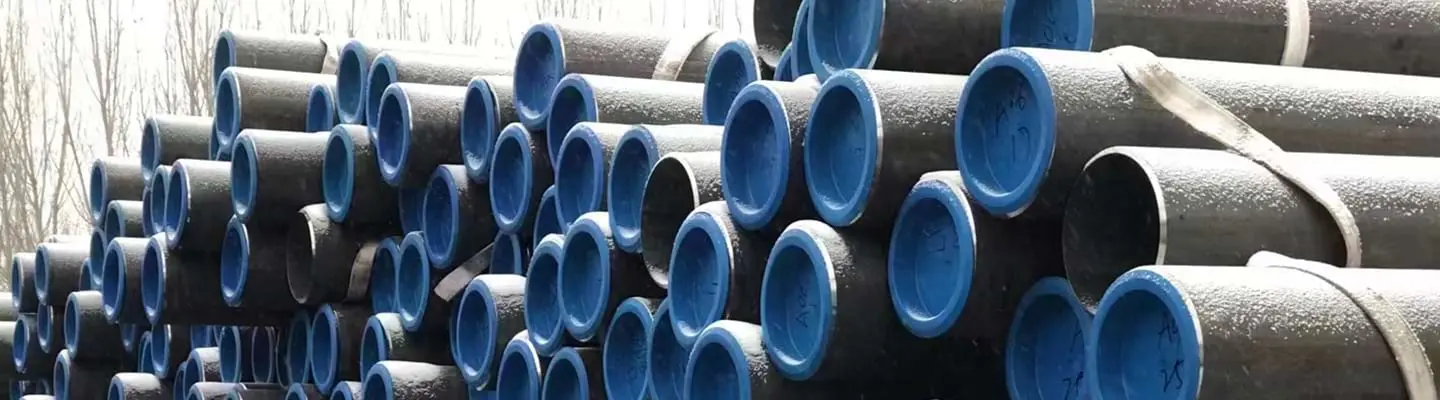
Electric resistance welded (ERW) pipe is the highest-volume welded steel pipe in the world. On gathering systems, distribution networks, and medium-pressure transmission lines, ERW line pipe delivers API 5L mechanical properties at significantly lower cost than seamless alternatives. For EPC engineers and procurement professionals specifying line pipe for projects in Africa, the Middle East, and South America, understanding where ERW fits — and where it does not — is essential for cost-effective pipe selection.
ZC Steel Pipe manufactures ERW welded line pipe to API Specification 5L, 46th Edition in grades Grade B through X70 for distribution, gathering, and transmission projects across Africa, the Middle East, South America, and Southeast Asia. All PSL2 products are supplied with EN 10204 3.1 MTCs and third-party inspection as standard.
Quick Answer
ERW (electric resistance welded, also called HFW) pipe is formed by roll-forming flat steel strip into a cylinder and fusing the edges with high-frequency current — a solid-state forge weld with no filler metal. It covers API 5L line pipe from Grade B (L245) through X70 (L485), in NPS 2 through NPS 24, and typically costs 25–40% less than seamless at the same grade and size. Order it as PSL2 — which mandates seam heat treatment above Ac3 — for anything beyond low-pressure dry-gas distribution, and always for sour or low-temperature service.
What we see on sour service tenders: The most common specification shortcut we see on sour gas gathering line tenders from West Africa is "PSL1 ERW — it's low pressure gathering, just 2 MPa MAOP." The low-pressure argument is correct for burst. It is wrong for sour service. In H2S environments, hydrogen-induced cracking and sulfide stress cracking are not pressure-driven failure modes — HIC initiates at zero applied stress, and SSC initiates at a fraction of SMYS. The 2 MPa MAOP is irrelevant to whether the ERW seam hardness exceeds NACE MR0175 limits. PSL1 ERW has no mandatory seam heat treatment. The as-welded HAZ is typically 280–350 HV10 — well above the 250 HV10 (22 HRC) limit for sour service. In H2S gas at 2 MPa, a PSL1 ERW seam with 320 HV10 hardness will initiate SSC as readily as in a 10 MPa pipeline. Specify PSL2 for all sour service, regardless of operating pressure.
What Is ERW Pipe?
ERW pipe is welded steel pipe made by continuously roll-forming a flat strip of hot-rolled steel (skelp) into a cylindrical shape and joining it along a single longitudinal seam using high-frequency electrical resistance — no filler metal is added.
The governing standard for ERW line pipe in oil and gas service is API Specification 5L, 46th Edition, which defines two product specification levels:
- PSL1 — standard quality: minimum yield and tensile, basic chemistry and dimensional requirements
- PSL2 — higher quality: adds maximum yield limits, maximum yield-to-tensile ratio, mandatory Charpy V-notch impact testing, carbon equivalent limits, and non-destructive examination of the weld seam
Within the API 5L grade family, ERW pipe covers Grade B (L245) through X70 (L485). For grades X80 (L555) and above, LSAW manufacturing is the standard in practice because the thicker walls and higher seam toughness demands of those grades are better served by the LSAW process. ERW is one of three welded routes — see the welded steel pipe types guide (ERW, LSAW, SSAW) for how they compare.
ERW Manufacturing Process
Strip Preparation
ERW line pipe begins as a hot-rolled coil (HRC) of steel strip, slit to the precise width needed to form the target pipe OD. Strip width accuracy is critical because it directly controls the finished OD — width tolerances are held to ±0.5 mm on modern slitting lines.
Roll Forming
The slit strip passes through a series of progressive forming rolls that bend it from a flat strip into a cylinder. The sequence moves from roughing rolls through fin-pass rolls that angle the two edges slightly inward, preparing them for the forge weld.
High-Frequency Welding
At the weld station, high-frequency alternating current — typically 100 to 400 kHz — is applied to the strip edges via contact shoes or an induction coil. Two physical effects concentrate the electrical energy precisely at the strip edges:
Skin effect: At high frequencies, current flows along the conductor surface rather than through the bulk. At 400 kHz, current penetrates only a fraction of a millimetre into the steel, concentrating energy at the edge surface.
Proximity effect: When two conductors carry current in opposite directions close to each other, current concentrates on the facing surfaces. As the strip edges converge toward the weld point, proximity effect focuses heat at the exact contact zone.
Together these effects heat the edges to forge-welding temperature — above 1,260 °C (2,300 °F) — in milliseconds. Squeeze rolls then forge the two hot faces together under pressure, expelling the oxide layer as a thin flash of metal. No filler metal is added. The weld is a solid-state forge weld with properties that depend entirely on the base steel chemistry and the thermal cycle.
The HF-ERW weld is a solid-state forge weld — no filler metal. That makes it fundamentally different from a SAW weld in one key way: the fusion line is where the two steel edges are pressed together under forge pressure, and the quality depends entirely on how well the oxide layer at the edges was expelled before the faces fused. If the squeeze roll pressure is insufficient, or if the edge temperature is non-uniform along the strip, the fusion line retains oxide inclusions — called "hook cracks" or "cold welds" — that are very difficult to detect with standard UT because they have minimal acoustic reflection when closed. When the ERW seam is heat-treated above Ac3 (PSL2 mandatory) and then re-inspected by full-length UT, the heat treatment opens any incomplete fusion areas slightly by thermal expansion mismatch — making them detectable. This is the second reason (beyond HAZ refinement) that PSL2 seam heat treatment is not a formality. It is a quality gate that makes seam UT more reliable.
Seam Finishing and Heat Treatment
After welding, the external weld flash is mechanically scarfed flush with the pipe OD. For pipe with smaller diameters, the internal flash may also be removed.
For API 5L PSL2 ERW pipe, seam heat treatment is mandatory. The weld heat-affected zone (HAZ) must be heated to above the Ac3 temperature — the full austenitisation temperature, typically above 900 °C — then air-cooled. This restores the HAZ grain structure to the same fine-grained condition as the base metal, ensuring the seam meets the same Charpy impact energy and tensile requirements as the pipe body. Without this step, the ERW seam HAZ retains a coarser, harder structure that can fail NACE MR0175 hardness limits or low-temperature Charpy requirements.
For API 5L PSL1 ERW pipe, no seam heat treatment is required by the standard.
Sizing, Testing, and Inspection
After seam treatment, the pipe passes through a rotary sizing mill to achieve final OD and roundness, then:
- Hydrostatic test — every joint is pressure-tested per API 5L Table 26 (Barlow formula at 60% or 75% SMYS)
- Ultrasonic seam inspection — full seam length scanned by automated UT for PSL2 (mandatory)
- Dimensional check — OD, wall thickness, straightness, and end squareness per API 5L Table 10
API 5L ERW Grades and Mechanical Properties
All values from API Specification 5L, 46th Edition (effective November 2018).
PSL1 — Yield and Tensile by Grade
| API 5L Grade | SI Designation | Min Yield (MPa) | Min Yield (ksi) | Min Tensile (MPa) | Min Tensile (ksi) |
|---|---|---|---|---|---|
| Grade B | L245 | 245 | 35.5 | 415 | 60.2 |
| X42 | L290 | 290 | 42.1 | 415 | 60.2 |
| X46 | L320 | 320 | 46.4 | 435 | 63.1 |
| X52 | L360 | 360 | 52.2 | 460 | 66.7 |
| X56 | L390 | 390 | 56.6 | 490 | 71.1 |
| X60 | L415 | 415 | 60.2 | 520 | 75.4 |
| X65 | L450 | 450 | 65.3 | 535 | 77.6 |
| X70 | L485 | 485 | 70.3 | 570 | 82.7 |
The most important column for ERW procurement is not the minimum yield — it is the PSL level. PSL1 entries in this table carry no seam heat treatment requirement, no Charpy requirement, and no maximum yield ceiling. For any service beyond low-pressure dry-gas distribution, PSL2 should be the default.
PSL2 — Additional Requirements
API 5L PSL2 adds maximum yield limits and a maximum yield-to-tensile (Y/T) ratio of 0.93 for pipes with OD greater than 323.9 mm (12.750 in), plus mandatory Charpy V-notch impact testing. For ERW pipe at X65 and X70, the M delivery condition (thermomechanically controlled process) is standard. For ERW, this PSL1-versus-PSL2 choice usually decides sour-service and low-temperature fitness — see the API 5L PSL1 vs PSL2 selection guide.
For the complete PSL1 and PSL2 grade tables including Charpy requirements and delivery conditions, see the API 5L specification tables →
To calculate wall thickness for your operating pressure and grade, use the Pipeline Design Calculator →
Standard Sizes — ERW Line Pipe (ASME B36.10M-2018)
ERW line pipe is commercially produced in NPS 2 through NPS 24. For large-diameter pipe above NPS 24, LSAW or SSAW manufacturing is standard. All dimensions from ASME B36.10M-2018.
| NPS | OD (in) | OD (mm) | STD Wall (in) | STD Wall (mm) | STD Wt (kg/m) | XS Wall (in) | XS Wall (mm) | XS Wt (kg/m) |
|---|---|---|---|---|---|---|---|---|
| 2 | 2.375 | 60.32 | 0.154 | 3.91 | 5.44 | 0.218 | 5.54 | 7.48 |
| 4 | 4.500 | 114.30 | 0.237 | 6.02 | 16.08 | 0.337 | 8.56 | 22.32 |
| 6 | 6.625 | 168.27 | 0.280 | 7.11 | 28.26 | 0.432 | 10.97 | 42.56 |
| 8 | 8.625 | 219.07 | 0.322 | 8.18 | 42.54 | 0.500 | 12.70 | 64.64 |
| 10 | 10.750 | 273.05 | 0.365 | 9.27 | 60.30 | 0.500 | 12.70 | 81.54 |
| 12 | 12.750 | 323.85 | 0.375 | 9.52 | 73.80 | 0.500 | 12.70 | 97.45 |
| 14 | 14.000 | 355.60 | 0.375 | 9.52 | 81.25 | 0.750 | 19.05 | 158.11 |
| 16 | 16.000 | 406.40 | 0.375 | 9.52 | 93.18 | 0.500 | 12.70 | 123.31 |
Note: For NPS 14 and above, the Standard (STD) wall is constant at 9.52 mm (0.375 in) per ASME B36.10M-2018.
ZC Steel Pipe supplies ERW line pipe in NPS 2" to NPS 24" (Grade B through X70). Wall thickness range: 3.2 mm to 22 mm. Fixed lengths (6 m, 12 m) and double random lengths (DRL, 10.7–13.1 m) are available.
Hydrostatic Test Pressure — What the Numbers Mean
The API 5L hydrostatic test is one of the most misread quality gates in ERW procurement. The formula is:
P_test = 2 × SMYS × t × f / D
For PSL2, f = 0.90 — the maximum allowed fraction of SMYS at test pressure.
Worked example — 12-inch X65M PSL2 ERW, wall 9.52 mm:
- P_test = 2 × 450 × 9.52 × 0.90 / 323.9
- P_test = 7,711.2 / 323.9 = 23.8 MPa (3,452 psi)
Compare that to the MAOP for a Class 1 onshore gas transmission line designed to ASME B31.8 at design factor F = 0.72:
- MAOP = 2 × 450 × 9.52 × 0.72 / 323.9 = 6,168.96 / 323.9 = 19.0 MPa
The hydrostatic test at 90% SMYS is 25% above the ASME B31.8 design MAOP. Every ERW joint that passes this test has demonstrated that its seam and body can sustain 25% above operating pressure — the test is a meaningful quality gate, not a procedural formality.
The critical point for sour service: if a PSL1 ERW joint with a seam hardness of 320 HV10 passes the hydrostatic test, it has proven burst strength. It has not proven sour service fitness. Hardness failure is independent of pressure capacity. This is the core of the PSL1-versus-PSL2 distinction in sour service — the hydrotest does not screen for SSC susceptibility.
Use the Pipeline Design Calculator → for project-specific wall thickness and pressure calculations.
ERW vs Seamless Pipe — When to Choose Each
| Criterion | ERW | Seamless |
|---|---|---|
| Seam | One longitudinal weld seam | No seam |
| Commercial OD range | NPS 2"–24" typical | NPS ⅛"–24" commercial range |
| Wall thickness | Economical to ~22 mm | Up to 100+ mm |
| Cost vs seamless | 25–40% lower at same grade and size | Baseline |
| PSL2 seam treatment | Required — normalized above Ac3 | N/A |
| Wall consistency | ±12.5% (coil-origin uniformity) | +20%/−12.5% tolerance |
| Preferred for | Gathering, distribution, medium-pressure mainline | HPHT, thick-wall, small-diameter, spool pieces |
| Sour service | Qualified with PSL2 seam treatment and hardness check | Readily qualified |
For a detailed comparison including weldability and cost analysis, see Seamless vs Welded Line Pipe Selection Guide →
When NOT to Specify ERW Line Pipe
Not every project is suited to ERW. The table below identifies the conditions where a different pipe form is the correct specification — not because ERW is inferior in general, but because the specific application exceeds ERW's certified capability or commercial range.
| Application | Why ERW Is Unsuitable | Correct Specification |
|---|---|---|
| Wall thickness > 20mm required | ERW practical limit; LSAW better suited | LSAW PSL2 |
| X80 grade | X80 is not commercially produced as ERW | LSAW PSL2 |
| HPHT process piping at T > 200°C | API 5L not certified for elevated temperature | ASTM A106 Grade B |
| Sour service without PSL2 | PSL1 seam untreated — exceeds NACE hardness | ERW PSL2 with seam treatment |
| Offshore / subsea (large diameter) | LSAW preferred for seam fatigue and wall capability | LSAW PSL2 |
| Induction bending | ERW seam orientation in bending zone is a risk | Seamless |
The HPHT process piping case is one EPC teams encounter more than they expect: a procurement team substitutes API 5L X65 ERW for ASTM A106 Grade B seamless in a process heater inlet spool on the basis that X65 has higher room-temperature yield strength. At 350°C, API 5L ERW pipe has no certified elevated-temperature mechanical properties. ASME B31.3 Table A-1 does not list API 5L as a permitted material for process piping. The spool must be replaced.
Named Failure Modes
Failure Mode 1: PSL1 ERW Seam in H2S Service — SSC at the HAZ
Mechanism: PSL1 ERW pipe has no mandatory seam heat treatment. The as-welded ERW HAZ has a narrow hard zone, typically 0.5–1.5 mm wide, directly adjacent to the fusion line. Hardness in this zone is commonly 280–350 HV10 — above the NACE MR0175 limit of 250 HV10 (22 HRC). In an H2S gathering line, atomic hydrogen from the H2S corrosion reaction is absorbed into the steel at the pipe bore. The hard HAZ zone is the highest-risk initiation site for sulfide stress cracking (SSC). Under the circumferential residual stress from the weld and the applied hoop stress from the line pressure, SSC cracks initiate at the hard HAZ and propagate toward the outer surface. In a 2 MPa gathering line, the applied hoop stress is low — but the residual stress from the weld is not, and SSC does not require the full SMYS to initiate in a zone above 22 HRC.
Diagnostic: Leakage or through-wall crack at or adjacent to the weld seam in H2S service. Crack is longitudinally oriented, parallel to the seam, within 1–2 mm of the fusion line. Hardness testing of the seam cross-section shows a hardness peak at the HAZ above 250 HV10. MTC shows PSL1 (no seam heat treatment). The pipe passed the hydrostatic test — burst capacity was unaffected.
Fix: For all H2S service — regardless of partial pressure — specify PSL2 with mandatory seam heat treatment above Ac3. Additionally, specify weld seam hardness testing on the MTC: "ERW seam HAZ hardness ≤ 22 HRC (250 HV10) per NACE MR0175 limits, tested on representative samples per frequency agreed in the ITP." PSL2 seam treatment and hardness verification are not redundant — the seam treatment controls the hardness, and the testing verifies it was achieved.
Failure Mode 2: ERW Pipe Used for HPHT Process Piping — Wrong Material Specification
Mechanism: An EPC project substitutes API 5L X65 ERW pipe for ASTM A106 Grade B seamless in a process heater inlet spool operating at 350°C and 8 MPa. The ERW pipe has similar room-temperature yield strength (450 MPa vs 240 MPa for A106 Grade B — actually stronger) and the OD matches. The substitution appears conservative on mechanical properties at room temperature. At 350°C, API 5L ERW pipe has no certified elevated-temperature mechanical properties — API 5L is not designed for high-temperature service and does not include temperature derating factors. ASTM A106 Grade B has published allowable stresses in ASME B31.3 Table A-1 that account for elevated-temperature strength reduction. The ERW pipe installed in the spool operates beyond its certified service range, and the design code (B31.3) does not recognize API 5L as a permitted material for this service.
Diagnostic: Design code review or construction inspection identifies API 5L ERW pipe in a B31.3 process piping system at temperature above 200°C. ASME B31.3 Table A-1 does not list API 5L as a permitted material. The spool must be replaced with A106 Grade B seamless.
Fix: Never substitute API 5L for ASTM A106 in high-temperature process piping. API 5L is a pipeline standard — not a pressure vessel or process piping standard. The design codes that govern process piping (B31.3, B31.1) specify ASTM standards with certified elevated-temperature allowables. If the design code requires A106, order A106.
Failure Mode 3: ERW Without Seam Heat Treatment — Brittle Fracture at Low-Temperature Hydrotest
Mechanism: PSL1 ERW 14-inch X52 gathering pipe is hydrotested in the field during construction. The ambient temperature is −3°C. The test water temperature is 8°C, but a pipe section stored in a shaded area has a steel temperature of −2°C before filling. The pipe body has adequate Charpy toughness at −3°C (API 5L PSL1 has no Charpy requirement, but the steel normally achieves adequate toughness). The ERW seam HAZ — without normalization — has a brittle-to-ductile transition temperature above 0°C. At −2°C steel temperature, the seam HAZ is on the lower shelf of its Charpy curve. A pressure surge during the hydrotest initiates a brittle fracture at a pre-existing notch in the seam area. The fracture runs along the seam for 4 m before arresting.
Diagnostic: Brittle fracture along the weld seam during hydrotest at ambient below 0°C. Fracture runs parallel to the weld, within or adjacent to the HAZ. Fracture surface shows crystalline morphology (brittle) adjacent to the seam, transitioning to dimpled (ductile) in the pipe body. MTC shows PSL1 — no seam heat treatment, no Charpy test.
Fix: Specify PSL2 for any gathering or transmission line where field hydrotest will be conducted at temperatures below 5°C. PSL2 ERW with seam normalization above Ac3 brings the HAZ Charpy transition temperature into line with the base metal. Never hydrotest PSL1 ERW pipe at below-freezing ambient conditions.
Purchase Order Guidance
Minimum Required PO Line Items for ERW Line Pipe
A complete ERW line pipe PO for oil and gas service must specify:
- Standard: API Specification 5L, 46th Edition
- PSL level: PSL1 or PSL2 — never leave blank
- Grade: e.g., X65 (or L450 in metric documentation)
- Delivery condition (PSL2): M, N, or Q — e.g., X65M
- Pipe form: ERW (not just "welded")
- Size: OD (in or mm) × wall thickness (mm) × length (DRL or fixed)
- End finish: plain end (PE) or bevelled end (BE per ASME B16.25, 30° ± 5°)
- Supplementary requirements: Annex H sour service, Charpy test temperature, third-party inspection, EN 10204 3.1 MTC
The PSL1 Sour Service Trap
Wrong PO: "12-inch X65 PSL1 ERW, sour service H2S 0.015 MPa partial pressure, wall 9.52mm, 30km"
What the mill ships: PSL1 ERW with no seam heat treatment. Seam HAZ at 300+ HV10. Hydrostatic test passes. Sour service life is compromised from day one — every joint that enters H2S service is delivering an untreated HAZ with hardness well above the NACE MR0175 limit of 22 HRC (250 HV10). The mill is fully API-compliant. The pipe is not fit for sour service.
Correct PO: "12-inch (323.9mm OD) API 5L X65M PSL2 per API Specification 5L, 46th Edition, ERW (high-frequency welded), delivery condition M, seam heat treatment above Ac3 temperature (mandatory for PSL2 ERW — confirm on MTC), sour service ISO 15156-2 Part 2 Zone 0 compliance, ERW seam HAZ hardness ≤ 250 HV10 (22 HRC) per NACE MR0175 — to be recorded on MTC from hardness tests at specified frequency agreed in the ITP, Charpy CVN at −10°C per PSL2, 100% full-length seam UT, hydrostatic test per PSL2, wall 9.52mm minimum, bevel ends, EN 10204 3.2 MTC with named TPI, 30km."
The difference between these two PO lines is not a paperwork formality. The first one leaves 30 km of sour-service gathering line with seam hardness that will initiate SSC. The second one creates a document trail — MTC hardness records, seam treatment confirmation, third-party witness — that makes the quality gate visible at every step of mill inspection and receiving.
What to Verify on the MTC
Before accepting an ERW pipe consignment, verify on the Mill Test Certificate (MTC):
- PSL level declared in the product designation
- Seam heat treatment type and temperature (PSL2 mandatory)
- Tensile test results — body and weld seam separately (PSL2)
- Charpy impact energy at the specified temperature (PSL2)
- Carbon equivalent (CE_IIW or CE_Pcm) for PSL2
- Hydrostatic test pressure and hold time
- Ultrasonic seam inspection confirmation (PSL2)
For the complete EN 10204 MTC review procedure, see Pipe Mill Test Certificate Guide →
Frequently Asked Questions
What does ERW stand for in pipe?
ERW stands for Electric Resistance Welded. High-frequency alternating current is applied to the edges of a flat steel strip, and resistance heating brings the edges to forge-welding temperature. Squeeze rolls press the edges together to form a solid-state weld — no filler metal is used.
What is the difference between ERW pipe and seamless pipe?
Seamless pipe is pierced from a solid billet with no longitudinal seam. ERW pipe is roll-formed from flat strip and welded along one seam using high-frequency current. Seamless typically costs 25–40% more than ERW at the same grade and size. ERW has a weld seam, which is treated and inspected for PSL2 service — seamless has no seam and is preferred for very thick walls, very small diameters, and the most demanding HPHT conditions.
What API 5L grades are available as ERW pipe?
API Specification 5L, 46th Edition permits ERW manufacturing for grades L245 (Grade B) through L485 (X70) in both PSL1 and PSL2. For PSL2 X65 and X70 ERW pipe, the M delivery condition (thermomechanically rolled coil) with mandatory seam heat treatment is standard.
Does ERW pipe require seam heat treatment?
For API 5L PSL2 ERW pipe, seam heat treatment to above the Ac3 temperature is mandatory to restore the heat-affected zone to the same mechanical properties as the parent pipe body. For PSL1, no seam heat treatment is required by the standard. This distinction is critical when specifying pipe for sour service or low-temperature service.
What is the maximum wall thickness for ERW line pipe?
Commercially, ERW line pipe is most cost-effective up to approximately 19–22 mm wall thickness. The upper limit also depends on the D/t ratio: ERW is typically applied where D/t exceeds 20–30. For thicker walls, LSAW or seamless manufacturing is more economical and delivers more consistent mechanical properties.
Can ERW pipe be used for sour service under NACE MR0175?
Yes. API 5L PSL2 ERW pipe with mandatory seam heat treatment typically meets NACE MR0175 / ISO 15156 hardness limits (22 HRC maximum for carbon steel) across both the seam and parent metal. PSL1 ERW pipe should not be used in H2S service without specific hardness testing of the seam — the untreated HAZ may exceed NACE hardness limits and initiate hydrogen cracking.
How is the ERW seam inspected after welding?
For API 5L PSL2 ERW pipe, the full seam length is scanned by automated ultrasonic testing (UT) to detect laminations and weld defects. Hydrostatic pressure testing is required for all API 5L pipe regardless of PSL level. Radiographic testing of the seam may be specified as a supplementary requirement on project specifications.
Is HFW pipe the same as ERW pipe?
Yes. HFW (High-Frequency Welded) and ERW are used interchangeably in the market. All modern ERW line pipe for oil and gas service uses high-frequency current (typically 100–400 kHz), which is correctly described as both HFW and ERW. Low-frequency ERW is no longer manufactured for pipeline service.