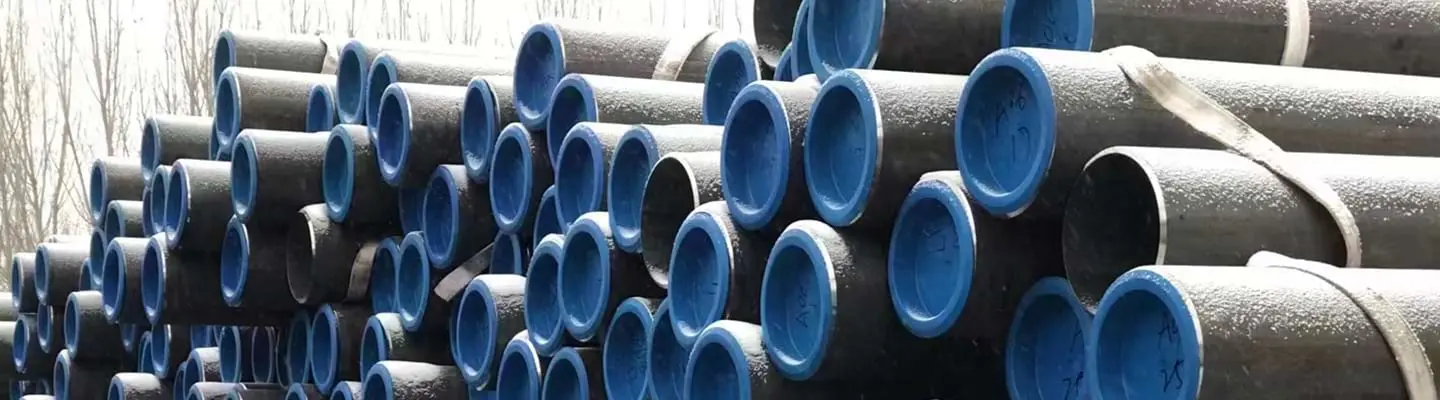
Welded steel pipe accounts for the majority of line pipe used globally in oil, gas, and water transmission. The three main welded pipe types — ERW, LSAW, and SSAW — differ fundamentally in how they are manufactured, which determines their size range, wall thickness capability, pressure rating, and suitability for different applications. Selecting the wrong type for a project specification creates procurement problems that are difficult to resolve after order placement. (For the welded-versus-seamless decision itself, see the seamless vs welded line pipe guide →.)
ZC Steel Pipe manufactures and supplies all three welded pipe types to API 5L across the standard size and grade range, primarily to EPC contractors and national oil companies in Sub-Saharan Africa, the Middle East, and Southeast Asia. This guide covers the manufacturing process, dimensional capabilities, pressure ratings, and application suitability of each type, with a selection matrix for common pipeline project scenarios.
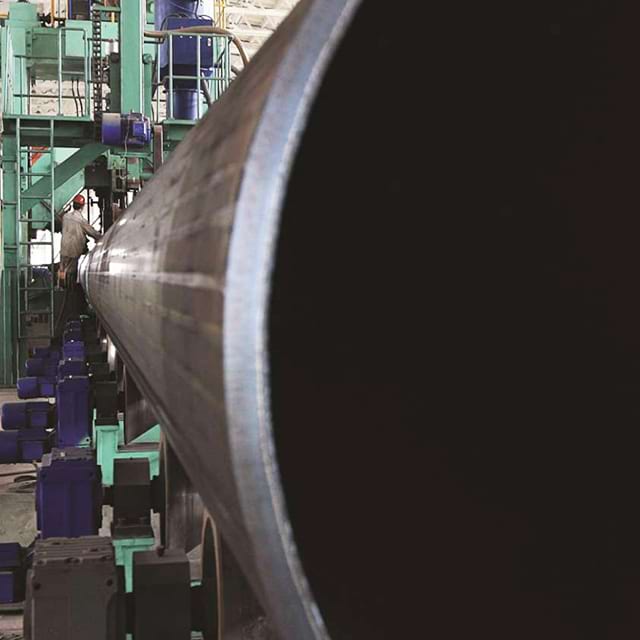 Large-diameter welded pipe on the ZC production line — the forming and welding station shapes the body and lays the seam in one continuous pass.
What we see on tenders from Sub-Saharan Africa: The most common specification error we encounter on line pipe tenders from that region is a project specification that states "ERW or welded" for the pipe type on a 12-inch gas gathering line that also specifies "sour service, H2S partial pressure 0.02 MPa." ERW is welded — but SSAW is also welded. Writing "welded" without specifying ERW or LSAW explicitly allows the mill to supply SSAW, which typically has a lower wall thickness limit, a spiral weld geometry with a longer seam per unit length, and is restricted or excluded from sour service by most major operator pipeline standards. "ERW" is specific. "Welded" is not. We flag this before any inquiry goes to the mill, but not every supplier will.
At a Glance
| ERW | LSAW | SSAW | |
|---|---|---|---|
| OD range | 1/2"–24" | 16"–60" | 16"–120" |
| Wall thickness | Up to ~20mm | Up to 50mm | Up to ~25mm |
| Weld seam | Longitudinal, electric resistance | Longitudinal, submerged arc | Spiral, submerged arc |
| Offshore / subsea | Limited | Standard | Not accepted |
| High-pressure gas > 70 bar | Up to ~24" | Preferred | Restricted / excluded |
| Relative cost | Lowest | Highest | Medium |
ERW is the low-cost default for small-to-medium diameters, LSAW is the choice for heavy wall, high grade, and offshore, and SSAW is the economical route to very large diameters where the spiral seam is acceptable. Specify the type by name — never just "welded" — or the mill will pick the cheapest process that fits the wording.
1. ERW — Electric Resistance Welded Pipe
ERW pipe is manufactured by cold-forming hot-rolled coil steel into a cylindrical shape using a series of forming rolls, then welding the longitudinal seam using electric resistance. The weld is formed by passing high-frequency electric current through the pipe edges as they are pressed together — no filler metal is used. The weld zone is then heat-treated and inspected by ultrasonic testing.
Manufacturing process:
- Feed: hot-rolled strip coil
- Forming: continuous roll forming
- Welding: high-frequency electric resistance (HF-ERW)
- Post-weld heat treatment: full body normalising or seam annealing
- Inspection: 100% UT of weld seam, hydrostatic test
Size range: 1/2 inch to 24 inch OD Wall thickness: up to approximately 20mm Grades: X42 to X70, PSL1 and PSL2 Standard: API 5L
ERW is the most cost-efficient welded pipe manufacturing process for small to medium diameters. For diameters up to 16 inch, ERW is typically the default choice for gathering lines, distribution systems, and low-to-medium pressure transmission.
ERW limitations
The primary limitation of ERW is the weld zone. The HF-ERW process produces a narrow heat-affected zone with different microstructure from the parent material. For sour service and high-toughness applications, weld zone properties must be independently verified. Modern HF-ERW with full seam heat treatment and 100% UT is reliable, but project specifications for critical service sometimes restrict ERW in favour of seamless or LSAW.
PSL1 ERW deserves particular caution in sour service. PSL1 does not mandate seam heat treatment above Ac3 — which means the as-welded HAZ can retain a hard microstructure that exceeds the NACE MR0175 / ISO 15156-2 limit of 22 HRC (approximately 250 HV10). The PSL level is not about pressure rating; it is about controlling the metallurgical condition of the weld seam. In H2S service, even a low-pressure gathering line can experience hydrogen-induced cracking at the seam — HIC is not driven by pressure, it is driven by hydrogen activity at susceptible microstructure. PSL2 ERW with confirmed seam heat treatment is the correct baseline for any sour service pipe, regardless of MAOP.
2. LSAW — Longitudinal Submerged Arc Welded Pipe
LSAW pipe is manufactured from heavy plate steel using a UOE or JCOE forming process. The plate is formed into a circular shape, welded by submerged arc welding from inside then outside, then cold-expanded to improve roundness and residual stress distribution.
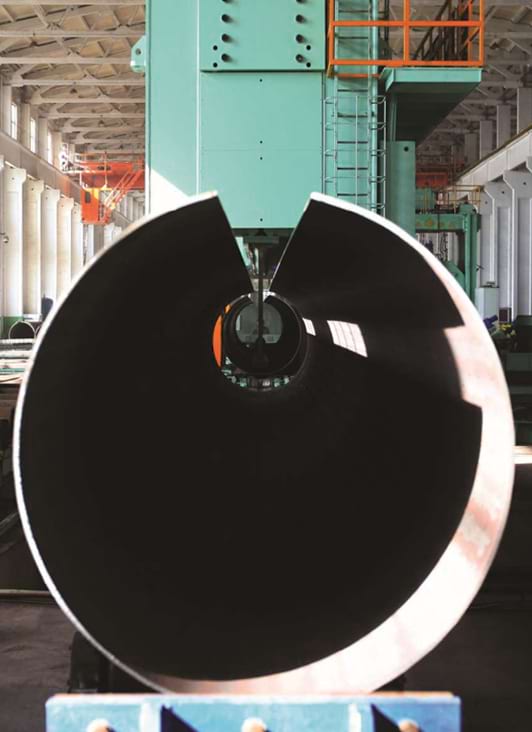 The JCOE "open-O" stage — heavy plate progressively pressed to a near-circular section before the longitudinal SAW seam is laid inside and out.
Manufacturing process:
- Feed: heavy plate (from plate mill)
- Forming: UOE or JCOE
- Welding: inside SAW + outside SAW
- Cold expansion: improves OD tolerance and mechanical properties
- Inspection: 100% UT of weld seam and plate edges, hydrostatic test, X-ray
Size range: 16 inch to 60 inch OD Wall thickness: 6mm to 50mm Grades: X52 to X80, PSL2 Standard: API 5L
LSAW is the preferred pipe type for high-pressure gas and oil transmission, offshore and subsea pipelines, and projects requiring heavy wall and high grade (X70, X80).
LSAW advantages
The submerged arc weld process produces a high-quality, deeply penetrating weld with excellent toughness and fatigue resistance. Cold expansion after welding improves dimensional accuracy — post-expansion OD tolerance and ovality are consistently tighter than non-expanded pipe, which matters for automatic welding systems on offshore laybarges and spool-base fabrication facilities. The single longitudinal weld geometry is well understood and conservatively rated in pressure design codes.
The submerged arc process in LSAW pipe welding burns entirely under a granular flux blanket — the arc is invisible, the weld pool is shielded, and there is no visible flame or arc to monitor from outside. This means the weld quality is not observable in real time by the human operator. The quality gate is 100% automated ultrasonic testing of the seam after welding — the UT scan detects defects that were invisible throughout the welding process. For a buyer, this means "SAW welding from a reputable mill" is a meaningful quality statement only if it comes with verified 100% AUT seam inspection records. The process alone is not the assurance — the post-weld inspection is. When reviewing MTCs for LSAW, confirm that the AUT seam records are included, not just stated. A MTC that says "100% UT performed" without attached scan records or a referenced inspection report number is not the same as a MTC with a traceable AUT record.
For the complete PSL1 and PSL2 grade tables, see the API 5L specification tables → and the ASME B36.10M pipe schedule chart →
To calculate design pressure or minimum wall thickness for your pipeline, use the Pipeline Design Calculator →
3. SSAW — Spiral Submerged Arc Welded Pipe
SSAW pipe is manufactured by helically winding strip steel at an angle and welding along the spiral seam using submerged arc welding. The spiral winding angle determines the relationship between strip width and pipe OD.
Manufacturing process:
- Feed: hot-rolled strip coil
- Forming: spiral winding on a mandrel
- Welding: inside SAW + outside SAW along helical seam
- Inspection: 100% UT of weld seam, hydrostatic test
Size range: 16 inch to 120 inch OD Wall thickness: typically up to 25mm Grades: X42 to X70, PSL1 and PSL2 Standard: API 5L
SSAW is the most economical option for very large diameter pipe, widely used for water transmission, low-to-medium pressure gas distribution, piling, and onshore oil and gas gathering where project specifications permit.
What we ship in large-diameter welded pipe: Above 24 inches there is no seamless route — spiral (SSAW) and longitudinal (LSAW) welded are the only options, and we see this most on conductor and riser strings. We supplied 65 pcs of 24″ 156 ppf X56 spiral-welded conductor riser to a Syrian drilling contractor — structural conductor connecting a drilling platform to the subsea wellhead, where the heavy spiral-welded body has to carry the combined tension, bending, and torsion of platform motion — and 280 pcs of 30″ 316.3 ppf X56 large-diameter riser to Africa with quick make-up connections engineered for repeated running and retrieval. At those diameters spiral welding is the economical route to the wall thickness and OD a conductor string needs, which is why it wins over seamless and longitudinal-weld pipe for structural well-construction members. In both cases X56 PSL1 gave the structural strength these strings need without paying for a higher grade, and the loading is structural — tension, bending, torsion — rather than the high-pressure gas service where the spiral seam would be an objection.
SSAW limitations
The spiral weld geometry creates a longer weld seam per unit length than LSAW, running at an angle to the pipe axis. For high-pressure gas transmission and offshore applications, SSAW is generally not accepted. Wall thickness capability is lower than LSAW for equivalent OD. DNV-ST-F101 (offshore pipeline standard) and most major operator pipeline specifications for gas transmission above 70 bar explicitly restrict or exclude SSAW — the helical seam geometry is the primary objection, not the SAW process itself.
4. Comparison Table
| Property | ERW | LSAW | SSAW |
|---|---|---|---|
| OD range | 1/2"–24" | 16"–60" | 16"–120" |
| Wall thickness | Up to ~20mm | Up to 50mm | Up to ~25mm |
| Weld type | Electric resistance | Submerged arc longitudinal | Submerged arc spiral |
| Grades available | X42–X70 | X52–X80 | X42–X70 |
| PSL2 available | Yes | Yes | Yes |
| Offshore use | Limited | Standard | Not accepted |
| Sour service | Yes (PSL2) | Yes (PSL2) | Yes (PSL2) |
| Heavy wall capability | Low | High | Medium |
| Relative cost | Lowest | Highest | Medium |
The cost differential between the three types is real but not the primary selection driver for critical service pipe. ERW is the lowest cost because the coil feed and continuous forming process is faster and cheaper than plate mill feed and plate-by-plate LSAW forming. SSAW falls between the two — the spiral geometry allows a narrower strip to produce a large diameter pipe, which is cost-effective at very large OD. LSAW is the most expensive because it requires plate mill feed, more complex forming tooling, and a longer post-weld inspection cycle. On a 24-inch gas transmission pipeline, choosing LSAW over SSAW adds cost but removes the specification ambiguity risk entirely.
5. Pipe Type Selection — Worked Calculation
Selecting the wrong pipe type often becomes visible only when the wall thickness calculation meets the grade and process constraints. Consider a concrete example.
For a 24-inch (609.6 mm OD) onshore gas pipeline at 9.0 MPa design pressure, ASME B31.8 Class 1 Division 1, design factor F = 0.72:
Minimum wall thickness: t = P × D / (2 × SMYS × F)
| Pipe Type | Grade | Calculation | t_min (mm) | Commercial Comment |
|---|---|---|---|---|
| ERW | X70 PSL2 (SMYS 485 MPa) | 9.0 × 609.6 / (2 × 485 × 0.72) | 7.86 | ERW technically viable at 24-inch; 24-inch is at the commercial ceiling of ERW supply — not all ERW mills qualify 24-inch for gas service; confirm mill capability before specifying |
| LSAW | X65M PSL2 (SMYS 450 MPa) | 9.0 × 609.6 / (2 × 450 × 0.72) | 8.47 | LSAW preferred at 24-inch; X65M is the most commonly available grade at this size from major mills |
| LSAW | X70M PSL2 (SMYS 485 MPa) | 9.0 × 609.6 / (2 × 485 × 0.72) | 7.86 | 0.61 mm wall saving vs X65M LSAW; requires separate X70M WPS qualification at the fabrication yard |
Reading the table: the ERW X70 and LSAW X70M solutions arrive at the same minimum design wall, but LSAW is the practical choice at 24-inch because ERW supply at that diameter is thin — few mills globally can qualify 24-inch ERW for high-pressure gas service. Specifying ERW at 24-inch is not wrong, but it substantially narrows the qualified supplier pool and increases lead time risk. LSAW X65M at 8.47 mm is the lowest-risk procurement path for this application. For the full property and chemistry tables behind these grades, see the X65 line pipe specifications → and X70 line pipe specifications → guides.
Use the Pipeline Design Calculator → for project-specific wall thickness and design pressure calculations.
6. Application Selection Guide
| Application | Recommended Type |
|---|---|
| Onshore gas transmission ≤24" | ERW PSL2 or Seamless |
| Onshore gas transmission >24" | LSAW PSL2 |
| Offshore/subsea pipeline | LSAW PSL2 |
| High-pressure oil transmission, large diameter | LSAW PSL2 |
| Water transmission, large diameter | SSAW or ERW |
| Low-pressure gas distribution | ERW or SSAW |
| Sour service gathering line | ERW PSL2 sour grade or Seamless |
| X70/X80 grade requirement | LSAW PSL2 |
| River/HDD crossing | LSAW heavy wall |
| Piling | SSAW or ERW |
The sour service gathering line row merits a specific note: "sour service" does not mean high pressure. HIC has been documented in gathering lines at MAOP below 2 MPa. The selection driver is H2S partial pressure, not operating pressure. Procurement teams who see a low-pressure gathering line and specify PSL1 ERW on cost grounds are making the wrong trade. PSL level controls seam heat treatment; it does not affect the pressure rating. Specify PSL2 whenever H2S is present, regardless of MAOP.
7. When NOT to Specify Each Pipe Type
| Do Not Use | Application | Reason | Use Instead |
|---|---|---|---|
| SSAW | Offshore / subsea pipeline | Helical weld — not accepted by DNV-ST-F101 or most operator specs | LSAW |
| SSAW | High-pressure gas transmission (> 70 bar) | Lower wall capability; helical seam under hoop stress not accepted by most transmission standards | LSAW |
| ERW | Wall thickness > 20mm required | ERW coil feed limits heavy wall; above ~20mm the coil strip cannot be reliably formed and welded by ERW | LSAW or seamless |
| ERW | Sour service without PSL2 | PSL1 ERW seam can exceed NACE MR0175 / ISO 15156-2 hardness limit of 22 HRC at the HAZ | ERW PSL2 with seam heat treatment above Ac3 |
| LSAW | Small diameter (< 16 inch) | Not economical; the plate mill and UOE/JCOE tooling setup cost is not recoverable at small diameter | ERW or seamless |
8. Named Failure Modes
SSAW Delivered on Gas Transmission Contract — Helical Seam Rejected
Mechanism: A project specification states "welded pipe, API 5L X60 PSL2" without specifying ERW or LSAW. The mill supplies SSAW, which is "welded API 5L X60 PSL2" and technically compliant with the purchase order wording. On arrival at the pipe yard, the project inspector notes the spiral weld geometry. The operator's project specification — referenced in the EPC contract but not incorporated into the pipe purchase order — explicitly restricts SSAW for gas transmission above 50 bar. The entire supply lot is rejected. Lead time to replace with LSAW: 16 weeks. The mill is not at fault — the PO was imprecise.
Diagnostic: Weld seam runs at an angle to the pipe axis (typically 45–75° to the longitudinal). OD stencil marking may show "SSAW" or "SAW spiral." The weld flash trim line on the external surface is helical rather than straight.
Fix: Add "LSAW" — not just "SAW" or "welded" — to every purchase order for gas transmission pipe above 50 bar. Cross-reference the operator's project specification pipe type restriction at the time of PO issue. Do not assume the mill will read the project specification; the mill reads the PO.
PSL1 ERW on Sour Gathering Line — Seam Hardness Exceeds NACE Limit
Mechanism: PSL1 ERW pipe has no mandatory seam heat treatment above Ac3. The as-welded HAZ retains a coarser, harder microstructure than the parent metal — typically 280–350 HV10 vs 160–200 HV10 for the base metal. In H2S service, the hard seam fails the NACE MR0175 / ISO 15156-2 limit of 22 HRC (approximately 250 HV10) and provides an initiation site for hydrogen-induced cracking and sulfide stress cracking. A procurement team specifying PSL1 on a low-pressure sour gathering line (MAOP 2 MPa) on cost grounds is making the calculation that low pressure means low risk. In sour service, HIC is not a pressure-driven failure — it occurs at near-zero applied stress when atomic hydrogen diffuses into the steel lattice at susceptible microstructure. PSL1 hardness control is absent; only PSL2 seam heat treatment controls the microstructure that drives HIC initiation.
Diagnostic: HIC blistering detected at or adjacent to the weld seam in sour service. Hardness testing of the seam cross-section shows values above 250 HV10 on PSL1 ERW pipe. The MTC shows no seam heat treatment record — for PSL1, this is not required, so the MTC is compliant while the pipe is not suited for sour service.
Fix: For any pipe in H2S service — regardless of operating pressure — specify PSL2. Review the MTC for a seam heat treatment record confirming temperature above Ac3. Confirm weld seam hardness testing results are documented on the MTC, not just stated.
Offshore Project Receives Non-Cold-Expanded LSAW — Ovality Stops Automatic Welding
Mechanism: A purchase order specifies "LSAW, API 5L X65 PSL2" for an offshore pipelay project using an automatic GTAW welding system. Cold expansion is standard practice for all LSAW from major mills and is required by most offshore pipeline standards — but it is not stated in the PO. The mill supplies LSAW JCOE without the cold expansion step, saving one production step. The non-expanded pipe has ovality of 0.5–1.0% of OD. The automatic welding system requires internal hi-lo ≤ 1.5 mm — achievable on cold-expanded pipe with 0.2–0.4% ovality, not on non-expanded pipe with 0.8% ovality. The installation vessel stops welding after the first joint fails the fit-up check. Vessel standby cost: USD 300,000 per day.
Diagnostic: Hi-lo gauge measurement exceeds the WPS limit at multiple joints. Mill dimensional records show no cold expansion step — the MTC has JCOE forming records but no post-expansion OD and ovality check.
Fix: Specify "LSAW, cold-expanded" explicitly on every automatic welding project. Require the mill to include pre- and post-expansion dimensional records in the MTC. Cold expansion is a standard LSAW production step — but the buyer must state it; the mill selects the most economical process that meets the PO.
9. Coating Compatibility
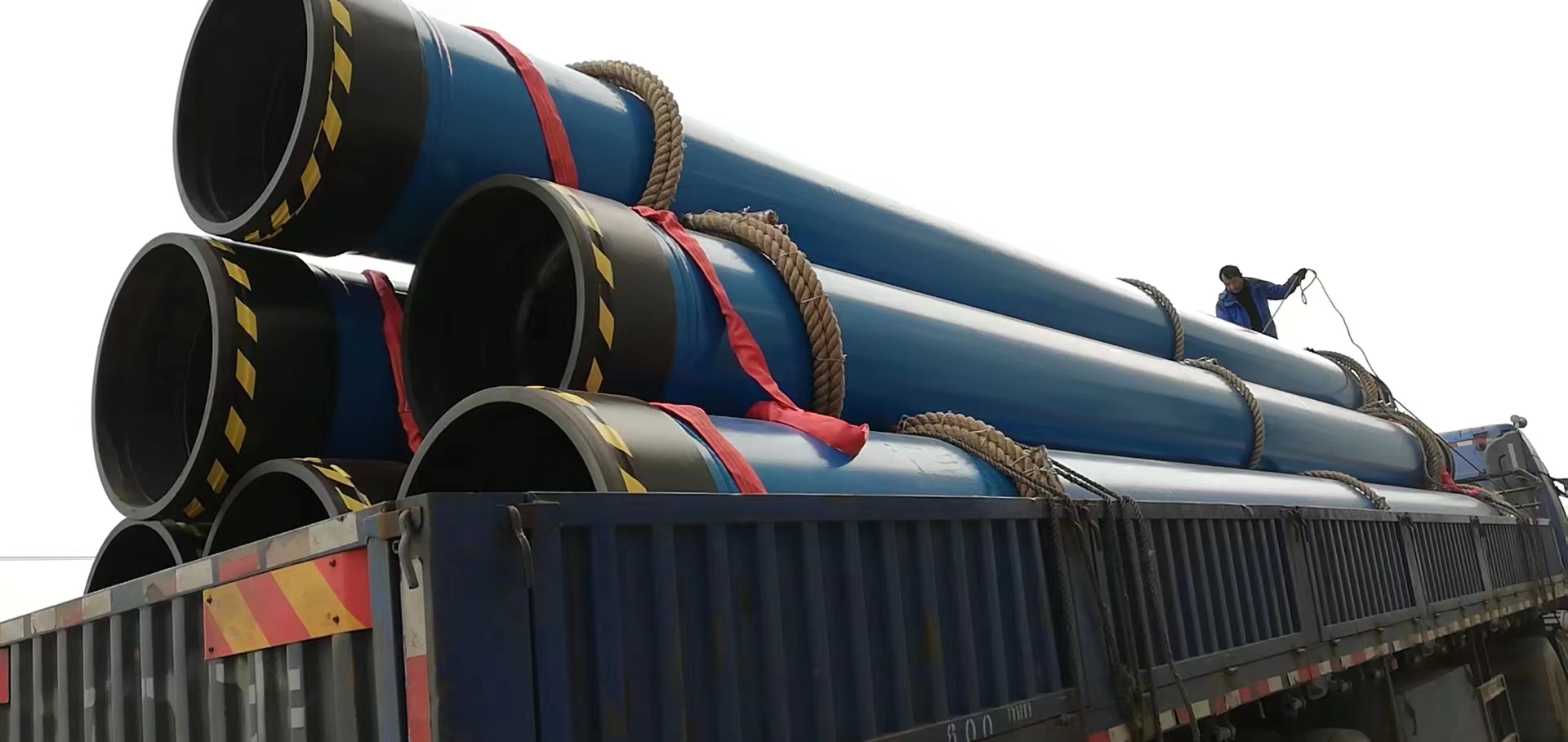 FBE-coated 600 mm welded line pipe strapped on a flatbed for a ZC project shipment.
All three welded pipe types are compatible with standard external coating systems (3LPE, FBE, 3LPP). For LSAW pipe used in offshore applications, FBE is the standard base coating before concrete weight coating. SSAW pipe with its spiral weld geometry requires careful coating application at the weld seam — confirm coating applicator experience with spiral pipe before specifying 3LPE on SSAW for buried service. Coating selection across systems is covered in the 3LPE, FBE and 3LPP coating selection guide →.
10. Procurement Checklist and Trap
Basic checklist
- Pipe type: ERW / LSAW / SSAW — state explicitly, not "welded"
- Standard: API 5L, specific edition (e.g. API Specification 5L, 46th Edition)
- Grade, delivery condition suffix, and PSL: e.g. X65M PSL2
- OD and wall thickness in mm (and NPS for reference)
- Length: random or fixed, range
- End finish: plain end or bevelled end (bevel angle per API 5L)
- Sour service: specify ISO 15156 compliance if H2S present — regardless of MAOP
- PSL2 seam heat treatment: state temperature requirement explicitly for ERW sour service
- Cold expansion: state "cold-expanded" explicitly for LSAW on automatic welding projects
- Coating: specify type, standard, thickness, and applicator qualification
- MTC: EN 10204 3.2 (third-party witnessed) or 3.1 — state explicitly
- Inspection scope: 100% AUT seam, hydrostatic test, dimensional, hardness records on MTC
Procurement trap
Wrong PO: "12-inch API 5L X60 PSL2 welded, sour service, wall 9.52mm, 80km"
What the mill ships: SSAW — "welded" is not specific. For 12-inch diameter, spiral welding is a cost-competitive process and fully compliant with the PO wording. The mill may also supply a non-M delivery condition because no suffix was stated — non-M X60 PSL2 may have a higher carbon equivalent and reduced weldability in field girth welding.
Correct PO: "12-inch (323.9mm OD) API 5L X60M PSL2 per API Specification 5L, 46th Edition, ERW (electric resistance welded), delivery condition M (thermo-mechanically rolled coil), seam heat treatment above Ac3 temperature (mandatory for PSL2 ERW sour service), ISO 15156-2 compliance required, weld seam hardness ≤ 22 HRC per heat documented on MTC, Charpy CVN at [specify design temperature], 100% seam UT, hydrostatic test per PSL2, EN 10204 3.2 MTC with named TPI, wall 9.52mm minimum, bevel ends 30° ± 2.5°, 80km."
The correct PO is longer. Every additional line exists because a mill has, at some point, made a compliant choice on each of those points that did not match what the project required. Writing a tight PO is not bureaucracy — it is the procurement team's only enforceable quality gate before the pipe leaves the mill.
Frequently Asked Questions
What is the difference between ERW, LSAW and SSAW pipe?
ERW (Electric Resistance Welded) pipe is made from coiled strip steel rolled into a cylinder and welded longitudinally using electric resistance — suitable for smaller diameters up to 24 inches. LSAW (Longitudinal Submerged Arc Welded) pipe is made from plate steel with one or two longitudinal submerged arc welds — used for larger diameters from 16 to 60 inches with higher wall thickness capability. SSAW (Spiral Submerged Arc Welded) pipe is formed by spirally winding strip steel and welding along the helical seam — efficient for large diameters but with lower pressure ratings than LSAW for equivalent wall thickness.
Which welded pipe type is best for offshore pipelines?
LSAW is the standard choice for offshore and subsea pipelines. Its single longitudinal weld, heavy wall capability, and tight dimensional tolerances meet the strict requirements of DNV-ST-F101 and offshore project specifications. SSAW is generally not accepted for offshore applications due to its helical weld geometry and lower resistance to external pressure. ERW can be used for offshore applications in smaller diameters but is less common than LSAW for critical subsea service.
What sizes are available for ERW, LSAW and SSAW pipe?
ERW pipe is available from 1/2 inch to 24 inch OD. LSAW pipe is available from 16 inch to 60 inch OD with wall thickness up to 50mm. SSAW pipe is available from 16 inch to 120 inch OD — the largest diameter option — but with thinner wall capability than LSAW. For the common pipeline range of 16–48 inch, all three types overlap but differ in wall thickness, weld configuration, and pressure rating.
Is ERW pipe suitable for sour service?
ERW pipe can be supplied to API 5L PSL2 in sour service grades (X52S, X60S, X65S) with the additional chemistry and toughness requirements of ISO 15156. The weld zone of ERW pipe must meet the same hardness limits as seamless pipe for sour service qualification. Specify PSL2 with the sour service suffix and confirm with the mill that weld zone hardness testing is included in the inspection scope.
What is the wall thickness range for LSAW pipe?
LSAW pipe wall thickness typically ranges from 6mm to 50mm depending on OD. For large diameter pipeline applications (24–48 inch), LSAW is the only welded pipe type capable of achieving the heavy wall thicknesses required for high-pressure transmission.
Can SSAW pipe be used for gas transmission?
SSAW pipe is used for gas transmission in many markets, particularly for lower-pressure distribution and gathering lines. For high-pressure gas transmission (above 70 bar), LSAW or seamless pipe is generally preferred. Project specifications for major gas transmission pipelines typically restrict or exclude SSAW — always check the project specification before quoting SSAW for gas service.
What API 5L grades are available in welded pipe?
ERW pipe is available in API 5L grades X42 through X70 in both PSL1 and PSL2. LSAW pipe is available in X52 through X80 PSL2. SSAW pipe is typically available in X42 through X70. Higher grades in welded pipe require controlled rolling and accelerated cooling of the parent plate — confirm grade availability with the mill for large diameter, heavy wall orders.