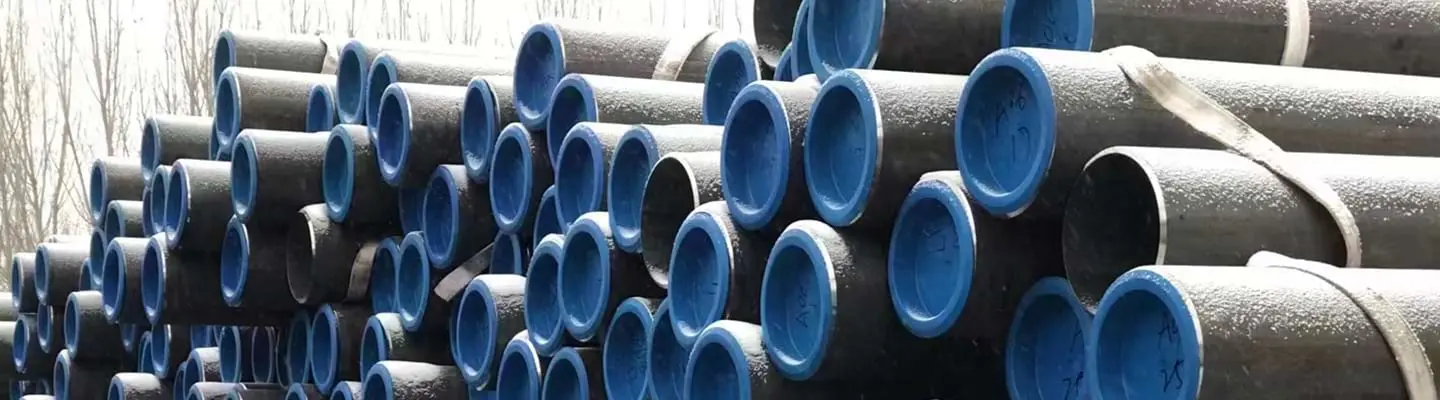
Line pipe is the backbone of oil and gas surface infrastructure — the steel pipe that carries crude oil, natural gas, natural gas liquids, and produced water from the wellhead through gathering systems, trunk lines, and transmission pipelines to processing facilities and end users. Understanding what line pipe is, how it differs from other pipe categories, and what specifications govern it is the starting point for any EPC procurement or pipeline engineering project.
ZC Steel Pipe manufactures and supplies API Specification 5L, 46th Edition seamless and welded line pipe across Africa, the Middle East, South America, and Southeast Asia. Available in PSL1 and PSL2, grades X52 through X80, with EN 10204 3.1 and 3.2 documentation and third-party inspection.
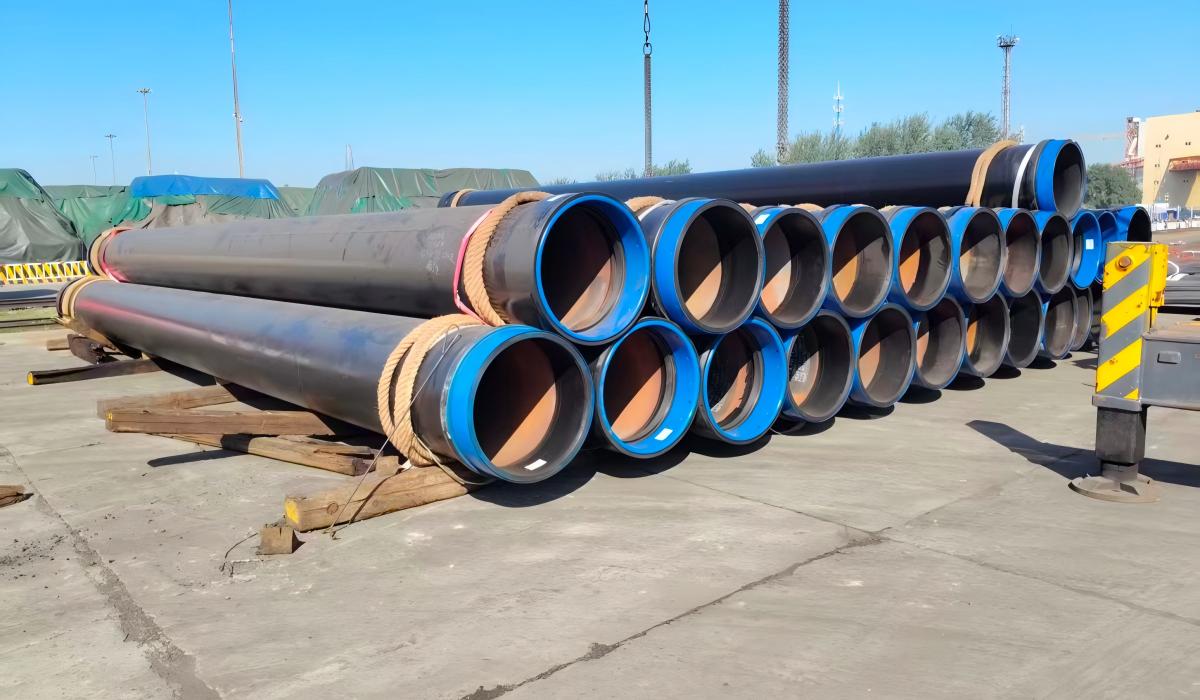 Coated line pipe on dunnage with capped ends, staged in the ZC yard before shipment — this batch was 24-inch X56 supplied to a project in Syria.
What we see on RFQs from Sub-Saharan Africa and the Middle East: The single most common document error in line pipe purchase orders is a PO that cites "ASME B31.8" or "BS EN 14161" as the pipe manufacturing standard. ASME B31.8 is a pipeline design code — mills cannot certify pipe to it. The actual material specification — the API 5L edition, PSL level, grade, and delivery condition suffix — is missing entirely. When we ask for the MTC reference, the procurement team sends a P&ID. Every line pipe order that lacks the full API 5L designation — grade, PSL level, delivery condition suffix — is an incomplete specification regardless of what design code governs the project. We flag this before the order is placed, but not every mill or trading house will.
What Is Line Pipe?
Line pipe is steel pipe manufactured specifically for the transportation of fluids — primarily oil, natural gas, natural gas liquids, and water — through pipeline systems. The governing standard is API Specification 5L, 46th Edition, which is technically harmonised with ISO 3183:2019. Both standards define the same requirements; API 5L uses US customary units alongside SI, while ISO 3183 is fully metric.
API 5L defines:
- Chemical composition limits by grade and delivery condition
- Mechanical property requirements: yield strength, tensile strength, yield-to-tensile ratio, elongation
- Two product specification levels (PSL1 and PSL2) with different mandatory test requirements
- Hydrostatic test requirements for every pipe length
- Dimensional tolerances for OD, wall thickness, straightness, and weight
- Non-destructive inspection requirements (expanded for PSL2)
- Optional supplementary requirements for sour service (Annex H), offshore (Annex J), and other conditions
Line pipe is supplied in plain-end lengths for field butt-welding. It is not supplied with threaded connections — that distinguishes it from OCTG (Oil Country Tubular Goods), which is threaded for downhole assembly.
Line Pipe vs Other Pipe Categories
Misidentifying pipe standards is a recurring procurement error in EPC projects. The four pipe families commonly confused with line pipe are:
API 5L Line Pipe vs API 5CT OCTG:
| Parameter | API 5L Line Pipe | API 5CT OCTG |
|---|---|---|
| Application | Surface fluid transmission | Downhole wellbore (casing, tubing) |
| End type | Plain ends — field welded | Threaded connections — made up at rig |
| Key tests | Hydrostat, CVN toughness, NDT | Collapse, drift, thread gauge |
| Yield range | 245–690+ MPa (Grade B – X100) | 276–930+ MPa (H40 – Q125) |
| Primary design code | ASME B31.4 / ASME B31.8 | Well design — API 5C3, operator specs |
| Governing standard | API 5L / ISO 3183 | API 5CT / ISO 11960 |
These products are not interchangeable. API 5CT casing does not carry an API 5L pressure rating, and API 5L line pipe does not carry the collapse, drift, or thread requirements of OCTG. Specifying one where the other is required creates a code compliance gap and potential liability.
API 5L Line Pipe vs ASTM A53 Standard Pipe:
ASTM A53 covers black and galvanized steel pipe for mechanical and low-pressure plumbing service. It has lower yield strength requirements than API 5L and does not include Charpy toughness, HIC testing, sour service, or pipeline-grade toughness verification. ASTM A53 Grade B (minimum yield 241 MPa / 35,000 psi) is commonly used in plant piping. It must not be substituted for API 5L in transmission pipeline service.
API 5L Line Pipe vs Structural Hollow Sections:
Structural pipe and hollow sections (ASTM A500, EN 10219, EN 10210) are designed for load-bearing structural applications — columns, trusses, frames. They are dimensioned and tested for structural performance, not internal pressure. Wall thickness tolerances, weld quality requirements, and impact testing are different from API 5L. Do not use structural pipe in pipeline service.
For the complete PSL1 and PSL2 grade tables, see the API 5L specification tables → and the ASME B36.10M pipe schedule chart →
To calculate design pressure or minimum wall thickness for your pipeline, use the Pipeline Design Calculator →
PSL1 and PSL2 — Product Specification Levels
API 5L defines two tiers of quality requirements:
PSL1 is the baseline. It requires:
- Defined yield and tensile strength within grade limits
- Hydrostatic test of every pipe length
- Visual inspection and dimensional verification
- No mandatory Charpy V-notch toughness test
- No mandatory carbon equivalent (CE) limit
- Limited mandatory NDT
PSL2 adds:
- Mandatory Charpy V-notch impact testing at a specified test temperature
- Maximum carbon equivalent limit (CE_IIW or Pcm depending on grade)
- Maximum yield-to-tensile ratio of 0.93 for pipe OD above 323.9 mm (12.750 in)
- Additional NDT: 100% automated UT of weld seam (welded pipe), magnetic particle or flux leakage inspection
- Maximum hardness limit of 22 HRC for sour service grades (when Annex H is specified)
All high-pressure transmission pipelines and all sour service applications specify PSL2. PSL1 is used primarily for gathering systems, distribution lines, and applications where the pipeline code allows the lower specification level.
PSL1 is not a cheaper version of PSL2 — it is a materially different engineering decision. PSL1 has no mandatory Charpy V-notch testing, no carbon equivalent ceiling, and no yield-to-tensile ratio limit. A PSL1 X65 pipe can arrive with a CE of 0.52% and no toughness test result on the MTC, and it is fully compliant with the standard. In cold climates or for pipelines with design temperatures below 0°C, PSL1 pipe can be catastrophically brittle without any record of that brittleness on the MTC. The cost difference between PSL1 and PSL2 for the same OD and grade is typically 3–8% — far less than the cost of a brittle fracture propagation event on a pressurised gas pipeline.
For a detailed comparison, see the API 5L PSL1 vs PSL2 line pipe selection guide.
API 5L Grade Table
All mechanical values from API Specification 5L, 46th Edition. PSL2 values shown.
| Grade (metric / imperial) | Min Yield (MPa) | Max Yield (MPa) | Min Yield (ksi) | Min Tensile (MPa) | Typical Application |
|---|---|---|---|---|---|
| L245 / B | 245 | 450 | 35.5 | 415 | Low-pressure gathering, distribution |
| L290 / X42 | 290 | 495 | 42.1 | 415 | Gathering, onshore distribution |
| L360 / X52 | 360 | 530 | 52.2 | 460 | Onshore transmission, moderate pressure |
| L415 / X60 | 415 | 565 | 60.2 | 520 | Onshore and offshore transmission |
| L450 / X65 | 450 | 600 | 65.3 | 535 | High-pressure transmission, most common mainline grade |
| L485 / X70 | 485 | 635 | 70.3 | 570 | Long-distance high-pressure transmission |
| L555 / X80 | 555 | 705 | 80.5 | 625 | Large-diameter high-pressure mainlines, strain-based design |
X65 and X70 are the dominant grades for long-distance oil and gas transmission. X80 is used on large-diameter high-pressure projects where higher grade reduces wall thickness and lowers the pipe tonnage requirement. The PSL2 yield ceiling matters operationally — a PSL2 X65 cannot arrive with a yield of 700 MPa, which means the pipe body strength is bounded for string design calculations. PSL1 carries no such ceiling. For individual grade specifications, see the dedicated X65, X70, and X80 articles.
Wall Thickness Design — ASME B31.8 Barlow Worked Example
The minimum required wall thickness for a gas transmission pipeline under ASME B31.8 is calculated using the Barlow formula:
t = P × D / (2 × SMYS × F)
where P = design pressure (MPa), D = outside diameter (mm), SMYS = specified minimum yield strength (MPa), and F = design factor (0.72 for Class 1 onshore location).
For a 24-inch (609.6 mm OD) onshore gas pipeline at 10.0 MPa (100 bar) design pressure, Class 1 location:
| Grade | SMYS (MPa) | Calculation | Min Wall (mm) |
|---|---|---|---|
| Grade B | 245 | 10.0 × 609.6 / (2 × 245 × 0.72) | 17.27 |
| X52 | 360 | 10.0 × 609.6 / (2 × 360 × 0.72) | 11.76 |
| X65 | 450 | 10.0 × 609.6 / (2 × 450 × 0.72) | 9.41 |
| X70 | 485 | 10.0 × 609.6 / (2 × 485 × 0.72) | 8.73 |
The grade selection decision is a wall thickness decision, which is a tonnage decision. Upgrading from X52 to X65 reduces minimum required wall by 2.35 mm — on a 200 km mainline in 24-inch OD, that difference in pipe weight is significant enough to justify the grade premium several times over. Upgrading further to X70 saves another 0.68 mm of wall but requires tighter field welding controls and a qualified WPS for higher-strength material.
Grade B is not competitive for transmission pressures above 5 MPa at this diameter — the required wall thickness exceeds what most mills routinely roll for this OD, and the pipe weight per metre makes it uneconomical for long hauls. For project-specific wall thickness calculations at your design pressure and OD, use the Pipeline Design Calculator →
Delivery Conditions
API 5L PSL2 grades above X52 are supplied in one of three delivery conditions, indicated by a suffix on the grade designation:
| Suffix | Delivery Condition | What It Means |
|---|---|---|
| Q | Quench and Tempered | Heated, quenched in water or oil, tempered — highest strength consistency |
| M | Thermo-Mechanically Rolled | Rolled at controlled temperature — no heat treatment after rolling |
| N | Normalised | Heated above Ac3 and air-cooled — used for lower grades |
The suffix matters for welding: X65M (thermo-mechanically rolled) has a lower carbon equivalent than X65Q, making it easier to weld in the field without preheat. For sour service, X65M is typically preferred because it achieves the required low CE without additional alloy content. Omitting the suffix from the PO is a procurement trap addressed in the Purchase Order Guidance section below.
Manufacturing Methods
API 5L line pipe is manufactured by four methods. The choice depends on OD, wall thickness, and service requirements.
Seamless: Produced from a solid steel billet by rotary piercing and rolling — no longitudinal weld seam. Used for OD up to approximately 16 inch (406 mm) and for high-pressure, sour service, or riser applications where a weld seam is undesirable. Typical size range: NPS 2 to NPS 16.
ERW (Electric Resistance Welded): Formed from hot-rolled strip with the edges joined by high-frequency electrical resistance welding. No filler metal. Cost-effective for moderate sizes and pressures. Typical size range: NPS 2 to NPS 24, though most ERW line pipe is below NPS 16.
LSAW (Longitudinal Submerged Arc Welded): Formed from steel plate (UOE or JCOE process) with one or two longitudinal submerged arc weld seams. Standard for large-diameter transmission pipe. Typical size range: NPS 16 to NPS 60.
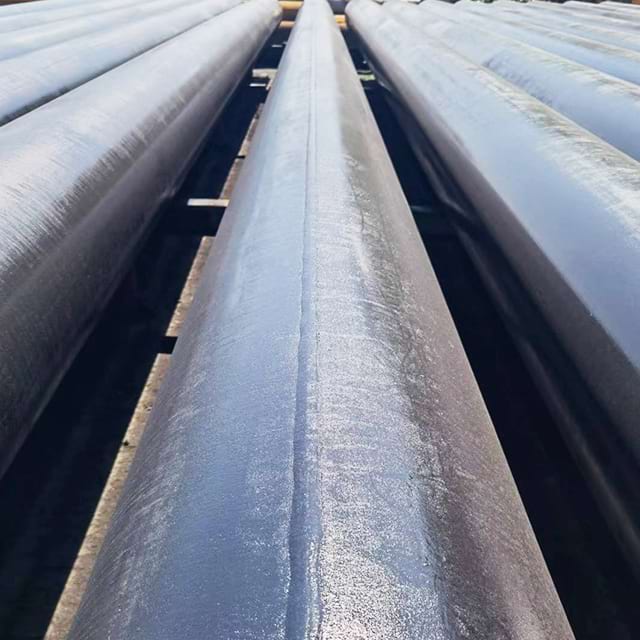 LSAW line pipe on outdoor racks — the single straight longitudinal submerged-arc weld seam distinguishes plate-formed LSAW from seamless and spiral-welded pipe.
SSAW (Spiral Submerged Arc Welded): Formed from coil with a helical weld seam. Lower capital cost than LSAW. Common for water transmission and lower-pressure gathering lines. Size range: NPS 4 to NPS 120.
For a detailed comparison of manufacturing methods and when to specify each, see the seamless vs welded line pipe selection guide and the welded steel pipe: ERW, LSAW, and SSAW types guide.
Line pipe grades go beyond fluid transport: Not every API 5L order is destined for a pipeline. We recently shipped 65 joints of 24" X56 in R3 to a Syrian drilling contractor as conductor riser — spiral-welded (SWAL) structural pipe with a ZC-4S quick make-up connection, not plain-end butt-weld line pipe. At 24" OD, spiral submerged-arc is the standard route, and X56 gives the conductor the structural strength it needs without the alloy cost of a high-grade transmission steel. The API 5L grade defines the steel; the connection and end finish are what tell you it is a structural string, not a mainline joint.
Applications by Pipeline Category
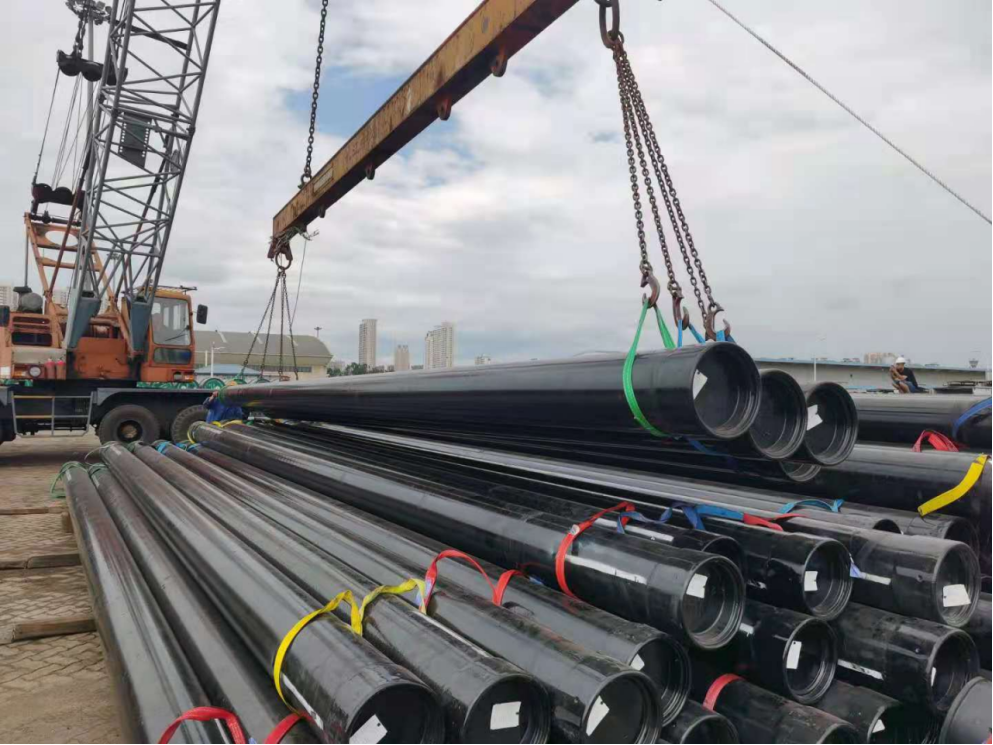 A sling of coated line pipe under the crane at the dock — part of a mixed OCTG and line pipe consignment ZC shipped to a project in Africa.
| Pipeline Category | Fluid | Common Grades | Typical OD | Code |
|---|---|---|---|---|
| Gathering (onshore) | Crude oil, gas, water | X52, X60 PSL1/PSL2 | NPS 4–16 | ASME B31.4 / B31.8 |
| Onshore transmission | Crude oil | X65, X70 PSL2 | NPS 8–36 | ASME B31.4 |
| Onshore transmission | Natural gas | X65, X70, X80 PSL2 | NPS 16–56 | ASME B31.8 |
| Sour service | Gas with H₂S | X65 PSL2 + Annex H | NPS 6–48 | ASME B31.8 + NACE |
| Offshore subsea | Oil or gas | X65, X70 PSL2 + Annex J | NPS 4–32 | DNV-ST-F101 |
| Water injection | Produced water | Grade B, X42 PSL1 | NPS 2–12 | ASME B31.4 |
For sour service (H₂S-containing fluids), API 5L PSL2 with Annex H supplementary requirements is mandatory. Annex H adds: maximum hardness of 22 HRC (250 HV), HIC (Hydrogen Induced Cracking) testing on base metal, additional Charpy requirements, and sulphide stress cracking (SSC) testing requirements. See the API 5L PSL2 Annex H sour gas metallurgy requirements article for the full Annex H specification.
When NOT to Specify PSL1
PSL1 is appropriate for low-pressure gathering in warm climates, water injection lines, and short distribution systems where Charpy toughness is not critical to system safety. Outside those narrow conditions, PSL1 creates engineering risk that PSL2 eliminates for a modest cost premium.
| Condition | Why PSL1 Fails | Correct Specification |
|---|---|---|
| Design temperature below 0°C | No mandatory Charpy — brittle fracture risk with no toughness record on MTC | PSL2 with CVN at specified temperature |
| Gas transmission pipeline | PSL1 CE not controlled — weld HAZ risk at elevated CE | PSL2 with delivery condition suffix |
| Sour service (H₂S present) | No HIC test, no CE limit — susceptible to hydrogen-induced cracking | PSL2 + SR15C (Annex H) |
| Offshore or subsea | No Y/T ratio control, no mandatory weld seam UT | PSL2 + project supplementary requirements |
| Automatic welding (PGAW, GMAW) | CE control required for consistent HAZ toughness across heats | PSL2 M (thermo-mechanically rolled) |
For any gas transmission pipeline — regardless of climate — specify PSL2. The incremental cost is trivial compared to the liability of a toughness failure. PSL1 on a gas transmission line is an engineering shortcut that transfers risk from the procurement budget to the pipeline operator.
Named Failure Modes
Failure Mode 1: PSL1 Pipe in Low-Temperature Service — Brittle Fracture
Mechanism: API 5L PSL1 does not mandate Charpy V-notch impact testing. A PSL1 X65 pipe body with inadequate impact toughness behaves in a brittle manner below its transition temperature — typically 0°C to −20°C for unoptimised chemistry. In a cold-climate pipeline (ambient below −5°C during hydrotest or commissioning), a brittle fracture can initiate at a minor stress concentration and propagate along the pipe body at high velocity. Once started, a brittle fracture in a pressurised gas pipeline does not arrest without a toughness barrier.
Diagnostic: Catastrophic fracture during cold-weather hydrotest or early commissioning. Fracture surface shows no plastic deformation — flat, glassy, crystalline appearance. MTCs show no Charpy test results (PSL1 — not required).
Fix: Specify PSL2 for all gas transmission pipelines in climates where ambient temperature falls below 0°C. For existing PSL1 pipe in stock, specify Charpy testing as a supplementary requirement before acceptance. Never substitute PSL1 for PSL2 on a gas pipeline on the basis of cost alone.
Failure Mode 2: X65 Without Delivery Condition Suffix — Wrong Weldability
Mechanism: A PO specifying "X65 PSL2" without the delivery condition suffix (Q, M, or N) allows the mill to ship X65Q (quench-and-tempered). X65Q has a higher carbon equivalent than X65M (thermo-mechanically rolled) — typically CE(IIW) 0.41–0.43% for X65Q vs 0.38–0.41% for X65M. In the field, the welding procedure was qualified on X65M. At ambient temperatures below 5°C, the X65Q pipe requires preheat to achieve the required HAZ toughness. Without preheat, the HAZ underbead cracks — a defect that may not appear on radiography until the crack opens under service pressure.
Diagnostic: HAZ cracking detected on post-weld UT or radiography during NDT. Cracking appears in the heat-affected zone, not in the weld fusion zone. MTC shows delivery condition as Q, while the project WPS was qualified on M.
Fix: Specify delivery condition suffix explicitly — "X65M" for most field-welded construction, "X65Q" only if the welding procedure is qualified for Q delivery. For automatic welding on large-diameter pipelines, X65M is the standard specification.
Failure Mode 3: ASTM A53 Substituted for API 5L in Gathering Line
Mechanism: ASTM A53 Grade B has minimum yield of 241 MPa (35 ksi) vs 360 MPa for X52 and 450 MPa for X65. When A53 pipe is installed in a gathering line designed for X52 or X65 operating pressure — because A53 was available and "looks the same" — the pipe operates above its allowable hoop stress. At a valve station or pig receiver where pressure can spike above MAOP, the A53 pipe can fail plastically and rupture.
Diagnostic: Pipe body rupture at a localised pressure surge above the design MAOP. MTC shows ASTM A53 Grade B, not API 5L. Metallurgical examination confirms lower yield strength than the design requires.
Fix: Establish a material traceability system from mill certification to field installation. Mark API 5L pipe with paint stencil grade code before it leaves the yard — A53 pipe has a different stencil format. Never accept ASTM A53 as a substitute for API 5L in pipeline service, regardless of nominal size match.
Purchase Order Guidance
A complete API 5L line pipe purchase order requires the following minimum information:
- Standard: API Specification 5L, 46th Edition (or ISO 3183:2019)
- PSL level: PSL1 or PSL2
- Grade: Full metric designation including delivery condition suffix — e.g., L450M / X65M (not just "X65")
- OD and wall thickness: In mm (or inches with decimal) — not schedule
- Length range: API 5L defines R1 (4–7.5 m), R2 (7.5–15 m), R3 (15+ m) — specify the range required
- End finish: Bevelled plain ends for welding; specify bevel angle if non-standard (API 5L default is 30° bevel)
- Supplementary requirements: State Annex H (sour service), Annex J (offshore), or other annexes explicitly
- Inspection and documentation: EN 10204 3.1 MTR minimum; 3.2 with independent inspector for critical service
- Coating: Specify if external or internal coating is required; coating specification is separate from API 5L
Procurement trap — grade suffix omission:
Wrong PO: "24-inch X65 pipe, API 5L PSL2, wall 14.3mm, plain ends, EN 10204 3.2, 50km"
What the mill ships: X65Q delivery condition (not M). No delivery condition suffix on the PO — mill chooses Q, which has higher CE. The field welding WPS was qualified for M and does not cover Q without re-qualification. At low ambient temperatures, the X65Q pipe requires preheat that was not in the project budget. The mill is fully API-compliant. The procurement team is not.
Correct PO: "24-inch (609.6 mm OD) API 5L X65M PSL2 per API Specification 5L, 46th Edition, wall thickness 14.3mm (minimum), bevel ends 30° ± 2.5°, delivery condition: thermo-mechanically rolled (M), Charpy CVN per PSL2 at −10°C, 100% pipe body and weld seam UT per PSL2, EN 10204 3.2 MTC with named TPI, Range R2/R3 [specify], coating per separate specification if required, 50km."
The difference between the wrong PO and the correct PO is the delivery condition suffix, the explicit Charpy temperature, and the UT requirement called out by PSL level. None of those additions cost procurement time. Missing them costs field welding time, NDT rework, and potentially a hold on the WPS qualification mid-construction.
ZC Steel Pipe supplies API 5L PSL2 line pipe in grades X52 through X80, seamless and welded (ERW, LSAW), with full EN 10204 3.1 and 3.2 documentation and third-party inspection available. Contact ZC with your grade, OD, wall thickness, and project location for supply availability and lead time.
Frequently Asked Questions
What is line pipe and what standard defines it?
Line pipe is steel pipe manufactured for the transport of oil, natural gas, water, and other fluids through pipelines. The primary governing standard is API Specification 5L, 46th Edition (identical in technical content to ISO 3183:2019). API 5L defines two product specification levels — PSL1 for general service and PSL2 for more demanding service with additional chemical, mechanical, and toughness requirements. Line pipe is distinct from OCTG (casing and tubing, governed by API 5CT), structural hollow sections, and general-service pipe governed by ASTM A53.
What is the difference between line pipe and OCTG?
Line pipe (API 5L / ISO 3183) is designed for surface fluid transport through buried or subsea pipelines. OCTG — Oil Country Tubular Goods (API 5CT) — covers casing and tubing used downhole in wellbores. The two product families have different mechanical requirements, different quality tests, and different connection systems. Line pipe typically has plain ends welded in the field; OCTG has threaded connections made up at the rig. Specifying one standard in a job that requires the other is a serious procurement error — the products are not interchangeable.
What is the difference between line pipe and standard pipe or structural pipe?
Standard pipe (ASTM A53) is a general-service pipe for low-pressure plumbing and mechanical applications — it has lower yield strength and fewer quality requirements than API 5L line pipe. Structural hollow sections (ASTM A500, EN 10219) are dimensioned and tested for structural load-bearing, not internal pressure. API 5L line pipe is specifically designed and tested for high-pressure fluid transmission: it has defined yield and tensile limits, hydrostatic testing, and optional toughness testing (Charpy V-notch) not required by structural or standard pipe standards. Do not substitute ASTM A53 or structural pipe for API 5L in transmission pipeline service.
What does PSL1 vs PSL2 mean for line pipe?
PSL (Product Specification Level) defines the mandatory quality requirements that a line pipe must meet. PSL1 is the baseline: defined yield strength, tensile strength, and hydrostatic test — no mandatory Charpy toughness, no chemistry carbon equivalent limit, and limited mandatory NDT. PSL2 adds mandatory Charpy V-notch toughness (at a specified test temperature), a maximum carbon equivalent limit, a maximum yield-to-tensile ratio of 0.93 (for pipe above 323.9 mm OD), and additional NDT requirements. Most transmission pipeline projects and all sour service applications specify PSL2.
What are the common API 5L line pipe grades?
API 5L grades are designated by yield strength in MPa (metric designation) or minimum yield in ksi (imperial designation). Common grades for transmission pipelines are X52 (minimum yield 360 MPa / 52,200 psi), X60 (415 MPa / 60,200 psi), X65 (450 MPa / 65,300 psi), X70 (485 MPa / 70,300 psi), and X80 (555 MPa / 80,500 psi). Grade B (245 MPa / 35,500 psi) is used for low-pressure gathering and distribution. Higher grades (X90, X100) are available in PSL2 for special project specifications. X65 and X70 PSL2 are the most widely specified grades for long-distance gas and oil transmission.
What manufacturing methods are used for line pipe?
API 5L line pipe is manufactured by three main methods. Seamless pipe is formed from a solid billet without a longitudinal weld seam — used for smaller diameters (typically below 16 inch) and high-pressure applications. ERW (Electric Resistance Welded) pipe is formed from hot-rolled coil with a high-frequency electric resistance weld — cost-effective for moderate sizes and pressures. LSAW (Longitudinal Submerged Arc Welded) pipe is formed from steel plate and welded with submerged arc welding — standard for large diameters (above 16 inch) used in major transmission pipelines. SSAW (Spiral Submerged Arc Welded) pipe uses a helical weld seam and is common for water transmission.
Can API 5L line pipe be used for both oil and gas transmission?
Yes. API 5L line pipe is designed and tested for transmission of oil, natural gas, natural gas liquids (NGL), and water. The operating code that governs the pipeline system — ASME B31.4 for liquid petroleum, ASME B31.8 for gas transmission — determines the design factors, inspection requirements, and material requirements applied to the line pipe. The API 5L standard itself does not specify whether the pipe is for oil or gas service. For sour service (H2S-containing fluids), API 5L PSL2 with Annex H supplementary requirements is specified regardless of whether the fluid is oil or gas.
What should be included in a line pipe purchase order?
A complete line pipe purchase order should specify: API 5L edition and PSL level (PSL1 or PSL2); grade designation (e.g., L450M / X65M); OD and wall thickness or schedule; pipe end type (plain ends, bevelled ends, or specific bevel angle); delivery condition suffix (Q = quench and tempered, M = thermo-mechanically rolled, N = normalised); supplementary requirements if applicable (Annex H for sour service, Annex J for offshore, HIC testing); inspection and documentation level (EN 10204 3.1 minimum, 3.2 for critical applications); and coating if required.