
BTC make-up torque is one of the most frequently misapplied parameters in casing running. The values published in API Recommended Practice 5C1 are widely referenced but rarely applied correctly — because they are calculated for a specific thread compound friction factor that does not match most compounds in common field use. The result is systematic under-makeup in operations using modern low-friction compounds, or over-makeup when high-friction compounds are applied without adjustment. Both conditions produce field failures that are entirely avoidable.
ZC Steel Pipe supplies API Specification 5CT, 11th Edition casing and tubing with BTC connections from 4½" through 20" OD across the full grade range from J55 through Q125. Most of our BTC orders go to intermediate and production casing strings for well programmes in West Africa, the Middle East, and Southeast Asia — markets where the rig crews are experienced but the torque documentation arriving with the well program is frequently incomplete.
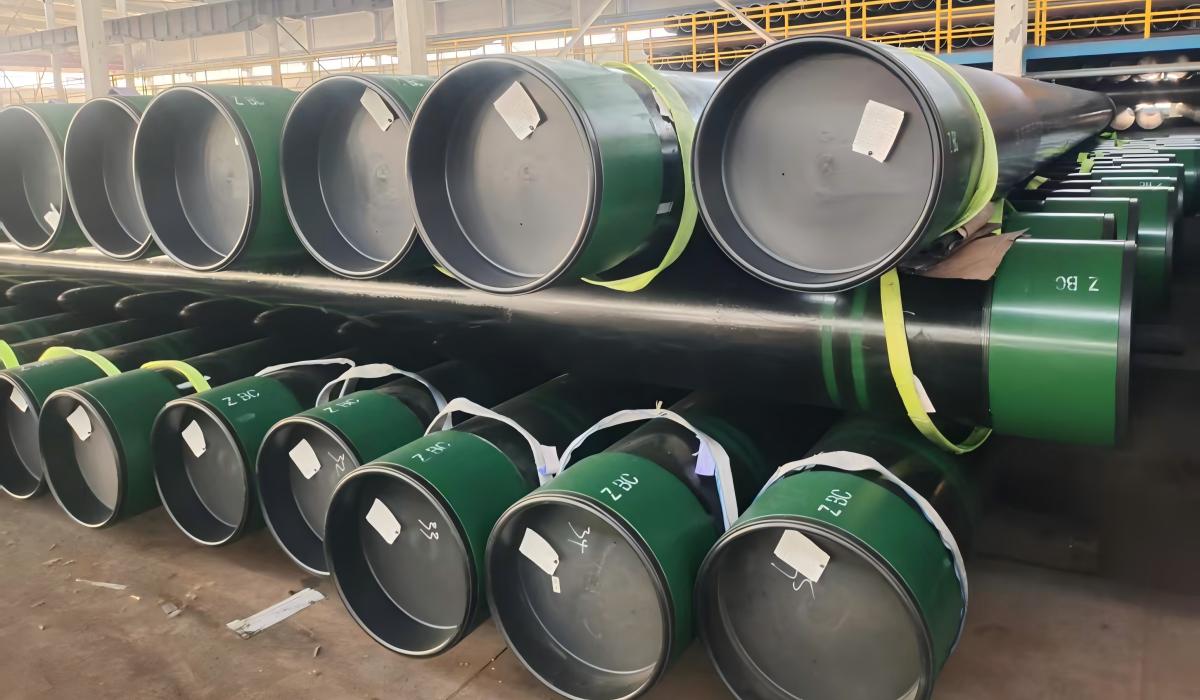 K55 casing with BTC couplings staged for a Colombian programme, green box protectors marking the buttress coupling ends.
What we see at the inspection stage: When SGS inspects BTC casing at our mill before shipment, the most common connection-related finding is not thread form — it is thread compound specification. We regularly receive purchase orders that specify "API-modified thread compound" without a friction factor. When the receiving yard uses green compound with friction factor 0.82, and the rig crew applies API 5C1 torque values directly, the string is systematically under-made-up by 18%. We now include a friction factor adjustment table in our inspection packing list.
This reference covers the API 5C1 torque methodology, a complete field torque table for 4½" through 13-3/8", friction factor adjustment calculations, the specific conditions where unadjusted 5C1 values will produce wrong results, named failure modes with field diagnostics, power tong setup requirements, and troubleshooting for the most common field discrepancies.
Quick Answer
Three things govern BTC make-up torque, and getting any one wrong causes field failures:
- The published 5C1 values assume a friction factor of 1.0 (traditional zinc "black dope"). Modern low-friction compounds under-make-up the string if you apply the table directly — e.g. a friction factor of 0.82 leaves the connection ~18% below target torque.
- The triangle stamp position is the primary acceptance criterion, not torque. Torque is the secondary check that flags a problem during make-up; the stamp defines the endpoint.
- Stay inside the min/max window: never accept below minimum (jump-out risk) or exceed maximum (permanent coupling deformation).
The full methodology, the field torque table, and the friction-factor adjustment follow. For the joint strength these torque values are protecting, see the joint strength calculator → and the API 5C3 joint-strength formulas →.
What API 5C1 Torque Values Represent
API 5C1 BTC make-up torque values are calculated using a thread engagement model based on the BTC thread geometry: 5 threads per inch, 1:16 taper, 3° load flank. The methodology accounts for three design limits simultaneously:
- Minimum thread engagement required to resist jump-out under the design combination of tensile load and internal pressure
- Coupling yield limit — the maximum torque the box can accept without plastic deformation of the coupling body
- Thread compound friction factor — assumed at 1.0 for API-modified compound (the traditional zinc-based "black dope")
Three torque values are defined for each size, weight, and grade combination:
| Torque Value | Definition | Field Use |
|---|---|---|
| Minimum | Lowest torque at which design thread engagement is achieved | Lower acceptance limit — never accept below this |
| Optimum | Target torque — full engagement with margin above minimum | Target for makeup — used alongside triangle stamp position |
| Maximum | Upper limit before coupling plastic deformation risk | Never exceed — over-torque damages the box permanently |
The triangle stamp position — the location of the coupling face relative to the pin triangle mark — is the primary acceptance criterion for BTC makeup. Torque values are the secondary criterion, used to detect problems during makeup rather than to define the makeup endpoint. A connection can reach the correct triangle position at a torque that diverges significantly from the tabulated value; understanding why that divergence occurred matters more than forcing either criterion to agree.
For a full explanation of triangle stamp procedure and the consequences of positional errors, see the BTC Buttress Thread Casing Field Guide →.
Thread Compound Friction Factor — The Critical Variable
Friction factor is the single most important variable in BTC make-up torque application, and the most commonly ignored. API 5C1 calibrates all torque values to a friction factor of 1.0, which corresponds to traditional API-modified zinc-based thread compound. Most casing crews today use low-friction environmentally compliant compounds — "green dope" — with friction factors in the range of 0.80 to 0.90.
The physical effect is direct: lower friction means more thread rotation for a given torque input. The coupling reaches the triangle position having rotated more turns, at a lower recorded torque than the tabulated value. The connection is correctly positioned but appears under-torqued to a crew applying unadjusted 5C1 targets. In practice, this produces two bad outcomes: the crew either accepts a correctly made-up connection after unnecessary alarm, or — more dangerously — applies additional torque to reach the tabulated minimum, over-making up the connection and risking box deformation.
Friction factor reference values by compound type:
| Compound Type | Friction Factor | Effect on Torque Target |
|---|---|---|
| API-modified zinc (black dope) | 1.00 | Baseline — use 5C1 values directly |
| Environmentally compliant (green dope) | 0.80–0.90 | Reduce required torque by 10–20% |
| Anti-galling paste (CRA-compatible) | 0.70–0.80 | Reduce required torque by 20–30% |
| High-viscosity heavy-duty compound | 1.05–1.15 | Increase required torque by 5–15% |
Always obtain the friction factor from the compound manufacturer's data sheet — the friction factor is not the same as the viscosity or consistency rating printed on the product label.
When NOT to Apply API 5C1 Values Directly
Five conditions exist where using unadjusted 5C1 torque values will systematically produce incorrect makeup. These are not edge cases — they are routine operating conditions on modern rigs.
Green or environmentally compliant compound (friction factor 0.80–0.90). This is now the default in most markets where environmental regulations restrict zinc-bearing compounds. The 5C1 torque values must be reduced by 10–20% before use. Running a 9-5/8" 47 lb/ft P110 string with a 5C1 optimum of 31,500 N·m and a green compound at FF 0.85 means the correct adjusted target is 26,775 N·m — not 31,500.
Compound applied from cold storage. Thread compound viscosity increases significantly at low temperatures, raising the effective friction factor above the manufacturer's stated value. Compound brought directly from a cold storage container (below 10°C) behaves more like a high-friction compound even when the data sheet quotes a low friction factor. Allow compound to reach ambient temperature before application, or verify the friction factor at the actual application temperature.
Re-run connections after breakout. Thread flank wear on a previously made-up and broken-out connection reduces the effective friction on subsequent makeups. The same compound will produce a lower effective friction factor on a worn thread than on a new thread, meaning the coupling reaches the triangle position at a lower torque than on the first run. After each breakout, inspect thread load flanks for wear and reduce the torque target if significant wear is observed. For critical strings, the third makeup cycle should be treated with the same caution as a first run with a low-friction compound.
Sour service connections running CRA-compatible anti-galling paste. Connections in L80, T95, or C110 service where the well programme specifies a CRA-compatible anti-galling paste (friction factor 0.70–0.80) require a torque reduction of 20–30%. A crew applying 5C1 minimum torque as the lower acceptance limit with this compound is over-torquing every connection.
Large-diameter pipe 16" and 20". At these sizes, BTC torque values should be verified with the coupling manufacturer before use. Compound distribution across a 16" or 20" thread surface is inherently less consistent than on smaller sizes — the pipe weight makes uniform dope application difficult, and tong die contact area relative to pipe body area creates a bending moment that the simple friction-factor adjustment does not capture. Use coupling-manufacturer-confirmed torque values and reduced makeup speed (below 12 RPM) for these sizes.
The triangle stamp position and the torque value are two separate acceptance criteria — not one criterion expressed two ways. A connection that reaches the triangle base at the adjusted optimum torque has satisfied both criteria independently. A connection that reaches the triangle base below adjusted minimum torque is positionally correct but mechanically uncertain — the tong may have slipped, the gauge may have been reading wrong, or the compound friction factor may differ from the assumed value. Both criteria must be satisfied simultaneously. If they disagree, investigate the discrepancy before running the joint.
BTC Make-Up Torque Reference Table
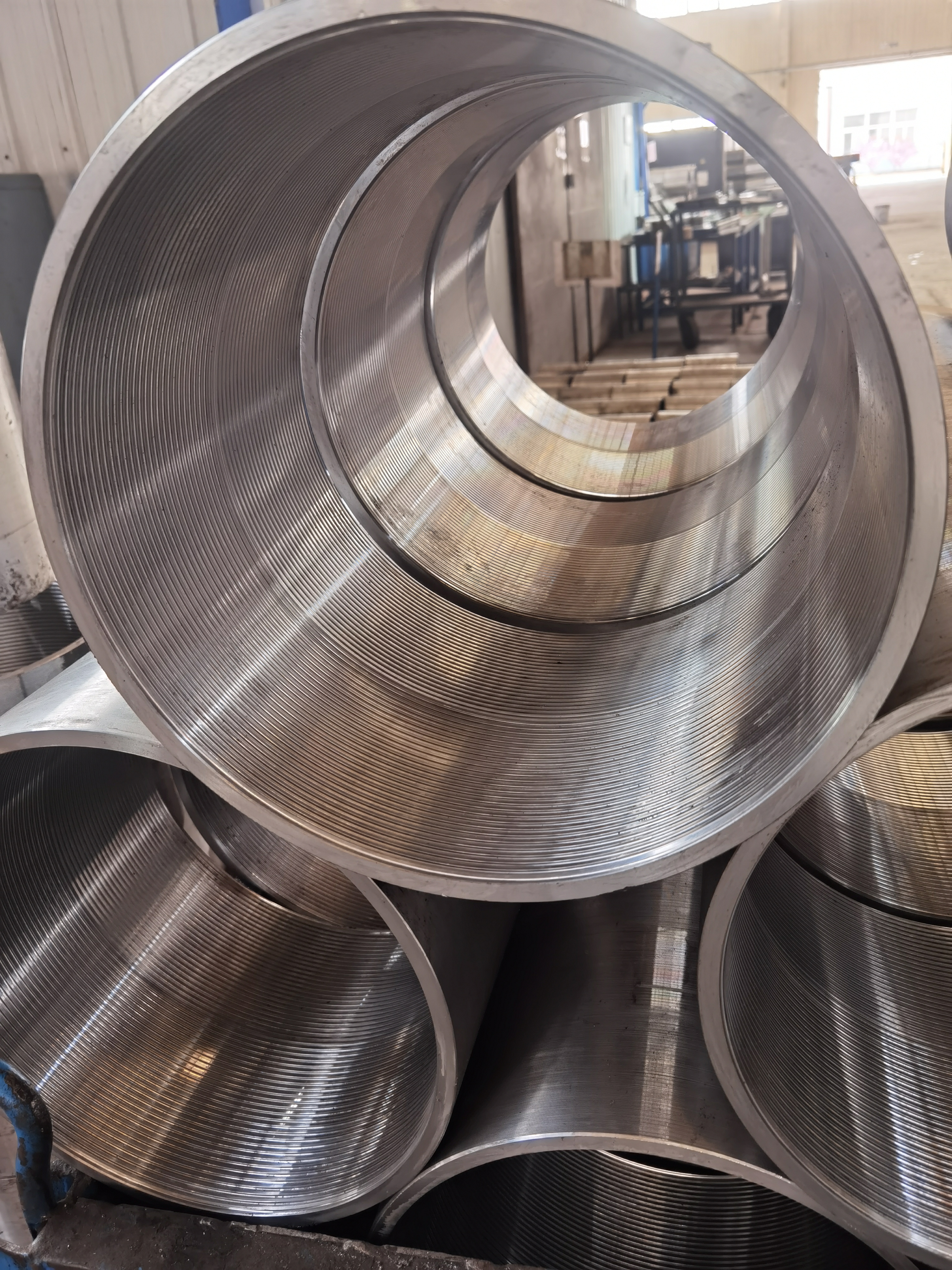 BTC couplings stacked before assembly — the internal buttress threads whose engagement the make-up torque is set to protect.
Values below are consistent with API 5C1 calculations for BTC connections. Verify against the current edition of API RP 5C1 before use. All values assume friction factor 1.0 (API-modified compound) — multiply the tabulated torque by the compound friction factor before running.
| OD (in) | OD (mm) | Weight (lb/ft) | Grade | Min Torque (N·m) | Opt Torque (N·m) | Max Torque (N·m) | Opt Torque (ft·lbf) |
|---|---|---|---|---|---|---|---|
| 4-1/2 | 114.3 | 11.60 | J55 | 2,700 | 3,100 | 3,700 | 2,285 |
| 4-1/2 | 114.3 | 11.60 | N80 | 3,000 | 3,500 | 4,200 | 2,580 |
| 5 | 127.0 | 15.00 | J55 | 3,600 | 4,200 | 5,000 | 3,095 |
| 5 | 127.0 | 15.00 | N80 | 4,100 | 4,800 | 5,700 | 3,540 |
| 5-1/2 | 139.7 | 17.00 | J55 | 4,800 | 5,600 | 6,600 | 4,130 |
| 5-1/2 | 139.7 | 17.00 | N80 | 5,600 | 6,500 | 7,700 | 4,795 |
| 5-1/2 | 139.7 | 20.00 | L80 | 6,800 | 7,800 | 9,200 | 5,750 |
| 5-1/2 | 139.7 | 23.00 | P110 | 8,200 | 9,400 | 11,100 | 6,930 |
| 7 | 177.8 | 23.00 | J55 | 9,100 | 10,500 | 12,400 | 7,745 |
| 7 | 177.8 | 23.00 | N80 | 10,800 | 12,400 | 14,600 | 9,145 |
| 7 | 177.8 | 26.00 | L80 | 12,000 | 13,800 | 16,300 | 10,180 |
| 7 | 177.8 | 26.00 | P110 | 13,300 | 15,200 | 18,000 | 11,215 |
| 7 | 177.8 | 29.00 | P110 | 14,800 | 17,000 | 20,100 | 12,535 |
| 7-5/8 | 193.7 | 29.70 | N80 | 14,200 | 16,300 | 19,300 | 12,020 |
| 7-5/8 | 193.7 | 39.00 | P110 | 20,000 | 23,000 | 27,200 | 16,965 |
| 9-5/8 | 244.5 | 40.00 | J55 | 19,000 | 21,900 | 25,900 | 16,150 |
| 9-5/8 | 244.5 | 40.00 | N80 | 22,400 | 25,600 | 30,300 | 18,890 |
| 9-5/8 | 244.5 | 47.00 | P110 | 27,500 | 31,500 | 37,300 | 23,230 |
| 9-5/8 | 244.5 | 53.50 | Q125 | 33,000 | 37,900 | 44,900 | 27,950 |
| 10-3/4 | 273.1 | 55.50 | N80 | 34,000 | 39,000 | 46,200 | 28,770 |
| 13-3/8 | 339.7 | 54.50 | K55 | 41,000 | 47,100 | 55,800 | 34,745 |
| 13-3/8 | 339.7 | 68.00 | K55 | 47,000 | 54,000 | 63,900 | 39,830 |
| 13-3/8 | 339.7 | 72.00 | N80 | 55,000 | 63,200 | 74,900 | 46,620 |
The table covers the most common casing sizes from 4½" through 13-3/8". All values assume friction factor 1.0 — multiply by the compound friction factor before use. For 9-5/8" 47 lb/ft P110, the most frequently ordered size in our HPHT project orders, the adjusted optimum torque with green compound at FF 0.85 is 26,775 N·m — approximately 19,750 ft·lbf. That is 4,725 N·m below the raw 5C1 tabulated value; applying the unadjusted figure would over-make up every connection in the string.
For sizes above 13-3/8" (16" and 20"), obtain torque values directly from the current API 5C1 edition and from the coupling manufacturer. These large sizes are particularly sensitive to compound friction factor and makeup speed variations, and the simple friction-factor multiplication used for smaller sizes understates the uncertainty at these diameters.
For the complete grade and connection-class specification tables, see the API 5CT specification tables →
To match a connection type to your well conditions, use the Pipe Grade Selector →
A real 9⅝″ K55 order: 9⅝″ 47 ppf is one of the most common BTC sizes on our order book — 1,200 joints of K55 BTC went to a Middle East operator in R3 with BTC gauge inspection certificates and thread compound pre-applied. When we pre-apply compound we state its friction factor on the packing documentation, because the failure we see most is a crew taking the raw API 5C1 torque against a low-friction compound and over-turning the connection to chase a number the adjusted target never intended.
Friction Factor Adjustment Procedure
When the compound friction factor differs from the API baseline of 1.0, adjust all three torque targets before running. The adjustment applies equally to minimum, optimum, and maximum:
Adjusted torque = API 5C1 torque × compound friction factor
Worked example: Running 9-5/8", 47.00 lb/ft P110 with a green compound (friction factor 0.85):
- API 5C1 optimum torque: 31,500 N·m
- Adjusted optimum: 31,500 × 0.85 = 26,775 N·m (19,750 ft·lbf)
- Adjusted minimum: 27,500 × 0.85 = 23,375 N·m (17,240 ft·lbf)
- Adjusted maximum: 37,300 × 0.85 = 31,705 N·m (23,390 ft·lbf)
The triangle stamp position requirement is unchanged — the coupling face must land between the triangle base and apex regardless of what compound is used. The torque adjustment ensures the tong reading at correct positional makeup aligns with the adjusted target, so that triangle position and torque agreement happen at the same point. If you apply the unadjusted 5C1 values with green compound, the coupling will reach the triangle base while the tong gauge reads below adjusted minimum — the connection is correct but will appear wrong to a crew expecting 31,500 N·m.
Document the adjusted torque values in the well program before running. Do not adjust on the fly at the rig floor without written engineering approval.
Named Failure Modes — BTC Makeup Failures
Galling
Galling is adhesive wear between pin and box thread flanks caused by metal-to-metal contact under high contact stress. The mechanism: when dope coverage is insufficient — from under-application, from a compound incompatible with the pipe steel, or from excessive makeup speed — localized metal-to-metal contact occurs at the thread load flanks. The contact pressure creates micro-welds between the surfaces. As makeup continues, the welds tear apart, pulling metal from both surfaces and depositing it in irregular patches.
Diagnostic: The torque curve shows a spike that exceeds optimum, followed by a sudden drop as the welded material tears away. Visually, galled threads show bright, torn, or cold-welded metal patches on the load flanks — distinct from the matte finish of undamaged threads. Galling is distinguishable from normal thread contact marks by the irregular, pulled appearance of the surface.
Fix: Stop makeup immediately on observing the spike-and-drop torque signature. Back the connection out fully. If galling is confirmed on inspection, remove the joint from service. Galling is progressive — a galled thread that is re-run will gall more severely on the next makeup and creates a permanent leak path through the damaged flank area. The connection is not salvageable by re-application of thread compound.
Under-Makeup (Triangle-Torque Mismatch)
Under-makeup occurs when the connection appears to have reached a torque threshold but thread engagement is actually insufficient for the applied load. The mechanism is usually a mismatch between the assumed and actual friction factor, combined with worn or slipping tong dies that produce a false torque reading without actually loading the connection threads.
Diagnostic: The coupling face stops below the triangle base while the tong gauge reads minimum or optimum torque. Visually, there is a visible gap between the coupling face and the triangle base on the pin. The tong gauge reading and the triangle position do not agree — the most reliable indicator that something in the system is wrong.
Fix: Do not simply apply additional torque to compensate. Investigate first: verify tong calibration against the reference standard, check die condition and die-to-pipe OD match, confirm the friction factor being used and recalculate the adjusted torque target. If the tong is correctly calibrated and the friction factor is confirmed, inspect the joint for dimensional non-conformance — an over-tight coupling or a pin with non-conforming thread dimensions can produce premature torque build-up before the positional target is reached. Document the finding and refer to the drilling engineer before running the joint.
Box Ovalizing (13-3/8" and Above)
Large-diameter coupling boxes can deform laterally under tong makeup torque at 13-3/8" OD and above. The mechanism: the power tong applies a bending moment to the coupling body during makeup. At large diameters, the coupling wall thickness is relatively small compared to the outer diameter, and the cross-sectional geometry makes the coupling susceptible to ovalization — deformation from round toward an oval bore — under the lateral load from tong dies.
Diagnostic: After makeup, an ID gauge passed through the connection shows a non-circular bore. Visually, the coupling body may show lateral deflection visible to the naked eye on large sizes. The ovalizing load usually comes from incorrect tong positioning — tong dies gripping the coupling body rather than the pipe body adjacent to the coupling, or backup tong positioned incorrectly.
Fix: Ensure the makeup tong grips the pipe body, not the coupling. Position the backup tong on the lower pipe body, not the coupling. For 13-3/8" and above, verify coupling wall thickness meets API 5CT specifications before running — undersized coupling wall is a mill defect that dramatically increases ovalization risk. For critical strings, measure coupling OD before and after makeup on a sample basis; an increase in OD perpendicular to the tong contact faces indicates ovalization. If ovalizing is confirmed, the joint must be removed from service — an ovalised box has reduced thread engagement and will be prone to jump-out under combined loading.
Power Tong Setup and Calibration
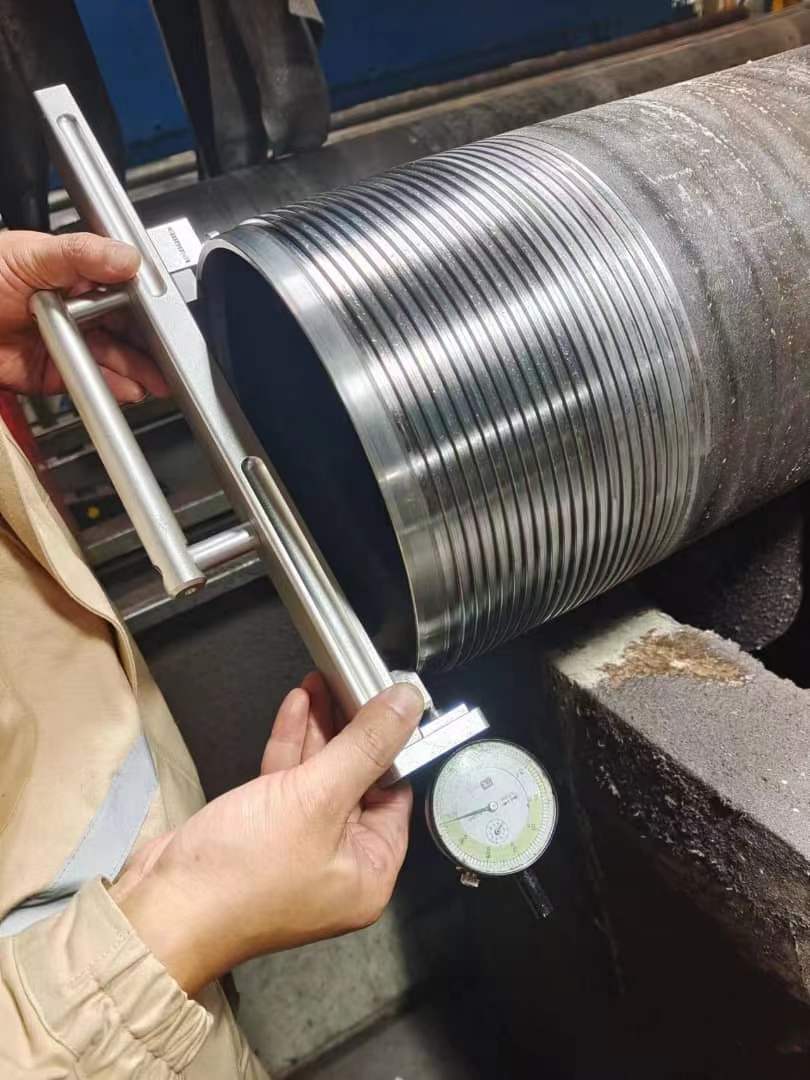 Thread gauging on a casing end at the QC stage — the dimensional check that runs alongside tong calibration before a string is made up.
Tong calibration is the most frequently neglected quality control step in BTC makeup. A tong with a 10% gauge error produces systematic under-makeup or over-makeup across an entire string — and the error is undetectable without calibration records.
Pre-run calibration requirements:
- Calibrate tong torque gauge against a certified reference (tong test stand or calibrated hydraulic load cell) before running
- Calibration record must include timestamp — most well programs require calibration within 12 hours of use
- Re-calibrate at the start of each crew shift for deep strings or sour service
- Verify tong dies are the correct size for the pipe OD — oversized dies reduce grip area and produce slipping, causing false torque readings
Die condition: Worn tong dies are a primary source of incorrect torque readings. New dies have sharp teeth that grip the pipe body firmly. Worn dies with blunted teeth slip under load — the tong gauge reads high torque while the connection receives minimal torque input. Inspect dies at the start of each job and replace when wear exceeds the tong manufacturer's limit. Slipping dies are particularly insidious because they produce a characteristic flat spot on the torque curve that can be mistaken for optimum torque rather than die slippage.
Makeup speed: BTC maximum recommended makeup speed is 20 RPM for sizes up to 9-5/8", and 15 RPM for 10-3/4" and above. Exceeding makeup speed generates frictional heat that temporarily reduces compound viscosity and friction factor, causing the connection to reach the triangle position at a lower-than-expected torque. This mimics the behaviour of a low-friction compound and will produce a triangle-position-before-minimum-torque discrepancy even when using API-modified compound. Maintain consistent makeup speed and record RPM in the tong data log.
Troubleshooting: When Torque and Triangle Disagree
The most common field discrepancies arise when triangle position and torque do not reach their targets simultaneously. The investigation sequence is the same in all cases: verify the tong, verify the compound friction factor, verify the joint dimensions — in that order.
Situation 1 — Triangle reached before minimum torque: The coupling face lands in the triangle zone but torque is below the adjusted minimum. Do not apply additional torque to compensate. First, verify tong calibration and compound friction factor. A crew that has not adjusted for green compound will encounter this situation on every joint. If calibration is confirmed and friction factor is correctly applied, investigate the joint: check OD and coupling dimensions for non-conformance, inspect threads for contamination, and measure coupling standoff. If no dimensional non-conformance is found, document and refer to the drilling engineer before running this joint.
Situation 2 — Minimum torque reached before triangle base: Torque has reached the adjusted minimum but the coupling face has not reached the triangle base. Thread engagement is insufficient at the torque applied — the connection is under-made-up positionally. Common causes: wrong thread compound with a higher friction factor than assumed (causing premature torque build-up), an over-tight coupling from manufacturing tolerance variation, or damaged or contaminated threads. Do not continue applying torque. Back out the connection and investigate before re-running. Forcing torque in this situation risks reaching maximum torque before achieving the required position — damaging the coupling body.
Situation 3 — Maximum torque reached before triangle base: Stop immediately. Applying torque beyond the maximum risks plastic deformation of the coupling. This situation indicates a serious problem — wrong connection type, grossly incorrect compound friction factor, or coupling/thread damage. Remove the joint from the string, inspect all thread dimensions and coupling condition, and refer to engineering before any further action.
Situation 4 — Torque spike and sudden drop: Galling has occurred. Back out immediately — do not continue makeup. Inspect thread flanks for adhesive wear damage. A galled joint must not be re-run; it creates a permanent leak path and will gall progressively on any subsequent makeup. See the Galling failure mode section above for the full diagnostic and removal protocol.
Purchase Order Guidance
What to specify when ordering BTC casing:
- API 5CT, 11th Edition — state PSL level (PSL-1 or PSL-2)
- Connection: BTC per API 5B
- Thread compound: specify compound manufacturer name and friction factor for the well program — not just compound type
- Mill test report: EN 10204 3.1 minimum; 3.2 for sour service or critical applications
- Thread gauge inspection: per API 5B — verify coupling and pin thread gauges are current-calibration
What to verify on the MTR before accepting a consignment:
- Heat number and chemical composition versus grade requirements in API 5CT
- Mechanical properties (yield, tensile, elongation, hardness) within grade limits
- For sour service grades (L80, T95, C90, C110): verify hardness is within the NACE MR0175 / ISO 15156 limit of 22 HRC maximum — not just within the API 5CT maximum, which is higher for some grades
Procurement trap — thread compound friction factor omission:
A PO that reads "BTC casing, API-modified thread compound" does not specify a friction factor. When the yard or rig crew receives this PO, they will use whatever compound is available on location — frequently a green compound with a friction factor between 0.80 and 0.88. The API 5C1 values are then applied uncorrected. The result is a string made up to the correct triangle position (positionally acceptable) but with thread flanks carrying less load than the design requires, because the lower friction allowed the coupling to rotate further before reaching what the crew recorded as "optimum torque." The coupling is in the right place. The mechanical engagement is substandard.
This failure mode is particularly difficult to detect after the fact — the torque records look low relative to the tabulated value, but the triangle positions are correct, so a post-run audit based on triangle photos alone will not catch it.
Correct PO language: "BTC connection, thread compound: [manufacturer name and product designation], friction factor [X.XX] per manufacturer data sheet at ambient temperature. Makeup torque based on API RP 5C1 values adjusted by friction factor [X.XX]. Adjusted optimum torque: [calculated value] N·m / [calculated value] ft·lbf. Makeup acceptance criteria: triangle position AND adjusted torque target must be satisfied simultaneously. Tong calibration records required as part of connection running report."
Procurement trap — coupling lot traceability in sour service:
API 5CT BTC couplings may be supplied from a different heat than the pipe body. In sour service, both the pipe body and the coupling must independently meet the NACE MR0175 / ISO 15156 hardness limit of 22 HRC maximum. Specifying "L80 BTC, sour service" without requiring separate coupling MTRs leaves the coupling qualification open. A pipe body with confirmed sour service compliance can be supplied with a coupling from a heat that has never been tested for hardness — and the shipment will be fully API 5CT-compliant. Specify coupling MTRs alongside pipe body MTRs, and verify coupling hardness independently. This is particularly important in markets where couplings are sourced from coupling manufacturers separate from the pipe mill.
ZC Steel Pipe supplies API 5CT casing with BTC connections across all standard sizes and grades, with EN 10204 3.1 and 3.2 documentation, third-party inspection, and sour service qualification available. Contact us for availability in your required OD, weight, grade, and PSL level.
Frequently Asked Questions
What is the source of BTC make-up torque values and which edition should I use?
BTC make-up torque values are published in API Recommended Practice 5C1, 'Recommended Practice for Care and Use of Casing and Tubing.' Use the current edition. The torque values in 5C1 are calculated for API-modified thread compound with a defined friction factor of 1.0. If your compound has a different friction factor, the tabulated torque must be adjusted before use — applying 5C1 values directly with a non-standard compound will produce incorrect makeup.
What is the difference between minimum, optimum, and maximum BTC make-up torque?
Minimum torque is the lowest acceptable torque at which the BTC connection achieves adequate thread engagement for the expected service loads. Optimum torque is the recommended target — it provides full thread engagement with a defined margin above minimum. Maximum torque is the upper limit beyond which the box coupling risks plastic deformation. In field practice, target the optimum torque and verify triangle stamp position as the primary acceptance criterion. Reaching maximum torque before the coupling face reaches the triangle base indicates a connection problem, not a reason to apply additional torque.
How does thread compound friction factor affect BTC make-up torque?
Friction factor directly determines how much thread rotation — and therefore engagement — results from a given torque input. API 5C1 torque values assume friction factor 1.0 (API-modified compound). Low-friction compounds (green dope, friction factor approximately 0.8) produce more rotation per unit of torque, meaning the coupling reaches the triangle position at a lower torque than the tabulated value. High-friction compounds (friction factor above 1.0) require more torque to achieve the same engagement. Always obtain the friction factor from the compound manufacturer and adjust the torque target accordingly.
Can I use the same BTC torque values for all casing grades?
No. BTC make-up torque values in API 5C1 are tabulated by OD, nominal weight, and grade. Higher-strength grades (P110 vs N80 vs J55) have different thread engagement requirements and different plastic deformation limits, producing different optimum and maximum torque values for the same OD and weight. Always use the grade-specific row in the torque table. Using J55 torque values for a P110 string of the same OD will generally under-torque the connection.
What should I do if the coupling face reaches the triangle base before minimum torque is achieved?
If the coupling face reaches the triangle base before achieving minimum torque, the connection is positionally acceptable but mechanically suspect. Do not force additional torque. Investigate the cause: confirm the compound friction factor and adjust the torque target; verify the tong is calibrated and the torque gauge is reading correctly; inspect threads for damage or contamination. If the cause cannot be identified, pull the joint from the string and inspect with thread gauges before deciding whether to re-run.
What causes BTC torque to spike and then drop during makeup?
A torque spike followed by a sudden drop is a galling signature — adhesive wear has occurred on the thread flanks, temporarily increasing friction before the damaged material tears away. Stop makeup immediately if you observe this pattern. Back out the connection, inspect threads for galling marks (bright, torn, or cold-welded metal patches), and remove the joint from service if galling is confirmed. Re-running a galled BTC connection will cause progressive damage and creates a permanent leak path.
How do I verify power tong calibration before running BTC casing?
Calibrate the power tong torque gauge against a certified torque reference — either a tong test stand or a calibrated hydraulic cell — before running. Most well programs require calibration within 12 hours of use. Verify calibration at the start of each shift for critical strings. Also confirm the tong die size matches the pipe OD and that the dies are in good condition — worn dies slip and produce false torque readings without actually loading the connection. Record calibration data in the running log.
How many times can BTC make-up torque be relied upon for repeated makeups?
BTC connections made up and broken out multiple times show progressive thread wear that reduces the effective engagement for a given torque input. By the third or fourth cycle, the tabulated API 5C1 minimum torque may no longer guarantee the same thread engagement as on a first makeup. After each breakout, gauge threads and inspect load flanks for wear before rerunning. For critical service (deep strings, sour service), limit BTC connections to a maximum of three makeup cycles and reduce the acceptable makeup position target accordingly.