High-strength low-alloy structural steel plate to ASTM A572 Grade 50 is the standard material for modern structural fabrication across construction, industrial, offshore, and heavy equipment applications. Its minimum yield strength of 345 MPa (50 ksi) — 38% higher than A36 — allows designers to specify lighter structural sections for the same load, and its weldability with standard low-hydrogen processes makes it practical for large welded fabrications without the thermal management demands of higher-strength steel.
ZC Steel Pipe sources and supplies ASTM A572 Grade 50 structural plate in thicknesses from 6 mm to 150 mm and widths up to 4000 mm for fabrication projects in our key markets. This guide covers grades, chemistry, mechanical properties, weldability, and application selection criteria.
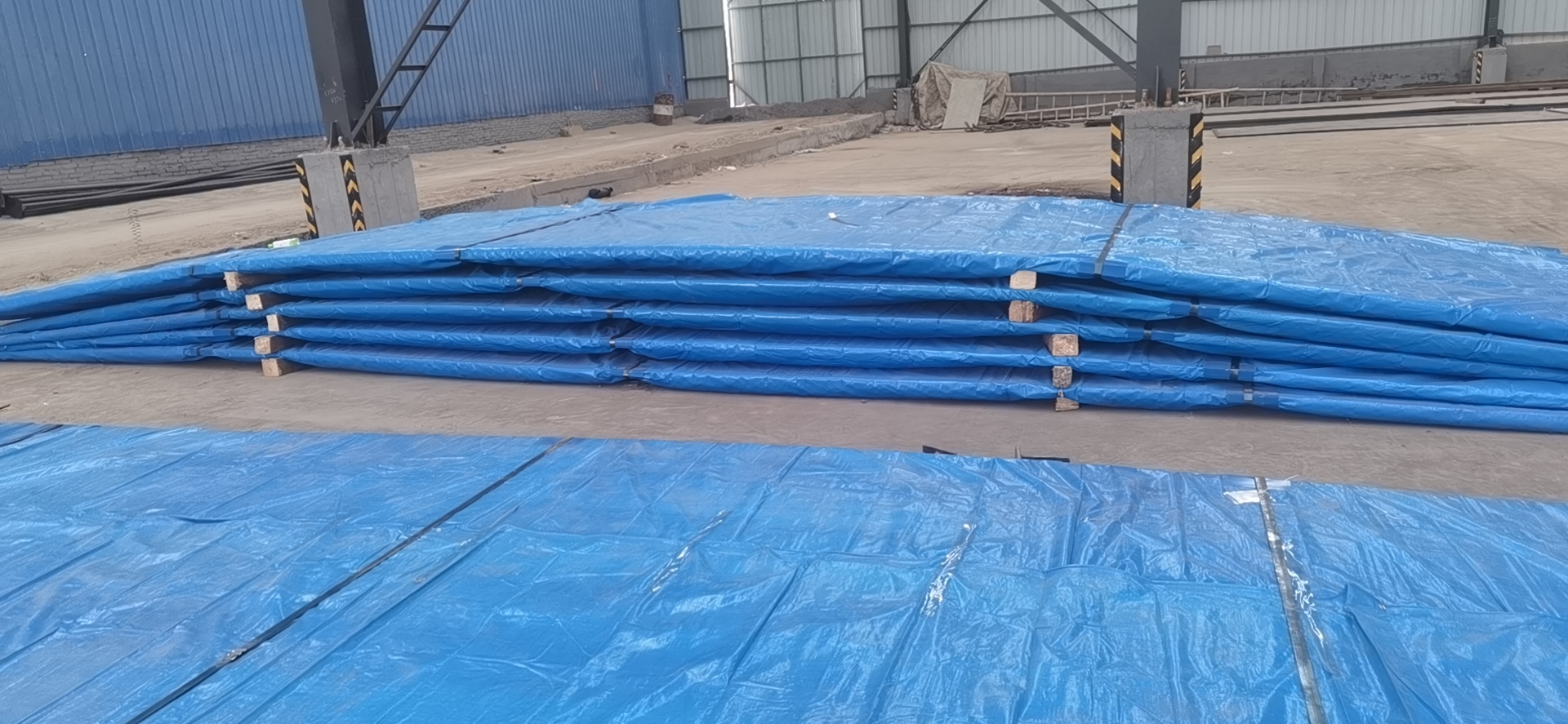 Tarp-wrapped heavy steel-plate bundles staged on timber in the mill yard ahead of shipment.
On an offshore topside structural project in West Africa, A572 Grade 50 plate was ordered without a carbon equivalent limit. The project structural specification required CE(IIW) ≤ 0.43 per DNV-ST-N001 for weldability assurance. Two of the six plate heats arrived with CE(IIW) = 0.47–0.48 — fully compliant with ASTM A572, which has no CE limit in the standard itself. The plates were rejected after arrival. Emergency substitution with EN 10025-4 S355M (CE(IIW) guaranteed ≤ 0.39) added eight weeks to the structural fabrication schedule. The CE check takes ten seconds during MTC review. The schedule recovery took eight weeks.
1. Grade Summary
| Grade | Min Yield (MPa) | Min Tensile (MPa) | Max Thickness (Plate) | Key Application |
|---|---|---|---|---|
| A572 Grade 42 | 290 | 415 | 150 mm | Low-strength structural where cost is primary |
| A572 Grade 50 | 345 | 450 | 100 mm | General structural — most common grade |
| A572 Grade 55 | 380 | 485 | 50 mm | Intermediate, limited use |
| A572 Grade 60 | 415 | 520 | 32 mm | High-strength, thinner sections only |
| A572 Grade 65 | 450 | 550 | 32 mm | Highest strength, restricted thickness |
Grade 50 is the dominant grade for plates. Grades 60 and 65 are available only in thin plate (≤32 mm), which limits their use in heavy structural applications.
2. Chemistry — Grade 50
| Element | Plate ≤32 mm | Plate 32–100 mm |
|---|---|---|
| Carbon (max) | 0.23% | 0.26% |
| Manganese | — | — (0.80–1.35% typical) |
| Phosphorus (max) | 0.040% | 0.040% |
| Sulfur (max) | 0.050% | 0.050% |
| Silicon | 0.40% max | 0.40% max |
| Columbium (Nb) + Vanadium + Nitrogen | Combined limits per grade |
ASTM A572 achieves its higher strength relative to A36 through micro-alloying with columbium (niobium) and/or vanadium rather than increased carbon. This micro-alloying approach — the HSLA route — maintains weldability while increasing yield strength, which is why A572-50 does not require significantly more preheat than A36 for equivalent thickness.
3. Mechanical Properties
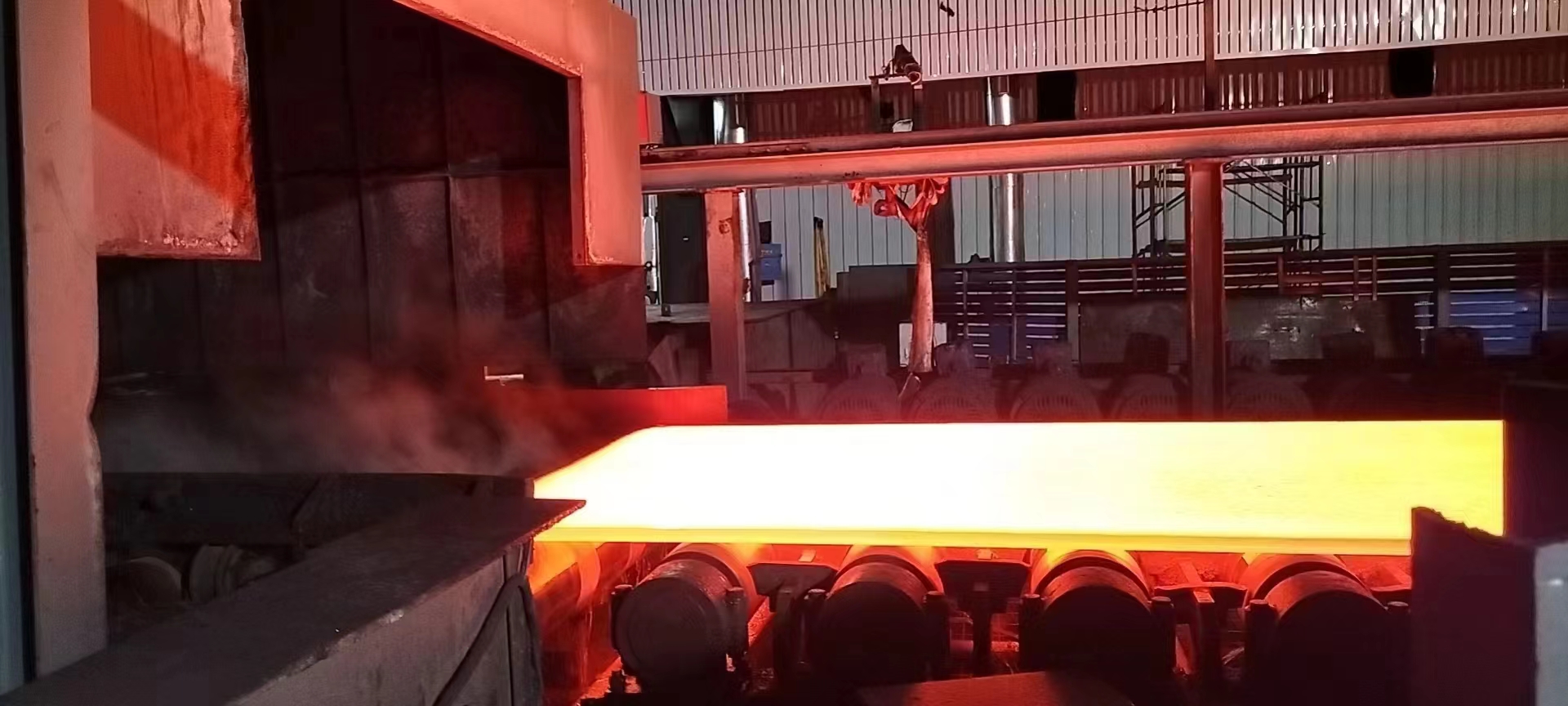 Yellow-hot plate exiting the furnace on the roller conveyor — mechanical properties are set during hot rolling.
Grade 50 — By Thickness
| Thickness | Min Yield (MPa) | Min Tensile (MPa) | Elong min (8") | Elong min (2") |
|---|---|---|---|---|
| ≤100 mm (4") | 345 | 450 | 21% | 18% |
| 100–125 mm | 290 | 450 | 21% | 18% |
| 125–200 mm | 290 | 415 | 21% | 18% |
The yield strength reduction for heavy plate (above 100 mm) is significant — Grade 50 above 100 mm effectively has the same yield strength as Grade 42 at standard thickness. For structural applications requiring 345 MPa yield above 100 mm, consider A709 Grade 50 (for bridges) or offshore-grade steel with certified properties.
To convert between MPa/ksi, mm/inches, and bar/psi, use the Unit Converter →
4. Comparison with A36 and Other Structural Grades
| Specification | Grade | Min Yield (MPa) | Min Tensile (MPa) | Typical Carbon | CE (typical) |
|---|---|---|---|---|---|
| ASTM A36 | — | 250 | 400 | ≤0.26% | ~0.40 |
| ASTM A572 | 50 | 345 | 450 | ≤0.23% | ~0.45 |
| ASTM A992 | — | 345 min, 450 max | 450 | ≤0.23% | ≤0.45 |
| EN 10025-2 | S275 | 275 | 410 | ≤0.22% | ≤0.43 |
| EN 10025-2 | S355 | 355 | 510 | ≤0.24% | ≤0.45 |
A36 remains appropriate for non-critical, light structural members where weld quality and strength efficiency are not primary concerns. A572-50 is the better choice when weight savings, section efficiency, or design code compliance matters. A992 (for wide-flange shapes only) adds yield-to-tensile ratio limits (≤0.85) for seismic applications.
Carbon Equivalent Calculation — Worked Example
For a typical A572 Grade 50 heat (verify actual CE from MTC): C = 0.22%, Mn = 1.28%, Cr = 0%, Mo = 0%, V = 0.04%, Ni = 0%, Cu = 0%
Step 1 — Apply CE(IIW) formula: CE(IIW) = C + Mn/6 + (Cr+Mo+V)/5 + (Ni+Cu)/15 CE(IIW) = 0.22 + 1.28/6 + (0 + 0 + 0.04)/5 + (0 + 0)/15 CE(IIW) = 0.22 + 0.213 + 0.008 + 0 CE(IIW) = 0.441
Step 2 — Compare to structural specification limits:
- AWS D1.1 for general structural: no blanket CE limit — but preheating requirements increase above CE 0.40
- Offshore structural (DNV-ST-N001, NORSOK M-120): CE ≤ 0.40–0.43 typical
- EN 10025-2 S355J2: CE ≤ 0.43 guaranteed
- EN 10025-4 S355M (TMCP): CE ≤ 0.39 guaranteed
Step 3 — Preheat per AWS D1.1 Table 3.2 for this CE: At CE 0.441 and plate thickness 25 mm, AWS D1.1 requires minimum preheat of approximately 65°C for low-hydrogen electrodes (E70 series), even for plate below 38 mm.
Conclusion: This heat (CE 0.441) marginally exceeds the common offshore CE limit of 0.43. It would be rejected for an offshore jacket specification requiring CE ≤ 0.43. The fix is to specify CE ≤ 0.43 on the PO and verify on MTC — or to order EN 10025-4 S355M which guarantees CE ≤ 0.39.
ASTM A572 does not specify a carbon equivalent limit. This is the fundamental difference between A572 and EN 10025 S355 sub-grades. S355J2 guarantees CE(IIW) ≤ 0.43 and is verified on every heat's MTC. A572 Grade 50 can have CE(IIW) anywhere from 0.38 to 0.50 depending on the heat chemistry — and any value is specification-compliant. For structural applications where weldability is critical (offshore jackets, seismic structures, heavy plate connections), the absence of a CE limit in A572 means the CE must be explicitly required in the purchase order and verified on every MTC before acceptance. "ASTM A572 Grade 50 with CE ≤ 0.43" is a fundamentally different PO from "ASTM A572 Grade 50."
5. Weldability
Preheat Requirements (AWS D1.1 Table 3.2)
| Plate Thickness | Grade 50 Preheat (low-hydrogen process) |
|---|---|
| Up to 19 mm (¾") | Not required |
| 19–38 mm (1.5") | Not required (E70 low-hydrogen) |
| 38–64 mm (2.5") | Minimum 66°C (150°F) |
| Above 64 mm | Minimum 107°C (225°F) |
These are minimum requirements — always verify with the applicable welding procedure specification (WPS). For heats with higher carbon (near the 0.23% limit), preheating at lower thicknesses may be prudent.
Low-hydrogen electrodes are mandatory for A572-50. Covered electrode (SMAW) E7018 or E7016, GMAW ER70S-6, FCAW E71T-1, or SAW EM12K are all appropriate.
Matching Filler Metal
| Process | Filler for Grade 50 |
|---|---|
| SMAW | AWS A5.1 E7018 |
| GMAW | AWS A5.18 ER70S-6 |
| FCAW | AWS A5.20 E71T-1 |
| SAW | AWS A5.17 EM12K / F7A2 |
All of these produce a weld deposit with minimum 70 ksi (485 MPa) tensile strength, which over-matches the 450 MPa base material minimum tensile.
6. Low-Temperature and Offshore Applications
Standard ASTM A572 Grade 50 does not include Charpy impact testing requirements. For offshore structural and low-temperature applications:
- ASTM A572 with Supplementary Requirement S1: Charpy impact at specified temperature. Specify test temperature (e.g. −20°C or −40°C) and minimum impact energy in the purchase order.
- ASTM A709 Grade 50 or 50W: Used for bridges and includes mandatory Charpy requirements.
- EN 10025-2 S355J2 or S355NL: Common offshore specification with guaranteed impact toughness at −20°C or −50°C respectively.
For offshore jacket structures in tropical waters (Africa, Middle East), A572-50 with S1 at 0°C is often acceptable. For North Sea or subzero environments, S355NL or equivalent with impact at −40°C is standard.
Carbon Equivalent for Offshore
Many offshore structural specifications (DNV-ST-N001, NORSOK M-120) require maximum carbon equivalent:
CE (IIW) = C + Mn/6 + (Cr+Mo+V)/5 + (Ni+Cu)/15 ≤ 0.40–0.43
Standard A572-50 may not always meet CE ≤0.40 — verify on the MTC and, if required, order thermomechanically rolled plate (e.g. EN 10025-4 S355M) which achieves CE ≤0.39 with guaranteed impact toughness.
7. Plate Tolerances and Surface Quality
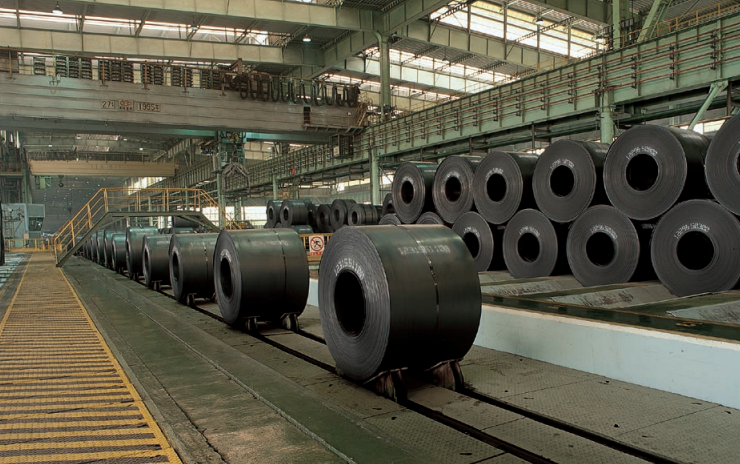 Coil and plate storage handling line in the mill, where dimensions and surface condition are checked before dispatch.
Dimensional tolerances for A572 plates are governed by ASTM A6 General Requirements:
| Dimension | Tolerance |
|---|---|
| Thickness | +3.0 mm / −0 mm (for plate ≤25 mm) |
| Width | ±3–6 mm (depends on plate width) |
| Length | +6–12 mm / −0 mm |
| Flatness | Per ASTM A6 camber and waviness limits |
| Edge condition | Mill edge or sheared to width |
Surface quality: plates are supplied with mill scale. Shot blasting to Sa 2.5 per ISO 8501-1 is typically required before coating — specify if required.
8. Application Guide
| Application | Specification | Notes |
|---|---|---|
| General structural frames | A572-50 AR | Standard supply |
| Offshore topside structure | A572-50 + S1 at 0°C or S355J2 | Charpy required |
| Offshore jacket (tropical) | A572-50 + S1 + CE ≤0.43 | Verify CE on MTC |
| Bridge girders | A709 Grade 50 | Separate bridge specification |
| Heavy equipment (cranes) | A572-50 Q&T or S355ML | Impact tested |
| Box piles and H-piles | A572-50 or A36 | Depends on load and specification |
| Base plates and gussets | A36 or A572-50 | Either acceptable; A572-50 preferred |
| Pressure vessel shells | A516-70 | Not A572 — use pressure vessel grade |
Tank shells aren't a structural-grade job either: Storage-tank plate is a different order from the structural HSLA plate this guide covers. For an African crude oil storage tank we rolled 500 pieces of ASTM A283M Grade C in four thicknesses — 8, 10, 12 and 14 mm stepped up the shell courses, heavier at the lower rings where hydrostatic head is highest. A283 Gr.C is the mild tank grade there: A572 Grade 50's 345 MPa yield buys nothing on an atmospheric tank governed by head rather than axial structural load. Match the plate to the load case, not to the highest-strength spec on the shelf.
When NOT to Use A572 Grade 50 Without Supplementary Requirements
| Scenario | Risk | Correct Approach |
|---|---|---|
| Offshore structural work with CE limit | A572 has no CE limit — mill may ship CE 0.47+ that causes HAZ hardening | Specify "CE(IIW) ≤ 0.43" on PO; verify on every MTC; or use EN 10025-4 S355M with guaranteed CE ≤ 0.39 |
| Low-temperature service below 0°C | Standard A572 has no Charpy requirement — toughness may be inadequate for cold service | Specify SR S1 Charpy at MDMT test temperature, minimum 27 J; or use S355J2 / S355NL with guaranteed impact grades |
| Heavy plate above 100 mm where 345 MPa yield required | A572-50 yield drops to 290 MPa above 100 mm — same as Grade 42 | Use A709 Grade 50 (for bridges) or project-specific offshore grade with certified 345 MPa above 100 mm |
| As-rolled plate in highly restrained welded joints | As-rolled banding and inclusions create Z-direction lamellar tearing risk at nozzle and attachment welds | Specify normalised condition or Z-quality testing (ASTM A770) for heavy restrained joints |
| Seismic structural connections without A992 | A572 does not limit yield-to-tensile ratio — over-strength can cause connection failures in seismic events | Use ASTM A992 for wide-flange shapes (Y/T ≤ 0.85 and YS max 448 MPa); both A36 and A572 lack these limits |
| A572 in pressure vessel service | A572 is a structural specification — no ASME boiler and pressure vessel code listing as a pressure-containment material | Use SA-516 (A516) for ASME pressure vessel work |
9. Procurement Checklist
Procurement trap — no carbon equivalent limit for offshore structural:
Wrong PO: "ASTM A572 Grade 50 plate, 25 mm × 2,000 mm × 8,000 mm, as-rolled."
What ships: A572-50 fully compliant with the standard — but CE(IIW) can be 0.38 to 0.50 depending on the heat. For a heat with C = 0.22% and Mn = 1.35%, CE(IIW) = 0.22 + 1.35/6 = 0.445 — above the offshore structural limit of 0.43. This plate will cause HAZ hardening above 300 HV during girth welding, requiring preheat that was not planned in the fabrication schedule.
Correct PO: "ASTM A572 Grade 50 plate, 25 mm × 2,000 mm × 8,000 mm, as-rolled. CE(IIW) maximum 0.43 — must be stated on MTC. SR S1: Charpy V-notch at 0°C, minimum 27 J (transverse). MTC: EN 10204 3.1 with full chemistry, CE(IIW) calculation, and impact results. Plate will be rejected if CE exceeds 0.43 on any heat."
Failure Modes
Failure Mode 1 — High CE causes HAZ cold cracking in structural weld
Mechanism: A572-50 plate with CE(IIW) = 0.47 is used for a heavily restrained welded column connection. The WPS specifies no preheat for plate ≤25 mm (per AWS D1.1 with low-hydrogen electrodes). However, the actual CE of 0.47 places the material in the "preheat recommended" zone for even thin plate in high-restraint joints. The HAZ cools rapidly after welding and forms a hardened zone above 300 HV. Hydrogen from the electrode moisture diffuses into the HAZ. A delayed cold crack appears 48 hours after welding — after the weld inspection record was closed.
Diagnostic: Crack found in HAZ during follow-up UT inspection the next week. Macrograph shows intergranular HAZ cracking. CE calculated from MTC chemistry is 0.47. The WPS preheat requirement was based on CE ≤ 0.43 — the plate's actual CE exceeded this threshold.
Fix: Verify CE(IIW) from MTC on every heat before welding commences. If CE > 0.43, increase preheat per the AWS D1.1 tables for higher-CE steels. For offshore structural work, reject heats with CE > 0.43 and require compliant replacement material.
Failure Mode 2 — No Charpy testing; brittle fracture in cold climate
Mechanism: A572-50 structural frame is fabricated for an LNG facility in a cold climate where winter ambient temperatures reach −25°C. No S1 Charpy testing is specified. Standard A572-50 has variable low-temperature toughness — as-rolled plate may transition from ductile to brittle behaviour between −10°C and −30°C depending on the heat. A seismic event during winter loading produces stress levels at a welded connection that exceed the material's brittle fracture threshold at −22°C. A brittle fracture propagates through the connection.
Diagnostic: Brittle (flat, granular) fracture face at the structural connection. Post-failure Charpy testing at −25°C confirms energy below 20 J — inadequate for seismic structural application. Original material had no impact test data.
Fix: For structural applications where the minimum design temperature is below 0°C, or where seismic design governs, specify SR S1 Charpy testing at the minimum design temperature. For cold-climate facilities, EN 10025-2 S355J2 (−20°C mandatory impact) or S355NL (−50°C) provides a guaranteed impact-tested alternative.
Failure Mode 3 — A572 Grade 50 above 100 mm: yield drops to Grade 42 level
Mechanism: A structural engineer designs a heavy column base plate using A572-50 at 115 mm thickness, assuming minimum yield of 345 MPa throughout. ASTM A572 Grade 50 yield requirement drops to 290 MPa for plate above 100 mm — effectively the same as Grade 42 at standard thickness. The column base plate is undersized for the actual 345 MPa design load. During proof load testing, the base plate yields at 290 MPa — below the design load.
Diagnostic: Permanent deformation observed in the column base plate during load testing. Stress calculation for the as-designed plate at 290 MPa yield confirms the plate is under-capacity for the design load, which assumed 345 MPa.
Fix: For plate applications above 100 mm requiring minimum yield of 345 MPa, A572 Grade 50 is not adequate. Evaluate ASTM A709 Grade 50 for bridge applications, or EN 10025-2 S355 which maintains 345 MPa yield to greater thickness with normalised condition. Alternatively, redesign the plate to accept the 290 MPa yield limitation.
- Standard: ASTM A572 (latest edition), Grade 50 (or state other grade)
- Product form: plate (confirm shapes or bars if different product)
- Thickness and width (in mm)
- Heat treatment: as-rolled (standard) or normalised (specify "N" for heavy plate)
- Supplementary requirements: S1 (Charpy impact — specify temperature and min energy)
- Carbon equivalent: specify maximum CE if required by project or design code
- Surface: as-rolled mill scale, or shot blast Sa 2.5
- UT: specify ASTM A578 if lamination detection required
- Mill test certificate: EN 10204 3.1 with full chemistry and CE calculation
- Marking: plate number, heat number, grade, weight per ASTM A6
Frequently Asked Questions
What does ASTM A572 cover?
ASTM A572 covers high-strength low-alloy (HSLA) columbium-vanadium structural steel in five grades: Grade 42, 50, 55, 60, and 65, where the grade number indicates the minimum yield strength in ksi. The specification covers plates, shapes (beams, channels, angles), and bars. Grade 50 is by far the most widely used grade and is the default structural steel specification for most modern construction in North America and many international projects — it has largely replaced the older A36 in structural applications due to its higher strength and essentially the same price per tonne.
What is the minimum yield strength of ASTM A572 Grade 50?
ASTM A572 Grade 50 requires a minimum yield strength of 50,000 psi (345 MPa) and minimum tensile strength of 65,000 psi (450 MPa), with minimum elongation of 21% in 8 inches or 18% in 2 inches. These properties apply to plate thicknesses up to 100 mm (4 inches). For plate above 100 mm, minimum yield reduces to 290 MPa. The higher yield of A572-50 compared to A36 (250 MPa yield) allows structural designers to specify lighter sections for equivalent load capacity.
What is the difference between ASTM A36 and A572 Grade 50?
ASTM A36 has a minimum yield of 250 MPa (36 ksi) and minimum tensile of 400 MPa (58 ksi). A572 Grade 50 has a minimum yield of 345 MPa (50 ksi) and minimum tensile of 450 MPa (65 ksi). A572-50 is 38% stronger in yield, which typically allows a 20–30% reduction in steel weight for equivalent structural performance. Both grades are weldable with standard procedures — A572-50 may require preheat for thicker sections. The cost per tonne is typically similar or slightly higher for A572-50, but the weight saving usually makes A572-50 the more economical overall structural choice.
Is ASTM A572 Grade 50 suitable for welded structural fabrication?
Yes, A572 Grade 50 has good weldability with standard welding processes (SMAW, GMAW, FCAW, SAW). For plates up to 20 mm thick, no preheat is typically required with low-hydrogen electrodes. For thicker plates or higher-carbon heats (carbon equivalent PCM above 0.22%), preheat of 50–100°C is recommended per AWS D1.1. The key requirement is the use of low-hydrogen welding consumables (E70 series) and, for critical structural connections, Charpy impact-qualified weld procedures. A572-50 is approved in AWS D1.1 Structural Welding Code — Steel.
What is the carbon equivalent for ASTM A572 Grade 50?
ASTM A572 Grade 50 does not specify a maximum carbon equivalent (CE) in the standard itself. However, most structural fabrication codes (AWS D1.1, EN 1011) use the IIW formula: CE = C + Mn/6 + (Cr+Mo+V)/5 + (Ni+Cu)/15. For typical A572-50 chemistry (C≈0.23%, Mn≈1.30%), CE ≈ 0.23 + 1.30/6 ≈ 0.45. This is in the range where low-hydrogen electrodes are required and preheat may be needed for thick sections. For projects specifying maximum CE limits (e.g. offshore jackets often require CE ≤0.40–0.43), a certified CE value from the mill must be verified on the MTC.
What structural applications commonly use ASTM A572 Grade 50 plate?
ASTM A572 Grade 50 plate is used in: offshore jacket legs and bracing (especially where DNV or API specifications permit A572-50 equivalents), structural beams and columns in buildings and industrial frames, bridge girders and box sections (AASHTO M270 Grade 50 matches A572-50), heavy equipment fabrication (crane booms, excavator booms), piling plates for box and H-piles, and welded structural frames for process plant. For offshore structures in sour or low-temperature environments, low-temperature impact testing may be required — verify against project specification.
How does ASTM A572 compare to EN 10025-2 S355 for international projects?
ASTM A572 Grade 50 (min yield 345 MPa) and EN 10025-2 S355 (min yield 355 MPa at ≤16 mm thickness, reducing to 335 MPa at 16–40 mm) are close in yield strength and are often used interchangeably in specifications that allow either. Key differences: S355 grades include low-temperature impact sub-grades (S355J0, J2, K2, NL at progressively lower impact test temperatures) that are not automatically included in A572-50. For offshore and low-temperature structural applications, S355J2 or S355NL is typically specified; the A572-50 equivalent requires S1 supplementary Charpy testing. Review the applicable structural design code (AISC, Eurocode 3, DNV-ST-N001) before selecting plate specification.