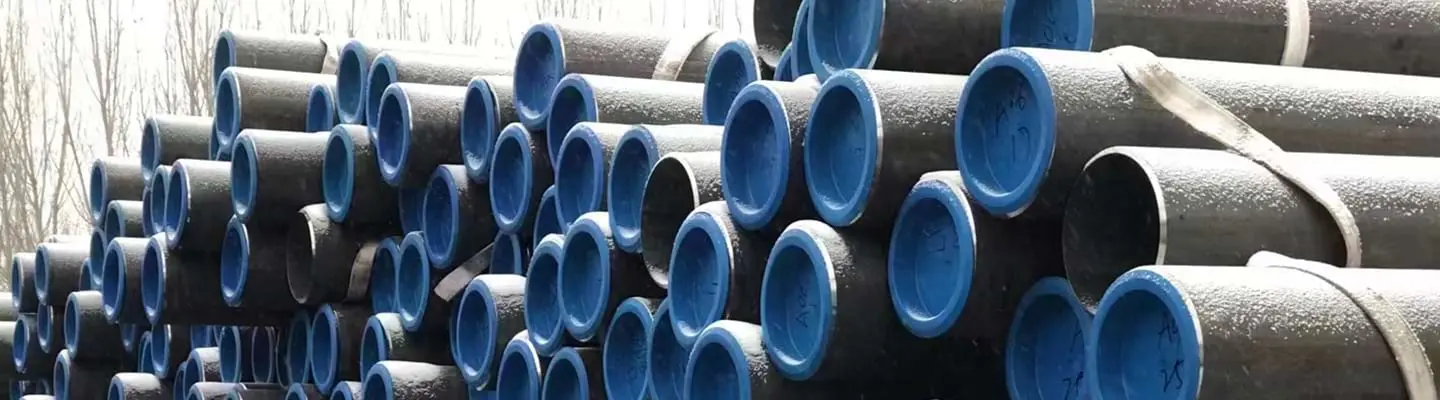
API 5L Grade B is the entry-level transmission grade in API Specification 5L, 46th Edition and the most widely traded carbon steel line pipe grade in the world. On gathering systems, injection lines, and medium-pressure distribution networks across sub-Saharan Africa, the Middle East, and South America, Grade B (L245) delivers adequate pressure containment for the majority of applications at the lowest material cost in the API 5L grade ladder. The grade itself is well-understood — the engineering decisions that actually determine project outcome are: which PSL level to specify, which delivery condition to order for PSL2, and when the economics justify upgrading to X52 or higher.
ZC Steel Pipe supplies API 5L Grade B line pipe as both seamless and ERW in NPS 2 to NPS 24 (60 mm to 610 mm OD), PSL1 and PSL2, for projects across Africa, the Middle East, South America, and Southeast Asia. EN 10204 3.1 MTCs are standard on all orders; 3.2 is available on request.
Quick Answer
API 5L Grade B — metric designation L245 — has a minimum yield of 245 MPa (35,500 psi) and minimum tensile of 415 MPa (60,200 psi) in both PSL1 and PSL2. The strength floor is identical; what changes between the two levels is how much the mill is bound. PSL1 sets floors only — no maximum yield, no yield-to-tensile cap, no Charpy toughness, no carbon-equivalent limit, and sulphur up to 0.030%. PSL2 adds a 450 MPa (65,300 psi) yield ceiling, a 655 MPa (95,000 psi) tensile ceiling, a 0.93 Y/T limit above 323.9 mm OD, mandatory Charpy testing, and tighter chemistry (S ≤ 0.015%, CE limits). Specify PSL1 only for low-pressure sweet gathering and distribution; specify PSL2 for sour service, sub-zero design temperatures, or any project referencing a Y/T ratio or toughness requirement.
| Requirement | PSL1 | PSL2 |
|---|---|---|
| Min yield | 245 MPa (35,500 psi) | 245 MPa (35,500 psi) |
| Max yield | Not specified | 450 MPa (65,300 psi) |
| Min tensile | 415 MPa (60,200 psi) | 415 MPa (60,200 psi) |
| Max Y/T ratio | Not specified | 0.93 (OD > 323.9 mm) |
| Charpy impact | Not required | Mandatory |
| Sulphur max | 0.030% | 0.015% |
What we see on purchase orders: Grade B without a PSL designation is the most common mis-specification we encounter on purchase orders for gathering line projects. The API 5L default when no PSL level is declared is PSL1. PSL1 has no Charpy requirement, no carbon equivalent limit, and no maximum yield ceiling. On sour service projects, the mill ships PSL1-compliant pipe that can fail NACE MR0175 / ISO 15156 hardness limits and initiate hydrogen-induced cracking under H2S partial pressure — problems the customer never requested protection against, because neither were governed by PSL1. We flag every Grade B PO without a declared PSL level before production begins. Not every mill will.
What Is API 5L Grade B?
API Specification 5L, 46th Edition (effective November 2018) defines Grade B — designated L245 in the metric SI system — as the minimum-strength grade in the API 5L transmission line pipe family. The "245" in L245 encodes the minimum yield strength in megapascals. Grade B sits at the bottom of the grade ladder:
| Grade | SI Designation | Min Yield (MPa) | Min Yield (ksi) |
|---|---|---|---|
| Grade B | L245 | 245 | 35.5 |
| X42 | L290 | 290 | 42.1 |
| X52 | L360 | 360 | 52.2 |
| X65 | L450 | 450 | 65.3 |
| X70 | L485 | 485 | 70.3 |
Grade B is manufactured as both seamless and ERW. For gathering and distribution lines below approximately 7 MPa (1,015 psi) operating pressure in Class 1 locations, Grade B PSL1 is the standard specification. For sour service, sub-zero design temperatures, or long-distance high-pressure transmission, PSL2 with the appropriate delivery condition is required — and the choice between BN, BM, and BQ determines the chemistry profile the mill produces.
Mechanical Properties — PSL1 and PSL2
All values from API Specification 5L, 46th Edition.
PSL1 — L245 / Grade B
| Property | Value |
|---|---|
| Min yield strength (pipe body) | 245 MPa (35,500 psi) |
| Min tensile strength | 415 MPa (60,200 psi) |
| Weld seam min tensile | 415 MPa (60,200 psi) |
| Max yield strength | Not specified |
| Max Y/T ratio | Not specified |
| Charpy V-notch impact testing | Not required |
The PSL1 table is short for a reason: API 5L PSL1 sets floors, not ceilings. There is no upper yield limit, no Y/T ratio cap, and no toughness requirement. A mill can produce PSL1 Grade B pipe with a yield of 400 MPa and be fully compliant. For pressure containment on a low-pressure gathering line, that is adequate. For anything requiring predictable yield-to-tensile behaviour, girth weld toughness, or sour service qualification, it is not.
PSL2 — L245 / Grade B
| Property | Value |
|---|---|
| Min yield strength (pipe body) | 245 MPa (35,500 psi) |
| Max yield strength | 450 MPa (65,300 psi) |
| Min tensile strength | 415 MPa (60,200 psi) |
| Max tensile strength | 655 MPa (95,000 psi) |
| Max Y/T ratio | 0.93 (OD > 323.9 mm / 12.750 in) |
| Weld seam min tensile | 415 MPa (60,200 psi) |
| Charpy V-notch impact testing | Mandatory |
PSL2 closes the gaps that PSL1 leaves open. The maximum yield ceiling of 450 MPa prevents the mill from producing over-hard pipe that may exceed NACE MR0175 hardness limits. The Y/T ratio cap of 0.93 — applicable only for OD greater than 323.9 mm — ensures sufficient post-yield deformation capacity for girth weld toughness requirements in large-diameter pipelines. Mandatory Charpy V-notch impact testing means the seam and pipe body toughness at your design temperature are certified, not assumed.
For the complete API 5L grade ladder with PSL1 and PSL2 tensile and Charpy properties, see the API 5L specification tables → and the ASME B36.10M pipe schedule chart →
To calculate design wall thickness for Grade B at your MAOP, use the Pipeline Design Calculator →
The PSL1 trap is not only a procurement problem — it is a design risk. PSL1 Grade B has no maximum yield limit. A mill can produce pipe at 400 MPa yield (well above the 245 MPa minimum) and every result is fully PSL1-compliant. For pipelines that require a Y/T ratio cap for girth weld toughness calculations — increasingly common in DNV-ST-F101 offshore design and ASME B31.8 strain-based design — PSL2 BM or BQ is required. PSL1 does not govern maximum yield at all, and no purchaser inspection requirement can extract that control retroactively from a PSL1 MTC.
Chemical Composition by Delivery Condition
All values from API Specification 5L, 46th Edition.
PSL1 — L245 / Grade B
| Element | Seamless (max %) | Welded (max %) |
|---|---|---|
| C | 0.28 | 0.26 |
| Mn | 1.20 | 1.20 |
| P | 0.030 | 0.030 |
| S | 0.030 | 0.030 |
| Nb + V + Ti combined | 0.15 | 0.15 |
| Nb + V combined | 0.06 | 0.06 |
PSL1 chemistry imposes no silicon limit, no carbon equivalent requirement, and the sulphur ceiling of 0.030% is three times the PSL2 limit. The elevated sulphur limit is the primary reason PSL1 Grade B is unsuitable for sour service: high sulphur promotes MnS inclusion formation, and MnS inclusions are the primary initiation site for hydrogen-induced cracking (HIC) in H2S-containing environments.
PSL2 — L245 / Grade B by Delivery Condition
| Element | BR / BN | BQ | BM |
|---|---|---|---|
| C max | 0.24% | 0.18% | 0.22% |
| Si max | 0.40% | 0.45% | 0.45% |
| Mn max | 1.20% | 1.40% | 1.20% |
| P max | 0.025% | 0.025% | 0.025% |
| S max | 0.015% | 0.015% | 0.015% |
| V max | — | 0.05% | 0.05% |
| Nb max | — | 0.05% | 0.05% |
| Ti max | 0.04% | 0.04% | 0.04% |
| CE (IIW) max | 0.43 | 0.43 | 0.43 |
| CE (Pcm) max | 0.25 | 0.25 | 0.25 |
The sulphur limit drops from 0.030% (PSL1) to 0.015% (PSL2) for all delivery conditions — a 50% reduction that meaningfully reduces MnS inclusion density. For Annex H sour service, a supplementary requirement of S ≤ 0.003% is specified on top of this PSL2 baseline. The BQ condition delivers the lowest carbon content (≤ 0.18%) through quench-and-temper processing, which achieves the best hardness uniformity across pipe body and HAZ. BM (thermomechanically controlled) is the most widely produced ERW Grade B PSL2 condition and combines weld-friendly carbon equivalent with microalloying elements that support Charpy performance — it is the practical default for ERW gathering line pipe in most markets we supply.
Wall Thickness Design Calculation
The ASME B31.8 minimum wall formula for a gas gathering line is:
t = P × D / (2 × SMYS × F × E × T)
where P is MAOP (MPa), D is OD (mm), SMYS is specified minimum yield strength (MPa), F is design factor, E is longitudinal joint factor, and T is temperature derating factor.
Worked example: NPS 8 (OD = 219.1 mm) Grade B PSL1 gathering line, MAOP = 4 MPa, Class 1 location (F = 0.72), ERW pipe (E = 1.0), operating below 120 °C (T = 1.0).
t = 4 × 219.1 / (2 × 245 × 0.72 × 1.0 × 1.0)
t = 876.4 / 352.8
t = 2.48 mm minimum required
The ASME B36.10M standard wall for NPS 8 is 8.18 mm — more than three times the calculated minimum. For a low-pressure Class 1 gathering line at this MAOP, the wall thickness is governed entirely by handling and installation minimum, not by pressure. Grade B PSL1 is structurally conservative in this application, which is why it dominates gathering line procurement: the engineering margin exists without requiring higher-strength grades.
Now compare the same 4 MPa MAOP on a NPS 16 (OD = 406.4 mm) line. Minimum wall:
t = 4 × 406.4 / (2 × 245 × 0.72 × 1.0 × 1.0) = 1625.6 / 352.8 = 4.61 mm minimum required
The NPS 16 standard wall of 9.52 mm still provides more than double the pressure minimum. At 10 MPa MAOP on the same NPS 16, the minimum wall requirement rises to 11.5 mm — close to the XS wall of 12.70 mm. At that point, upgrading to X52 (SMYS 360 MPa) reduces minimum wall by approximately 32%, which on a long-distance project translates to meaningful tonnage and cost reduction.
Delivery Conditions for PSL2
The delivery condition suffix designates the heat treatment route and is appended to the grade designation (BN, BQ, BM, or BR). The condition must be explicitly called out on the purchase order — it is not optional for PSL2.
| Suffix | Condition | Description | Typical Use |
|---|---|---|---|
| R | As-rolled | No heat treatment after rolling | Low-specification gathering; uncommon for Grade B PSL2 |
| N | Normalised | Heated above Ac3, air-cooled | Standard for seamless Grade B PSL2 in most markets |
| Q | Quenched and tempered | Water quenched then tempered | Lowest carbon (≤ 0.18%); best toughness uniformity; sour service |
| M | Thermomechanically controlled | TMCP rolling | Standard for ERW Grade B PSL2; weld-friendly CE |
For sour service Annex H applications, BM or BQ is preferred because both conditions achieve the carbon equivalent (CE_IIW ≤ 0.43) and low carbon content that maintain NACE MR0175 / ISO 15156 hardness compliance after field girth welding. BQ additionally offers the lowest base carbon for applications where post-weld hardness in the HAZ is the controlling constraint — relevant for sour service in high H2S partial pressure wells above 0.3 kPa.
Procurement teams sometimes omit the delivery condition suffix on the assumption that the mill will choose. The mill will — and it will choose the condition most economical to produce, which for seamless pipe at lower volumes is often BN rather than BQ or BM. For projects where the delivery condition affects weld procedure qualification or sour service NACE compliance, specify it on the PO.
Grade B in Sour Service (Annex H)
API 5L Annex H defines supplementary requirements for sour service — pipelines transporting fluids containing H2S above the threshold defined in NACE MR0175 / ISO 15156. For Grade B PSL2, qualifying for Annex H requires:
- PSL2 as the base specification (PSL1 Grade B cannot qualify for Annex H)
- S ≤ 0.003% (versus the PSL2 baseline of 0.015%)
- Calcium treatment to modify MnS inclusion morphology
- HIC testing per NACE TM0284 — Crack Length Ratio (CLR) ≤ 15%, Crack Thickness Ratio (CTR) ≤ 5%, Crack Sensitivity Ratio (CSR) ≤ 2%
- SSC testing per NACE TM0177, Method A, at 90% SMYS
- Hardness ≤ 250 HV10 per NACE MR0175 / ISO 15156-2
HIC failure mechanism in PSL1 Grade B: When PSL1 Grade B is placed in a wet H2S environment, atomic hydrogen generated by the corrosion reaction penetrates the steel lattice and accumulates at MnS inclusions — the predominant non-metallic inclusion type in higher-sulphur steels. Internal blistering develops as hydrogen gas recombines at inclusion interfaces, building internal pressure and propagating cracks parallel to the pipe wall. The visible symptom is surface blistering; the concealed damage is planar cracks through the pipe wall thickness. This is a service failure that a hydrostatic test at ambient temperature will not detect — the pipe passes hydrostatic, enters service, and initiates HIC over weeks to months of exposure.
If a project specification references NACE MR0175 / ISO 15156 and the purchase order reads "API 5L Grade B PSL1," the mill is not obligated to deliver Annex H compliance. The PO must explicitly reference Annex H, specify S ≤ 0.003%, and list the HIC and SSC test requirements.
When NOT to Use Grade B
Grade B PSL1 is the default for low-pressure gathering lines. Four conditions where it is the wrong choice:
1. Design pressure drives wall thickness to uneconomical dimensions. At MAOP above 10 MPa in NPS 12 and larger, Grade B requires walls that approach or exceed standard XS schedule thickness. X52 PSL2 reduces the calculated minimum wall by approximately 32% at the same MAOP, and X65 PSL2 reduces it by approximately 46%. On long-distance export lines or main transmission pipelines, the weight and material cost savings from upgrading to X52 or X65 outweigh any price premium per tonne of higher-grade pipe.
2. Sour service where PSL2 Annex H is not specified. A Grade B order without explicit PSL2 and Annex H supplementary requirements delivers PSL1 chemistry (S ≤ 0.030%) into service conditions that require S ≤ 0.003% and HIC testing. The mechanism is not theoretical — MnS inclusions initiate internal hydrogen blistering under sustained H2S partial pressure, and the failure presents as wall perforation after weeks to months in service with no prior external indication.
3. Operating temperature below 0 °C. PSL1 Grade B carries no Charpy V-notch requirement. In cold climate service — sub-arctic gathering lines, cold desert night temperatures below 0 °C, or offshore northern subsea applications — seam toughness on PSL1 ERW pipe is uncertified. HAZ failure on an ERW seam at low temperature is a documented failure mode. PSL2 with a Charpy requirement at the design minimum temperature is required.
4. Applications requiring certified Y/T ratio control. Strain-based design per DNV-ST-F101 or ASME B31.8 Appendix N requires a documented Y/T ratio. PSL1 sets no maximum yield, which means the Y/T ratio is neither governed nor certifiable. PSL2 caps maximum yield at 450 MPa and limits Y/T to 0.93 for OD above 323.9 mm, giving the pipeline designer a basis for girth weld fracture assessment.
Grade B vs X42 vs X52 — When to Upgrade
| Property | Grade B (L245) | X42 (L290) | X52 (L360) |
|---|---|---|---|
| Min yield (MPa) | 245 | 290 | 360 |
| Min tensile PSL1 (MPa) | 415 | 415 | 460 |
| Approximate wall saving vs Grade B | — | ~16% | ~32% |
| Typical application | Gathering, low-pressure distribution | Medium-pressure gathering, onshore | Transmission, export, offshore lines |
| Cost index | Lowest | Low | Medium |
At PSL1, X42 and Grade B share the same minimum tensile strength of 415 MPa — only the minimum yield differs. Moving from Grade B to X42 allows thinner walls at the same operating pressure, but without a tensile step-up. This makes X42 most useful for mid-range gathering pressures between 7 and 10 MPa where Grade B wall starts to look thick and X52's cost premium is not yet justified. Upgrading to X52 delivers both yield and tensile increases, enabling meaningful wall reduction on long-distance lines. For high-pressure mainline service above 10 MPa in NPS 16 and above, X65 or X70 is the modern standard.
The upgrade decision is fundamentally a wall thickness economics calculation: multiply the wall thickness reduction by the pipe OD circumference, multiply by run length, and compare the pipe tonnage saved against the per-tonne grade premium. At typical Grade B and X52 market prices, the upgrade pays off in total installed cost when wall thickness exceeds roughly 12 mm on lines longer than 20 km. Below that, Grade B remains the more economical choice.
For a detailed PSL1 versus PSL2 decision framework, see API 5L PSL1 vs PSL2 Line Pipe Selection Guide →
Standard Sizes (ASME B36.10M)
Grade B line pipe is available across all standard ASME B36.10M sizes. The table below shows common NPS with Standard (STD) and Extra Strong (XS) wall thicknesses. All dimensions from ASME B36.10M-2018.
| NPS | OD (in) | OD (mm) | STD Wall (mm) | XS Wall (mm) |
|---|---|---|---|---|
| 4 | 4.500 | 114.30 | 6.02 | 8.56 |
| 6 | 6.625 | 168.27 | 7.11 | 10.97 |
| 8 | 8.625 | 219.07 | 8.18 | 12.70 |
| 12 | 12.750 | 323.85 | 9.52 | 12.70 |
| 16 | 16.000 | 406.40 | 9.52 | 12.70 |
| 20 | 20.000 | 508.00 | 9.52 | 12.70 |
| 24 | 24.000 | 609.60 | 9.52 | 12.70 |
For NPS 14 and above, the STD wall is constant at 9.52 mm per ASME B36.10M regardless of pipe diameter. This means that for large-diameter Grade B, the governing wall thickness on low- to medium-pressure lines is almost always the schedule minimum rather than pressure design — the pipe is pressure-conservative and the schedule exists to ensure adequate wall for handling, threading, and field welding without through-wall distortion. ZC Steel Pipe supplies Grade B in NPS 2 to NPS 24 as both seamless and ERW.
For the complete ASME B36.10M schedule table including intermediate schedules (Sch 20, 40, 80, 120, 160, and XXS), see the ASME B36.10M pipe schedule chart →
Purchase Order Guidance
Minimum Required PO Line Items
- Standard: API Specification 5L, 46th Edition
- PSL level: PSL1 or PSL2 — always specify explicitly
- Grade: Grade B or L245
- Delivery condition (PSL2 only): BN, BQ, or BM — do not leave this for the mill to select
- Pipe form: seamless or ERW
- Size: OD × wall thickness × length (DRL or fixed)
- End finish: plain end (PE) or bevelled end (BE, 30° ± 5°)
- Supplementary requirements where applicable: Annex H (sour service), Charpy temperature and minimum absorbed energy, EN 10204 3.1 MTC, third-party inspection scope
The PSL1 Default Trap
The single most consequential procurement error with Grade B: specifying "API 5L Grade B" without a PSL level. Without a declared PSL, API 5L defaults to PSL1. On a project specification that references sour service, low-temperature service, or Y/T ratio limits anywhere in the engineering basis, "API 5L Grade B" with no PSL level on the PO means the mill ships PSL1-compliant pipe — no Charpy, no CE limit, no maximum yield, and sulphur up to 0.030%. The pipe passes hydrostatic test, carries a clean MTC, and will fail NACE MR0175 / ISO 15156 hardness requirements the project specification requires but the purchase order never asked for.
The correct PO language for a sour service gathering line: "API 5L Grade B PSL2, BM delivery condition, Annex H supplementary requirements, S ≤ 0.003% on chemical analysis, HIC testing per NACE TM0284, SSC testing per NACE TM0177 Method A, Charpy V-notch at [design temperature] per API 5L Table E.5, EN 10204 3.1 MTC."
Every word in that specification is load-bearing. Leaving out "PSL2" gives the mill the option to ship PSL1. Leaving out "Annex H" removes the HIC and SSC test obligations. Leaving out "S ≤ 0.003%" means the mill is compliant at 0.015%.
What to Verify on the MTC
- PSL level declared in the grade designation on the MTC header — "Grade B PSL2" not just "Grade B"
- Delivery condition suffix (BN, BQ, BM) matches the PO
- Carbon equivalent values — CE_IIW and CE_Pcm — within PSL2 table limits
- Charpy V-notch impact test results: temperature, specimen size (full, 3/4, or 2/3), average and minimum absorbed energy
- Hydrostatic test pressure and calculation basis
- Seam UT inspection confirmation for ERW PSL2 pipe
- Ca treatment record and heat chemistry sulphur for Annex H sour service orders
- Heat number traceability from chemistry to mechanical test to hydrostatic test records
For the full EN 10204 MTC review procedure, see Pipe Mill Test Certificate Guide →
Frequently Asked Questions
What is the difference between API 5L Grade B PSL1 and PSL2?
API 5L Grade B PSL1 sets a minimum yield of 245 MPa (35,500 psi) and minimum tensile of 415 MPa (60,200 psi) with no Charpy toughness, carbon equivalent, or maximum yield requirements. PSL2 adds a maximum yield of 450 MPa (65,300 psi), maximum tensile of 655 MPa (95,000 psi), a Y/T ratio limit of 0.93 for OD above 323.9 mm, mandatory Charpy impact testing, and stricter chemistry with carbon equivalent limits.
What is the L245 designation for Grade B?
L245 is the ISO metric designation for API 5L Grade B, where 245 refers to the minimum yield strength in megapascals. API 5L 46th Edition recognises both Grade B and L245 as the same grade. Specify L245 for metric-system project documentation; Grade B remains standard in North American projects.
What delivery conditions are available for Grade B PSL2?
API 5L PSL2 Grade B is available in four delivery conditions: R (as-rolled), N (normalised), Q (quenched and tempered), and M (thermomechanically rolled or formed). The condition is appended to the grade designation — BR, BN, BQ, or BM. BM is most common for ERW pipe; BQ achieves the lowest carbon and is preferred for applications demanding the tightest CE control.
Does API 5L Grade B require Charpy impact testing?
No for PSL1. Yes for PSL2 — Charpy V-notch impact testing is mandatory. Test temperature and minimum absorbed energy are specified by the purchaser based on design temperature and pipe OD. For sour service per API 5L Annex H, a common specification is 27 J minimum average at 0 °C for full-size specimens.
Can API 5L Grade B be used for sour service?
Yes — API 5L Grade B PSL2 with Annex H sour service conditions (HIC testing, S ≤ 0.003%, tight CE control, calcium treatment of inclusions) is qualified for H2S-containing pipelines under NACE MR0175 / ISO 15156. PSL1 Grade B is not suitable for sour service without supplementary chemistry and toughness controls, because neither the carbon equivalent nor the Charpy toughness are governed by PSL1.
What is the maximum Y/T ratio for Grade B PSL2?
The maximum yield-to-tensile (Y/T) ratio for API 5L Grade B PSL2 is 0.93, applicable to pipe with OD greater than 323.9 mm (12.750 in). This cap ensures the pipe retains meaningful post-yield plastic deformation capacity — a requirement for strain-based design and for girth weld toughness in large-diameter pipelines.
When should I upgrade from Grade B to X52 or X65?
Upgrade to X52 or higher when the wall thickness required for your MAOP at Grade B becomes uneconomical or too heavy. For gathering lines below 7 MPa in NPS 2 to 8 sizes, Grade B is typically adequate. For main transmission lines above 10 MPa in NPS 12 and above, X52 reduces wall by about 32% and X65 by about 46% versus Grade B — delivering significant weight and cost savings on long-distance projects.
Is API 5L Grade B the same as ASTM A53 Grade B?
No. API 5L Grade B (L245) has a minimum yield of 245 MPa (35,500 psi) and minimum tensile of 415 MPa (60,200 psi). ASTM A53 Grade B has 241 MPa (35,000 psi) minimum yield and 414 MPa (60,000 psi) minimum tensile — nearly identical values but from different standards with different scopes, chemistry requirements, and inspection procedures. API 5L governs oil and gas transmission pipeline service; ASTM A53 covers structural, mechanical, and general low-pressure service.