ASTM A106, ASTM A53, and API 5L Grade B are three of the most frequently cited carbon steel pipe specifications, and all three can describe pipe with nearly identical room-temperature mechanical properties. That overlap creates a recurring procurement problem: the specifications are interchangeable in the mill data sheet but are not interchangeable on the project specification. Selecting the wrong one leads to non-conformance at inspection, code compliance issues during commissioning, or field weld cracking from inadequate carbon equivalent control.
ZC Steel Pipe supplies seamless carbon steel pipe and API 5L line pipe to multiple specifications for export markets in Africa, the Middle East, South America, and Southeast Asia. This guide covers the scope, chemistry, mechanical properties, and design-code context for each specification, and provides a decision framework for selecting the correct one.
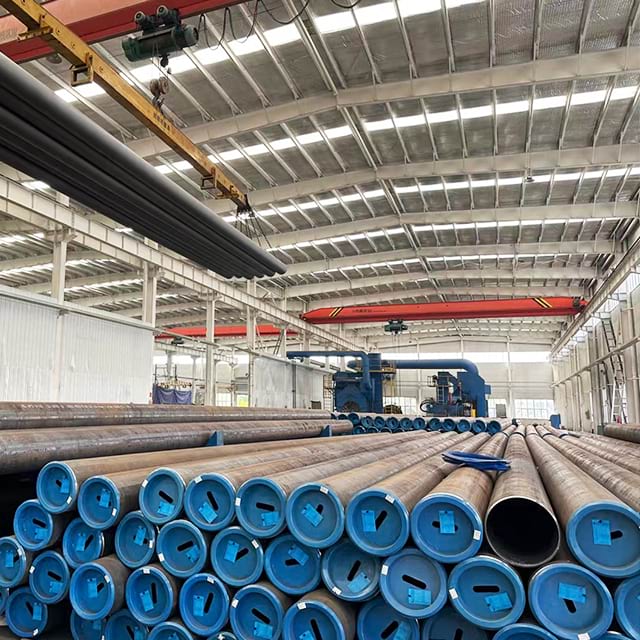 Seamless carbon steel pipe in the ZC warehouse, blue end caps in place, staged under an overhead crane ahead of dispatch.
Quick Answer — Which Specification
All three carry a ~240–245 MPa (35 ksi) minimum yield and 415 MPa (60 ksi) minimum tensile, so they are not separated by strength — they are separated by product form and design code:
| Spec | Product form | Written for | Governing code |
|---|---|---|---|
| ASTM A106 Gr.B | Seamless only | High-temperature plant/process piping (> 200 °C) | ASME B31.3 / B31.1 |
| ASTM A53 Gr.B | Seamless or ERW | General & moderate-temperature service | ASME B31.9 / utility |
| API 5L Gr.B (L245) | Seamless or welded | Hydrocarbon pipeline transmission | ASME B31.4 / B31.8 |
Pick by the design code and service, not by the datasheet: if the code says A106, do not substitute A53 or API 5L; A106 adds the heat treatment and seamless requirement for high-temperature pressure service. API 5L adds carbon-equivalent (weldability) limits and, at PSL2, Charpy toughness that A53/A106 do not require. The detailed chemistry, CE, and design-code tables are below; for the seamless-versus-welded decision that sits underneath this, see seamless vs welded line pipe →.
The dual-stencil problem appears on nearly every project where API 5L PSL2 is specified for a sour gas pipeline. Pipe arrives stencilled "API 5L Gr.B / A53 Gr.B / A106 Gr.B" — three specifications on one stencil. The procurement team accepts it: "it meets API 5L." It does not meet API 5L PSL2. Dual stencilling means the pipe chemistry satisfies all three specifications simultaneously — but PSL2 requires Charpy testing, a CE limit, and additional NDE that do not appear in A53 or A106. The presence of the API 5L stencil does not automatically mean PSL2 compliance. The MTC must explicitly show the PSL level declared in the product designation, the Charpy test results, and the calculated CE/Pcm values. If those are absent, the pipe is PSL1, regardless of what three specifications are on the stencil.
What ASTM A53 Covers
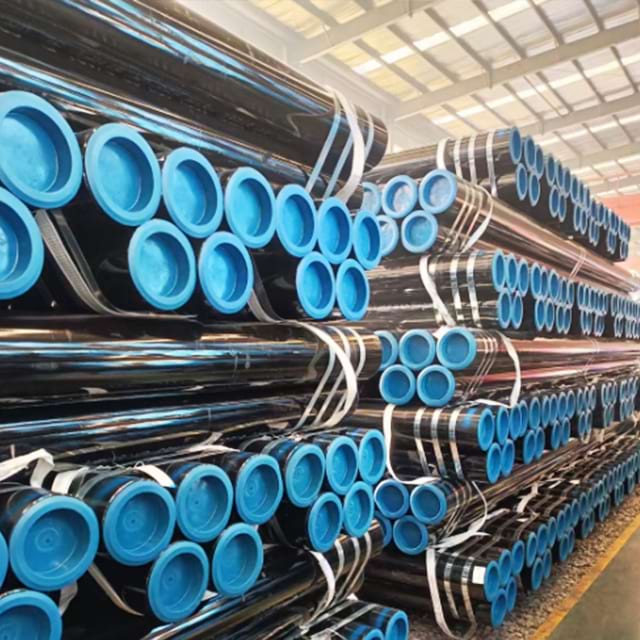 Pipe bundles strapped and end-capped for export. The mill stencil and MTC — not the stack — tell you whether a length is A53, A106, or API 5L.
ASTM A53 is an ASTM International product specification for carbon steel pipe in two grades and three types:
- Grade A: Lower strength — yield min 205 MPa (30 ksi), tensile min 330 MPa (48 ksi)
- Grade B: Standard strength — yield min 240 MPa (35 ksi), tensile min 415 MPa (60 ksi)
Product types:
- Type S (Seamless): Hot-finished or cold-drawn; no weld seam
- Type E (Electric Resistance Welded): Longitudinal ERW seam; normalised after welding for Grade B in NPS ≥ 2
- Type F (Furnace Butt Welded): Available in Grade A only; restricted to NPS ½ through NPS 4; lowest cost, not suitable for pressure service above low-moderate levels
A53 covers sizes NPS ⅛ through NPS 26. The specification includes requirements for hydrostatic testing, bend testing, and flattening tests. It does not mandate carbon equivalent limits for weldability.
Typical applications: Water and gas distribution, HVAC, fire sprinkler systems, low-pressure process piping, structural and general-purpose pipe. A53 Grade B Type S is also used in moderate-temperature process applications when A106 is not required by the design code.
What ASTM A106 Covers
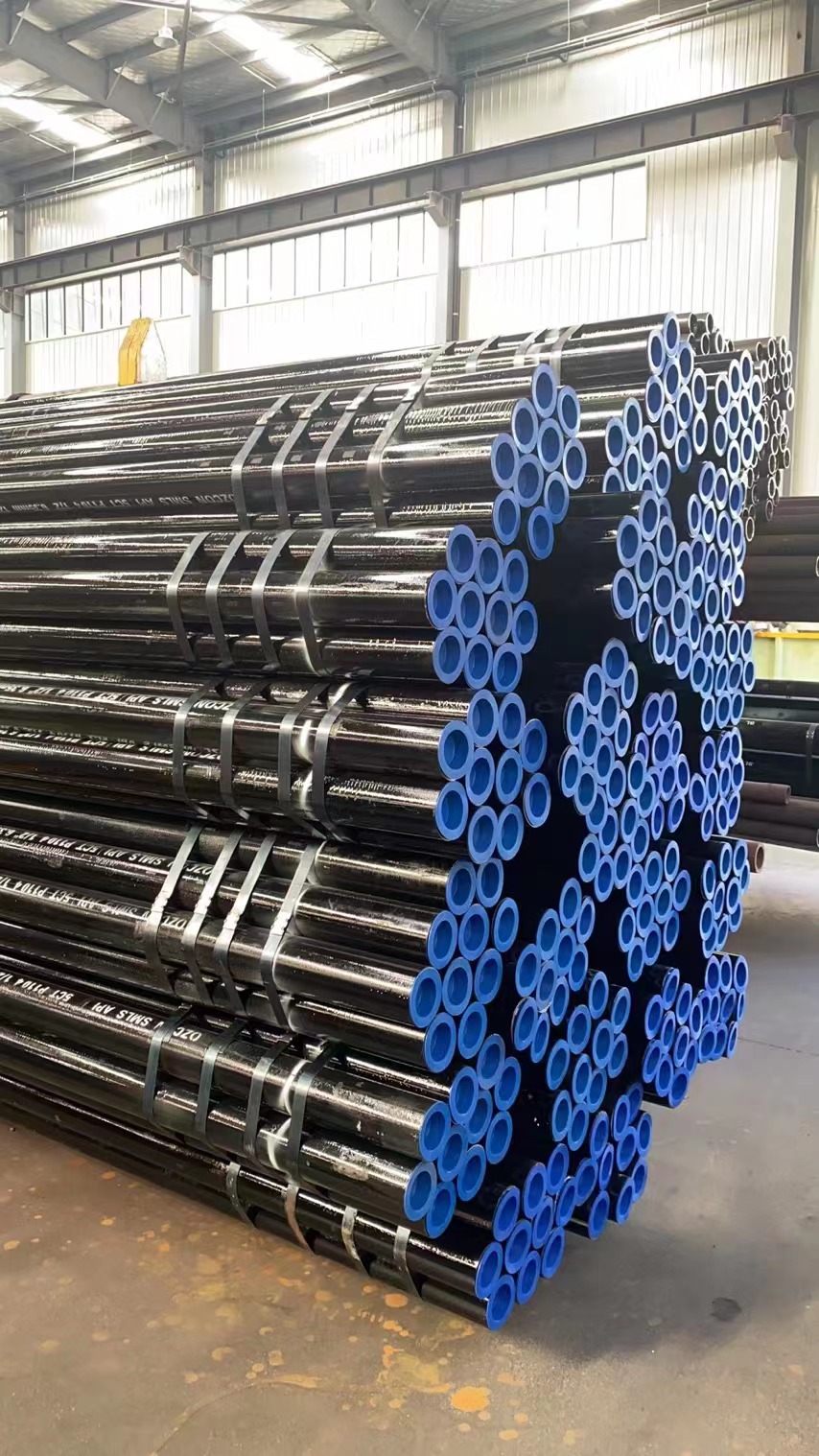 Seamless (SMLS) tube stencilled on the body. A106 covers seamless product only — there is no ERW A106, which is the first distinction from A53.
ASTM A106 is an ASTM International specification for seamless carbon steel pipe in three grades:
- Grade A: Yield min 205 MPa (30 ksi), tensile min 330 MPa (48 ksi)
- Grade B (most commonly specified): Yield min 240 MPa (35 ksi), tensile min 415 MPa (60 ksi)
- Grade C: Yield min 275 MPa (40 ksi), tensile min 485 MPa (70 ksi)
A106 covers seamless pipe only — it does not include an ERW or welded product type. This is the first critical distinction from A53. The specification covers sizes NPS ⅛ through NPS 48.
A106 Grade B must be hot-finished or normalised (heat treatment per Section 6 of the standard), which improves homogeneity and toughness for high-temperature pressure service. The chemistry requires carbon max 0.30%, with manganese 0.29–1.06%. Silicon is required at a minimum of 0.10% to provide adequate deoxidation for high-temperature service.
Typical applications: Refinery process piping (ASME B31.3), power plant piping (ASME B31.1), boiler feed systems, steam lines, and any plant piping where the design code requires seamless pipe at elevated temperature.
What API 5L Grade B Covers
API 5L (API Specification 5L, 46th Edition) covers seamless and welded steel pipe for pipeline transportation of oil, gas, and water. Grade B — designated L245 in SI notation — is the entry-level line pipe grade.
Mechanical properties (from API 5L 46th Edition):
| Property | PSL1 | PSL2 |
|---|---|---|
| Min yield (SMYS) | 245 MPa (35,500 psi) | 245 MPa (35,500 psi) |
| Min tensile (SMTS) | 415 MPa (60,200 psi) | 415 MPa (60,200 psi) |
| Max yield | Not specified | 450 MPa (65,300 psi) |
| Max tensile | Not specified | 655 MPa (95,000 psi) |
| Max Y/T ratio | Not specified | 0.93 (D > 323.9 mm) |
| Weld seam min tensile | 415 MPa | 415 MPa |
PSL2 imposes a maximum yield strength and a yield-to-tensile (Y/T) ratio limit — requirements that A53 and A106 do not include — because over-strength pipe in a pressure-rated pipeline can fail more brittly in overload conditions. The full PSL1-versus-PSL2 decision, including Charpy and NDE, is covered in the API 5L PSL1 vs PSL2 selection guide →, and the complete grade ladder is on the API 5L specification tables →.
Chemistry — PSL1 (seamless): C max 0.28%, Mn max 1.20%, P max 0.03%, S max 0.03%
Chemistry — PSL2 (all delivery conditions): Stricter limits including CE (IIW) max 0.43% and Pcm max 0.25%, with tighter S max (0.015%) and P max (0.025%). The CE and Pcm limits are the defining feature that sets API 5L PSL2 apart from the ASTM process pipe specifications.
For full PSL1 and PSL2 grade tables, see the API 5L Spec Tables →
API 5L PSL2's maximum yield strength limit — an upper ceiling on SMYS, not just a floor — has no counterpart in ASTM A53 or A106. A53 and A106 specify only minimum yield. A mill can produce A53 Grade B pipe with 380 MPa actual yield (57% above the 240 MPa minimum) and it is fully compliant. In a buried transmission pipeline governed by ASME B31.8, the Barlow MAOP formula uses SMYS — the specified minimum. If the actual yield is significantly above SMYS, the pipe has more burst capacity than the design assumes, which is generally harmless. But over-strength pipe also means higher yield-to-tensile ratio in practice, and in overload (ground movement, thermal expansion spike), the pipe may yield less plastically and fail more brittly than a pipe closer to SMYS. PSL2's Y/T ratio limit of 0.93 and maximum yield ceiling exist to maintain predictable plastic behavior under overload conditions. Process pipe in a plant (A106 domain) experiences controlled, monitored loads — a pipeline buried for 50 years does not. That engineering difference is why PSL2 has the limits that ASTM standards do not.
Key Differences at a Glance
| Parameter | ASTM A53 Gr.B | ASTM A106 Gr.B | API 5L Gr.B PSL1 | API 5L Gr.B PSL2 |
|---|---|---|---|---|
| Product form | Seamless + ERW | Seamless only | Seamless + welded | Seamless + welded |
| Min yield | 240 MPa (35 ksi) | 240 MPa (35 ksi) | 245 MPa (35.5 ksi) | 245 MPa (35.5 ksi) |
| Min tensile | 415 MPa (60 ksi) | 415 MPa (60 ksi) | 415 MPa (60.2 ksi) | 415 MPa (60.2 ksi) |
| Max yield | Not specified | Not specified | Not specified | 450 MPa |
| Carbon equiv. limit | None | None | None | CE ≤ 0.43%, Pcm ≤ 0.25% |
| Charpy impact testing | Not required | Not required | Not required | Required |
| High-temp suitability | Limited | Yes (to ~535°C) | Not designed for high-temp | Not designed for high-temp |
| Design code application | B31.3 moderate-temp, plumbing, structural | B31.3 high-temp, B31.1 | B31.4, B31.8 pipelines | B31.4, B31.8 pipelines |
| ERW weld NDE | Basic | N/A (seamless) | As per table | Full body ET + hydrostatic |
Chemistry Comparison
| Element | ASTM A53 Gr.B (seamless) | ASTM A106 Gr.B | API 5L Gr.B PSL1 (smls) | API 5L Gr.B PSL2 (BN delivery) |
|---|---|---|---|---|
| Carbon max | 0.30% | 0.30% | 0.28% | 0.24% |
| Manganese max | 1.20% | 1.06% (min 0.29%) | 1.20% | 1.20% |
| Phosphorus max | 0.05% | 0.035% | 0.030% | 0.025% |
| Sulfur max | 0.045% | 0.035% | 0.030% | 0.015% |
| CE (IIW) | Not specified | Not specified | Not specified | ≤ 0.43% |
| Pcm | Not specified | Not specified | Not specified | ≤ 0.25% |
The most meaningful chemistry difference is the sulfur limit: API 5L PSL2 requires S ≤ 0.015% versus 0.030–0.045% permitted in the ASTM specifications. Lower sulfur reduces manganese sulfide (MnS) inclusions, improving toughness and HIC resistance — critical for buried pipeline service where hydrogen-assisted cracking is a long-term risk.
Carbon Equivalent Comparison and Weld Preheat Consequence
The carbon equivalent (CE) determines whether girth welds require preheat in field construction. For Grade B pipe without significant alloying elements (Cr, Mo, V, Cu, Ni all minimal), the IIW formula simplifies to:
CE(IIW) = C + Mn/6 + (Cr+Mo+V)/5 + (Cu+Ni)/15 ≈ C + Mn/6
For the same nominal Grade B strength level (min yield 240–245 MPa), three actual pipe chemistries are possible:
| Specification | C (%) | Mn (%) | CE(IIW) | Preheat implication (10 mm wall, 10°C ambient) |
|---|---|---|---|---|
| ASTM A53 Gr.B (no CE limit) | 0.28 | 1.10 | 0.28 + 0.18 = 0.46 | Preheat ~75–100°C required for field girth welds |
| API 5L Gr.B PSL1 (no CE limit) | 0.26 | 1.10 | 0.26 + 0.18 = 0.44 | Preheat ~50–75°C typically required |
| API 5L Gr.B PSL2 (CE ≤ 0.43%) | 0.22 | 1.10 | 0.22 + 0.18 = 0.40 | Can weld without preheat in mild ambient conditions |
All three examples are fully compliant with their respective specifications. The CE difference between A53 and PSL2 is 0.06% — a number that looks trivial on a chemistry certificate but has direct construction cost consequences.
For a large-diameter gathering system with 5,000 girth welds, the difference between "preheat required" and "no preheat required" translates to significant construction time, fuel, equipment, and quality assurance cost. Preheat at 75–100°C on a remote location in cold ambient conditions requires preheating rings, temperature verification, and hold time — on every joint. PSL2's CE limit is a practical engineering specification, not a chemistry bureaucracy.
Use the Pipeline Design Calculator → for wall thickness and design pressure calculations.
Which Specification to Use
| Application | Correct specification |
|---|---|
| Long-distance oil/gas/water transmission pipeline | API 5L (grade by pressure × diameter) |
| Refinery process piping, high-temperature service > 200°C | ASTM A106 Grade B |
| Moderate-temperature process or utility piping (< 200°C) | ASTM A53 Grade B or A106 Grade B |
| Fire sprinkler, water distribution, structural use | ASTM A53 Grade A or B |
| Sour service pipeline (H2S environment) | API 5L PSL2 with Annex H (HIC-tested) |
| Field girth-welding without preheat in large diameter | API 5L PSL2 (CE and Pcm controlled) |
For API 5L grade selection above Grade B — X42 through X80 — see the API 5L PSL1 vs PSL2 selection guide → and the Pipeline Design Calculator →
When NOT to Use A53, A106, or API 5L PSL1
| Do Not Use | In This Application | Use Instead |
|---|---|---|
| ASTM A53 | Long-distance pipeline (ASME B31.8/B31.4) | API 5L (grade by pressure) |
| ASTM A53 ERW | Sour service without seam heat treatment | ERW API 5L PSL2 |
| ASTM A106 | Long-distance buried pipeline | API 5L PSL2 |
| API 5L (any grade) | ASME B31.3 high-temperature process piping > 200°C | ASTM A106 Grade B |
| API 5L PSL1 | Sour service pipeline | API 5L PSL2 + Annex H |
| API 5L PSL1 | Cold-climate pipeline with Charpy requirement | API 5L PSL2 with specified CVN temperature |
| Dual-stencil pipe | PSL2 specification without MTC verification | Verify PSL level on MTC before acceptance |
Named Failure Modes
Failure Mode 1: ASTM A53 ERW Installed as API 5L in Sour Pipeline — Wrong MTC, Wrong Seam
Mechanism: A sour gas gathering line is specified as API 5L X52 PSL2 seamless. A procurement shortcut installs 6-inch A53 Grade B Type E (ERW) — "it's the same strength level, and we had it in stock." A53 Grade B Type E has minimum yield 240 MPa vs X52 PSL2's 360 MPa — it is not the same strength level. More critically: A53 ERW has no mandatory seam heat treatment standard in A53, and has no CE limit. In H2S service, the A53 ERW seam operates at 300+ HV10 hardness — above the NACE MR0175 sour service limit. SSC initiates at the seam within 18 months of first gas.
Diagnostic: SSC failure at the weld seam of the gathering pipe. MTC review shows ASTM A53 Grade B Type E — not API 5L X52 PSL2. No CE limit on the MTC. No Charpy test. No seam heat treatment record.
Fix: Never substitute ASTM A53 for API 5L in any sour service pipeline. They are different standards with different regulatory acceptance in pipeline design. Maintain separate inventory for plant piping (A53/A106) and pipeline (API 5L). Apply the correct stencil interpretation: API 5L stamp alone does not mean PSL2.
Failure Mode 2: Dual-Stencil Pipe Accepted as PSL2 — Missing Charpy at Inspection
Mechanism: API 5L X65 PSL2 is specified for a 16-inch gas pipeline at −10°C Charpy test temperature. Pipe arrives stencilled "API 5L X65 / A53 Gr.B / A106 Gr.B." The inspector accepts the API 5L stencil as PSL2 compliance without checking the MTC detail. The MTC shows no Charpy test results — the pipe was produced to PSL1 (which meets A53 and A106 requirements at minimum). PSL2 Charpy requirement was never met. Two years into service, a cold winter drops ambient to −15°C during a planned pig run. A brittle fracture initiates at a surface scratch and propagates in the pipe body.
Diagnostic: Brittle fracture in service at temperatures below the Charpy test temperature. MTC review shows no Charpy test data despite API 5L stencil. Product designation on MTC shows "API 5L X65" without "PSL2" specified.
Fix: Always verify the PSL level on the MTC, not the pipe stencil. The MTC product designation must state "PSL2" — not just "API 5L." Require Charpy test records with temperature and energy values to be present on every PSL2 MTC. If Charpy records are absent, the pipe is PSL1 regardless of the stencil.
Failure Mode 3: A106 Grade B Used in Buried Pipeline — No CE Limit, Field Weld Cracking
Mechanism: An EPC project uses ASTM A106 Grade B seamless for a 6-inch buried oil pipeline at a remote location, because A106 was available and API 5L was on long lead. A106 Grade B has no CE limit. The supply lot has CE(IIW) = 0.46%. The pipeline is constructed by a field welding team with a WPS qualified for API 5L Grade B (CE ≤ 0.43%) at no preheat. With A106 at CE = 0.46%, the same welding procedure produces hydrogen-assisted HAZ cracking on several joints during cold-night welding. The cracks are subsurface, not detected on visual or RT inspection, and open under operating pressure within 6 months.
Diagnostic: Subsurface HAZ cracking at girth welds, initiating at the fusion line, propagating in the HAZ perpendicular to the applied stress. Cracking detected by TOFD or phased array UT. CE from MTC chemistry is 0.46% — above the preheat threshold for the WPS. A106 MTC shows no CE limit or CE value.
Fix: For field-girth-welded pipelines, specify API 5L PSL2 — not ASTM A106 or A53 — because only API 5L PSL2 controls CE and Pcm. If A106 must be used in a pipeline context, calculate CE from the actual heat chemistry on the MTC and verify it falls within the WPS preheat qualification range. If CE exceeds the no-preheat limit, apply preheat.
Purchase Order Guidance
Specify the design code, not just the material specification. The design code (ASME B31.3, B31.4, B31.8, or the relevant EPC project specification) determines which material specification and product level is acceptable. Order the material to the code requirements, not to what happens to be available on the market.
Procurement trap — A53 ERW shipped as A106: A53 ERW pipe and A106 seamless pipe can carry nearly identical markings (both may be Grade B, Schedule 40, same dimensions), but A53 ERW is not acceptable as a substitute for A106 seamless under B31.3 high-temperature service. Verify the product type on the MTR: "Type S" (seamless) versus "Type E" (ERW).
Procurement trap — PSL1 shipped when PSL2 is required: API 5L PSL1 and PSL2 pipe can be the same dimensions with similar MTR yield and tensile values, but PSL2 requires Charpy testing, CE limits, and additional NDE that PSL1 does not. If the project specifies PSL2, confirm that the MTR includes the Charpy test records and the CE/Pcm calculated values — not just the tensile and yield data.
Procurement trap — dual-stencil ambiguity: The most dangerous procurement error in this category is accepting dual-stencil pipe as PSL2 compliant. Pipe stencilled "API 5L Gr.B / A53 Gr.B / A106 Gr.B" satisfies all three specifications simultaneously — but it satisfies only PSL1 API 5L requirements. The mill ships dual-stencil pipe because the chemistry happens to fall within all three limit sets. If PSL2 is needed, the MTC must explicitly show PSL2 data (Charpy results, CE/Pcm values, PSL2 stated in the product designation). The presence of an API 5L stamp on the stencil does not automatically mean PSL2 compliance.
Wrong PO: "8-inch carbon steel pipe, Grade B, Schedule 40, API 5L compliant, sour service, MTC 3.2 required"
What the mill ships: Dual-stencil A53/A106/API 5L Grade B, PSL1 (no Charpy, no CE, no seam treatment — all three standards are satisfied by PSL1). The mill is fully correct per the PO as written. Sour service is noted on the PO but is not linked to any specific chemistry or inspection requirement, so it has no contractual effect.
Correct PO: "8-inch (219.1 mm OD) API 5L Grade B PSL2 per API Specification 5L, 46th Edition, seamless (S), delivery condition N (normalized), sour service: ISO 15156-2 Zone 0 compliance, hardness ≤ 22 HRC per NACE MR0175, Charpy CVN at −10°C minimum 40 J average, CE(IIW) ≤ 0.43% per heat (stated on MTC), EN 10204 3.2 MTC with named TPI, wall [specify mm minimum], bevelled ends, [specify length range]."
Minimum PO line items for API 5L Grade B PSL2:
- Specification: API 5L, 46th Edition, Grade B, PSL2
- Delivery condition: suffix (R, N, Q, or M)
- OD, wall thickness, and length
- End preparation (plain end, bevelled to ASME B16.25)
- Charpy test temperature and minimum energy
- HIC testing if sour service (Annex H)
- MTC per EN 10204 3.1 or 3.2
Frequently Asked Questions
What is the main difference between ASTM A106 and ASTM A53?
ASTM A106 covers only seamless carbon steel pipe and is the mandatory specification for high-temperature pressure service (above approximately 300°C). ASTM A53 covers both seamless and electric resistance welded (ERW) pipe, and includes Type F (furnace butt welded) in Grade A. A53 is appropriate for general-purpose, moderate-temperature applications but is not acceptable as a substitute for A106 in high-temperature pressure piping without explicit code authority. The key chemical difference is that A106 imposes tighter carbon equivalent control and requires normalising heat treatment for certain dimensions.
Can ASTM A53 Grade B be substituted for ASTM A106 Grade B?
A53 Grade B seamless and A106 Grade B have nearly identical minimum yield (240 MPa / 35 ksi) and tensile (415 MPa / 60 ksi) values, and their carbon limits are similar. However, A53 does not mandate the same heat treatment requirements as A106 for high-temperature service, and A53 ERW is not accepted in place of seamless A106 for pressure piping under ASME B31.1 or B31.3 without additional qualification. If the design code specifies A106, do not substitute A53 without engineering review.
What is the difference between A53 Grade A and Grade B?
Grade A has lower minimum strength: yield 205 MPa (30 ksi) and tensile 330 MPa (48 ksi). Grade B is stronger: yield 240 MPa (35 ksi) and tensile 415 MPa (60 ksi). Grade A is available in Types E (ERW), S (seamless), and F (furnace butt welded). Grade B is available in Types E and S only. In practice, virtually all A53 pipe specified for pressure service is Grade B. Grade A at the lower strength level is used in plumbing, low-pressure HVAC, and structural applications.
Why is API 5L Grade B different from ASTM A53/A106 Grade B despite similar strength values?
Although API 5L Grade B (L245), ASTM A53 Grade B, and ASTM A106 Grade B all require a minimum yield of approximately 240–245 MPa, they are written for entirely different service applications. API 5L is specifically designed for hydrocarbon pipeline transmission — it includes carbon equivalent (CE) limits for field weldability, Charpy impact requirements at PSL2, and inspection regimes tuned to long-distance pipeline risk. ASTM A53/A106 are process pipe specifications aimed at refinery and plant piping, with different heat treatment, end preparation, and testing requirements.
What does dual stencilling mean on carbon steel pipe?
Dual stencilling (e.g., A106 Gr.B / A53 Gr.B / API 5L Gr.B) means the pipe meets the chemical and mechanical requirements of all marked specifications simultaneously. This is common and legitimate when the chemistry falls within all three limits. However, the weakest applicable requirement governs for each design parameter. For example, if a spool piece is dual-stencilled A106/API 5L but is installed in a pipeline governed by API 5L PSL2 with Charpy requirements, the pipe must still have Charpy test reports — the dual stencil alone does not satisfy the PSL2 supplementary requirements.
Which specification should I use for oil and gas transmission pipelines?
API 5L is the correct specification for oil, gas, and water transmission pipelines. The choice of grade within API 5L (Grade B, X42, X52, X60, X65, X70) depends on operating pressure, diameter, wall thickness economics, and the design code (typically ASME B31.4 or B31.8). ASTM A53 and A106 are process pipe specifications and are not appropriate as primary pipeline specifications for long-distance hydrocarbon transmission, even though their minimum mechanical properties overlap with API 5L Grade B.
When is ASTM A106 Grade B the right choice over API 5L?
ASTM A106 Grade B is the standard choice for refinery and plant process piping operating at elevated temperatures — typically above 200°C and up to 535°C — under ASME B31.3. It is also used in boiler feed water piping and steam systems under ASME B31.1. API 5L is not generally specified for plant piping; it is optimised for buried or above-ground long-distance pipeline transmission. When the design code is B31.3 or B31.1 and the service is high-temperature pressure piping, A106 Grade B is the correct material specification.
What is CE (carbon equivalent) and why does it matter for API 5L Grade B PSL2?
Carbon equivalent (CE) is a formula that predicts weld cracking risk by combining the effects of carbon, manganese, silicon, chromium, molybdenum, vanadium, copper, and nickel content. For API 5L Grade B PSL2, the CE (IIW formula) must be ≤ 0.43 for all delivery conditions, and the Pcm (Ito-Bessyo formula) must be ≤ 0.25. These limits ensure the pipe can be girth-welded in the field without preheat for typical pipe diameters and wall thicknesses. ASTM A53 and A106 do not impose CE limits, which means field girth welding of thicker sections may require higher preheat to avoid hydrogen-assisted cracking.