Carbon steel boiler tubes manufactured to ASTM A192 and ASTM A210 are the most widely used tube materials in fire tube and water tube boilers, economisers, superheaters, and shell-and-tube heat exchangers operating at moderate temperatures and pressures. Correctly specifying the right grade for a given operating condition prevents premature failure, reduces tube replacement cost, and ensures ASME Section I compliance.
ZC Steel Pipe supplies seamless carbon steel boiler tubes to ASTM A192 and A210 across a range of outside diameters and wall thicknesses. This guide covers the chemistry, mechanical properties, heat treatment requirements, hydrostatic testing, and appropriate applications for each grade.
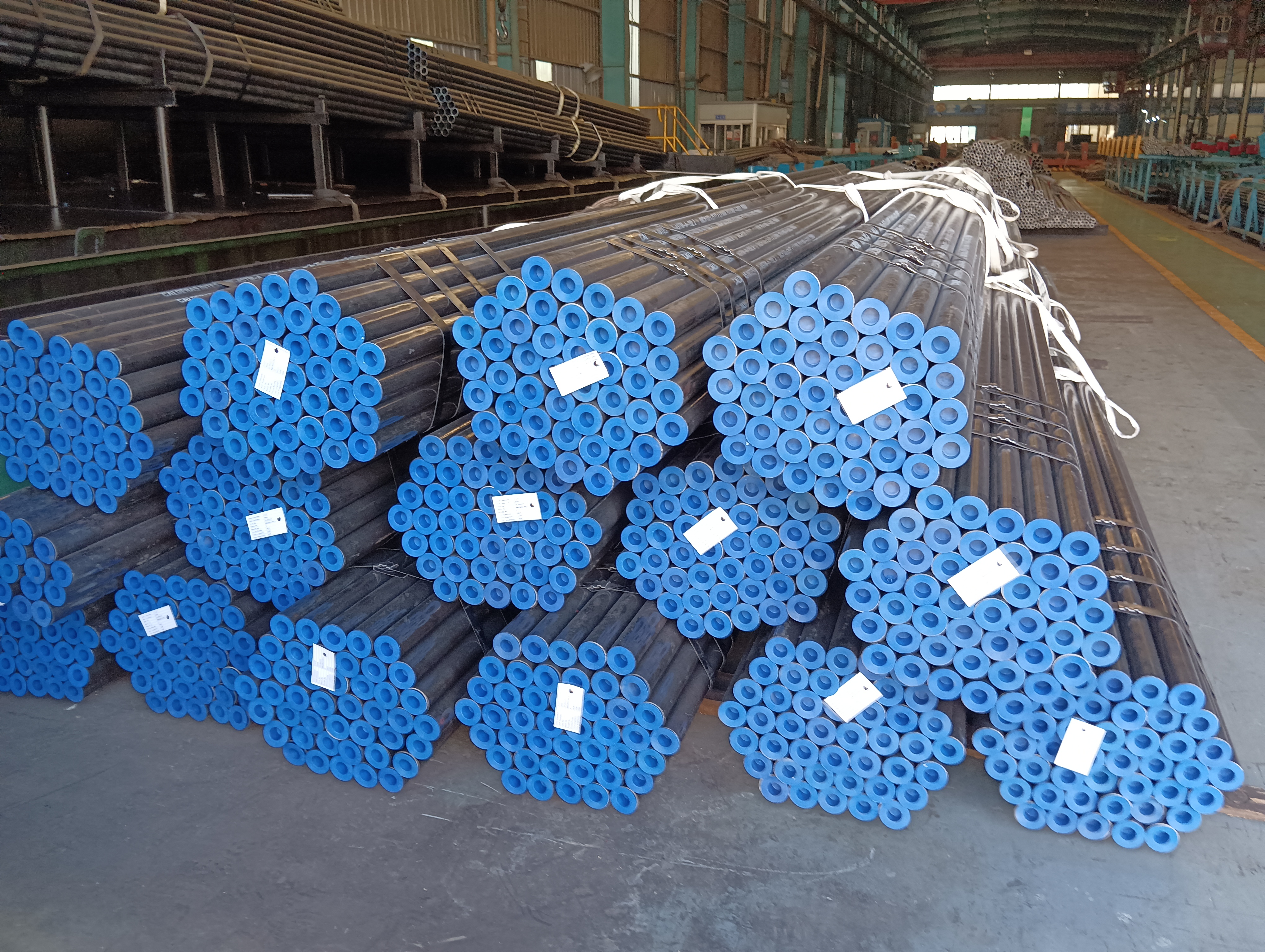 Seamless small-diameter tubes bundled with protective blue end caps and per-bundle ID tags, staged in the mill before a ZC delivery to South America.
On an East Africa industrial project, A192 was specified for a fire-tube boiler at 12 bar and 180°C — a correct application. The same specification was then used without revision for the superheater section of the same boiler operating at 420°C and 35 bar. The carbon steel tubes passed mill hydrostatic test and were installed. At 19 months of operation, the superheater tubes showed blistering and hydrogen damage consistent with operating above the carbon steel creep limit. The replacement specification was A210 Grade A-1 tubes with a creep-temperature cross-check against ASME Section I — a step that should have been done before the original order.
1. Overview of the Two Standards
| Property | ASTM A192 | ASTM A210 Grade A-1 | ASTM A210 Grade C |
|---|---|---|---|
| Carbon content (max) | 0.06% | 0.27% | 0.35% |
| Silicon (min) | — | 0.10% | 0.10% |
| Min tensile (MPa) | 325 | 415 | 485 |
| Min yield (MPa) | 180 | 255 | 275 |
| Min elongation (2") | 35% | 30% | 30% |
| Max hardness | 77 HRB | — | — |
| Heat treatment | Cold drawn + stress relieved | Heat treated | Heat treated |
| Primary application | Fire tube, economisers | Water tube boilers | High-pressure boilers |
ASTM A192 is a lower-carbon, lower-strength tube designed for ease of fabrication, particularly tube sheet rolling and mechanical expanding. ASTM A210 Grade A-1 is the standard utility boiler tube grade offering better mechanical properties.
ASTM A192's very low carbon (≤0.06%) is intentional for a specific reason: tube sheet expansion. In fire-tube boilers, the tube ends are mechanically rolled into the tube sheet, deforming the tube material plastically. If carbon content is higher, the tube is stiffer and more prone to cracking at the roll. A192's soft, ductile microstructure is optimised for this forming step — not for high-pressure service. Specifying A192 where A210 is needed to meet ASME Section I allowable stress is not conservative; it is under-specifying the wall thickness for the actual pressure.
2. ASTM A192 — Detailed Specification
Chemistry
| Element | Limit |
|---|---|
| Carbon | ≤0.06% |
| Manganese | 0.27–0.63% |
| Phosphorus | ≤0.035% |
| Sulfur | ≤0.035% |
| Silicon | ≤0.25% (when specified) |
The very low carbon (≤0.06%) is intentional — it ensures maximum formability and minimises risk of embrittlement at the weld or tube expansion joint. This is a key reason A192 is preferred for fire tube boilers where tube ends are mechanically expanded into tube sheets.
Size Range
ASTM A192 tubes are manufactured from ½ inch (12.7 mm) OD up to 5 inches (127 mm) OD. Wall thickness is specified by the purchaser as minimum wall thickness in inches or mm. Common OD × wall combinations for fire tube boilers:
- 50.8 mm OD × 4.0 mm WT
- 63.5 mm OD × 4.0 mm WT
- 76.1 mm OD × 4.5 mm WT
- 88.9 mm OD × 5.0 mm WT
Heat Treatment
A192 tubes are cold drawn and stress relieved. Stress relieving is performed at a temperature below the lower critical transformation temperature (approximately 650°C for carbon steel) to relieve cold working stresses without significantly altering microstructure.
For SA-192, SA-209, SA-210, and SA-213 mechanical properties and tube dimensions, see ASME Section I allowable stress tables
To convert between MPa/ksi, mm/inches, and bar/psi, use the Unit Converter →
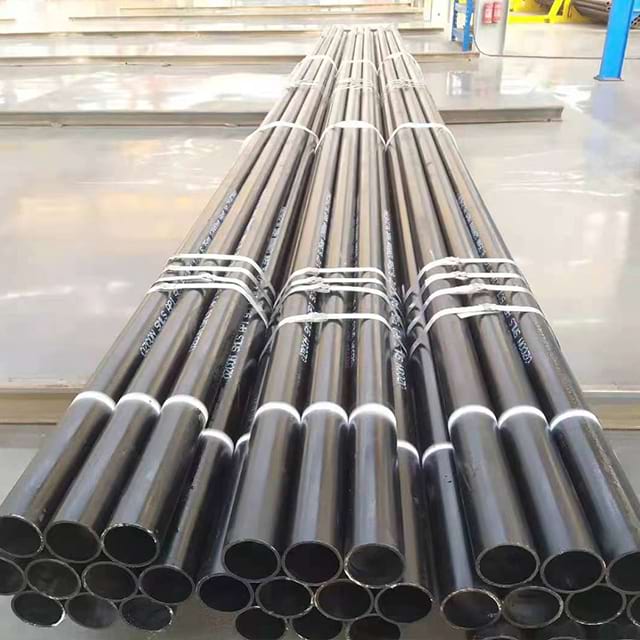 Seamless carbon steel boiler tubes strap-bundled on the shop floor, cut ends facing out, ready for marking and dispatch.
3. ASTM A210 — Detailed Specification
Chemistry
| Element | Grade A-1 | Grade C |
|---|---|---|
| Carbon (max) | 0.27% | 0.35% |
| Manganese (max) | 0.93% | 0.29–1.06% |
| Phosphorus (max) | 0.035% | 0.035% |
| Sulfur (max) | 0.035% | 0.035% |
| Silicon (min) | 0.10% | 0.10% |
The higher carbon content of A210 relative to A192 provides greater tensile and yield strength for high-pressure service, but reduces formability. The ≥0.10% Si minimum in A210 helps deoxidise the steel during melting and improves weldability.
Mechanical Properties
| Grade | Min Tensile (MPa) | Min Yield (MPa) | Elongation (min) |
|---|---|---|---|
| A-1 | 415 | 255 | 30% in 2" or 16% in 8" |
| C | 485 | 275 | 30% in 2" or 16% in 8" |
Heat Treatment
A210 tubes are supplied in the heat-treated condition. Acceptable heat treatment conditions under the standard:
- Annealing
- Normalising
- Normalising and tempering
- Quenching and tempering (for Grade C when required)
The specific heat treatment used must be agreed between manufacturer and purchaser and documented on the mill test certificate.
4. Hydrostatic Testing
Each tube to both A192 and A210 must pass a hydrostatic test performed by the manufacturer. The test pressure is calculated from:
P = 2St / D
Where:
- P = hydrostatic test pressure (psi or MPa)
- S = allowable fibre stress from ASME Section I tables
- t = specified minimum wall thickness
- D = specified outside diameter
The maximum test pressure is:
- A192: 2,500 psi (17.2 MPa)
- A210: 3,000 psi (20.7 MPa)
Hydrostatic Test Pressure Calculation — Worked Example
For ASTM A192 tube: OD = 63.5 mm (2.50 in), WT = 4.0 mm (0.157 in)
Step 1 — ASME Section I allowable fibre stress (S) for A192 at room temperature: S ≈ 10,200 psi (from ASME Section I Table PG-23 — use the current edition value)
Step 2 — Apply the formula P = 2St/D: P = 2 × 10,200 psi × 0.157 in / 2.500 in P = 3,204 / 2.500 = 1,281 psi
Step 3 — Check against maximum: Calculated P = 1,281 psi < 2,500 psi maximum for A192 Test pressure = 1,281 psi (the formula result governs for this thin-wall tube)
Step 4 — Repeat for A210 Grade A-1 at same geometry (S ≈ 12,800 psi): P = 2 × 12,800 × 0.157 / 2.500 = 1,607 psi Still below the 3,000 psi A210 maximum. Test at 1,607 psi.
Note: Always calculate P = 2St/D for each OD × wall combination. Do not assume the flat maximum always governs — for thin-wall tubes, the formula produces a lower (and more appropriate) test pressure.
If agreed between manufacturer and purchaser, a nondestructive electric test (electromagnetic induction or ultrasonic) can be substituted for the hydrostatic test.
5. Dimensional Tolerances
| Dimension | A192 Tolerance | A210 Tolerance |
|---|---|---|
| OD (up to 1½ inch) | ±0.5% or ±0.4 mm | ±0.5% or ±0.4 mm |
| OD (above 1½ inch) | ±0.75% or ±0.8 mm | ±0.75% or ±0.8 mm |
| Wall thickness (min) | −0% (full minimum) | −0% (full minimum) |
Wall thickness is specified as a minimum — the manufacturer may supply heavier wall than ordered. OD tolerance is symmetric; wall tolerance is a minimum-only requirement.
6. Application Guide
| Application | Recommended Grade | Reason |
|---|---|---|
| Fire tube boiler tubes | A192 | Low carbon, excellent tube sheet expansion |
| Economiser tubes (low-pressure) | A192 | Adequate strength, easy to form |
| Water tube boiler circuits | A210 Gr A-1 | Higher strength for higher pressure service |
| Superheaters and reheaters | A210 Gr A-1 | Higher tensile and yield strength |
| High-pressure drum boilers (>100 bar) | A210 Gr C | Maximum strength in carbon steel range |
| Shell-and-tube heat exchangers | A192 or A210 Gr A-1 | Depends on pressure and temperature |
For operating temperatures above 425°C where high-temperature creep is a concern, chromium-molybdenum alloy tube grades per ASTM A213 (T11, T22, T91) should be considered instead of carbon steel.
What we ship as heat exchanger tube: A recent A192 order we filled for a South American heat exchanger manufacturer was 2,000 pieces of OD 2½" (63.5 mm) × 3 mm wall, cut to 25 ft, clear-varnished inside and out with fitted end caps — a shell-and-tube bundle supply, not boiler pressure parts. The varnish request is common on heat-exchanger orders: it keeps the cold-drawn bore clean through ocean transit so the fabricator can expand into the tubesheet without mechanical cleaning first.
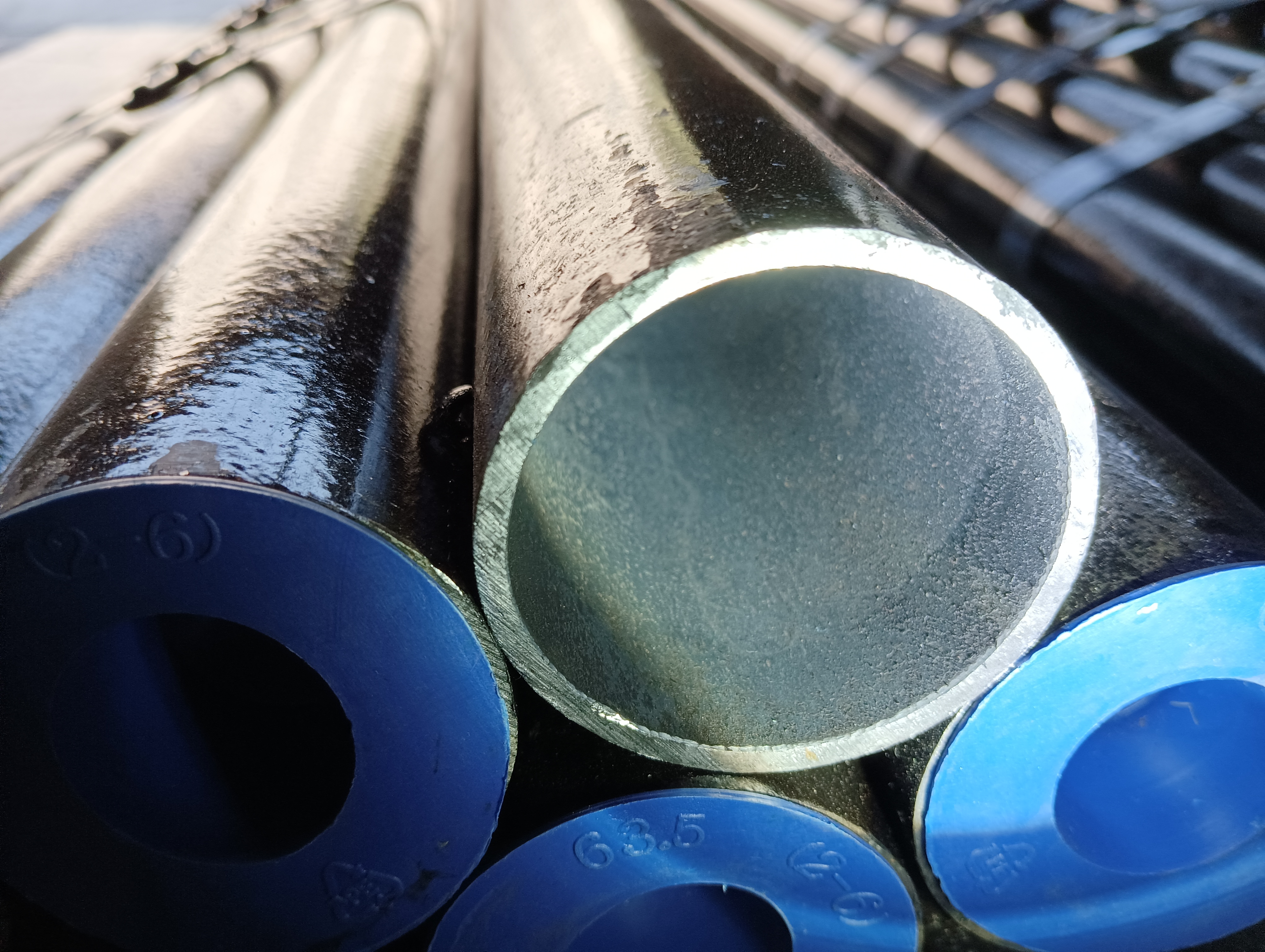 Close-up of a seamless tube end with a clean, bright bore and fitted blue end caps — the same heat-exchanger tube supply ZC shipped to South America.
When NOT to Use ASTM A192
| Scenario | Risk | Correct Approach |
|---|---|---|
| Superheater tubes above 425°C | A192 carbon steel creep limit approached; ASME Section I allowable stress drops sharply | Use A213 T11 (to 565°C), T22 (to 593°C), or T91 (to 650°C) |
| High-pressure water tube boilers above 70 bar | A192 minimum yield 180 MPa requires thick walls; tube weight becomes impractical | Use A210 Grade A-1 (255 MPa yield) to achieve thinner, lighter walls |
| "A192 or A210" specified without grade lock | Mill ships A192 when A-1 is required — wall thickness underdesigned for pressure | Always lock the grade explicitly: "ASTM A210 Grade A-1" not "A192 or A210" |
| Economiser tubes in flue gas with acid dewpoint risk | A192 low-silicon variant has reduced corrosion resistance to sulphurous condensate | Specify A210 Grade A-1 or apply low-temperature protection (bypass or surface coating) |
| Shell-and-tube heat exchangers with process-side corrosion | Plain carbon steel not adequate for corrosive process fluids | Select appropriate corrosion-resistant alloy; A192/A210 is for steam/water service only |
7. Marking and Documentation
Each tube must be marked with:
- Manufacturer's name or trademark
- ASTM specification (A192 or A210)
- Grade (for A210: A-1 or C)
- Tube OD × wall thickness
- Heat number (lot traceable to mill test certificate)
Mill test certificate (MTC) must include:
- Heat analysis (ladle chemistry)
- Product analysis (per tube body)
- Mechanical test results (tensile, yield, elongation, hardness)
- Heat treatment description
- Hydrostatic test confirmation (or NDE test confirmation)
Procurement trap — grade not locked for pressure service:
Wrong PO: "ASTM A192 or A210 seamless boiler tubes, 63.5 mm OD × 4.0 mm WT, mill lengths."
What ships: Mill ships A192 (lower-cost, easier to form). The ASME Section I design was performed assuming A210 Grade A-1 minimum yield 255 MPa. A192 yield is 180 MPa — 29% lower. The wall thickness of 4.0 mm is undersized for the design pressure at A192 allowable stress. The boiler inspector flags this during the code compliance review before commissioning.
Correct PO: "ASTM A210 Grade A-1 seamless boiler tubes, 63.5 mm OD × 4.0 mm WT minimum, mill lengths, heat-treated condition per ASTM A210 Section 8. Hydrostatic test per standard. MTC EN 10204 3.1 with heat analysis, product analysis, mechanical test results, and heat treatment description."
Failure Modes
Failure Mode 1 — A192 installed above temperature limit
Mechanism: A192 tubes are specified for a superheater operating at 420°C and 45 bar. At this temperature, carbon steel ASME Section I allowable stress is near its lower limit and declining. The design wall was calculated from A210 Grade A-1 allowable stress — A192's lower allowable would require a thicker wall to be code-compliant. The tubes installed are under-walled for the actual operating condition. Over 18–24 months, creep produces measurable tube elongation, tube sheet pull-out at the rolled joint, and eventually steam leakage.
Diagnostic: Steam leakage at tube-to-tube-sheet joints after 18–24 months. Metallurgical examination shows tube elongation and microstructural evidence of creep deformation. MTC shows A192, not the A210 specified in the design. Design recalculation confirms A192 allowable stress requires 20% greater wall thickness than provided.
Fix: Replace affected tubes with A210 Grade A-1 at the design wall thickness. Issue a non-conformance report to the supplier. Revise all future POs to explicitly state grade — "ASTM A210 Grade A-1" — not "A192 or A210."
Failure Mode 2 — A210 supplied without heat treatment documentation
Mechanism: A210 Grade A-1 tubes are purchased and a mill test certificate is issued showing correct chemistry and mechanical properties. The heat treatment condition is listed as "per standard" — no specific heat treatment type (anneal, normalise, normalise and temper) is stated. During a code compliance audit, the inspector requires documentation of the specific heat treatment applied. The mill cannot provide it. The tubes are accepted provisionally, but a code non-conformance is raised requiring retrospective documentation that the mill cannot supply.
Diagnostic: MTC shows no heat treatment description or states "per standard" without specifying the method. Boiler code inspector flags missing documentation. No furnace records available from the mill to confirm the treatment applied.
Fix: Future POs must include: "Heat treatment condition shall be documented on the MTC — specify whether annealed, normalised, or normalised and tempered. Furnace temperature records to be available on request."
Failure Mode 3 — Hydrostatic test pressure calculated incorrectly
Mechanism: The mill performs the hydrostatic test at the maximum standard pressure (2,500 psi for A192) rather than calculating P = 2St/D for the specific tube geometry. For a thin-wall tube with high specified wall, the formula-calculated test pressure may be lower than 2,500 psi and the correct test is actually less severe. For a thick-wall tube, the formula may produce a higher required test pressure than the standard maximum — a condition the purchaser must agree to allow the substitution of NDE. If neither party checks the formula, a tube may pass at the standard maximum but fail below the required test pressure for that geometry.
Diagnostic: Engineering review of the MTC shows the hydrostatic test was performed at a flat 2,500 psi without showing the P = 2St/D calculation for the ordered OD and wall. For some tube geometries, the required test pressure from the formula exceeds 2,500 psi — meaning NDE should have been specified as the alternative, not the hydrostatic test at the standard maximum.
Fix: For all boiler tube orders, require the MTC to show the hydrostatic test pressure actually applied AND the calculated P = 2St/D value for the specific OD and wall. If these differ, the MTC must explain the reason (agreed NDET substitution, or flat maximum cap applied).
8. Procurement Checklist
- Standard: ASTM A192 or ASTM A210 Grade A-1 or C (latest edition)
- OD and minimum wall thickness (in inches or mm)
- Length: random (mill length) or exact cut length
- Heat treatment condition: state requirement or accept per standard
- Hydrostatic test: per standard, or specify NDET alternative
- Surface finish: outside bare, or pickle and oil
- Marking: per standard marking requirements
- Mill test certificate: EN 10204 3.1 (usually required for pressure applications)
- Supplementary requirements: specify if Charpy impact (at low temperature) or NDE (UT, ET) required
Frequently Asked Questions
What is the difference between ASTM A192 and A210?
ASTM A192 is a seamless carbon steel tube specification intended for high-pressure service at moderate temperatures. It has a very low carbon content (≤0.06%) and low silicon content (≤0.25%), giving it excellent cold workability and a soft tube that is easily expanded into tube sheets. ASTM A210 covers medium-carbon steel boiler and superheater tubes in two grades — Grade A-1 (≤0.27% C) and Grade C (≤0.35% C) — with higher strength than A192. A210 is used where higher tensile and yield strength are required for larger boiler designs operating at higher pressures.
What are the minimum mechanical properties of ASTM A192 boiler tubes?
ASTM A192 requires a minimum tensile strength of 47,000 psi (325 MPa), minimum yield strength of 26,000 psi (180 MPa), and minimum elongation of 35% in 2 inches. The Brinell hardness is limited to 77 HRB maximum. These are relatively modest mechanical properties — A192 is designed for thin-wall, small-diameter tubes where ease of forming and tube-sheet expansion is more important than pressure capacity.
What are the mechanical properties of ASTM A210 Grade A-1?
ASTM A210 Grade A-1 requires a minimum tensile strength of 60,000 psi (415 MPa), minimum yield strength of 37,000 psi (255 MPa), and minimum elongation of 30% in 2 inches (or 16% in 8 inches). Grade C requires minimum tensile of 70,000 psi (485 MPa), minimum yield of 40,000 psi (275 MPa), and minimum elongation of 30% in 2 inches. Both grades have higher strength than A192, allowing thinner tube walls at a given pressure.
What heat treatment is required for A192 and A210 boiler tubes?
ASTM A192 tubes are cold drawn and stress relieved. Stress relieving removes residual stress from the cold drawing process and reduces the risk of stress corrosion cracking. ASTM A210 Grade A-1 and Grade C tubes are supplied in the heat-treated condition — the standard requires that the tubes be either annealed, normalized, or normalised and tempered depending on grade and wall thickness. Both grades require hydrostatic testing of each tube before shipment.
What is the hydrostatic test requirement for ASTM A192 and A210 tubes?
Each tube must be hydrostatically tested at a pressure calculated from the formula P = 2St/D, where S is the allowable fibre stress (from ASME Section I allowable stress tables), t is the specified wall thickness, and D is the outside diameter. The maximum hydrostatic test pressure is 2,500 psi (17.2 MPa) for A192 and 3,000 psi (20.7 MPa) for A210 unless otherwise agreed. As an alternative to the hydrostatic test, nondestructive electric test (NDET) may be substituted when agreed between manufacturer and purchaser.
What are typical applications of ASTM A192 tubes?
ASTM A192 tubes are used in fire tube boilers (the tube carrying hot gases), water tube boilers as economiser tubes (preheating the feedwater before the steam drum), and as heat exchanger tubes in moderate-pressure, moderate-temperature shell-and-tube heat exchangers. Their low carbon content and excellent formability also make them suitable for hydraulic forming and tube sheet rolling operations.
What applications use ASTM A210 boiler tubes?
ASTM A210 Grade A-1 is used in power boiler water tube circuits, superheaters, reheaters, and economisers where higher pressure and temperature conditions require better mechanical properties than A192. Grade A-1 is the dominant grade and is widely used in utility boilers, industrial boilers, and waste heat recovery units. Grade C sees use in high-pressure applications such as once-through boilers and drum boilers above 100 bar.