R95 is the grade that procurement teams often treat as interchangeable with T95 — same yield range, both Q+T, both in the 95 ksi slot of the API grade ladder. That assumption is wrong, and the consequences run in both directions. Buyers on sweet well projects sometimes order T95 when R95 would be faster to source and cheaper to procure, adding unnecessary complexity to the MTC requirements and hardness testing documentation. More seriously, buyers on sour well projects occasionally accept R95 in place of T95 because a supplier offers it as an "equivalent" — it is not. R95 has no hardness limit and is not qualified for H2S service under NACE MR0175 / ISO 15156 under any circumstances.
Understanding R95 correctly means understanding what it is and what it deliberately is not. It is a quench-and-tempered sweet-service grade that provides a meaningful yield step above N80 and L80 without the procurement overhead of the restricted-yield sour grades. For the right application — confirmed sweet wells with design loads that sit between the 80 ksi and 110 ksi brackets — it is a clean, efficient specification.
ZC Steel Pipe supplies API 5CT R95 casing in seamless form to PSL-2, with EN 10204 3.1 and 3.2 MTC documentation and third-party inspection by SGS, Bureau Veritas, or TÜV. We supply to operators and OCTG distributors working on sweet oil and gas projects in West Africa, the Middle East, and Southeast Asia.
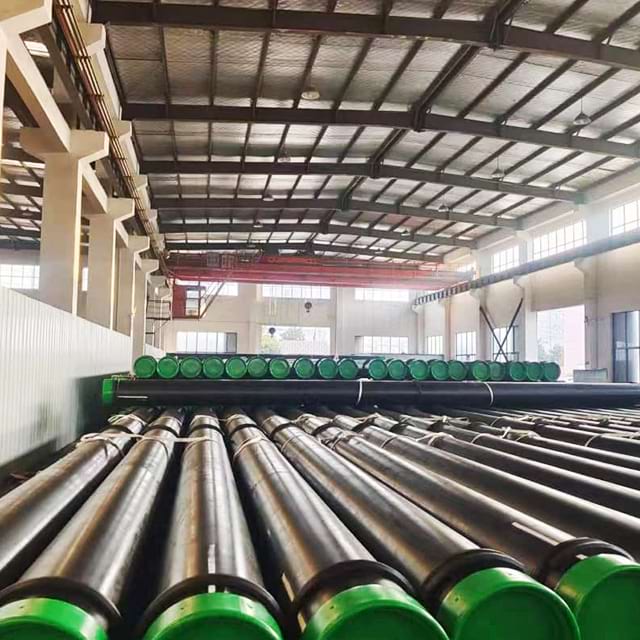 Sunlit racks of finished casing with green end caps at ZC Steel Pipe, staged for inspection before dispatch.
Quick Answer
R95 is a sweet-service-only casing grade: 655 MPa (95 ksi) minimum yield, 758 MPa (110 ksi) maximum, quench-and-tempered, with no maximum hardness limit. That missing hardness ceiling is exactly why R95 is not qualified for H2S sour service under NACE MR0175 / ISO 15156 — for a sour well at the same strength, specify T95 instead.
| Property | R95 |
|---|---|
| Min yield | 655 MPa (95 ksi) |
| Max yield | 758 MPa (110 ksi) |
| Min tensile | 724 MPa (105 ksi) |
| Max hardness | None specified by API 5CT |
| Heat treatment | Quench and temper (mandatory) |
| Sour service (NACE MR0175) | Not approved |
Use R95 when a confirmed sweet well needs more strength than N80 or L80 but does not yet demand P110. See the full API 5CT grade tables →, or match a grade to your well with the Pipe Grade Selector →.
What we see on orders: R95 purchase orders we receive often say "95 ksi casing" or "95 ksi Q+T" without specifying R95 or T95 by name. When a PO is ambiguous like that, we contact the buyer before placing with the mill — because the grade designation matters for MTC content. R95 MTCs do not include hardness testing; T95 MTCs must include hardness survey results per API 5CT 10.7. If the mill interprets the order and defaults to T95, the buyer receives a higher-specification product than they ordered, but the MTC scope is different and may not align with the project documentation requirements. Specifying R95 or T95 explicitly on the PO takes ten seconds and eliminates that ambiguity entirely.
What Is API 5CT R95?
R95 is defined in API Specification 5CT, 11th Edition / ISO 11960 as a Group 1 casing and tubing grade with a minimum yield strength of 655 MPa (95,000 psi) and a maximum yield of 758 MPa (110,000 psi). It is produced exclusively by quench and temper heat treatment — API 5CT does not permit normalized-and-tempered or as-rolled supply for R95.
Three characteristics define R95's position in the grade ladder:
No hardness limit. API 5CT specifies no maximum hardness for R95 — neither in HRC nor HBW. This is the fundamental distinction from the sour-service grades. NACE MR0175 / ISO 15156-2 qualifies carbon and low-alloy steel casing grades for H2S service based on a maximum hardness ceiling of 22 HRC. Without that ceiling, a grade cannot be qualified for sour service regardless of yield strength, chemistry, or heat treatment. R95 is strictly sweet-service.
Quench and temper heat treatment. The Q+T requirement is what achieves 95 ksi minimum yield from R95's high-carbon chemistry. Other heat treatment routes are not permitted. The Q+T process is the same mechanism used for T95 — the difference is that R95 Q+T is optimized only to meet the yield and tensile minimums, without the additional constraint of a hardness ceiling.
Wider chemistry latitude. R95 carries a 0.45% maximum carbon limit, extendable to 0.55% when oil-quenched. This is significantly looser than T95's tighter alloy and sulphur controls. The wide latitude means more mill sources, shorter lead times, and generally lower cost than sour-service grades — appropriate because R95's sweet-service application does not require the tightly controlled microstructure that sour grades demand.
R95 sits in the API Group 1 classification alongside N80-1, N80Q, and L80-1. Group 1 grades are distinguished from Group 2 (C90, T95) and Group 3 (C110) primarily by the absence of strict hardness controls. The color identification band for R95 under API 5CT is one brown band applied to the pipe body.
Mechanical Properties
All values are from API Specification 5CT, 11th Edition.
| Property | R95 |
|---|---|
| Minimum yield strength | 655 MPa (95,000 psi) |
| Maximum yield strength | 758 MPa (110,000 psi) |
| Minimum tensile strength | 724 MPa (105,000 psi) |
| Maximum hardness | No limit specified by API 5CT |
| Heat treatment | Quench and temper (Q+T) — mandatory |
| Sour service (NACE MR0175) | Not approved |
| API Group | Group 1 |
| Color code | One brown band |
The yield band runs 655 to 758 MPa (95 to 110 ksi). Both limits matter. A heat below 655 MPa is non-conforming. A heat above 758 MPa is also non-conforming — even though higher yield might seem more conservative. The upper bound is what separates R95 from P110 on yield, and both limits must be verified on every MTC before acceptance.
The 724 MPa (105 ksi) minimum tensile is a secondary requirement. On a well-produced R95 heat, the yield-to-tensile relationship is typically around 0.90 — within the material behavior expected from Q+T carbon steel. If a heat shows minimum tensile close to 724 MPa with yield near 758 MPa, that tight spread is worth flagging with the mill for review of the heat treatment record.
For the complete grade ladder with tensile, hardness, and chemistry limits, see the API 5CT specification tables →
To match a grade to your well conditions, use the Pipe Grade Selector →
Chemical Composition
API 5CT 11th Edition specifies the following chemistry limits for R95. All values are maximum unless otherwise noted.
| Element | Limit |
|---|---|
| Carbon (C) | 0.45% max (0.55% max if oil-quenched) |
| Manganese (Mn) | 1.90% max |
| Silicon (Si) | 0.45% max |
| Phosphorus (P) | 0.030% max |
| Sulphur (S) | 0.030% max |
| Chromium (Cr) | Not restricted |
| Molybdenum (Mo) | Not restricted |
| Nickel (Ni) | Not restricted |
| Niobium (Nb) | Not restricted |
| Copper (Cu) | Not restricted |
API 5CT does not restrict chromium, molybdenum, nickel, niobium, or copper for R95. The manufacturer selects alloy additions to achieve the required yield and tensile properties. This is the normal approach for Group 1 grades — the standard specifies output requirements, not the metallurgical route to get there.
The carbon maximum deserves attention. At 0.45%, R95 allows a significantly higher carbon content than T95's effective limit (T95 has tighter alloy controls that discourage high-carbon alloy strategies to achieve the hardness ceiling). The oil-quench provision extends the carbon maximum to 0.55% — mills that use oil quenching rather than water quenching can run higher carbon content to achieve the target yield without risk of quench cracking. This flexibility in the heat treatment route is one reason R95 is faster to produce and available from more mill sources than T95.
The sulphur maximum of 0.030% is the same as N80 and L80 Type 1 — compare this with T95's 0.010% maximum sulphur, or C90's equally tight 0.010% limit. High sulphur content promotes the formation of manganese sulphide inclusions, which act as hydrogen traps and crack initiation sites in H2S environments. For sweet service, 0.030% sulphur is acceptable. In a sour environment, 0.030% sulphur is a reliability risk — which is exactly why R95 cannot be used in H2S wells regardless of what the yield stencil reads.
The identical yield, different grade trap: R95 and T95 both carry a 655–758 MPa (95–110 ksi) yield range and both require Q+T heat treatment. A buyer who sees these numbers and concludes the grades are interchangeable is reading half the specification. T95 requires hardness testing per API 5CT Section 10.7 on every heat — R95 does not. This means accepting R95 on a T95 purchase order is not just a grade-marking issue; the MTC content is different. A T95 MTC includes a hardness survey; an R95 MTC does not. If a project specification requires T95 with hardness qualification, receiving R95 — even if it has the correct yield — is a document non-conformance that can hold up acceptance at the receiving yard. Write the grade explicitly on the PO.
Burst Pressure Example
The API Barlow formula per API 5C3 gives the internal yield pressure for casing as:
P = 0.875 × (2 × SMYS × t) / D
where SMYS is the specified minimum yield strength, t is the nominal wall thickness, and D is the nominal outside diameter. The 0.875 factor is API's standard mill tolerance reduction (87.5% of nominal wall).
Worked example: 7" 26 lb/ft R95 casing
For 7" 26 lb/ft R95, the nominal wall thickness t = 0.362 inch, OD D = 7.000 inch, SMYS = 95,000 psi:
P = 0.875 × (2 × 95,000 × 0.362) / 7.000
P = 0.875 × (68,780) / 7.000
P = 0.875 × 9,826
P = 8,597 psi, rounded to 8,600 psi
This is the minimum burst resistance based on minimum yield. A string design would apply a design factor — typically 1.1 to 1.25 for burst depending on the operating company's design standard — so the maximum allowable burst working pressure from this calculation would be in the range of 6,900–7,800 psi, depending on the safety factor applied.
For collapse resistance, the applicable formula regime (yield-strength, plastic, transition, or elastic) is selected based on the D/t ratio. For 7" 26 lb/ft, D/t = 7.000 / 0.362 = 19.3. At this D/t, the collapse regime for R95 requires confirming against the API 5C3 grade coefficient table. Use the Barlow Pressure Calculator → for burst and the Collapse Calculator → for collapse across the full R95 size range.
R95 vs T95 — The Same Yield, Different Grade
This is the most consequential section in this article. R95 and T95 occupy the same yield bracket in the API grade ladder, both require Q+T heat treatment, and both produce pipe stenciled with the same 95 ksi minimum. A procurement engineer who skims only the mechanical properties table will see two grades that look identical. They are not.
| Property | R95 | T95 Type 1 | T95 Type 2 |
|---|---|---|---|
| Min yield (MPa / ksi) | 655 / 95 | 655 / 95 | 655 / 95 |
| Max yield (MPa / ksi) | 758 / 110 | 758 / 110 | 758 / 110 |
| Min tensile (MPa / ksi) | 724 / 105 | 724 / 105 | 724 / 105 |
| Max hardness (HRC) | No limit | 25.4 | 22 |
| Hardness testing required | No | Yes (API 5CT 10.7) | Yes (API 5CT 10.7) |
| H2S service (NACE MR0175) | Not approved | Conditional (needs SR15) | Yes — directly qualified |
| Carbon max (%) | 0.45 (0.55 oil-Q) | 0.45 | 0.45 |
| Sulphur max (%) | 0.030 | 0.010 | 0.010 |
| Phosphorus max (%) | 0.030 | 0.020 | 0.020 |
| Alloy restrictions | None | Cr 0.40–1.50%, Mo 0.25–0.85% | Cr 0.40–1.50%, Mo 0.25–0.85% |
| MTC hardness survey | Not required | Required | Required |
| Typical lead time vs R95 | Baseline | +1 to +3 weeks | +2 to +4 weeks |
The hardness testing requirement drives a real difference in the inspection and documentation cycle. T95 requires hardness testing per API 5CT Section 10.7 — a full survey of the pipe body hardness — on every production heat. This adds inspection time and MTC content. For a buyer sourcing pipe for a sweet well, ordering T95 when R95 is the correct specification adds lead time and documentation overhead for no engineering benefit. The test results will exist on the MTC and will need to be reviewed and filed — work that achieves nothing if the application never required NACE qualification.
The chemistry differences between R95 and T95 are not cosmetic. T95's tighter sulphur (0.010% vs 0.030% for R95) and phosphorus (0.020% vs 0.030%) limits, combined with the mandated Cr-Mo alloying range, are specifically designed to ensure that the Q+T process produces a uniform, fine-grained martensite that responds predictably to tempering — because T95 must reliably achieve a hardness ceiling to meet NACE requirements. R95's looser chemistry works fine for sweet-service pressure containment but would not reliably produce the controlled hardness distribution that sour service demands.
The substitution direction that matters: Receiving T95 on an R95 purchase order is acceptable (and occasionally useful for lead time when a mill has T95 stock). The substitution that creates a safety problem runs the other way: receiving R95 on a T95 purchase order for a sour service well. The yield markings look the same. The stenciled grade designation is the only reliable field indicator of which product you have — and only a review of the MTC against the PO confirms that the actual production heat meets the specification ordered.
When NOT to Use R95
R95 is the correct specification for confirmed sweet wells with loads between 80 ksi and 110 ksi. There are four conditions where R95 should not be used:
1. Any well with confirmed or potential H2S. If the formation gas analysis shows H2S at any concentration that triggers sour service classification under NACE MR0175 / ISO 15156-2, R95 is disqualified. The mechanism is sulphide stress cracking (SSC): in the presence of H2S and moisture, hydrogen atoms generated by the corrosion reaction diffuse into the steel lattice and accumulate at high-stress sites, particularly grain boundaries and inclusions. High-hardness steel — which R95 can produce, since there is no hardness ceiling — is more susceptible to hydrogen embrittlement and SSC initiation. A string of R95 casing running through an H2S-bearing zone can fail catastrophically with no macroscopic warning. SSC failures in high-hardness pipe do not look like corrosion failures: the pipe surface may appear intact while subsurface crack propagation reaches critical depth. Specify T95 Type 2 or C90 for any sour well — see the sour-service grade selection guide → for the NACE partial-pressure logic.
2. Wells classified as sour by NACE MR0175 even at low H2S partial pressures. NACE MR0175 / ISO 15156-2 defines sour service based on total system pressure and H2S partial pressure — not H2S concentration alone. At high total pressures, even trace H2S concentrations can produce H2S partial pressures above the NACE threshold. Do not rely on low H2S percentage to justify R95 without running the NACE partial pressure calculation.
3. When the project specification requires sour service qualification documentation. If the project specification document requires NACE MR0175 compliance, third-party sour service material qualification, or a hardness survey on the MTC, R95 cannot satisfy these requirements regardless of well conditions. The absence of a hardness limit means no hardness qualification document can be issued.
4. When string design calculations at critical sections exceed 758 MPa (110 ksi) yield. R95's maximum yield of 758 MPa is identical to P110's minimum. If the string design requires guaranteed minimum yield above 95 ksi to satisfy the collapse or burst load case — for example, in deep high-pressure wells where wall thickness is constrained by coupling geometry — R95 does not provide sufficient yield margin. Move to P110.
R95 vs N80 vs P110 — Selection Logic
| Property | N80Q | R95 | P110 |
|---|---|---|---|
| Min yield (MPa / ksi) | 552 / 80 | 655 / 95 | 758 / 110 |
| Max yield (MPa / ksi) | Not specified | 758 / 110 | Not specified |
| Min tensile (MPa / ksi) | 689 / 100 | 724 / 105 | 862 / 125 |
| Max hardness | No limit | No limit | No limit |
| H2S service | Not approved | Not approved | Not approved |
| Heat treatment | Q+T | Q+T | Q+T |
| Chemistry complexity | Low | Low | Low |
| Burst resistance gain vs previous | — | +19% at min yield | +16% at min yield |
The yield steps across this trio are meaningful. R95's 655 MPa minimum is 19% above N80Q's 552 MPa — for a given pipe geometry, burst and collapse resistance scale approximately linearly with yield, so R95 delivers roughly 19% better minimum burst resistance than N80Q in the same OD and wall. P110's 758 MPa minimum is approximately 16% above R95.
Choose N80Q when: The well is sweet, loads are satisfied at 80 ksi with available wall thicknesses, and reducing material cost is a priority. N80Q is the highest-volume sweet-service grade and typically has the shortest lead times and most competitive pricing.
Choose R95 when: Design calculations show that N80Q fails the burst or collapse load case — even at the heaviest available wall — and the well is confirmed sweet. R95 delivers the next yield step without entering the sour-service grade procurement process.
Choose P110 when: Design calculations show that R95 fails the load case, or when the well design specifies 110 ksi minimum for any other reason. P110 also dominates in high-pressure high-temperature (HPHT) wells where design margins are tight and yield consistency across the string is critical.
The N80Q–R95 boundary is the most common decision point on medium-depth sweet gas wells in West Africa and the Middle East. The answer is almost always resolved by running the string design with the burst and collapse load cases. If N80Q passes at a wall weight that is available and economic, use N80Q. If it requires a wall that is not available or drives the string weight above the running equipment limit, R95 is the next step.
Standard Sizes
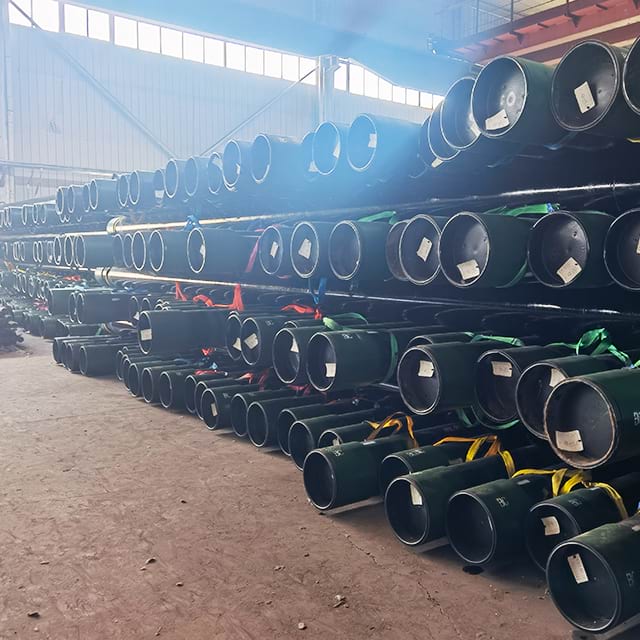 Large-diameter casing with green couplings, thread protectors, and identification tags in the ZC yard.
R95 casing is produced in the standard API 5CT size range. Common production casing and intermediate casing sizes in R95 are:
| OD (inches) | OD (mm) | Nominal weight range (lb/ft) | Typical application |
|---|---|---|---|
| 4½ | 114.3 | 9.50–13.50 | Deep production casing / liner |
| 5 | 127.0 | 11.50–15.00 | Production casing |
| 5½ | 139.7 | 13.00–20.00 | Production / intermediate casing |
| 7 | 177.8 | 17.00–38.00 | Intermediate / production casing |
| 7⅝ | 193.7 | 24.00–45.30 | Intermediate casing |
| 9⅝ | 244.5 | 32.30–58.40 | Surface / intermediate casing |
| 10¾ | 273.1 | 32.75–65.70 | Surface casing |
| 13⅜ | 339.7 | 48.00–72.00 | Surface casing |
R95 is less commonly ordered at 13⅜" and larger — at surface casing depths, the collapse and burst loads rarely require 95 ksi, and N80 or K55 typically suffice. The grades where R95 earns its position are the production and intermediate strings at depth, typically 7" through 9⅝", where formation pressure and temperature combine to generate loads above what 80 ksi grades can handle in standard weights.
Range designations follow API 5CT: R1 (4.88–7.62 m), R2 (7.62–10.36 m), and R3 (10.36–14.63 m). R2 is the most common range for production strings. R3 reduces the connection count for deep strings and is preferred where rig efficiency and connection leak risk drive the specification — the fewer connections made up in the hole, the lower the risk of a connection-related well integrity event.
Product form: R95 is supplied as casing. It is not a common production-tubing grade — shallow-to-medium sweet tubing strings are specified in N80Q or L80 instead. For the full casing weight ladder and drift by size, see the API 5CT casing sizes and weights guide →.
Purchase Order Guidance
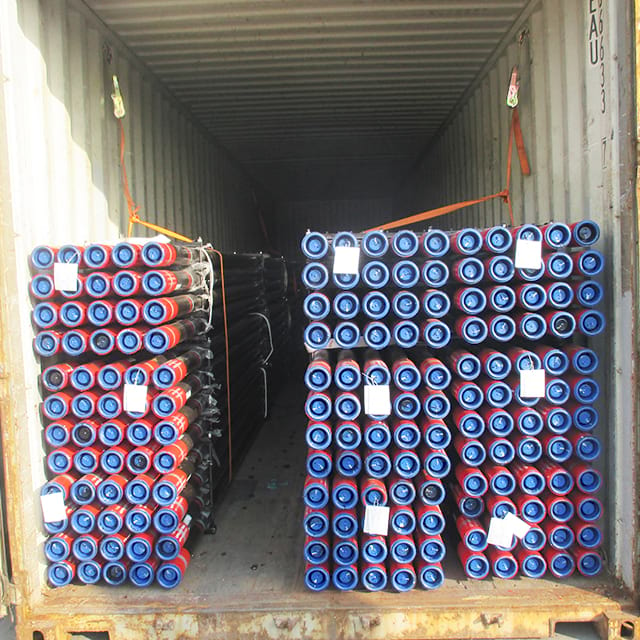 Casing lashed and secured inside a shipping container — how ZC loads export orders for sea freight to West Africa, the Middle East, and Southeast Asia.
A complete R95 purchase order must specify:
- Grade: API 5CT R95 (write "R95" — not "95 ksi casing", not "95K Q+T")
- Standard: API Specification 5CT, 11th Edition / ISO 11960
- PSL: PSL-2 recommended for all production and intermediate strings; PSL-1 acceptable for surface strings in some project specifications
- OD and nominal weight: e.g., 7" 26.00 lb/ft
- Connection: BTC, LTC, or premium — name the connection specification. For premium connections, reference the manufacturer's qualified connection designation and API 5C5 qualification category
- Range: R2 or R3. Confirm range availability for the specific OD and weight combination — not every mill runs R3 in all sizes
- MTC: EN 10204 3.1 minimum for most applications; EN 10204 3.2 (third-party witnessed) for critical strings and for operators in West Africa who routinely require 3.2 as a market default
- Supplementary requirements: SR2 (Charpy impact testing) if specified by the project, SR13 (seamless process verification) if required
Procurement trap — the R95/T95 grade label: The dangerous substitution is R95 for T95 in a sour well, but there is a secondary trap worth naming: N80Q can reach 95 ksi yield in production, and a mill will sometimes offer N80Q stock to a buyer asking for "95 ksi Q+T pipe." N80Q is also Q+T and can comply with 95 ksi minimum yield under the N80 grade envelope — but it is not R95. R95 must be stenciled R95 on the pipe body. If your PO says "N80" and the mill ships pipe with 95 ksi yield, they are within specification for N80Q. If you ordered R95 and receive N80-marked pipe, the grade stencil is non-conforming regardless of the yield result on the MTC. The MTC must state R95, Q+T heat treatment, and a heat number traceable to the production record. Verify all three before acceptance.
What to verify on the MTC before accepting an R95 consignment:
- Grade designation reads R95 (not N80, not T95, not "95K")
- Heat treatment: quench and temper stated explicitly
- Yield strength in the range 655–758 MPa (95–110 ksi) for each heat
- Tensile strength at or above 724 MPa (105 ksi)
- Chemistry within the limits in the table above — particularly carbon ≤ 0.45% (or ≤ 0.55% with confirmation of oil quench), sulphur ≤ 0.030%, phosphorus ≤ 0.030%
- PSL-2 confirmed if PSL-2 was ordered (PSL-1 and PSL-2 have different inspection scope — the MTC scope reflects which was produced)
- No hardness test results required on an R95 MTC; if hardness results appear, verify the heat was not produced as T95 and re-designated
MTC review for the sour service boundary: We have received R95 orders from buyers on projects where the well classification was listed as "potentially sour — under review." That classification is not a basis for using R95. A well under sour service review should be treated as sour for specification purposes until a formal NACE MR0175 analysis confirms it is not. The cost of re-specifying to T95 Type 2 before the order is placed is trivial compared to the cost of replacing an R95 string in a well that turns out to be H2S-bearing.
Frequently Asked Questions
What is API 5CT R95 casing pipe?
API 5CT R95 is a casing and tubing grade defined in API Specification 5CT / ISO 11960 with a minimum yield strength of 655 MPa (95,000 psi) and a maximum of 758 MPa (110,000 psi). It is produced by quench and temper heat treatment and carries no maximum hardness limit, placing it in the sweet-service only category. R95 occupies the non-sour 95 ksi slot on the API grade ladder — the position T95 fills when a well does contain H2S. For sweet wells that require more pressure containment than L80 or N80 but do not yet demand P110's 110 ksi, R95 is the straightforward specification.
Is R95 approved for H2S sour service wells?
No. R95 is not approved for H2S sour service under NACE MR0175 / ISO 15156. Unlike the restricted-yield sour service grades (L80, C90, T95), R95 has no maximum hardness limit — the hardness ceiling is what NACE MR0175 uses to qualify casing grades for H2S environments. A pipe with high hardness is susceptible to sulphide stress cracking regardless of yield strength grade marking. If the well has confirmed or potential H2S, specify T95 Type 2 or C90 — not R95.
What is the difference between R95 and T95?
R95 and T95 have identical yield ranges — 95 to 110 ksi (655 to 758 MPa) — but differ critically on sour service qualification. T95 has a maximum hardness limit (25.4 HRC for Type 1, 22 HRC for Type 2) that enables NACE MR0175 qualification for H2S service. R95 has no hardness limit and cannot be used in sour wells. T95 also has tighter chemistry controls (lower carbon and sulphur maxima) to ensure uniform heat treatment response. R95's looser chemistry, particularly the 0.45% carbon maximum (extendable to 0.55% if oil-quenched), makes it faster and cheaper to produce but unsuitable for corrosive environments.
What heat treatment does R95 require under API 5CT?
API 5CT specifies quench and temper (Q+T) heat treatment for R95. The standard does not permit normalized-and-tempered or as-rolled supply for R95. The Q+T requirement is what gives R95 its 95 ksi minimum yield from a relatively high-carbon steel chemistry. While T95 Q+T also carries a hardness ceiling to control the upper end of the hardness distribution, R95's Q+T is managed only to meet the yield and tensile minimums without a hardness upper limit.
What are the chemistry limits for R95 casing per API 5CT?
API 5CT 11th Edition specifies R95 chemistry as: carbon maximum 0.45% (may increase to 0.55% maximum if oil-quenched), manganese maximum 1.90%, silicon maximum 0.45%, phosphorus maximum 0.030%, and sulphur maximum 0.030%. No minimum manganese, chromium, molybdenum, niobium, nickel, or copper limits are specified — the manufacturer selects the alloy addition strategy to achieve the required mechanical properties. These chemistry limits are significantly looser than the sour-service grades C90 and T95, which require tighter sulphur and controlled alloy additions.
How do I choose between R95 and P110 for a non-sour deep well?
The choice between R95 and P110 comes down to the design loads at the critical string section. P110's 758 MPa (110 ksi) minimum yield delivers approximately 16% more burst and collapse resistance than R95's 655 MPa (95 ksi) minimum. For wells where the collapse/burst load envelope can be met at 95 ksi, R95 avoids the premium cost and longer lead times associated with P110. P110 is the better choice when depth or temperature drives loads above what R95 can handle with available wall thicknesses, or when connections capable of carrying P110 loads are already specified. Run the string design calculation first; if R95 passes the load check with appropriate safety factors, it is the more economical specification.
What color band identifies R95 pipe under API 5CT?
API 5CT specifies one brown band as the pipe body color identification for R95. Color coding under API 5CT is applied to the pipe body, not the coupling, and is intended as a handling identification aid. Color codes are never a substitute for checking the stenciled grade marking, heat number, and MTC — the stencil and MTC are the traceable documentation. Color can fade or be painted over during transport and storage.
What connections are compatible with R95 casing?
R95 casing is compatible with the full range of API and premium connections — STC, LTC, BTC, and metal-to-metal seal premium connections. The connection selection for R95 follows the same load efficiency logic as other OCTG grades: STC offers lower tensile efficiency and is typically limited to surface or intermediate strings in lower-load wells; LTC improves tensile efficiency for deeper strings; BTC provides higher compression and tension ratings for most R95 applications. Premium connections are used when axial, bending, and pressure loads exceed API connection capacity, or when gas-tight requirements apply.