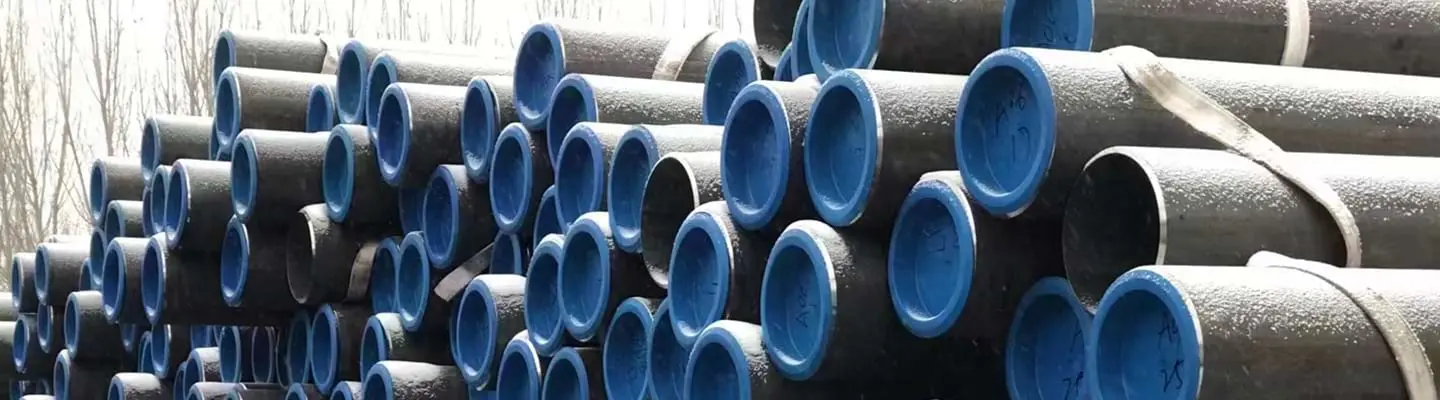
Three grades compete for every medium-pressure pipeline project quote: X52, X60, and X65. All three fall under API Specification 5L, 46th Edition. All three are carbon-manganese steels. The choice between them comes down to pressure containment requirements, weld procedure constraints, supply availability, and — on long routes — the economics of carrying less pipe per kilometre.
ZC Steel Pipe supplies all three grades in seamless and welded (LSAW and ERW) form to pipeline projects across West Africa, the Middle East, and Southeast Asia. The grade call we see most often is a choice between X60 and X65 PSL2 for 16-inch to 24-inch mainlines — and that decision almost always comes down to wall thickness economics rather than any strict engineering requirement.
What These Three Grades Are
All three are defined in API Specification 5L, 46th Edition. The dual-designation format names each grade by its SI yield limit first (L-series) and imperial second (X-series): L360 / X52, L415 / X60, L450 / X65. In purchasing documents and mill drawings the X-designation is used universally.
In the grade ladder, X52 sits at the lower end of the medium-pressure range, X60 at the middle, and X65 near the top of what is routinely produced in ERW and LSAW form. Above X65 the grades (X70, X80) require more tightly controlled thermomechanical rolling, more stringent toughness testing, and a narrower set of mills capable of consistent supply.
Mechanical Properties
Numbers drawn directly from api-5l-spec.json — API 5L 46th Edition.
PSL1
| Grade | Min Yield (MPa / psi) | Min Tensile (MPa / psi) | Yield Ceiling | Y/T Ratio Limit |
|---|---|---|---|---|
| X52 | 360 / 52,200 | 460 / 66,700 | None | None |
| X60 | 415 / 60,200 | 520 / 75,400 | None | None |
| X65 | 450 / 65,300 | 535 / 77,600 | None | None |
PSL1 has no yield ceiling and no yield-to-tensile ratio requirement. A mill can ship X65 PSL1 at 590 MPa actual yield and be fully compliant. For pipeline safety calculations that use the specified minimum yield strength (SMYS), this matters: if actual yield significantly exceeds SMYS, the burst safety factor in service is lower than calculated. This is one reason most project specifications require PSL2 for transmission pipelines.
PSL2
| Grade | Min Yield (MPa) | Max Yield (MPa) | Min Tensile (MPa) | Max Tensile (MPa) | Max Y/T | Delivery Conditions |
|---|---|---|---|---|---|---|
| X52 | 360 | 530 | 460 | 760 | 0.93 | N, Q, M |
| X60 | 415 | 565 | 520 | 760 | 0.93 | N, Q, M |
| X65 | 450 | 600 | 535 | 760 | 0.93 | Q, M only |
The yield ceiling is the defining PSL2 feature — it bounds the yield range and prevents over-strong pipe from distorting burst calculations. The Y/T max of 0.93 applies only when OD > 323.9 mm (12.750 in); for smaller diameters no Y/T limit applies.
The critical manufacturing distinction: X65 PSL2 does not support the N (normalised) delivery condition. X52 and X60 PSL2 can be supplied normalised, which requires simpler heat treatment equipment and is available from more mills. X65 PSL2 requires either Q+T furnace capability or a thermomechanical controlled process (TMCP) rolling mill. When you need X65 PSL2 and your supply market is limited, this distinction matters for lead time.
What we see on orders: Procurement teams occasionally write "X65N" or "L450N" on a purchase order, expecting a normalised X65 as they might request for X60. That combination does not exist in API 5L 46th Edition. Normalised delivery is not a permitted condition for X65 or X70 PSL2. We flag this before order placement — the correct designations are X65Q or X65M depending on the required delivery condition.
For the complete tensile and toughness specification tables, see the API 5L specification tables →
Chemical Composition — PSL2 (M Delivery Condition)
Numbers drawn from api-5l-spec.json. M suffix (thermomechanically rolled) is shown; Q suffix has different C and Mn limits.
| Grade | C max | Mn max | P max | S max | Nb+V+Ti max | CE IIW max | CE Pcm max |
|---|---|---|---|---|---|---|---|
| X52M | 0.22 | 1.40 | 0.025 | 0.015 | 0.15 | 0.43 | 0.25 |
| X60M | 0.12 | 1.60 | 0.025 | 0.015 | 0.15 | 0.43 | 0.25 |
| X65M | 0.12 | 1.60 | 0.025 | 0.015 | 0.15 | 0.43 | 0.25 |
The chemistry difference between X60M and X65M is negligible in this table — both are at C 0.12 max. X65M achieves higher yield through tighter microstructural control during TMCP rolling rather than higher carbon or manganese content. This is why X65M and X60M behave almost identically during field welding — the weld procedure qualification and preheat requirements are essentially the same.
For the Q delivery condition, X60Q allows C up to 0.18 and Mn up to 1.7; X65Q also allows C 0.18 and Mn 1.7. The CE IIW limit is 0.43 for both.
The carbon equivalent ceiling of CE IIW 0.43 is the same for X52, X60, and X65 PSL2 (Q and M suffix). This means weld procedure qualification for X65 does not require fundamentally different preheat temperatures than X60 — provided the actual CE values reported on the MTCs are similar. Where projects have pre-qualified WPS procedures for X60, it is worth checking whether the existing CE range covers the X65 order certificates before launching a full requalification programme.
Wall Thickness Design — Worked Calculation
The Barlow formula (modified for pipeline design) governs required wall thickness for a given pressure class and grade. Under ASME B31.8, design pressure is related to wall thickness by:
t = P × D / (2 × SMYS × F × E × T)
Where:
- P = MAOP (MPa)
- D = pipe OD (mm)
- SMYS = minimum specified yield strength (MPa)
- F = design factor (0.72 for Class 1, Division 2 cross-country pipeline)
- E = longitudinal joint factor (1.0 for seamless or LSAW; 1.0 for ERW with seam test)
- T = temperature derating factor (1.0 at ≤120°C)
Example: 16-inch (406.4 mm OD) onshore gas pipeline, MAOP = 7.0 MPa (70 bar), Class 1 Design Factor F = 0.72
| Grade (SMYS) | Required t (mm) | Approximate pipe weight (kg/m) |
|---|---|---|
| X52 (360 MPa) | 7.0 × 406.4 / (2 × 360 × 0.72) = 5.49 mm | ~55.3 |
| X60 (415 MPa) | 7.0 × 406.4 / (2 × 415 × 0.72) = 4.76 mm | ~47.8 |
| X65 (450 MPa) | 7.0 × 406.4 / (2 × 450 × 0.72) = 4.39 mm | ~44.2 |
Weights approximate; actual order weight depends on the next available commercial wall schedule above the minimum required.
Over a 200 km route, the difference between X52 and X65 is approximately (55.3 − 44.2) × 200,000 = 2,220 tonnes of pipe. At $750–900/tonne for large-diameter line pipe, that is $1.7–2.0 million in material cost alone, before factoring in transportation, handling, and coating. X65 also reduces coating weight and transport frequency. For a project of this scale, the grade premium on X65 PSL2 over X52 PSL1 is recovered in less than the first third of the route.
For your specific diameter and MAOP, use the Pipeline Design Pressure Calculator → to compute the required wall thickness and compare across grades.
When X52 Is Sufficient
X52 is the right call in three scenarios:
Short-route distribution lines. For runs under 30 km where total pipe tonnage is low, the material price difference between X52 and X65 is not meaningful. The cost of requalifying welding procedures and the risk of a smaller supplier base for X65 can outweigh the wall thickness savings on short projects.
Low-pressure utility and gathering service. Systems operating below 30 bar MAOP, where wall thickness is driven by handling minimums rather than pressure design, gain nothing from upgrading to X65. At MAOP of 25 bar on a 12-inch line, X52 at 2.4 mm covers the pressure requirement; minimum wall for handling typically requires 4.0–5.0 mm regardless of grade, so the Barlow formula is not the limiting constraint.
Markets with limited X65 supply. In some regions where only local ERW mills are available, X65 PSL2 M-suffix is not produced reliably. Specifying X60 PSL2 with N or M delivery condition gives access to a wider supply base without significant wall thickness penalty.
When to Move to X60
The step from X52 to X60 delivers roughly 13% more yield strength, which translates to approximately 13% less wall thickness for the same pressure class. On a 100 km, 24-inch mainline this saves approximately 900–1,000 tonnes — enough to justify the upgrade in most project economics.
X60 is also the practical minimum for any project that must meet Charpy impact toughness requirements. Most transmission pipeline specifications call for PSL2 with supplementary toughness requirements (SR4B or equivalent), and X60 PSL2 with N, Q, or M delivery condition is the lowest grade where this is well-established across global mills.
When X65 Is Required or Strongly Preferred
Large-diameter, high-pressure transmission. At 16-inch OD and above, at MAOP above 50 bar, upgrading from X60 to X65 saves 1–2 mm of wall thickness. That saving multiplies dramatically with pipe diameter and route length. The gas transmission industry has effectively standardised on X65 PSL2 for 24-inch and 36-inch mainlines for this reason.
Projects with LSAW pipe. Large-diameter LSAW pipe requires TMCP rolling capability regardless of grade to achieve required toughness in the HAZ and weld. Since TMCP mills can produce X65M without additional cost over X60M (the process is the same, only the rolling schedule differs), X65 LSAW pipe often carries a minimal premium over X60 from mills that are already in TMCP production.
Projects requiring sour service with Annex H. API 5L Annex H HIC-tested pipe is available in both X60 and X65. However, X65 PSL2 Annex H requires both controlled chemistry and TMCP rolling — the mill population is smaller. If your project needs X65 PSL2 Annex H, qualify your mill before order placement and allow additional lead time.
What we see comparing PSL2 certifications: On projects where both X60 PSL2 and X65 PSL2 heats are running simultaneously, the MTCs look almost identical — same S and P limits, same CE IIW 0.43 ceiling, same toughness test format. The difference shows up in actual yield: X65 heats routinely report 480–560 MPa actual yield, while X60 heats typically come in at 435–500 MPa. For projects that post-yield check against the PSL2 ceiling, X65's ceiling of 600 MPa gives more working room than X60's 565 MPa.
PSL1 vs PSL2 — Which Level for Each Grade?
| Application | Recommended PSL level |
|---|---|
| Low-pressure gathering, short route | X52 PSL1 or X60 PSL1 |
| Mainline gas or oil transmission | X60 PSL2 minimum; X65 PSL2 preferred |
| Sour service (H₂S present) | X52–X65 PSL2 + API 5L Annex H |
| Offshore pipeline | X65 PSL2 minimum; X70 for large-diameter |
| Cross-country gas transmission | X65 PSL2 standard; X70 for high-pressure large-diameter |
The most important thing to understand about PSL1 is what it lacks compared to PSL2: no yield ceiling, no Y/T ratio limit, no mandatory Charpy toughness testing (for most sizes), no CE limit. PSL1 is a manufacturing standard; PSL2 is an engineering standard. Any project where fracture propagation, safety class, or design factor matters should default to PSL2.
Purchase Order Guidance
Minimum PO line items
- Specification: API Specification 5L, 46th Edition
- Grade and PSL: e.g., L450M / X65M, PSL2
- OD × wall thickness × length range
- Manufacturing process: seamless / ERW / LSAW
- Delivery condition: Q or M (X65); N, Q, or M (X52 and X60)
- End finish: bevelled per API 5L SR4C or project specification
- Supplementary requirements: list each by number — e.g., SR4B (Charpy toughness), SR15 (HIC — Annex H), SR22 (yield ceiling for PSL1)
- Coating: specify system and standard (e.g., 3LPE to DIN 30670 Level M)
- MTC: EN 10204 3.1 minimum; 3.2 (third-party witnessed) for most export projects
- Test pressure: per API 5L Table E.7 unless project specifies higher
Procurement traps
Trap 1 — Ordering X65 PSL2 with an N suffix. "L450N / X65N" is not a valid product under API 5L 46th Edition. X65 PSL2 requires Q or M delivery condition. If you need the lower carbon content of a normalised supply, X60N PSL2 is the correct grade — it has almost identical weldability.
Trap 2 — Assuming PSL1 yield is close to SMYS. A PO for "X60 PSL1" receives pipe with ≥ 415 MPa yield — but no upper limit. Some mills routinely produce X60 PSL1 at 510–520 MPa actual yield. If your MAOP design assumed SMYS = 415 MPa and the actual pipe is 500 MPa, the safety factor on burst is narrower than the calculation suggests. For transmission pipelines, specify PSL2 and enforce the yield ceiling.
Trap 3 — Not specifying a supplementary requirement for Y/T ratio. API 5L PSL2 applies the 0.93 Y/T ratio limit only when D > 323.9 mm. For pipe at or below 12.750-inch OD, there is no Y/T limit under PSL2. If your project design or DNV/ISO code requires a Y/T limit on smaller-diameter pipe, call it out explicitly as a supplementary requirement.
What to verify on the MTC
- Grade, PSL level, and delivery condition suffix match the PO exactly
- Actual yield values fall within the PSL2 window — not just at or above the minimum
- CE IIW ≤ 0.43 (or CE Pcm ≤ 0.25 for project-specified limit)
- Charpy test temperature, specimen size, and results per SR4B or project spec
- Heat analysis and product analysis both present
- Hydrostatic test pressure (calculated or recorded mill test)
- For Annex H orders: HIC test results with CLR, CTR, CSR values per NACE TM0284
For wall thickness and weight selection across the common pipeline OD range, see the ASME B36.10M pipe schedule tables → and the API 5L specification tables →
Frequently Asked Questions
What is the difference between X52, X60, and X65 line pipe?
X52, X60, and X65 are API 5L carbon steel line pipe grades with minimum yield strengths of 360 MPa (52,200 psi), 415 MPa (60,200 psi), and 450 MPa (65,300 psi) respectively. Higher yield means less wall thickness is required to contain the same pressure, which reduces pipe weight and often the total installed cost of a pipeline.
When should I specify X65 instead of X60?
X65 makes sense when the higher yield strength meaningfully reduces wall thickness — typically on pipelines ≥ 16 inches OD at MAOP above 50 bar, where each millimetre of wall thickness represents substantial tonnage over a long route. X65 requires PSL2 with Q or M delivery condition; no normalised (N) suffix is available, which limits the supplier base slightly compared to X60.
Can X52 PSL1 and X60 PSL1 be mixed on the same pipeline project?
Technically yes, but in practice project specifications rarely allow grade mixing within a single pipeline segment because it complicates pipe tracking, weld procedure qualification, and inspection records. If your project calls for X60 PSL1, specify all pipe in that segment as X60 PSL1.
Does X65 PSL1 have a yield ceiling?
No. API 5L PSL1 sets no maximum yield strength for any grade. A mill can supply X65 PSL1 at 580 MPa actual yield and be fully compliant. PSL2 introduces a yield ceiling of 600 MPa for X65, which is why PSL2 is required on most high-integrity projects — the bounded yield range makes burst and fracture calculations more predictable.
What delivery condition should I specify for X65 PSL2?
X65 PSL2 is available in Q (quenched and tempered) and M (thermomechanically rolled or formed) delivery conditions only. The N (normalised) suffix, which is available for X52 and X60 PSL2, is not an option for X65 or X70. If you write 'X65N' on a purchase order, no compliant supply exists under API 5L.
Is X60 PSL2 suitable for sour gas service?
X60 PSL2 can be ordered with Annex H (HIC) requirements for sour gas service. This requires supplementary testing for hydrogen-induced cracking resistance — the key parameters are crack length ratio, crack thickness ratio, and crack sensitivity ratio tested per NACE TM 0284. Chemistry limits tighten further, particularly for S, P, and carbon equivalent. X65 can also be ordered to Annex H, but mill capability for X65 PSL2 HIC-tested pipe is more limited.
What is the carbon equivalent limit for X65 PSL2?
For X65Q and X65M, API 5L 46th Edition sets CE IIW max at 0.43 and CE Pcm max at 0.25. These limits ensure adequate weldability without preheat under typical pipeline construction conditions. X60Q has the same IIW limit of 0.43, but X60N specifies CE by agreement between purchaser and manufacturer.
Which grade is most common for 24-inch gas transmission pipelines?
X65 PSL2 has become the dominant grade for large-diameter gas transmission pipelines in most markets. The combination of adequate yield strength, good toughness, established weld procedure databases, and controlled chemistry under PSL2 makes it the standard specification for 16-inch to 48-inch onshore transmission.